
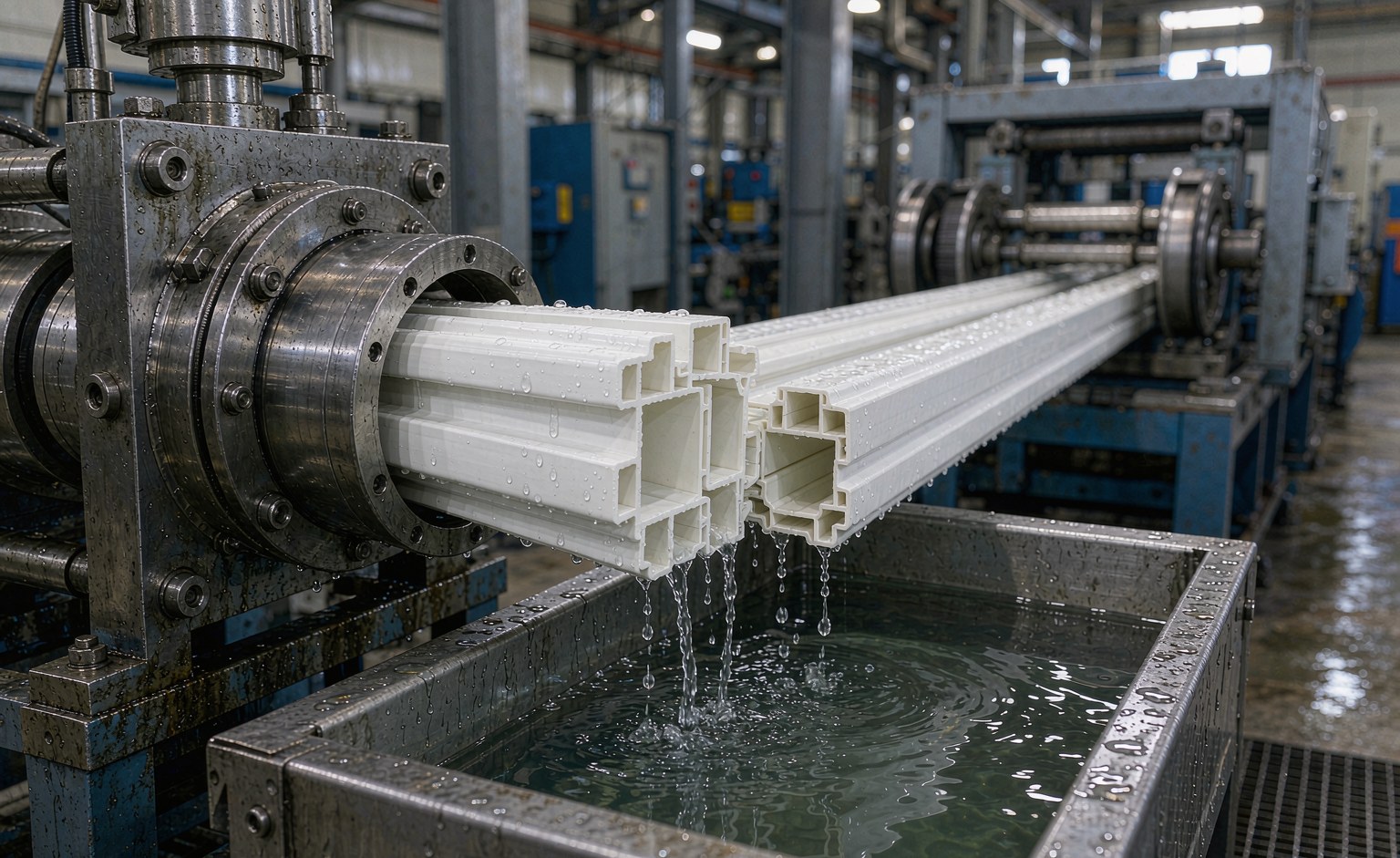
Extrusion is the cheapest way to make a plastic part, provided the part is the right shape. The material is pushed continuously through a die, so cost scales with cross-sectional area and length, not with volume in the moulding sense. There is no cavity, no clamp force, and no cycle time per part — just metres per hour.
The catch is equally simple: the cross-section must be constant. You cannot extrude a boss on one end, a taper, or a hole through the side. Everything that varies along the length is a secondary operation, and secondary operations are where extrusion projects quietly become expensive.
- 1. 1. What extrusion can and cannot do
- 2. 2. Solid, hollow, co-extruded, foamed
- 3. 3. The line, stage by stage
- 4. 4. Die design and tooling cost
- 5. 5. Material selection
- 6. 6. Realistic tolerances
- 7. 7. Cross-section design rules
- 8. 8. Colour, finish and lamination
- 9. 9. Secondary operations — where the cost hides
- 10. 10. Seven common defects
- 11. 11. What to send for an accurate quote
- 12. 12. Frequently asked questions
- 13. Send a cross-section drawing, get a die cost and a price per metre
In this guide
1. What extrusion can and cannot do
Picture a toothpaste tube being squeezed: whatever shape the nozzle is, that is the shape of everything that comes out. Extrusion is that, continuously, in engineering plastic.
Extrusion is the right process when
- The part is long relative to its cross-section — trim strips, rails, window profiles, edge banding, sealing strips, tubes, rods, channels.
- 必要なのは length in metres or kilometres, cut to size. Cost per metre falls with run length, not with quantity of discrete pieces.
- The part needs to be one material end to end, or two materials side by side (co-extrusion).
- You want low tooling cost — a die is $1,000–$8,000 versus $10,000+ for an injection mold.
Extrusion is the wrong process when
- The geometry changes along the length — varying wall, tapered sections, periodic features.
- 必要なのは closed 3D shapes — a box, a housing, a curved handle. Those are moulded or formed.
- 必要なのは very tight tolerance in two axes at once. Extrusion holds well in the cross-section but drifts along the length.
- Volume is low and the profile is short. Below a few hundred metres, die cost per metre dominates.
2. Solid, hollow, co-extruded, foamed
| タイプ | 説明 | Typical products |
|---|---|---|
| Solid profile | Single material, no internal voids. Simplest die, tightest tolerance control. | Edge trim, glazing beads, wear strips, rods, decorative trims |
| Hollow / multi-chamber | Internal cavities formed by a die with a calibrated core. Needs vacuum or pressure calibration to hold the cavity. | Window and door profiles, conduit, handrails, panel edges |
| Co-extrusion | Two or three extruders feed one die; materials bond side by side or as a skin over a core. | UV-stable capstock over recycled core, colour-matched seals, soft-touch grips on rigid carriers |
| Tri-extrusion | Three materials, typically a rigid core with two flexible sealing lips in different hardnesses. | Automotive door seals, weatherstripping, window gaskets |
| Foamed profile | Chemical or physical blowing agent expands the melt; density drops 30–60%. | Trim, spacers, decorative mouldings, thermal breaks |
| Tube / pipe | Annular die with a mandrel or spider; sized by vacuum or pressure. | See our separate plastic pipe extrusion guide |
Profile extrusion variants. Co-extrusion is usually the cheapest way to combine weather resistance with a low-cost core.
3. The line, stage by stage
An extrusion line is a sequence, and each stage can put a defect into your part. Understanding the sequence tells you which questions to ask.
Two stages deserve a buyer's attention. キャリブレーション is where the outside dimension is actually set — the die only gets it close. A line with weak vacuum calibration produces profiles that are dimensionally correct at the die and wrong by the time they cool. And haul-off speed is your wall thickness control: pull faster and the wall thins, pull slower and it thickens. When a supplier reports wall variation of ±10% across a run, haul-off and screw speed stability are the usual culprits.
4. Die design and tooling cost
The die is a steel block with a machined flow channel. Its job is to take a cylindrical melt stream and redistribute it into your cross-section with even velocity at every point — no dead spots, no faster flow in the thick sections.
| Profile complexity | Die cost | Lead time | 備考 |
|---|---|---|---|
| Simple solid (rod, strip, bead) | $800–$2,000 | 10–15 days | Often a stock die or minor modification |
| Solid with complex outline | $1,500–$3,500 | 15–20 days | Asymmetric flow needs balancing |
| Hollow, single chamber | $2,500–$5,000 | 18–25 days | Requires a calibrated core or bridge die |
| Multi-chamber (3+) | $4,000–$9,000 | 22–30 days | Each wall is a separate flow path to balance |
| Co-extrusion (2–3 materials) | $5,000–$15,000 | 25–35 days | Adds a feedplate and separate flow channels |
| Calibration sleeve / jig set | $1,000–$4,000 | included | Often quoted separately — check |
Indicative die and tooling costs for PVC/ABS/PE profiles, 2026. Complex hollow dies may need two or three trials before sign-off.
Note the last row. Calibration tooling is frequently a separate line item, and a quote that excludes it is not comparable to one that includes it. Ask explicitly: "Is calibration, the vacuum sleeve and the first article inspection included?"
5. Material selection
| 素材 | Key properties | Service temp | 最適 |
|---|---|---|---|
| PVC-U (rigid) | Cheap, flame retardant, excellent weatherability, good stiffness | 60 °C | Window profiles, conduit, trim, panels — the highest-volume profile material |
| PVC-F (flexible) | Plasticised, Shore A 60–90, good sealing | 55 °C | Gaskets, seals, edge trim |
| ABS | Tough, good surface, easy to bond and print | 85 °C | Appliance trims, enclosures, automotive interior |
| ASA | ABS-like strength with 10+ year UV colour stability | 90 °C | Outdoor profiles, capstock, façade trims |
| PP | Chemical resistance, living hinge, low cost | 100 °C | Chemical tanks, packaging, hinged closures |
| 高密度ポリエチレン | High impact, moisture barrier, weldable | 80 °C | Outdoor edging, marine, pipe and tube |
| PC | Transparent, very high impact | 120 °C | Light diffusers, guards, clear channels |
| PMMA | Optical clarity, hard surface, UV stable | 80 °C | Light covers, decorative profiles |
| TPE / TPV | Elastomeric, co-extrudable with PP/ABS, 60–90 Shore A | 90–110 °C | Sealing strips, soft-touch grips, weatherseals |
| TPU | Abrasion resistant, transparent grades available | 80 °C | Hose, belting, protective edge trim |
Profile extrusion materials. For outdoor parts, ASA or PVC outperforms ABS on colour retention by a wide margin.
6. Realistic tolerances
Extrusion tolerances are quoted against the cross-section, and they are looser than most drawings assume. For PVC profiles the reference is DIN 16941; many suppliers also work to a commercial table like the one below.
| Dimension | コマーシャル | 精密 | 備考 |
|---|---|---|---|
| Wall thickness, <3 mm | ±0.15 mm | ±0.08 mm | Best controlled on the haul-off |
| Wall thickness, 3–6 mm | ±0.25 mm | ±0.12 mm | Thicker walls cool unevenly |
| Outside dimension, <50 mm | ±0.25 mm | ±0.10 mm | Set by the calibration sleeve |
| Outside dimension, 50–150 mm | ±0.40 mm | ±0.20 mm | Hollow profiles drift more |
| Outside dimension, >150 mm | ±0.60 mm | ±0.30 mm | Thermal shrinkage dominates |
| 真直度 | 1.0 mm / m | 0.5 mm / m | Depends on cooling symmetry |
| Cut length | ±1.0 mm | ±0.3 mm | Servo cut-to-length |
| Twist | 1.5° / m | 0.5° / m | Worst on asymmetric sections |
Typical as-extruded capability. Length tolerance is a cutting function, not an extrusion one — it can always be tightened.
Two structural realities worth accepting. First, shrinkage after extrusion continues for 24–48 hours — measure your first article after relaxation, not straight off the line. Second, asymmetric sections twist. If the mass is not balanced about the centreline, cooling pulls it into a helix, and no amount of calibration fully removes it. Balance the section at design stage.
7. Cross-section design rules
Wall thickness
Keep between 0.8 and 6 mm, and as uniform as the function allows. Thick sections cool slower, pull the profile and add cost linearly. A 2 mm wall that works is always cheaper than a 3 mm wall that is "safer".
Uniform flow
The die fills every part of the cross-section at once. A 1 mm wall next to a 6 mm wall means the thin section freezes while the thick one still flows — producing internal stress and dimensional drift. Where a thickness change is unavoidable, taper it over at least 3× the thickness difference.
Radii, not sharp corners
Internal radius at least 0.5 mm, ideally equal to wall thickness. Sharp internal corners are where PVC profiles crack under impact, and they are impossible to fill cleanly in the die.
Hollow chambers
Minimum internal chamber dimension about 4 mm; below that the calibrating core becomes fragile and cannot be cooled. Chamber walls need to be self-supporting — a large flat unsupported span will bow under vacuum calibration.
Balance the section
Design so the mass is symmetric about both axes where possible. If it cannot be, add a compensating rib or accept a twist allowance. This single rule prevents more dimensional disputes than any other.
Think about the cut
How will the profile be cut to length, and does the cut end need to be square, sealed or capped? A profile designed for a straight chop saw cut is cheaper than one needing a CNC-machined end.
8. Colour, finish and lamination
- Through-colour — masterbatch in the melt. Cheapest, but the colour is the same all the way through, so scratches show less. Best for solid colours.
- Co-extruded capstock — a thin skin of ASA or PMMA over a cheaper core. Best weathering per dollar, and it allows a recycled or foamed core.
- Film lamination — a decorative or protective film bonded during extrusion. Gives woodgrain, metallic and high-gloss finishes that cannot be extruded directly.
- Embossing / texturing — an embossing roller after calibration. Hides surface marks and adds grip; adds a small tooling cost.
- Post-coating — spray or powder. Usually the most expensive route and the least durable; use only when the other options cannot hit the finish.
9. Secondary operations — where the cost hides
| Operation | Typical added cost | When you need it |
|---|---|---|
| Cut to length (servo) | $0.05–$0.30 / piece | Almost always |
| Punching / notching | $0.10–$0.80 / piece | Drainage slots, fixing holes, cable exits |
| Milling / end machining | $0.50–$3.00 / piece | Mitred ends, connector seats |
| Bending / post-forming | $0.40–$2.00 / piece | Arched trims, corner radii |
| Welding (corner / butt) | $0.80–$4.00 / joint | Frames, window sashes, closed loops |
| Insert / hardware fitting | $0.20–$1.50 / piece | Screw bosses, clips, end caps |
| Printing / hot stamping | $0.15–$0.60 / piece | Branding, graduations, orientation marks |
Indicative secondary operation costs. If a quote looks unusually cheap, check which of these were assumed away.
10. Seven common defects
| 欠陥 | What you see | Cause and fix |
|---|---|---|
| Dimensional drift | Profile creeps out of tolerance over a long run | Haul-off or screw speed instability, die temperature drift. Stabilise the line, add in-line gauging. |
| Surface roughness / melt fracture | Sharkskin or dull bands on the surface | Output rate too high for the die, or melt too cold. Reduce screw speed, raise temperature, enlarge the die land. |
| Twist / bow | Profile spirals or curves along its length | Asymmetric cooling or unbalanced section. Balance cooling jets, redesign the section, adjust haul-off alignment. |
| Visible weld line | Faint seam where flow recombines around a core | Spider or bridge die marks. Increase melt temperature at the recombination point, move the line to a hidden face. |
| Bubbles / voids | Internal cavities in a thick wall | Moisture or insufficient back pressure. Dry the resin, raise back pressure, check for air entrapment. |
| Colour variation | Shade shift between runs or within a run | Masterbatch dosing inconsistency, or regrind ratio changing. Fix the let-down ratio and record it. |
| Poor gloss | Matte patches on a gloss profile | Calibration sleeve too cold or contaminated. Clean and re-polish the sleeve, adjust cooling. |
Extrusion defect map. Twist and dimensional drift are section-design problems more often than process problems.
11. What to send for an accurate quote
Most extrusion quotes are guesses because the enquiry was incomplete. Send these seven items and you will get a price you can hold a supplier to.
- A dimensioned cross-section drawing (DXF, DWG or PDF) with wall thickness and all critical dimensions called out.
- Material and grade, including any flame-retardant or UV requirement, and whether regrind is acceptable.
- Colour reference — RAL, Pantone, or a physical sample. Say whether through-colour or capstock.
- Length per piece and total annual quantity in metres — not pieces. Extrusion is priced per metre.
- Tolerance class for the two or three dimensions that actually matter, not the whole drawing.
- Secondary operations required, with a drawing of any punch or notch.
- End use and environment — indoor, outdoor, chemical contact, temperature range. This decides the material more often than the drawing does.
12. Frequently asked questions
How much does a custom extrusion die cost?
A simple solid profile die runs $800–$2,000. Hollow and multi-chamber profiles requiring a calibrated core run $2,500–$9,000, and co-extrusion dies $5,000–$15,000. Calibration sleeves and jigs are sometimes quoted separately, so confirm what is included.
What is the minimum order for custom extrusion?
Usually 300–1,000 metres per profile, or one production run of a few hours. Below that, the die cost per metre becomes uneconomic. Many suppliers will run a 100–200 m trial for sampling before committing to a production order.
What tolerance can plastic profile extrusion hold?
±0.25 mm on outside dimensions under 50 mm and ±0.15 mm on walls under 3 mm is standard commercial capability. Precision extrusion can reach ±0.10 mm, but requires in-line gauging and a very stable line.
Can you match a specific colour?
Yes — to RAL or Pantone, or against a physical sample. Expect a colour chip for approval before the production run. Note that matt and gloss surfaces of the same colour read differently, so approve the chip in the intended finish.
Can extruded profiles be bent or welded?
Yes. PVC and ABS profiles can be post-formed hot into arcs and corners, and welded into frames using corner or butt welding. Both are secondary operations with their own tooling, so specify them at quotation stage rather than after the profile is approved.
How long does custom extrusion tooling take?
10–15 days for a simple solid die, 18–30 days for hollow or multi-chamber profiles, and 25–35 days for co-extrusion. Add 3–7 days for sampling and first-article approval, and budget one die correction on complex hollow sections.
Send a cross-section drawing, get a die cost and a price per metre
DXF, DWG or a dimensioned PDF is enough to start. We will come back with die cost, lead time, achievable tolerances and a per-metre price at your annual volume.




 JA
 EN
 ES
 FR
 DE
 PT
 AR
 RU
 KO
 IT
 NL
 TR
 PL
 ID
