
Uplastech moulds precision thermoplastic components from 0.1 g micro parts to 2,000 g technical housings — with in-house mould making, engineering resins, and the first-article documentation your quality team will actually ask for.
Up to 40-cavity precision tooling for high-volume programmes — with ±0.05 mm capability on critical features, in-house steel, and a parameter sheet that keeps shot 50,000 identical to shot one.
Injection Molding Product Types
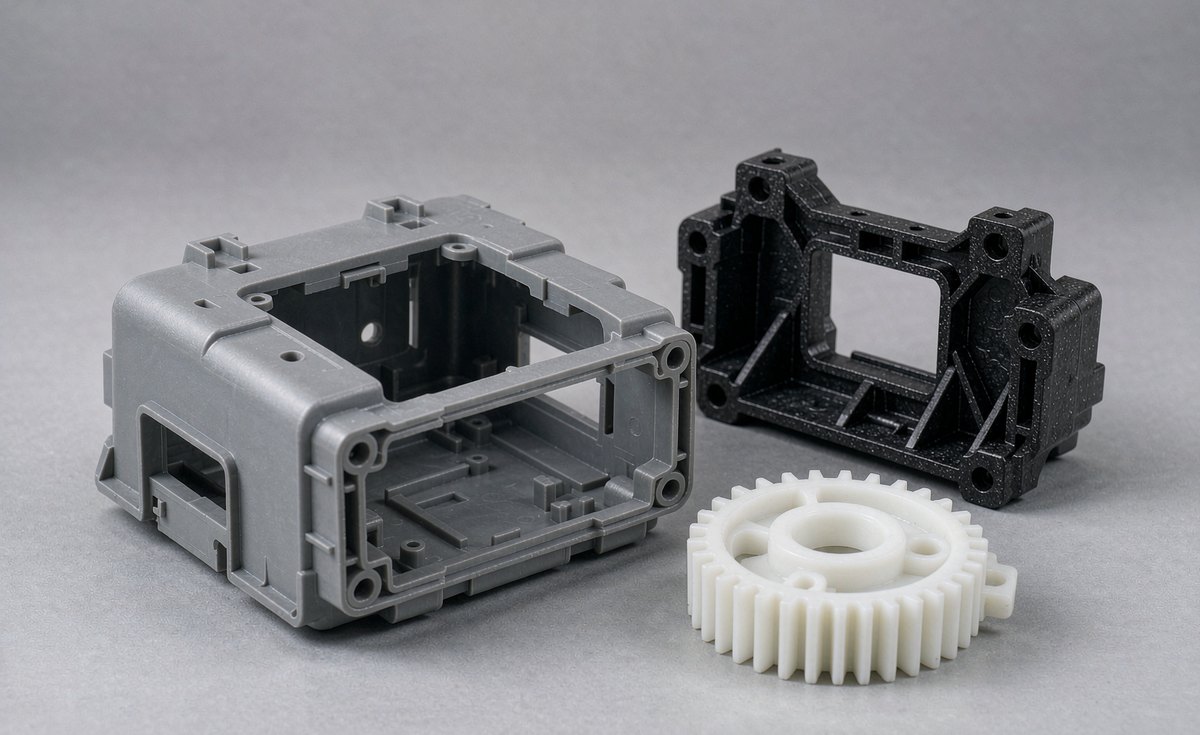
Custom Injection Molding
General-purpose precision moulding for housings, covers, brackets and enclosures. Single and multi-cavity tools, engineering thermoplastics, cosmetic and functional finishes.
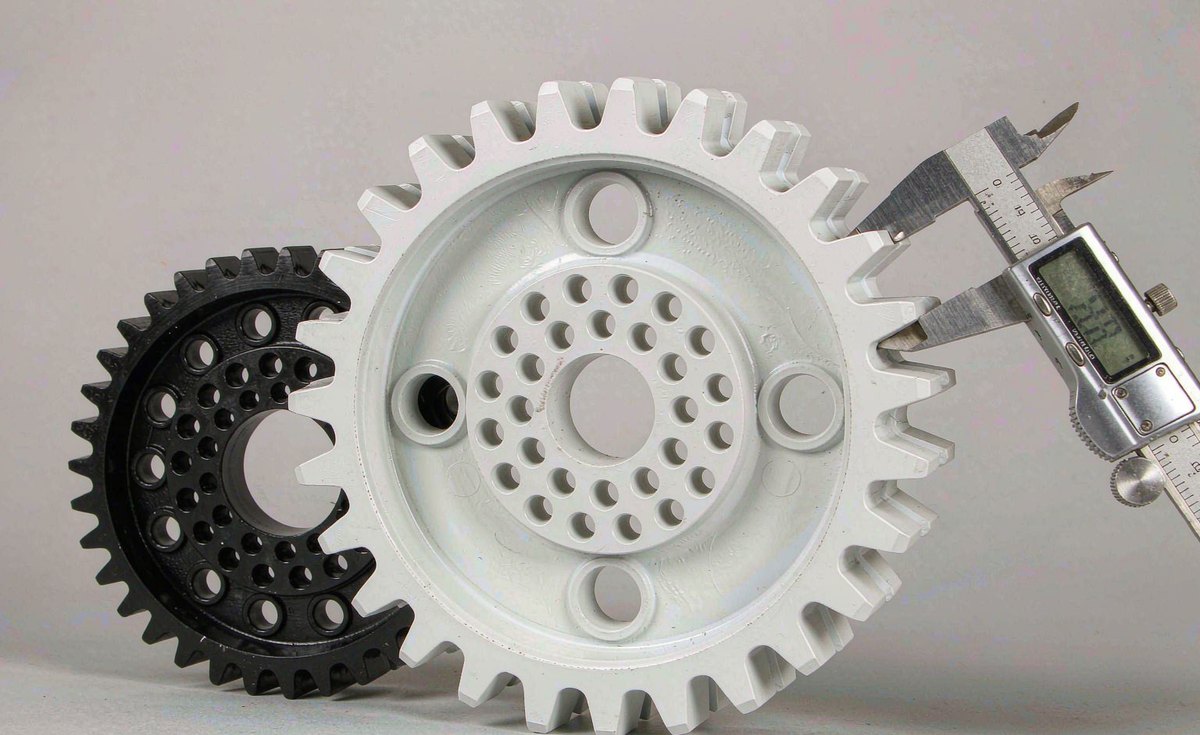
Precision Injection Molding
Tight-tolerance work held to ±0.05 mm: gears, connectors, sensor bodies and optical parts. Stable mould temperature control, SPC on critical dimensions, full dimensional reports.
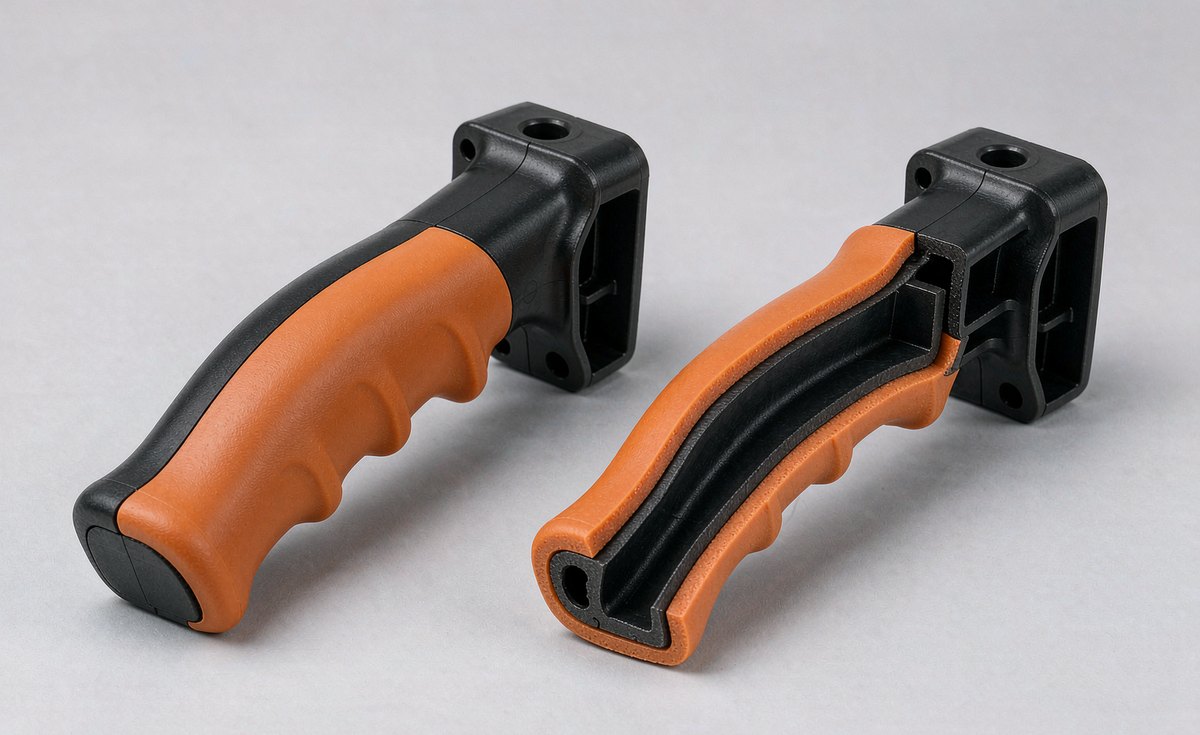
Two-Shot Molding (2K)
Rigid and soft materials in one cycle. Soft-touch grips on tool bodies, colour-coded buttons, and TPE seals bonded directly to a structural substrate — no assembly, no adhesive.

Insert Molding
Brass, steel and threaded inserts moulded in place for load-bearing bosses. Stronger than heat-set inserts, and immune to pull-out and spin under torque.

Thin-Wall Injection Molding
Walls down to 0.6 mm for packaging, containers and lightweight enclosures. High-speed injection, fast-cycling tooling and precise flatness control on large panels.

Micro Injection Molding
Sub-gram parts for medical devices, electronics and micro-fluidics. Micro-machined tooling, high injection velocity, and handling equipment that will not lose a 3 mg part.
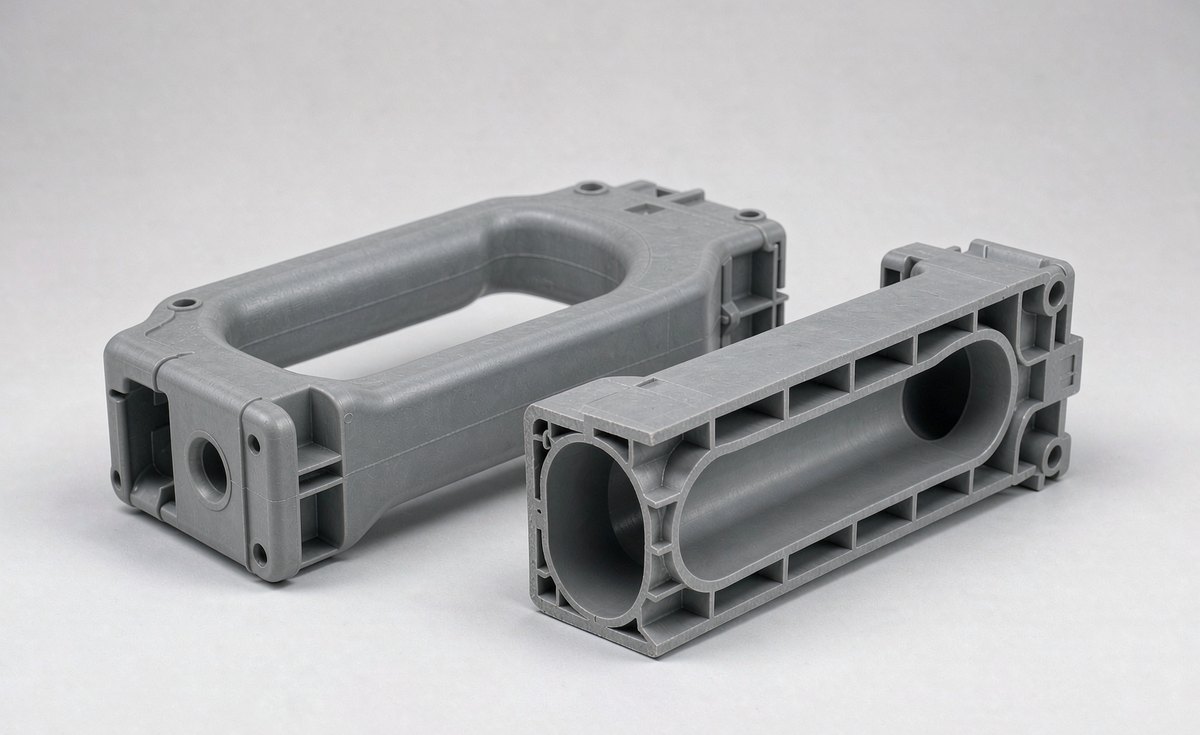
Gas-Assisted Injection Molding
Hollow cores in thick sections without sink marks. Handles, levers and large panels gain stiffness with less material, shorter cycles and dramatically lower warpage.

Structural Foam Molding
Thick-wall, large-footprint parts with a dense skin and cellular core. Low internal stress makes it the right answer for big housings that would warp if solid moulded.
Not sure which process fits your part? Send a STEP file — we will tell you which of the eight is cheapest to tool and run at your volume.
What Is Custom Injection Molding?
Thermoplastic pellets are dried, melted in a heated barrel, and forced under pressure into a closed steel cavity. The melt is held while it cools, then the part is ejected — finished, in one cycle, with no secondary shaping. Cycle times run from 8 seconds for a micro part to over 90 seconds for a thick technical component.
What separates a good moulder from an average one is not the machine. It is the tool, the drying discipline, and whether anyone is measuring the process instead of eyeballing the part. A 2 mm ABS housing that sinks, warps or flashes is almost never a machine problem — it is a tool or a parameter sheet problem, and both are decided before the first shot.
Injection Molding Capabilities
| Capability | Range |
|---|---|
| Part weight | 0.1 g – 2,000 g |
| Maximum part size | Approx. 600 × 400 × 250 mm |
| Cavitation | 1 to 40 cavities |
| General tolerance | ±0.10 mm (<100 mm), ±0.30 mm (100–300 mm) |
| Precision tolerance | ±0.05 mm on critical features, with SPC |
| Wall thickness | 0.6 mm – 6 mm |
| Mould steel | P20 / 718H, NAK80, S136, H13 |
| Mould life | 100,000 – 1,000,000 shots by steel grade |
| Tooling lead time | 25–45 days for a production tool |
| Surface finish | SPI A1–D3, MT textures, high polish |
Typical capability. Confirm the specific range against your drawing before quoting.
Engineering Resins We Mould
| 素材 | 収縮 | Drying | Where it belongs |
|---|---|---|---|
| ABS | 0.4–0.7% | 80 °C / 2–3 h | Housings, cosmetic covers, tool cases |
| PP | 1.5–2.5% | Not required | Living hinges, caps, containers, trim |
| PC | 0.5–0.7% | 120 °C / 4 h | Lenses, guards, electrical enclosures |
| PA6 / PA66 | 0.8–1.5% | 80–100 °C / 4 h | Gears, brackets, structural parts |
| POM | 1.8–2.2% | Not required | Precision gears, clips, bearings |
| PBT / PET | 0.3–0.8% | 120 °C / 3–4 h | Connectors, coil formers, electrical parts |
| PMMA | 0.3–0.6% | 80 °C / 3–4 h | Light guides, display lenses, signage |
| PPSU / PSU | 0.6–0.8% | 150 °C / 4 h | Sterilisable medical and food-service parts |
| TPE / TPU | 1.0–2.0% | 70–80 °C / 2 h | Grips, seals, overmoulded soft-touch surfaces |
| PA-GF / PBT-GF | 0.3–0.6% | 100 °C / 4 h | Structural parts needing stiffness and heat resistance |
Indicative processing windows. Flame retardants, glass fillers and impact modifiers shift all three columns — always confirm against the grade datasheet.
How the Process Runs
- DFM review and mould design. We check wall thickness, draft, radii, undercuts and gate position against your drawing, and tell you which changes would cut your part price before steel is cut.
- Tool making. In-house CNC, EDM and wire cutting. Core and cavity steel is selected against your volume, not against the cheapest quote.
- T1 sampling. First shots are measured against a ballooned drawing and reported, not just photographed.
- Parameter freeze. Mould temperature, packing profile and cooling time are locked into a set-up sheet so shot 50,000 matches shot 1.
- Production and SPC. Critical dimensions are checked on a defined frequency; out-of-trend data triggers a process adjustment, not a rework loop.
- Finishing and packing. Degating, ultrasonic welding, pad printing, assembly and clean-room packing as specified.
アプリケーション
- 自動車 — interior trim clips, sensor housings, under-hood brackets in PA-GF, fluid reservoirs.
- Medical and laboratory — instrument housings, fluidic cartridges, sterilisable trays in PPSU.
- エレクトロニクス — connector bodies, coil formers, enclosures with EMI-shielding options.
- Industrial equipment — machine guards, cable management, pneumatic fittings.
- Consumer and appliance — cosmetic housings, two-shot handles, thin-wall packaging.
品質管理
Every production run ships with a first-article inspection report, a dimensional report against the agreed critical characteristics, and material certificates traceable to the resin batch. Where the part carries a cosmetic requirement, we agree the A-surface and a limit sample before T1 — because "looks fine" is not a specification, and arguing about it after 20,000 parts is expensive for both sides.
Frequently Asked Questions
What is the minimum order quantity for custom injection molding?
There is no technical minimum — we will run 200 pieces if the tooling is justified. The economic threshold is usually 1,000–2,000 pieces, below which vacuum forming or CNC machining is cheaper once tooling is amortised.
How much does an injection mold cost?
A single-cavity P20 production tool for a part under 150 mm typically runs $4,000–$12,000. Medium housings with side actions run $12,000–$30,000, and large multi-cavity tools $30,000–$90,000. Steel grade, cavitation, hot runner and polish level are the four biggest levers.
How long does it take from design to delivery?
Usually 5–8 weeks: 3–7 days for DFM and mould design sign-off, 25–45 days for tool making, then T1 sampling and any correction, then production. Tools with multiple slides add two to three weeks.
Can you mould parts from our existing tool?
Yes. We start with a mould condition inspection and a dimensional report before the first production run, so any pre-existing wear is documented and agreed before it becomes a dispute.
Do you offer overmolding and two-shot parts?
Yes — rigid substrate with TPE or TPU overmould, either in a two-shot tool or as a sequential overmould on a pre-moulded insert. Material pairing matters: not every TPE bonds to every substrate, and we will confirm adhesion before committing to a tool.
What documentation comes with a shipment?
First-article inspection report, dimensional report on agreed critical characteristics, material certificate with batch traceability, and a process parameter sheet on request. PPAP-style documentation is available for automotive programmes.
Get a DFM review before you commit to tooling
Upload your part and target volume. We return a manufacturability review, tooling cost, cycle time estimate and an indicative part price.
 JA
 EN
 ES
 FR
 DE
 PT
 AR
 RU
 KO
 IT
 NL
 TR
 PL
 ID
