
What silicone rubber actually is
Silicone rubber is not a rubber in the way natural rubber or EPDM is. Its backbone is a chain of alternating silicon and oxygen atoms — a siloxane — with organic groups attached to the silicon. There is no carbon-carbon backbone to be attacked by ozone, ultraviolet light or oxygen, which is why silicone survives outdoors for decades where a hydrocarbon rubber cracks in two years.
The same backbone explains the temperature range. Silicone stays flexible from about −60 °C to +200 °C continuously, and for short periods to 250 °C. It does this without plasticisers, so there is nothing to migrate out and nothing to make the part go brittle with age.
What silicone does not do is mechanical strength. Tensile strength is typically 6 to 12 MPa, tear strength 15 to 40 kN/m, and abrasion resistance is poor. If the part has to resist cutting, tearing or sliding wear, silicone is the wrong material regardless of temperature.
HCR: the workhorse
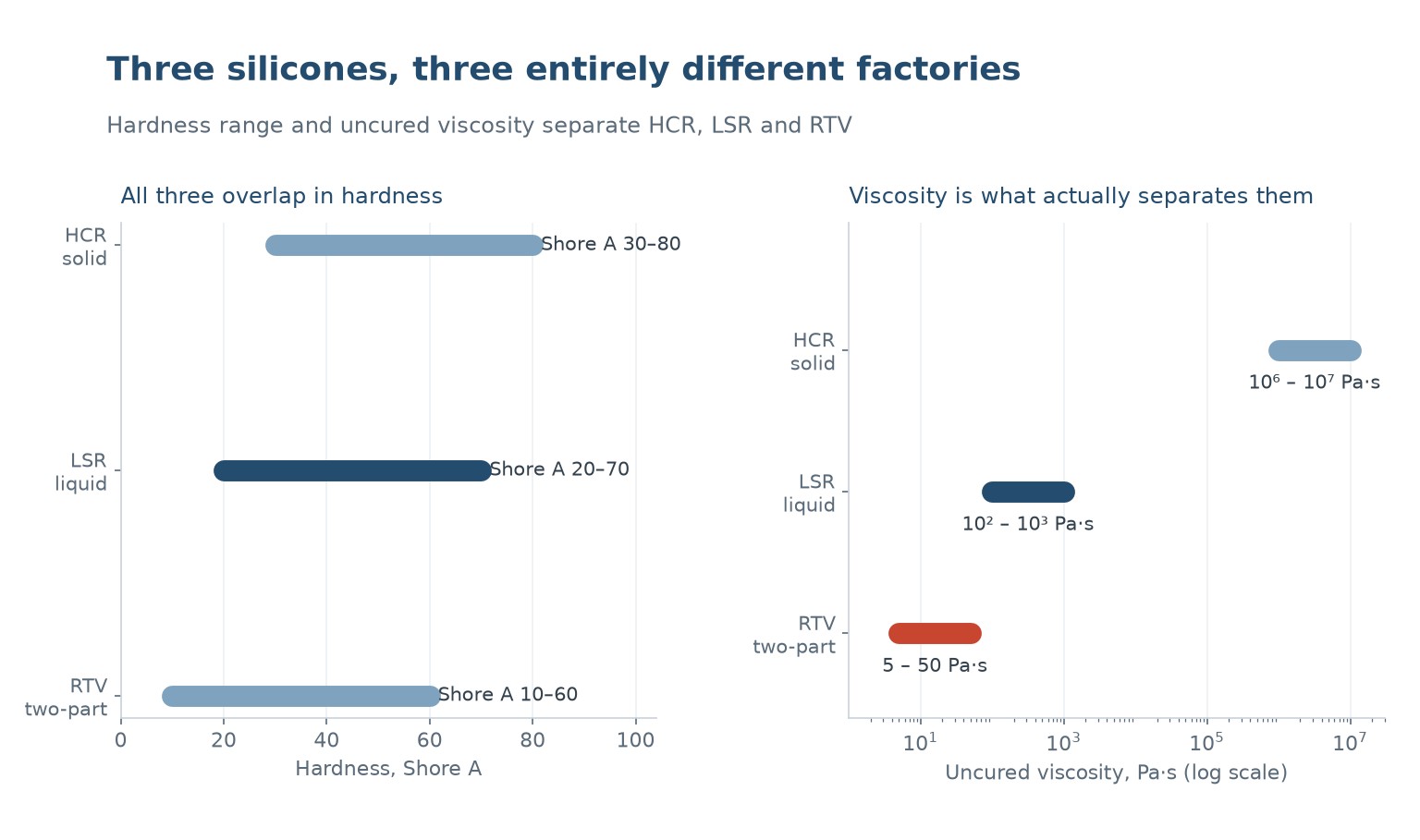
High-consistency rubber is what most people picture when they think of silicone. It arrives as a gum that is mixed with fillers and curative on a two-roll mill, then shaped by compression, transfer or extrusion. Uncured viscosity is in the millions of pascal-seconds — it does not flow, it deforms.
HCR covers the widest hardness range, Shore A 30 to 80, and gives the best tear strength and compression set of the three. It is also the cheapest per kilogram, which is why it dominates seals, gaskets, hoses, keypads and anything made in volume by compression moulding.
The cost of HCR is labour. A compression mould has to be opened, loaded with a preform, closed, cured and opened again. Cycle time is measured in minutes, not seconds. Multi-cavity tools and automatic preform placement reduce the labour but do not change the fundamental rhythm.
| プロパティ | HCR | LSR | RTV |
|---|---|---|---|
| Uncured form | Gum, milled sheet or strip | Two pumped components | Two poured components |
| 粘度 | 10⁶ – 10⁷ Pa·s | 10² – 10³ Pa·s | 5 – 50 Pa·s |
| Hardness range | Shore A 30 – 80 | Shore A 20 – 70 | Shore A 10 – 60 |
| Tear strength | Best | グッド | Lowest |
| Typical cycle | 2 – 10 min | 10 – 60 s | Hours to days |
| Tooling cost | ミディアム | Highest | Lowest |
| Best volume | 100 – 100,000 | 10,000 – millions | 1 – 1,000 |
Table 1 — The three silicone families side by side. Volume is the first filter; hardness almost never is.
LSR: not rubber moulding at all
Liquid silicone rubber is a two-component system, each part low viscosity, pumped from a drum through a static or dynamic mixer and injected directly into a hot mould. It cures in seconds because it is platinum-catalysed and the mould is at 170 to 200 °C.
The process has more in common with plastic injection moulding than with rubber compression moulding. Cold-runner systems keep the mixed compound at 20 to 30 °C right up to the gate, so there is no waste in the runner; the part cures only when it enters the hot cavity. Cycle times of 20 to 40 seconds for a small part are normal.
LSR is the right answer when the part is small, the volume is high, the geometry is complex, or the tolerance is tight. It is the wrong answer when the part is large and simple, because the tooling cost is high and the machine time is expensive.
The limitation nobody mentions at quotation stage is the metering system. LSR is mixed at a 1:1 ratio and the ratio must be held within about 1 percent. A worn pump gives parts that are under-cured on one face and over-cured on the other, and the defect looks like a mould problem. Check the mix ratio before you touch the tool.
RTV: prototypes, tooling and small runs
Room-temperature-vulcanising silicone cures without external heat, usually when two components are mixed or when moisture in the air reaches the compound. It is poured or dispensed into an open mould, so the tooling can be as simple as a machined aluminium block or a 3D-printed shell.
RTV has two jobs in a factory. The first is prototypes: a design that will eventually be LSR can be cast in RTV in a week, in a tool that costs a fraction of a production mould, and the parts can be tested for fit and feel. The second is the mould itself — RTV silicone is the standard material for casting resin and plaster parts, because it reproduces detail and releases without a release agent.
What RTV will not do is production. Pot life is minutes to hours, cure is hours to days, and the mechanical properties are the weakest of the three. It is also the most expensive per kilogram. Using it for a production run of 20,000 parts is a decision that looks cheap on the tooling line and expensive everywhere else.
Choosing: five questions, in order
Material selection for silicone is usually decided by the process, and the process is decided by volume and geometry. Ask these in order and the answer falls out.
- How many parts? Under 1,000, RTV. Between 1,000 and 100,000, HCR. Above 100,000, look hard at LSR.
- How big is the part? Above about 300 mm in any direction, HCR compression is usually the only economic route. LSR machines are limited by clamping force and shot size.
- How tight is the tolerance? LSR holds ±0.05 mm on small features; HCR holds ±0.15 mm and often ±0.25 mm on flexible sections.
- Does it need inserts or bonded parts? LSR overmoulds onto plastic and metal cleanly. HCR can too, but the placement is manual.
- What is the hardest requirement? If it is tear strength or compression set, HCR. If it is optical clarity or a durometer below 30, LSR.
| 申し込み | Typical choice | なぜ |
|---|---|---|
| O-rings and gaskets | HCR | Compression set and cost |
| Keypads | HCR | Tear strength at the web |
| 医療用チューブ | HCR extruded or LSR | Dependent on lumen tolerance |
| Baby teats | LSR | Low hardness, clarity, no volatiles |
| Automotive seals | HCR | Volume and heat resistance |
| Wearable device seals | LSR | Small, precise, high volume |
| Prototype housings | RTV | Tooling cost |
| Casting moulds | RTV | Detail reproduction and release |
Table 2 — Where each family usually lands. The overlaps are real; the default is what most projects choose.
Fluorosilicone and the grades that solve one problem
Standard silicone swells badly in hydrocarbon fuels and oils. Fluorosilicone replaces some methyl groups with trifluoropropyl groups, which raises the fluorine content and drops fuel swell from 100 percent to under 20. The price is three to five times standard silicone, and the low-temperature flexibility is worse.
Other special grades exist for specific failures. Phenyl silicone for very low temperature. Conductive silicone loaded with carbon or silver for EMI gaskets. Thermal gap filler loaded with ceramic for heat transfer. Sponge silicone for compressible sealing at low force. Each is a standard polymer with a filler or a side group changed, and each is specified because one property in the standard grade was not enough.
What the datasheet does not tell you
A silicone datasheet gives hardness, tensile strength, elongation, tear strength and compression set, all measured on standard test sheets cured under standard conditions. None of those numbers describes your part.
Three things change in production. Cure state: a part that is slightly under-cured reads soft and has poor compression set, and it will continue to cure in storage. Section thickness: a 10 mm section cures differently from a 2 mm one, and the properties follow. Post-cure: a part that has been post-cured at 200 °C for four hours has lower volatiles and better compression set than one that has not, and the datasheet does not say which it measured.
Ask for the cure schedule and the post-cure condition alongside the properties. A supplier who cannot tell you both is quoting a material, not a part.
What is the difference between HCR and LSR silicone?
HCR is a high-viscosity gum mixed with filler and shaped by compression, transfer or extrusion. LSR is a low-viscosity two-component liquid pumped and injected into a hot mould. The finished polymer is similar; the process, tooling and cycle time are completely different.
Which silicone is best for food contact?
Any of the three can be food contact compliant, but the grade matters more than the family. Ask for FDA 21 CFR 177.2600 and EU 10/2011 documentation, and confirm that the post-cure was done — volatiles are the usual reason a compliant material fails a migration test.
Can I make 500 parts in LSR?
You can, but you will pay for a production tool to make a prototype quantity. Below about 1,000 parts, RTV casting or HCR compression is almost always cheaper overall.
Why does my silicone part feel sticky after moulding?
Either under-cure or oil bleed. Under-cured silicone has a tacky surface that persists; a properly cured part with an oil bleed additive feels slick rather than sticky. Check the cure curve before changing the compound.
What Shore A hardness should I specify for a seal?
Shore A 50 to 60 for most static seals, 30 to 40 where the sealing force must be low, 70 where the seal must resist extrusion under pressure. Hardness is a compromise between sealing and extrusion resistance, not a quality indicator.
Does silicone rubber degrade in sunlight?
Standard silicone is one of the most UV-stable elastomers and will last 20 years outdoors without a protective coating. The exceptions are thin sections with certain pigments, and any grade with an organic additive that is not UV stabilised.
Sourcing silicone parts and unsure which process?
Tell us the part size, the annual volume and the hardest requirement. We will tell you whether it belongs in HCR, LSR or RTV, and what the tool will cost in each.




 JA
 EN
 ES
 FR
 DE
 PT
 AR
 RU
 KO
 IT
 NL
 TR
 PL
 ID
