The problem
Symptom. A distributor unwraps a pallet of white PVC profile and finds 0.9 mm dents under every 16 mm strap, with no corner protectors and the strapping tool logged at 2 800 N.
What it costs. Dented face lengths cannot be fitted on a visible elevation, so the pallet is rejected and the claim stalls because nobody photographed the strapped stack before unloading.
This guide ties the dent to strap tension and corner contact pressure, and gives the four pieces of evidence a strapping claim needs.
Photograph the pallet before you blame the haulier
A strap dents a face when contact pressure passes PVC-U's roughly 50 MPa yield. A 16 mm strap at 2 800 N on a bare 2 mm corner gives P = 2 800 / (16 x 2) = 87.5 MPa; a 25 mm protector widens contact to 20 mm and drops that to 8.75 MPa.
| Strap tension (N) | Dent depth (mm) | Bare-corner pressure (MPa) |
|---|---|---|
| 900 (specified) | 0.00 | 28.1 |
| 1 200 (maximum) | 0.05 | 37.5 |
| 2 000 | 0.35 | 62.5 |
| 2 800 (logged fault) | 0.90 | 87.5 |
Table 1 - Strap tension against dent depth and contact pressure
Need a fixed price for this profile?
Send the cross-section drawing, material, cut length and annual volume. We will review die, calibration and tolerance, then return a written tooling and production quotation.
Trace the dent from strap tension to the corner
Treat the split below as illustrative engineering guidance, not a measured survey. Typically strap marks trace to excess tension, no corner protection, missing interleaves and no evidence record, so read the tool log before rejecting the compound.
A five-step diagnostic sequence
- Photograph before unloading.
Take timestamped photos of the strapped pallet and the tool setting; a claim without them is usually called handling damage. - Read the strap tension.
Check the tool log; 2 800 N on a 16 mm PET strap is well above the 1 200 N maximum and explains a 0.9 mm dent. - Measure the dent.
Lay a straightedge across the mark and use a feeler gauge; 0.90 mm against a 0.10 mm limit is permanent, not a scuff. - Check protectors and interleaf.
Confirm a 25 mm corner protector and a 0.5 mm kraft sheet; a bare 90 degree edge concentrates 87.5 MPa on 2 mm of face. - Write the packing and claim clause.
Specify 900 N, a 25 mm protector, an interleaf, a 0.10 mm dent limit and photo-plus-gauge evidence so a mark is a tension record.
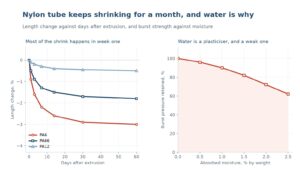
The chart below is a typical result from that measurement step. Use it to separate a design limit from a setting that can still be recovered.

Set the strapping and protection parameters
Four settings keep the face clean: strap tension of 900 N (1 200 N maximum), a 25 mm radius corner protector 3 mm thick, a 0.5 mm kraft interleaf and a dent limit of 0.10 mm. At 2 800 N the dent reaches 0.9 mm.
| パラメータ | Agreed value | What goes wrong outside it |
|---|---|---|
| Strap tension (16 mm PET) | 900 N, 1 200 N max | 2 800 N gives 87.5 MPa and a 0.9 mm dent |
| Corner protection | 25 mm radius, 3 mm thick | Bare corners concentrate load on a 2 mm edge |
| Interleaf | 0.5 mm kraft every layer | Face-to-face contact marks under tension |
| Dent acceptance / evidence | 0.10 mm limit, photo + gauge | A 0.9 mm dent with no record is disputed |
Table 2 - Palletising settings for the packing specification
Prove it with a strap tension trial
Run a tension trial with one pallet: strap at 900, 1 200, 2 000 and 2 800 N and gauge each dent. Depth reads 0.00, 0.05, 0.35 then 0.90 mm, so the 0.10 mm acceptance limit sits just above 1 200 N.
| Field symptom | Most likely cause | Check that confirms it |
|---|---|---|
| Dent exactly under each strap | Tension far above 1 200 N | Tool log reads 2 800 N on a 16 mm PET strap |
| Deep mark at bundle corners only | No 25 mm corner protector | Unwrapped pallet shows bare 90 degree edges |
| Marks between adjacent layers | No 0.5 mm interleaf | Face-to-face contact with no kraft sheet |
| Claim rejected as handling damage | No photo or depth record | Nothing timestamped before unloading |
Table 3 - Matching the dent to the palletising fault
Write the claim evidence into the packing spec
Write the claim evidence into the order: a 900 N tension setting, a 25 mm protector, an interleaf, and timestamped photos of the strapped pallet plus a depth-gauge reading. Both parties holding one photo set turn a dent into a tension record.
Need the section checked before tooling?
Send us the section and the installation conditions. We will review wall balance, tolerance and fixing detail, then return a marked-up drawing with a tooling quotation.
What to send us
- Cross-section drawing with wall thicknesses
- Material and colour
- Installation temperature range
- Fixing method and run length
What a corner protector saves over a delivery season
A protector is cheap cover. 87.5 MPa on a bare corner is 1.75 times the 50 MPa yield and dents 0.9 mm deep; a 3 mm protector at 900 N holds 0.00 mm and keeps the whole pallet fit for a visible elevation.
Before you release this extruded profile
- Strap tension of 900 N with a 1 200 N maximum is in the packing spec
- A 25 mm radius, 3 mm thick corner protector is required
- A 0.5 mm kraft interleaf between layers appears in the palletising spec
- A dent depth limit of 0.10 mm is the acceptance criterion
- Timestamped photos and a depth-gauge record are the agreed claim evidence
Write the measurement temperature and the tolerance into the drawing; most disputes are really about how the part was measured.
Why does my profile have dents under every strap?
Tension is too high for a bare corner. A 16 mm strap at 2 800 N gives P = 2 800 / (16 x 2) = 87.5 MPa, above PVC-U's roughly 50 MPa yield, so it indents about 0.9 mm.
What strap tension should I specify?
900 N with a 1 200 N maximum. At 1 200 N the dent is 0.05 mm; at 2 800 N it reaches 0.90 mm, nine times the 0.10 mm acceptance limit.
Do corner protectors really help?
Yes. A 25 mm radius protector widens contact from 2 mm to about 20 mm, dropping 2 800 N from 87.5 MPa to 8.75 MPa, well below the yield point.
Why was my claim rejected?
Usually no evidence. Without timestamped photos of the strapped pallet and a depth-gauge reading before unloading, a 0.9 mm dent is easily dismissed as handling damage.
Does an interleaf matter?
Yes. A 0.5 mm kraft sheet between layers stops face-to-face marking under tension, especially when a warm pallet is strapped tight.
What should the packing clause say?
900 N tension (1 200 N max), a 25 mm corner protector, a 0.5 mm interleaf, a 0.10 mm dent limit, and photo-plus-gauge evidence for any claim.
Get a profile that holds its dimension
Send us the profile section, the length and the service conditions. We will review die, calibration and tolerance, then quote tooling and production with a defined measurement method.
To get an accurate quote, send:
- Profile cross-section drawing
- Material and colour
- Cut length and annual volume
- Service temperature and exposure
Why buyers work with Uplastech
ISO 9001, ISO 14001 and ISO 45001 certified. Founded in 2016, with injection moulding lines in Shanghai and an extrusion plant in Jiangsu. Moulding machines from 90T to 1100T and a maximum shot weight of 5100 g. Samples and a written quotation are available on request.
Continue reading
- Extrusion dimensional drift
- Extrusion profile tolerance
- Profile calibration and cooling
- PVC profile weathering and colour
- PVC window profile design
Ready to specify? See our plastic profile extrusion services または request a written quotation.






 JA
 EN
 ES
 FR
 DE
 PT
 AR
 RU
 KO
 IT
 NL
 TR
 PL
 ID