
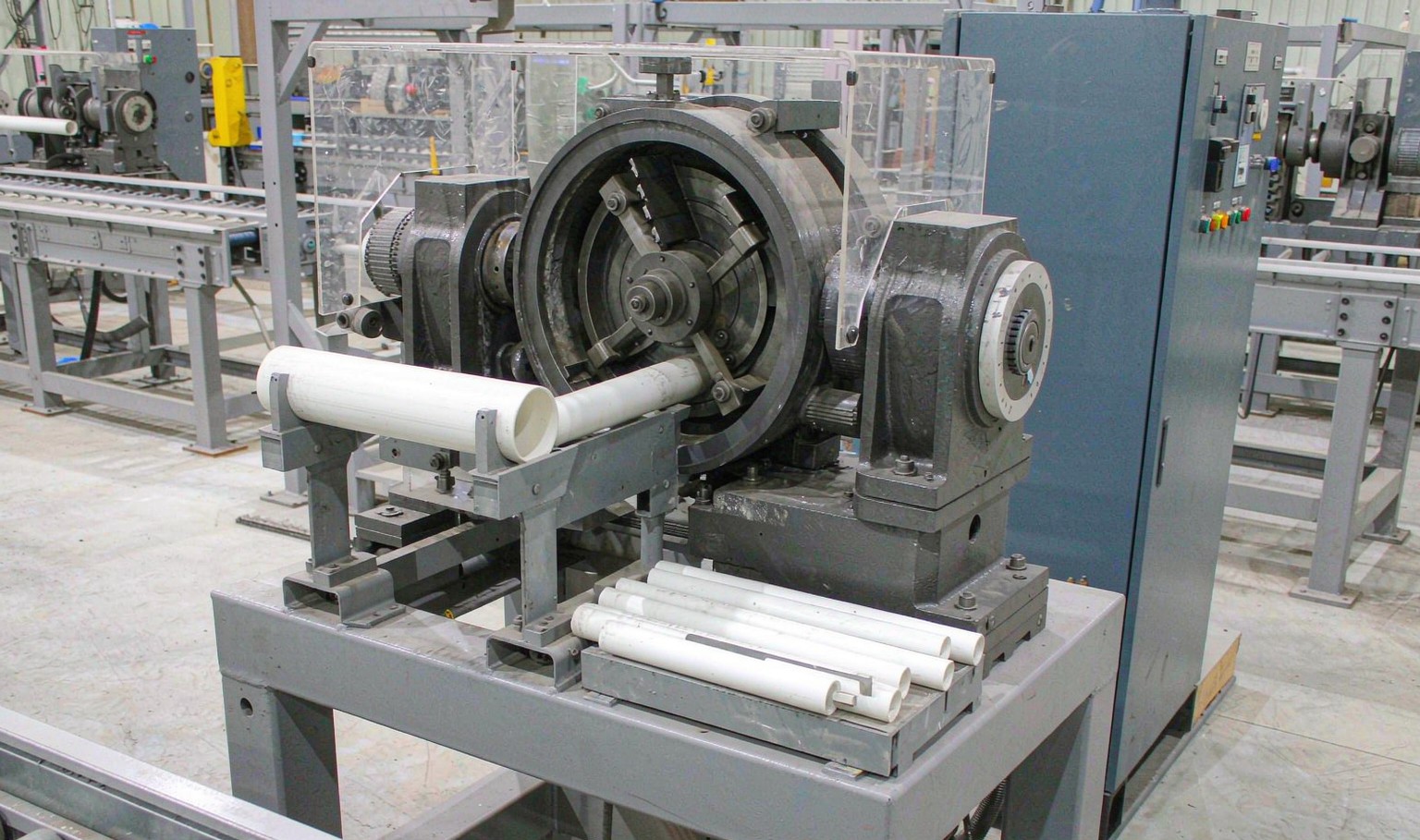
The cutter is a line constraint, not an accessory
Extrusion is continuous, so something has to decide where a length ends. That decision sets two things: the tolerance on the cut length, and the maximum speed the line can run. Both are properties of the cutter, and both are usually decided after the extruder has been chosen.
The mistake is to treat the cutter as a finishing detail. A line with a 60 metre per minute haul-off and a saw that manages 8 is an 8 metre per minute line, and the capital spent on the extruder and the haul-off is idle 87 percent of the time.
There are three families in common use: the planetary cutter, which carries blades around the pipe on a rotating head; the guillotine, which drops a blade through the product; and the saw, which cuts with a circular blade that travels with the line. Each has a speed ceiling and a tolerance that follow from its mechanism.
The choice is usually obvious once the line speed and the cut tolerance are written down. It becomes unobvious when the product range is wide, because a cutter that suits a 40 mm pipe at 20 metres per minute may not suit a 110 mm pipe at 4.
Planetary: the fast one
A planetary cutter has a rotating head carrying two or more blades. The head rotates once per cut, and the blades are geared so that their tangential speed matches the line speed at the moment of contact. That is what allows it to cut on the fly without stopping the line.
It is the fastest of the three, and it is the only one that holds a tight tolerance at high speed. On a 40 mm pipe the tolerance stayed within 0.4 mm from 5 to 15 metres per minute and reached 0.9 mm at 30. The mechanism is inherently synchronous, so the error grows slowly with speed rather than jumping.
The limits are the pipe diameter and the wall. The head has to be large enough that the blades clear the product, so a planetary cutter for 110 mm pipe is a big machine. And a thick wall needs a slower feed per revolution, which caps the line speed regardless of the head.
Planetary cutters produce a clean, square cut with minimal burr, which matters for anything that will be socketed or joined. They also produce almost no swarf, which matters for potable water pipe and for anything that has to be clean.
Guillotine: the cheap one
A guillotine drops a blade through the product, usually while the product is held by a clamp that travels with the line. It is simple, cheap, and it works well on thin-wall pipe and small profile up to moderate speed.
The cut is a shear, so the product is deformed before it separates. On thin wall that is invisible; on thick wall it produces an oval end and a burr on one side. The blade also wears on one edge, so the cut quality drifts over a shift in a way that a planetary cut does not.
The speed ceiling comes from the travel length of the clamp. The clamp has to hold the product while the blade passes, then release and return, and that cycle time sets the maximum cuts per minute. On a 3 metre length at 25 metres per minute the line produces 8 cuts per minute, which is close to the limit for a small guillotine.
Where a guillotine wins is on short lengths and low speed. A 100 mm cut length on a small profile at 5 metres per minute is 50 cuts per minute, which no planetary head would enjoy and a guillotine with a fast return handles easily.
Saw: the universal one
A saw travels with the line and cuts with a circular blade. It will cut any diameter, any wall, and any material including filled and foamed products that a blade would crush. It is the most flexible of the three and the slowest.
The tolerance is the problem. Measured across the same speed range, the saw held 0.8 mm at 5 metres per minute and reached 4.6 mm at 30, and in practice it is rarely run above 8 to 10 because the blade overheats and the burr becomes unacceptable.
The saw also produces swarf. On a pipe that will carry drinking water, or a profile that will be visible, the swarf has to be removed, and that is an extra station. On a filled material the swarf is abrasive and wears the blade quickly.
Where a saw is right is large diameter, thick wall, and anything where the cut face will be machined afterwards. A 315 mm PE pipe at 1 metre per minute is a saw job; nothing else will do it, and the tolerance does not matter because the end will be faced before it is welded.
| Cutter | Max line speed | Tolerance at 30 m/min | Swarf | 最適 |
|---|---|---|---|---|
| Planetary | 60 m/min | 0.9 mm | None | Pipe and tube, tight length, clean end |
| Guillotine | 25 m/min | 3.0 mm | None | Thin wall, short lengths, low cost |
| Saw | 8 m/min | 4.6 mm | はい | Large diameter, thick wall, filled material |
Table 1 — The three cutter families against speed, tolerance and application
Tolerance against speed, in numbers
Running all three on the same 40 mm pipe over the same speed range gives a clean comparison. The planetary held 0.4 mm up to 15 metres per minute and 0.9 at 30. The guillotine held 0.5 at 5, 0.9 at 15, 2.1 at 25 and 3.0 at 30. The saw held 0.8 at 5, 1.6 at 15, 3.4 at 25 and 4.6 at 30.
The shapes of the curves are different, and that matters more than the absolute numbers. The planetary is nearly flat, so its tolerance is predictable across the speed range. The guillotine and the saw both curve upward, so a line that runs at 15 metres per minute on Monday and 25 on Tuesday will produce two different tolerances from the same machine.
That is why a specification that says plus or minus 1 mm and a line that runs at varying speed is a specification that will be missed intermittently. Either the speed is fixed or the cutter has to be one whose curve is flat in the working range.
The other variable is temperature. A cut made on a warm pipe deforms more than one made on a cold pipe, because the material is softer and the blade pushes it before it shears. On a line with a short cooling trough, the cut tolerance drifts as the bath warms up over a shift.
How to choose
Start with the cut length tolerance the product needs. Pipe that will be socketed needs a square end within a millimetre, which points at planetary. Profile that will be packed in a box needs plus or minus 3 mm, which a guillotine can hold at moderate speed.
Then check the speed. If the line has to run above 25 metres per minute, the guillotine is out and the saw was never in. If it has to run above 40, only a planetary head will do, and the head size becomes the constraint on diameter.
Then check the material. Filled, foamed or glass-reinforced products wear a blade fast and can crush under a guillotine. A saw tolerates them better, at the cost of swarf and speed.
The last check is the changeover. A line that runs six products a week needs a cutter that can be changed or adjusted in minutes. A planetary head with fixed blades for one diameter is fast and inflexible; a saw with a travelling carriage is slow and universal. The right answer depends on the product mix, not on the machine datasheet.
| If the requirement is | Then the cutter is |
|---|---|
| Tolerance under 1 mm at any speed | Planetary |
| Line speed above 40 m/min | Planetary |
| Short lengths at low speed | Guillotine |
| Large diameter or thick wall | Saw |
| Filled or foamed material | Saw |
| No swarf allowed | Planetary or guillotine |
Table 2 — Requirement against cutter family
Three mistakes that cost a line
The first is sizing the cutter for the average product rather than the hardest one. A cutter that handles 90 percent of the range will stop the line for the other 10, and those are usually the orders with the tightest delivery date.
The second is ignoring the acceleration of the travelling carriage. A saw that has to accelerate to line speed before it cuts loses time on every cut, and at short lengths that time dominates the cycle. The datasheet speed is the cutting speed, not the effective throughput.
The third is forgetting the take-away. A cutter that drops the cut length onto a pile needs an operator; one that drops it onto a conveyor needs a conveyor. On a fast line the take-away is often the real bottleneck, and it is the cheapest thing to fix before the cutter is bought.
What is the fastest type of extrusion cutter?
A planetary cutter, which cuts on the fly and can follow a line at 60 metres per minute or more while holding under a millimetre.
What tolerance can a guillotine hold?
About 0.5 mm at low speed, degrading to 2 to 3 mm by 25 to 30 metres per minute as the shear deformation grows.
Why does my saw cut drift during a shift?
Blade wear and product temperature. A warm pipe deforms more before it shears, and a worn blade pushes rather than cuts, so the tolerance opens up over the shift.
Can a planetary cutter cut square?
Yes, it gives the squarest end of the three, which is why it is used on pipe that will be socketed or welded.
Do I need a travelling carriage for a saw?
Yes, the saw has to move with the line during the cut. The acceleration of that carriage is often the real limit on throughput at short cut lengths.
Which cutter produces no swarf?
Planetary and guillotine, because both shear or slice rather than remove material. A saw produces swarf that has to be collected, especially on potable water pipe.
A line that cannot cut as fast as it extrudes?
Tell us the product, the diameter, the cut length and the speed you need. We will tell you which cutter family fits and what it does to the line.




 JA
 EN
 ES
 FR
 DE
 PT
 AR
 RU
 KO
 IT
 NL
 TR
 PL
 ID
