CPET Ovenable Trays: Dual-Ovenable From a Thermoformer
CPET is ordinary PET formed against a hot mould. The heat that crystallises the sheet is what lets the tray survive 220 degrees, and it is paid for in cycle time, thirty seconds at a time.
ホーム / ブログ

CPET is ordinary PET formed against a hot mould. The heat that crystallises the sheet is what lets the tray survive 220 degrees, and it is paid for in cycle time, thirty seconds at a time.

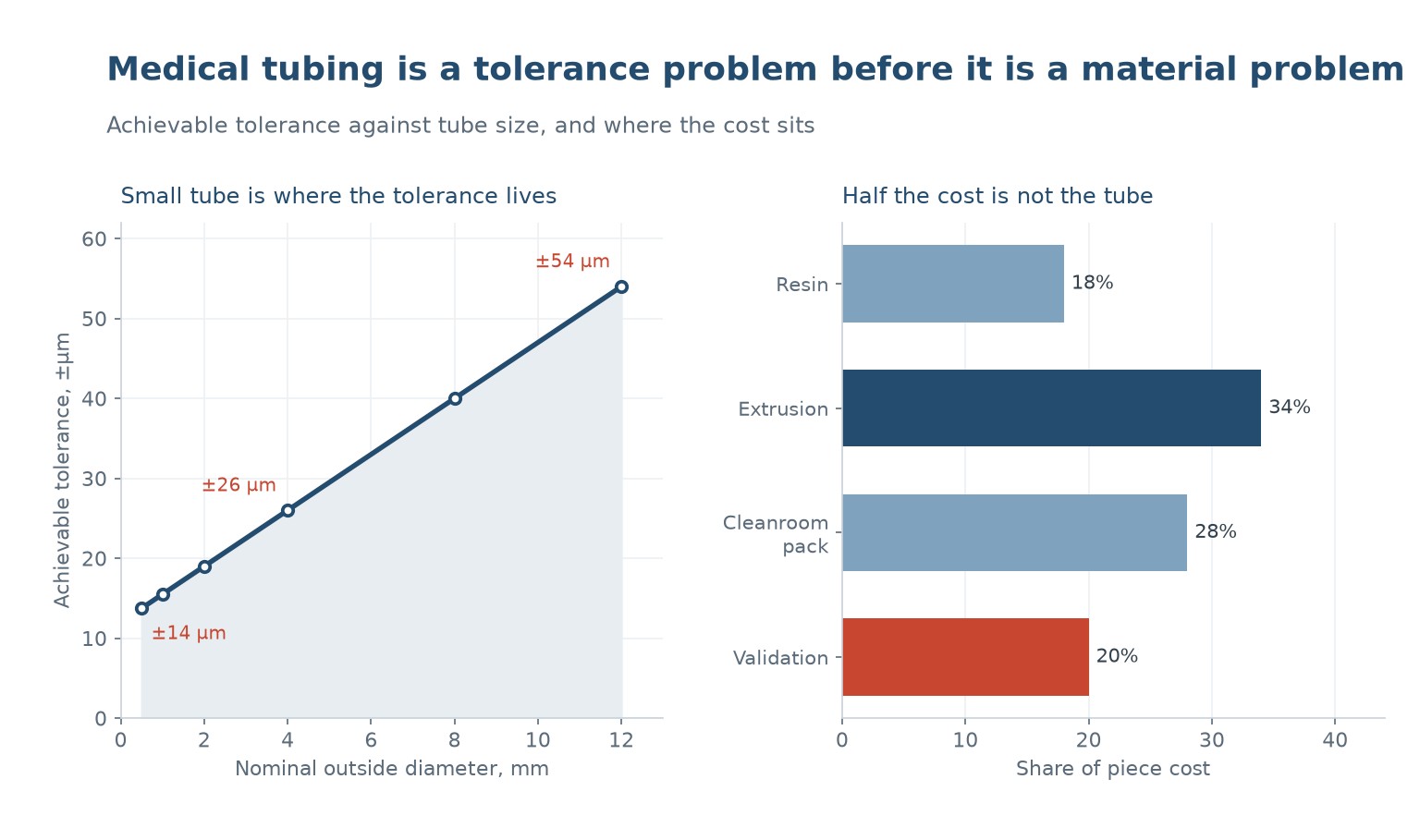
A 0.5 mm catheter tube is held to plus or minus 14 micrometres, and half the piece cost is not the tube at all. In medical tubing the product is the tolerance and the paperwork around it.

Thirty percent glass takes nylon from 80 to 165 MPa and from 14 to 4.3 kJ/m2 of notched impact. The same fibre that adds the strength is what makes the part warp and the gate wear out.
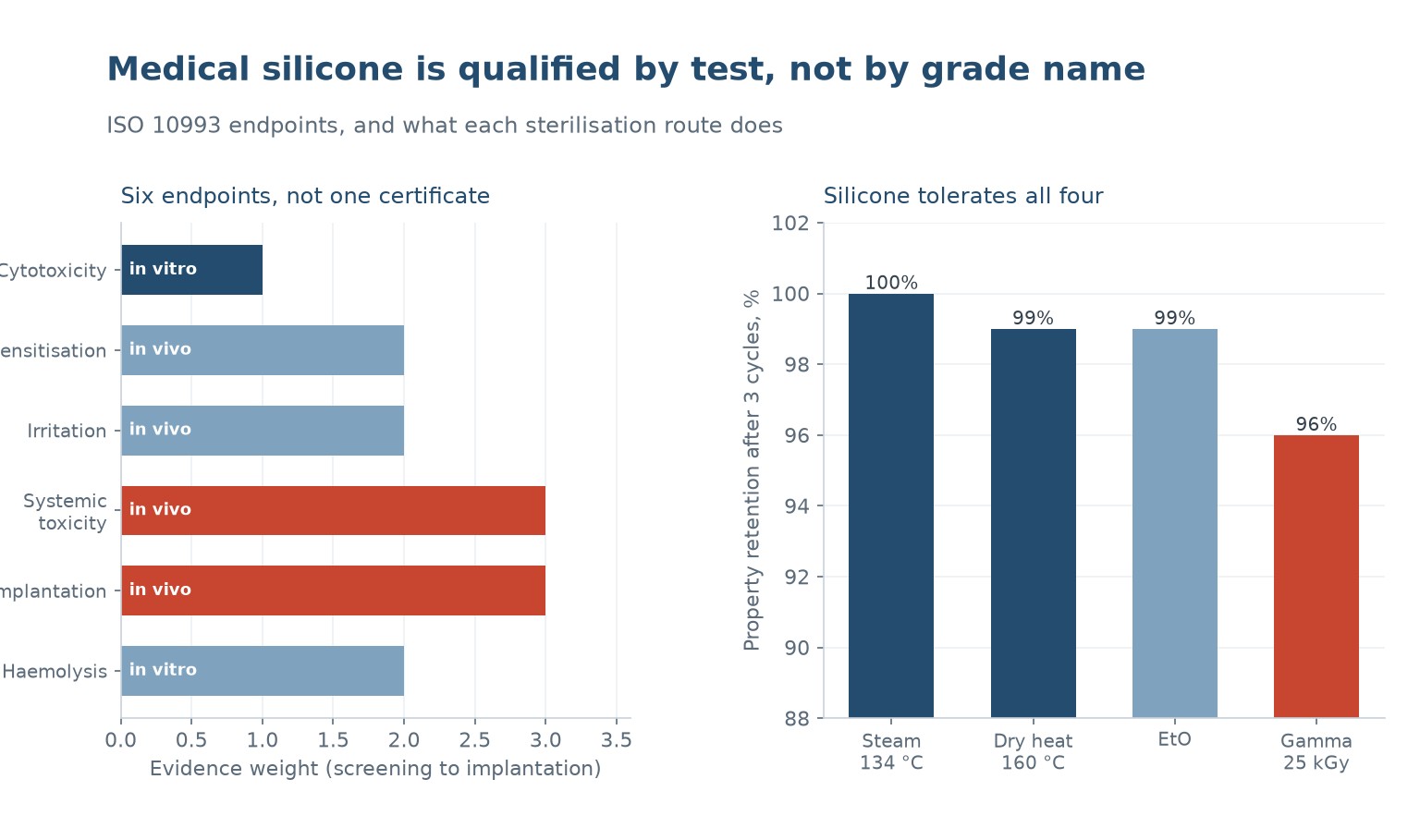
Medical grade is not a grade. It is a test matrix, a sterilisation route and a change control system. A material that passes USP Class VI is not automatically suitable for an implant.

A 0.5 mm polypropylene cup comes off a roll-fed line in about two seconds. At that speed the forming window is 15 °C wide and every defect is a thousand cups before anyone notices.

A five-layer pipe puts 0.18 mm of EVOH behind 1.8 mm of polyethylene. The function is in the thin layer, and the tie layers holding it are 0.12 mm each.

Liquid crystal polymer fills a 0.2 mm wall at 200 MPa and comes out with twice the strength along the flow as across it. Both facts come from the same molecular order.
Food-grade silicone is not a material property, it is a set of documents. FDA, EU 10/2011 and BfR XV ask different questions, and a part that passes one is not automatically compliant in the other.

PLA forms at 105 to 145 °C, which means it runs on a machine set up for PET with the heaters turned down. The complication is that amorphous PLA softens at 55 °C, and a coffee cup is hotter than that.

A 2.5 metre pipe cannot be extruded on a 2.5 metre line. Winding a profile onto a mandrel makes it possible, and the stiffness comes from the structure rather than the wall.

Polyetherimide moulds at 370 °C, needs four hours of drying at 150 °C, and punishes a long residence time with chain scission. It is a material that rewards a disciplined shop.
Fluorosilicone drops fuel swell from 100 percent to under 20. It also costs three to five times standard silicone and gives up cold flexibility. Here is when that trade is worth making.
Copyright 2023 © All Right Reserved デザイン:Rometheme
クリックしてチャット
今、オンラインにいる。
こんにちは、Uplastechのジョンです。
WhatsApp Us
オンライン 🟢 プライバシーポリシー
WhatsApp us