
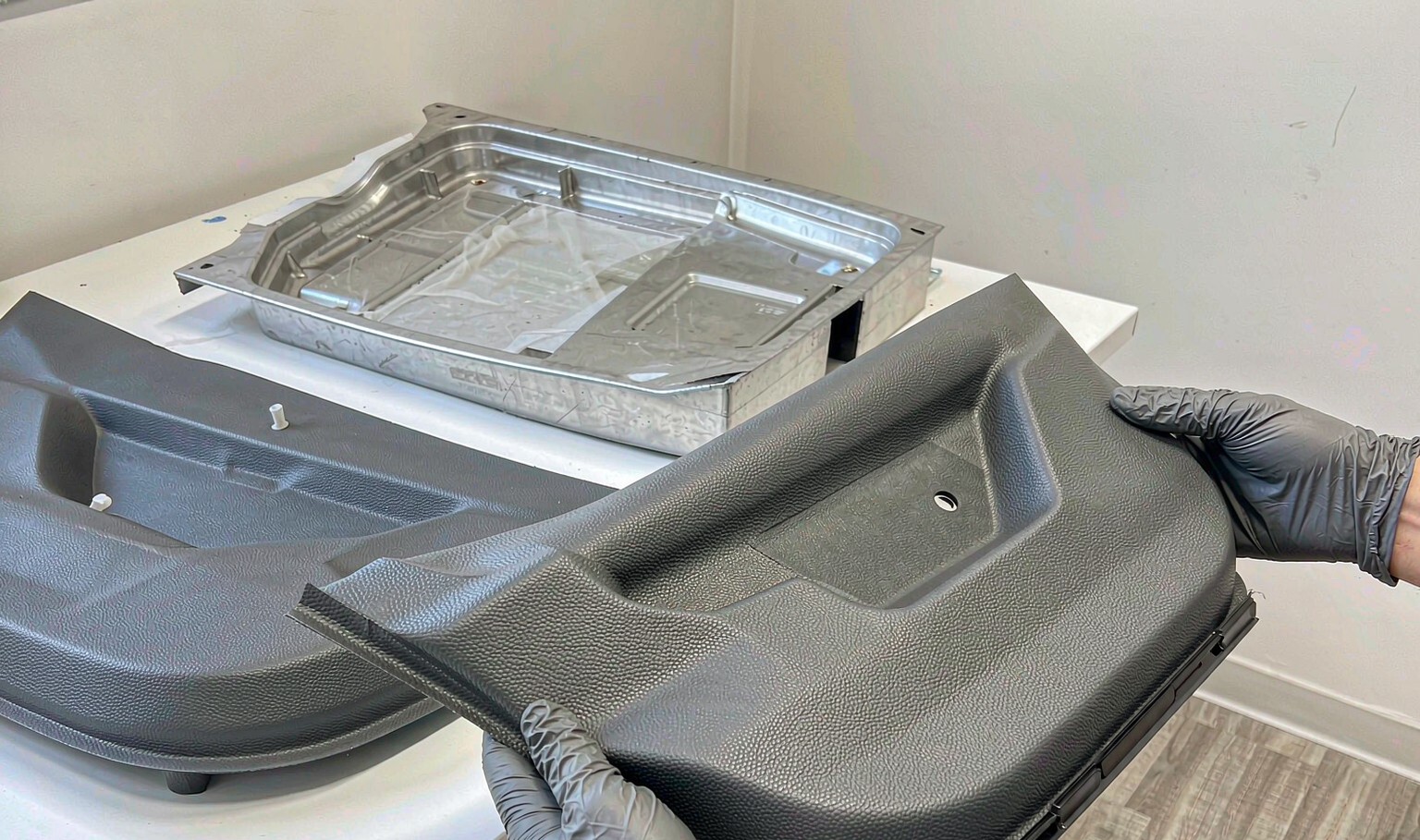
A grained skin is a forming problem first
An automotive interior panel is judged by touch and by eye before it is judged by anything else. The grain has to look like leather, feel like leather and stay that way across a cabin that reaches 90 C in the sun and minus 30 C in a Scandinavian winter.
The grain can come from the sheet, from the tool, or from a coating. Whichever route is used, the forming process is what decides whether the grain survives. A sheet that is stretched thins, and a texture that is a surface relief thins with it: the peaks flatten and the valleys fill, and the panel that comes out of the tool has less grain than the sheet that went in.
That is why the grain specification is written against the formed part and not against the sheet. A 120 micron grain in the sheet is a number that means nothing until somebody says at what draw ratio it is measured.
Detail washes out where it draws
Grain depth retention against draw ratio is a steep curve. At a draw ratio of 0.2 the formed part keeps 93 percent of the moulded depth. At 0.4 it keeps 85, at 0.6 it keeps 72, at 0.8 it keeps 56, and at 1.0 it keeps 42.
A draw ratio of 1.0 means the depth drawn equals the width of the feature, which on a door panel happens at every sharp transition: the armrest, the speaker bezel, the switch recess. Those are exactly the places a customer touches, and they are the places where the grain is thinnest.
The answer is not a deeper grain in the sheet. A deeper grain stretches further and produces a coarser surface where it is not stretched, so the panel ends up with two different textures on it. The answer is a shallower draw, a larger radius, or a plug that pre-stretches the material evenly instead of letting it thin locally.

Read-through is a demould temperature problem
Read-through is the shadow of a rib or a boss showing on the visible face. On a foam-backed skin it is the foam collapsing; on a plain thermoformed skin it is the rib pulling the surface as the part cools. Either way it is measured in microns of surface deviation and it is visible at about 15.
The controlling variable is the temperature at which the part is released. At 60 C the read-through is about 8 microns. At 70 C it is 14, at 80 C it is 24, at 90 C it is 38, and at 100 C it is 55, which is a visible shadow on any grain.
The mechanism is straightforward: a part released hot is still soft, the rib cools and shrinks after release, and the shrinkage pulls the visible face. A part released cold has already done most of its shrinking while it was still held on the tool, so the rib cannot pull anything.
Which makes cooling time the fix, and cooling time is the thing everybody wants to cut. The compromise is a cooled fixture: form at a short cycle, demould hot, and clamp the part in a fixture while it finishes cooling. The fixture costs less than the cycle time it saves and it removes the read-through.
The materials and what each is good at
ABS is the default interior skin. It forms easily, it takes a grain well, it accepts a paint or a soft-touch coating, and it is cheap. Its weakness is heat: a black ABS panel in direct sun can reach 90 C and start to sag, which is why the grade matters.
TPO, a polypropylene based olefin, is the material for a large panel that has to survive heat and UV. It is tougher, it does not need a coating for UV stability, and it is harder to grain because the melt strength is lower and the texture tends to wash out more at a given draw.
PVC and PVC/ABS are used where a soft touch and a deep grain are the priority and the heat requirement is modest. Polypropylene on its own is the cheapest and the least dimensionally stable, and it is used for hidden panels and for substrates rather than for visible skins.
| 素材 | Heat | Grain | Note |
|---|---|---|---|
| ABS | ミディアム | 素晴らしい | Default, needs UV protection |
| TPO | 高い | グッド | No coating needed, harder to grain |
| PVC/ABS | Low-medium | 素晴らしい | Soft touch, deep grain |
| PP | 高い | フェア | Cheap, poor dimensional stability |
| PC/ABS | 高い | グッド | Tough, expensive |
Table 1 — Interior skin materials and the trade each one makes
Three ways to get a grain
An etched tool is the most common. The aluminium or steel tool is chemically etched or laser textured with the grain, and the grain is transferred to the sheet where the sheet touches the tool. It reproduces the tool exactly, it lasts as long as the tool, and it only appears on the tool side, which means the grain has to be on the outside of the part.
A pre-grained sheet is embossed during extrusion. The grain is in the sheet before forming, it is on the outside of the part regardless of which side faces the tool, and it is the same depth everywhere before the draw. It is the cheaper route for a simple panel and the one that washes out most at a high draw.
A coating is sprayed or laminated after forming. It can put a grain on a part that could not be grained any other way, and it adds a process, a curing step and a durability question. It is used for low volume and for repairs rather than for production.
| Route | Grain on | Wash-out | 用途 |
|---|---|---|---|
| Etched tool | Tool side | 低い | Production, deep grain |
| Pre-grained sheet | Both sides | High at draw | Simple panels |
| コーティング | Applied | None | Low volume, repair |
Table 2 — Grain routes and how each behaves in forming
Dimensional discipline
An interior panel has to fit a gap. The gap to the adjacent panel is typically 0.5 to 1.5 mm and it is visible, so a panel that is 2 mm out shows a shadow line that a customer reads as a build defect. That is the standard the part is actually held to, and it is much tighter than the forming tolerance alone.
The tolerance stack is the sheet shrinkage, the forming shrink, the trim allowance and the fixture. Thermoformed parts shrink after forming for hours, and a part trimmed immediately is a part trimmed at the wrong size. The usual sequence is form, cool in a fixture, then trim, with the trim fixture built to the cooled dimension.
The trim itself is a separate operation with its own tolerance. A five axis router holds plus or minus 0.2 mm; a steel rule die holds plus or minus 0.5 and needs a flat part; a punch holds better but only on a simple outline. The choice of trim sets the fit.
And the fixture is where most of the dimensional discipline lives. A part that is clamped while it cools holds the shape it was clamped in, and a part that is stacked while it cools takes the shape of the stack. Cooling fixtures look like an expense and they are the cheapest way to hold a fit.
Why does the grain disappear on a deep draw?
Because the sheet thins as it draws, and a surface texture thins with it. At a draw ratio of 1.0 only about 42 percent of the moulded grain depth survives, against 93 percent at 0.2.
What causes read-through on an interior panel?
Releasing the part too hot. A part demoulded at 100 C shows about 55 microns of rib shadow; at 60 C it is 8. Cooling in a fixture is the usual fix.
Should the grain be in the tool or in the sheet?
In the tool for a production part with a deep grain, because it survives the draw better. A pre-grained sheet is cheaper and washes out more at a high draw.
What tolerance does a thermoformed interior panel hold?
Plus or minus 0.5 mm on a trimmed outline, but the fit gap is 0.5 to 1.5 mm, so the whole stack including shrinkage and trim has to be controlled to meet it.
Why trim after cooling rather than immediately?
Because the part shrinks for hours after forming. Trimming hot gives a part that is undersize once it has cooled, and the error is not repeatable.
Which material for a large sun-exposed panel?
TPO, because it survives heat and UV without a coating. ABS is easier to grain and cheaper but it needs UV protection and it sags at the top of the temperature range.
A grain that washes out, or a panel that will not fit?
Send the drawing, the grain sample and the draw depth. We will tell you the draw ratio, the grain route and the cooling fixture the part needs.




 JA
 EN
 ES
 FR
 DE
 PT
 AR
 RU
 KO
 IT
 NL
 TR
 PL
 ID
