
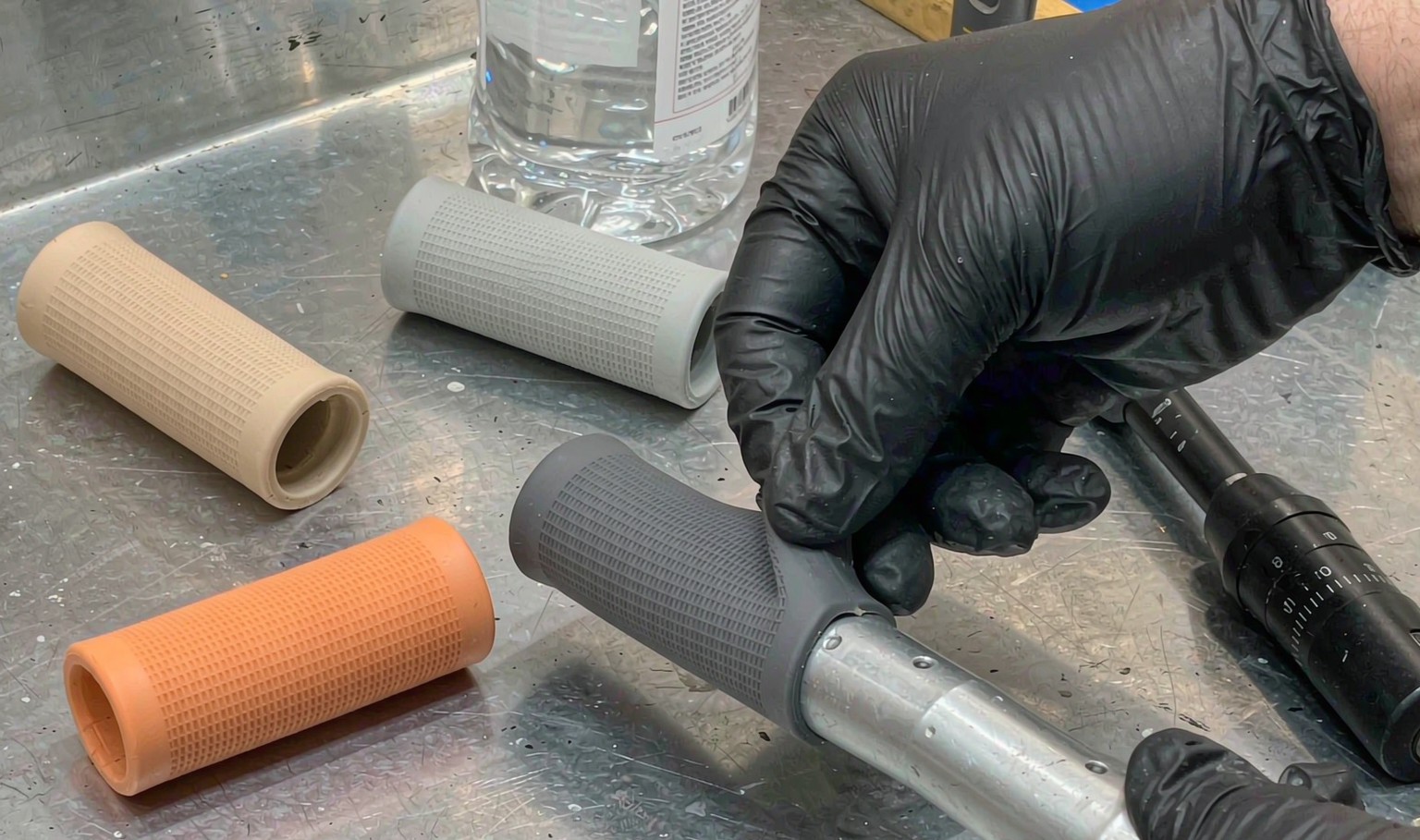
Grip is interference plus friction
A grip sleeve holds by two mechanisms and they are not independent. The sleeve is moulded with an inside diameter smaller than the substrate, so it has to stretch to go on, and the elastic recovery presses it against the substrate. That normal force, multiplied by the coefficient of friction, is the force that resists twisting and pulling off.
The interference is set by the moulded ID, and it is spent on assembly. A sleeve that is stretched 15 percent to go on has given up part of its interference, and it does not get it back completely: silicone relaxes, and a sleeve that was stretched on Monday is looser on Friday.
The friction is set by the compound and the surface. A soft silicone has a higher coefficient of friction than a hard one, a textured surface has more than a smooth one, and a wet or oily surface has far less than either. All three of those are specification choices, and the last one is the one that decides whether the product works with sweaty hands.
Stretch helps, then it hurts
Pull-off force against stretch is not monotonic. With no stretch the sleeve is a loose fit and the pull-off force is about 30 N, which is the friction of a sleeve that is not gripping at all. At 5 percent it is 46 N, at 10 percent 58 N, and at 15 percent it peaks at 64 N.
Then it falls. At 20 percent the pull-off force is 61 N, because the wall has thinned by 20 percent and the normal force per unit area has fallen faster than the interference has risen. The sleeve is stretched so thin that it behaves like a rubber band rather than a grip.
That peak at 15 percent is the design point, and it is also the practical assembly limit. A sleeve designed for 15 percent interference is a sleeve that can be fitted by hand with lubricant; one designed for 25 percent needs a press or a vacuum and will still relax out of its grip.

Softer is grippier, until it tears
Coefficient of friction against hardness is close to linear over the useful range: 1.35 at Shore A 20, 1.18 at 30, 1.02 at 40, 0.86 at 50 and 0.72 at 60. A soft silicone conforms to the substrate and to the hand, which is why it grips.
The limit is tear strength and compression set. A Shore A 20 sleeve is very grippy and it tears at the end where it is being pulled on, and it takes a permanent set after a few months under interference. Shore A 40 to 50 is the usual production compromise for a grip that has to survive being fitted and used.
The other limit is feel. A very soft sleeve feels vague in the hand because it moves on the substrate; a harder one feels positive but slippery when wet. Most handlebar and tool grips end up between 30 and 45 Shore A, and the pattern on the surface is doing more for the wet grip than the hardness is.
Assembly is where the interference is spent
The standard method is a lubricant. Water with a little detergent, or isopropyl alcohol, lets the sleeve slide on and then evaporates, and the sleeve grips. Oil or grease does not evaporate and leaves a permanently lubricated interface, which is the most common reason a sleeve rotates on its substrate.
The second method is air. A low pressure air line under the sleeve inflates it slightly and it slides on, then the air is released. It works on a long sleeve and on a substrate that cannot take a lubricant, and it needs a fixture with an air port.
The third is a vacuum or a mechanical stretcher, which is used for very high interference or a very long sleeve. All three do the same thing: they temporarily reduce the interference. The difference is what is left behind, and only the evaporating lubricant and the air leave nothing.
The fourth is nothing at all, and it is the best one if the design allows it. A sleeve with 5 to 10 percent interference can be pushed on dry with a twist, and a dry-fitted sleeve holds better than any lubricated one because the interface is clean.
| 方法 | Interference | Residue | 用途 |
|---|---|---|---|
| Dry, twisted | 5-10% | None | Short sleeve, by hand |
| Water and detergent | 10-20% | None after drying | General assembly |
| Isopropyl alcohol | 10-20% | None | Cleanroom, fast drying |
| Compressed air | 15-25% | None | Long sleeve, fixture |
| Oil or grease | Any | Permanent | Never on a grip |
Table 1 — Assembly methods and what each leaves behind
The surface does more than the compound
A smooth silicone sleeve is slippery when wet regardless of hardness. A ribbed, dimpled or knurled surface gives water somewhere to go and gives the hand an edge to push against, and the difference in wet grip is larger than the difference between Shore A 30 and Shore A 50.
The pattern also has to be mouldable. A deep undercut rib cannot be stripped from a two plate tool, so the pattern is usually a shallow rib or a dimple with draft, or the sleeve is moulded with a split tool and the parting line is placed where the hand does not sit.
The pattern has a second function: it hides wear. A smooth sleeve shows every scuff and every shiny patch, and a ribbed one looks the same for years. On a product where appearance is part of the value, that matters as much as the grip.
There is also the question of what the sleeve is gripping. A sleeve on a painted aluminium tube grips the paint, and the paint is what fails. A sleeve on a bead blasted or anodised surface grips the metal. The substrate surface is part of the grip specification and it is usually left to the tube supplier.
How a grip sleeve fails
Tearing at the end is the most common. The sleeve is pulled on by its rim, the rim is where the stress concentrates, and a Shore A 20 compound tears there before the body of the sleeve is anywhere near its limit. A rolled or thickened rim spreads the load and it is a moulding feature rather than a material one.
Rotation is the second. A sleeve that has been fitted with oil, or one that has relaxed out of its interference, rotates on the substrate under torque. It looks fine and it fails the function, and it is the failure that a pull-off test does not catch.
Staining is the third, and it is a compound question. Some silicone compounds exude a little oil that stains a light coloured substrate or a painted surface, and a plasticiser from a PVC substrate can migrate into the silicone and soften it. A migration barrier or a different compound is the fix.
UV and ozone are less of an issue for silicone than for most elastomers, but a coloured sleeve still fades. A pigment that is stable at the moulding temperature can still be attacked by the peroxides in a nearby curing process, and a bright orange sleeve that goes pink in a year was the wrong pigment.
| Failure | Symptom | 原因 |
|---|---|---|
| Tear at the rim | Split where it was pulled on | Soft compound, sharp rim |
| ローテーション | Sleeve turns under torque | Oil lubricant, relaxation |
| Staining | Substrate discolours | Compound exudate, migration |
| Fading | Colour goes pale | Pigment, UV |
| Compression set | Sleeve goes loose | Low grade compound, heat |
Table 2 — Grip sleeve failures and what causes each
How much interference should a grip sleeve have?
Ten to fifteen percent of the substrate diameter. Pull-off force peaks at 15 percent, and past that the wall thins and the grip falls away.
Why does my sleeve rotate on the handlebar?
Almost always assembly lubricant that did not evaporate, or relaxation out of the interference. Water and detergent or isopropyl alcohol leave nothing behind; oil does not.
What hardness is best for a grip?
Thirty to forty five Shore A. Softer grips harder but tears at the rim and takes a set; harder lasts longer and is slippery when wet.
Does the surface pattern matter?
More than the hardness. A ribbed or dimpled surface drains water and gives the hand an edge, and it hides scuffing that a smooth sleeve would show.
Why does my sleeve tear when fitting?
The rim is the stress concentration and a soft compound tears there. A rolled or thickened rim, and a lubricant that evaporates, are the two fixes.
Can silicone stain the substrate?
Yes. Some compounds exude a little oil, and plasticiser from a PVC substrate can migrate in and soften the sleeve. A migration barrier solves it.
A grip that rotates, tears at the rim or goes slippery when wet?
Send the substrate diameter, the wall and the assembly method. We will tell you the interference, the hardness and the pattern the grip needs.




 JA
 EN
 ES
 FR
 DE
 PT
 AR
 RU
 KO
 IT
 NL
 TR
 PL
 ID
