
Two numbers decide whether the part ships
A silicone teat, spoon or soother is judged by two measurements that sound similar and are not. Volatiles are what leaves the part as vapour when it is heated in an oven, and they are reported as a percentage of the part's own weight. Extractables are what leaves the part into a liquid that it is soaked in, and they are reported the same way.
The first is a measure of how completely the rubber was cured and how much low-molecular-weight material is still sitting in it. The second is a measure of what a baby's mouth would actually pick up, because saliva is a liquid and a teat spends its life in one. Both matter, and a part can pass one while failing the other.
This is why a silicone baby product cannot be specified by hardness and colour alone. A 40 Shore A teat from one supplier and a 40 Shore A teat from another can differ by a factor of five in volatiles, because the difference is in the post-cure, not in the compound.
Post-cure is where the volatiles go
Silicone cures by a hydrosilylation or a peroxide reaction, and neither reaction goes to completion inside the mould. What comes out of the press is a part that is dimensionally stable and structurally sound but still contains unreacted low-molecular-weight siloxane, plus the by-products of whichever cure chemistry was used.
Post-cure is a second, slower bake in an air oven, usually between 180 and 200 C for two to eight hours, sometimes in a stepped ramp. It does two things at once: it drives the residual reaction to completion, and it volatilises the short chains that would otherwise migrate out over the life of the part.
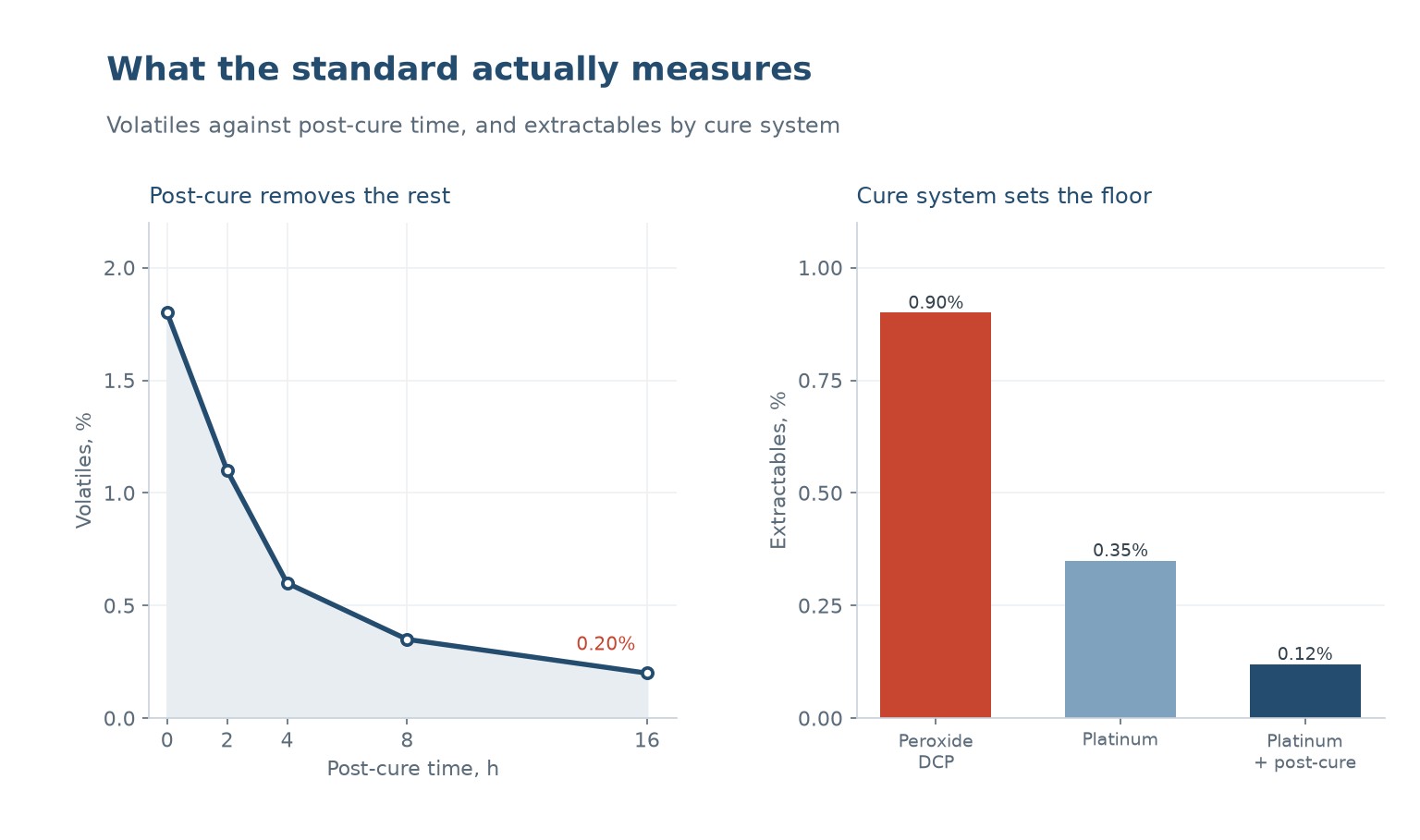
The curve is steep at the start and flat at the end. A part straight out of the press measures about 1.8 percent volatiles; two hours of post-cure takes it to 1.1; four hours to 0.6; eight hours to 0.35; sixteen hours to 0.20. The first four hours remove two thirds of the problem, and the next twelve remove the rest at a cost that is entirely oven time.
The practical consequence is that post-cure is a capacity decision, not a quality decision. An oven that holds 500 teats and runs for four hours produces a part at 0.6 percent; the same oven run for eight hours produces half as many parts at 0.35. Where the specification sits decides which of those two the plant runs.
The cure system sets a floor post-cure cannot pass
Platinum-catalysed silicone and peroxide-cured silicone behave differently under the same post-cure, because the by-products are different. A peroxide cure leaves acid residues and volatile organic fragments from the catalyst; a platinum addition cure leaves almost nothing except the excess of the crosslinker.
Measured as extractables after a standard soak, a peroxide-cured part sits around 0.90 percent, a platinum-cured part around 0.35, and a platinum-cured part that has been post-cured around 0.12. Post-cure cannot take a peroxide part below about 0.5, because the residue is chemically bound into the network rather than sitting in it as free oil.
That is the single most useful fact when a baby product fails a migration test. If the part is peroxide-cured, more oven time will not fix it and the compound has to change. If it is platinum-cured and failing, the post-cure is short or the oven is not reaching temperature.
| Cure system | Extractables | Post-cure helps | Typical use |
|---|---|---|---|
| Peroxide (DCP) | 0.90% | Limited, floor near 0.5% | Thick mouldings, low cost |
| Platinum addition | 0.35% | Yes, strongly | Teats, spoons, medical |
| Platinum + post-cure | 0.12% | Already applied | Baby contact, food contact |
| Peroxide + post-cure | 0.55% | Marginal | Not for mouth contact |
Table 1 — Extractables by cure system, before and after post-cure
Extractables are a test condition, not a material property
An extractables number means nothing without the liquid, the temperature and the time. The same teat can read 0.12 percent in water at 40 C for 24 hours and 0.8 percent in a fatty simulant at 70 C for two hours, because silicone swells in oil and releases more of what is inside it.
Baby products are usually tested against saliva simulant or against water, and food-contact products against olive oil or a fatty simulant. The two are not interchangeable, and a supplier who quotes a single extractables figure without naming the condition has quoted nothing useful.
The temperature matters more than the time in most cases, because diffusion through silicone is strongly temperature dependent. Doubling the soak time at 40 C adds less extractable than raising the temperature to 70 C for the same time. This is why a product that passes at 40 C can fail at 70.
| Simulant | Condition | What it stresses |
|---|---|---|
| Water | 40 C, 24 h | Hydrophilic residues, catalyst traces |
| Saliva simulant | 37 C, 4 h | Mouth contact, repeated use |
| Olive oil | 70 C, 2 h | Swelling, oil-soluble residues |
| Ethanol 50% | 40 C, 24 h | Alcohol-based wipes and sterilising |
| Steam | 121 C, 20 min | Autoclave cycles, repeated |
Table 2 — The same part gives different numbers in different simulants
Taste and smell come from the same place as the numbers
A complaint about a teat tasting of rubber is not a cosmetic issue; it is the same volatiles that the oven test measures, arriving at the customer's nose. The compounds responsible are short siloxane chains and peroxide fragments, and they are detectable at concentrations far below any regulatory limit.
This is why a part can be compliant and still be rejected. A volatile content of 0.6 percent passes most specifications and still leaves a noticeable odour in a sealed bag after a week. Brands that sell on sensory quality post-cure to 0.2 or below, and pay for the oven time, because the complaint rate is the thing they are actually managing.
Packaging matters here too. A part packed hot into a sealed bag traps the volatiles against the surface and they reabsorb; the same part cooled and packed in a ventilated liner does not. This is a packing instruction, not a material change, and it is free.
What to put on the drawing
A silicone baby product drawing that says only 'food grade silicone, 40 Shore A' has specified almost nothing. The useful drawing names the cure system, the post-cure cycle, the volatile limit and the extractables limit with its test condition, and it names the simulant.
It should also name the colour masterbatch, because some pigments are carried on a peroxide-compatible base and some are not, and a colour change can quietly move the part from a platinum cure to a peroxide one.
Finally, it should name what happens after moulding. If the part is printed, laser-marked or assembled, those steps can reintroduce contamination that the post-cure removed, and the sequence has to be written down.
Is platinum-cured silicone always better for baby products?
For mouth contact, yes, on extractables. It costs more per kilogram and it is more sensitive to catalyst poisons in the mould and in the pigment, so the process has to be cleaner. For a part that never touches a mouth, peroxide is usually fine.
How long should post-cure be?
Four hours gets most of the benefit and eight hours gets most of the rest. Going past eight is usually about odour and sensory quality rather than about passing a limit, and it doubles the oven time.
Can post-cure be shortened by raising the temperature?
A little. Above about 200 C the risk is that the part starts to degrade and to lose mechanical properties, and the gain in volatiles is small. A stepped ramp is more effective than a higher soak.
Does boiling a teat at home remove the volatiles?
It removes some surface residue but it does not drive the reaction to completion, because the part is not held at temperature long enough. A part that needs home boiling to be acceptable was under-cured at the factory.
Why does the same part smell different in different colours?
The pigment masterbatch is a separate compound and it can carry its own volatiles, or it can poison a platinum catalyst and leave the part under-cured. A colour change is a material change and should be re-tested.
Is there a volatile limit that applies everywhere?
No. Limits come from the customer's specification or from the market's food-contact rules, and they differ. What is consistent is that lower is better for taste and smell, and that the test condition has to be quoted with the number.
Sourcing a silicone baby product?
Send the drawing and the market you are selling into. We will tell you which cure system and which post-cure cycle the specification actually needs, and what that does to unit cost.




 JA
 EN
 ES
 FR
 DE
 PT
 AR
 RU
 KO
 IT
 NL
 TR
 PL
 ID
