
The same datasheet, two different sheets
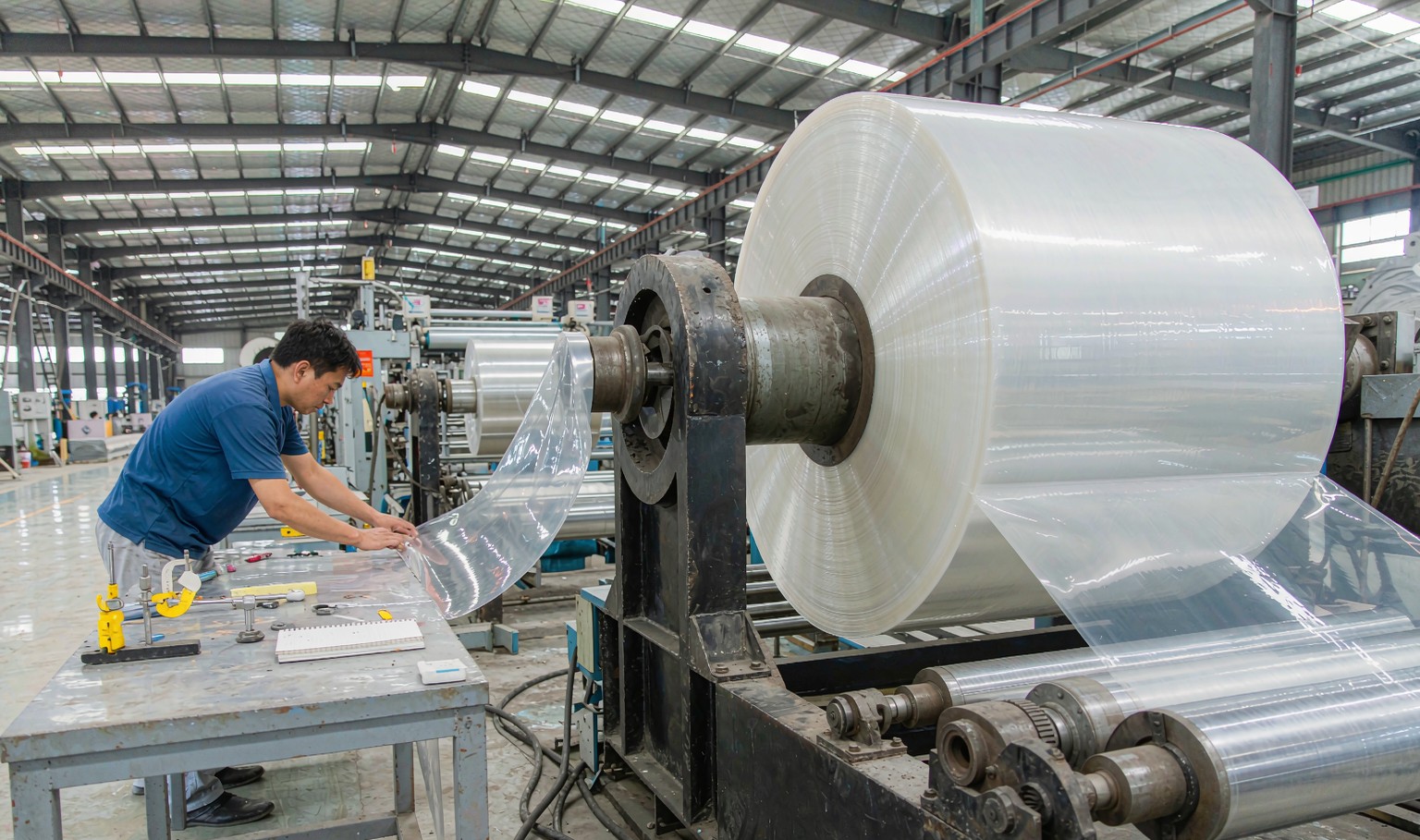
Two sheet suppliers can quote the same polymer, the same thickness and the same width, and deliver sheet that behaves completely differently in a former. One sags evenly and forms at a wide range of oven settings; the other sags in the middle, forms only in a narrow window, and produces parts with a consistent shrink that varies from roll to roll.
The datasheet describes the polymer, not the sheet. What differs is how the sheet was made: the quench rate, the draw-down ratio, the roll temperatures and the winding tension. Those set the residual stress in the sheet, and residual stress is what the former is actually fighting.
A thermoforming-grade sheet is therefore a sheet made with the forming step in mind. It is not a different polymer and it is often not a different formulation; it is the same material run so that it arrives at the oven flat, stress-relieved and predictable.
Residual stress is the thing that moves
A sheet that is quenched fast on a chill roll freezes a skin while the core is still hot. As the core cools it contracts, and because the skin is already solid, the contraction is resisted and locked in as stress. The sheet leaves the line flat enough to wind, but it is not in equilibrium.
When the former heats the sheet, the stress is released. The sheet moves, and it moves differently in different places. That is why a stressed sheet sags unevenly, why it draws to one side, and why parts from the same roll can differ.
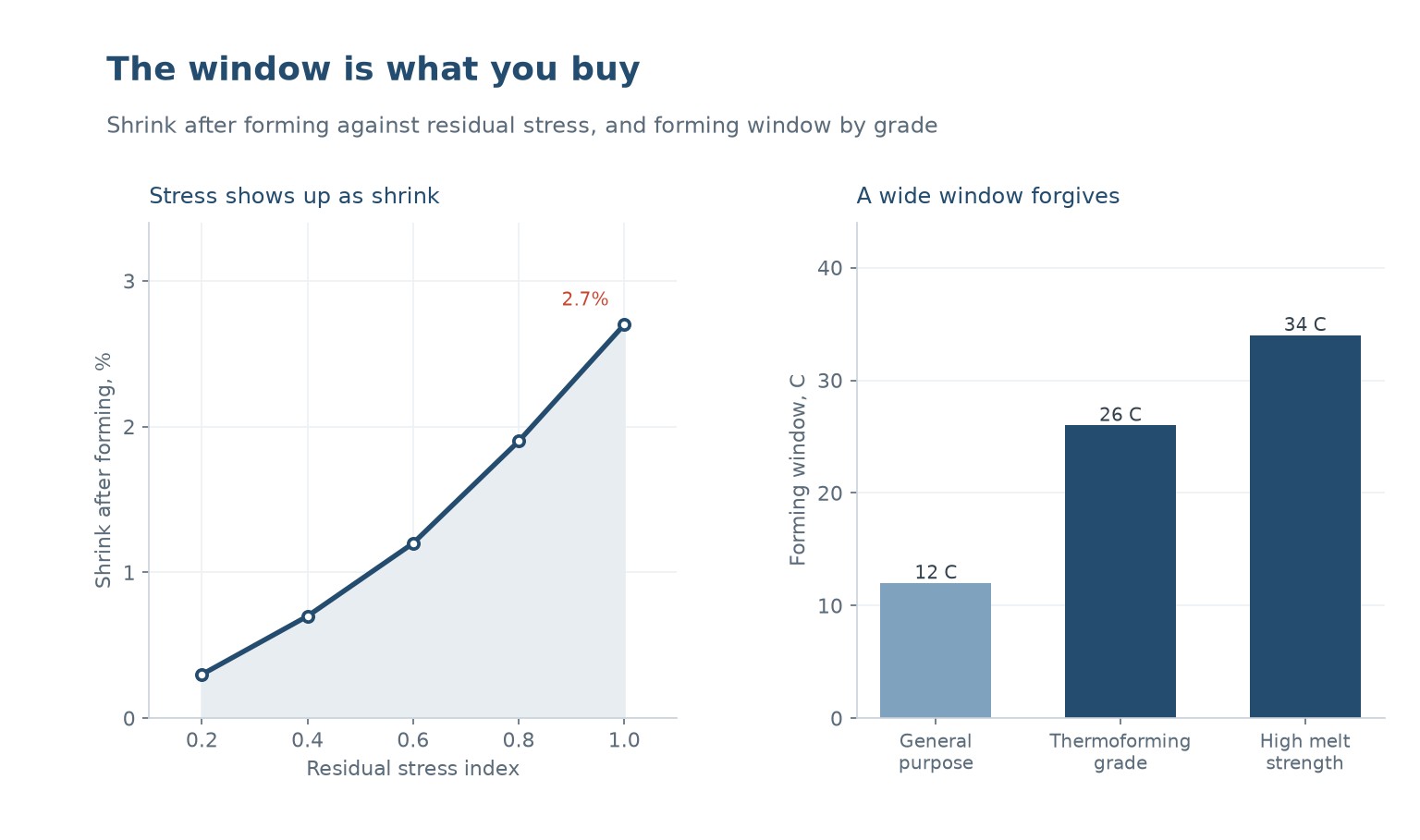
The consequence that matters commercially is shrink after forming. A sheet with a high residual stress index shrinks 2.7 percent after forming; a well-relieved sheet shrinks 0.3. The difference is not cosmetic: it changes the trim line, the fit in an assembly and the repeatability of a stacked part.
The forming window is what you are buying
The forming window is the range of sheet temperature over which a part forms acceptably. A general-purpose sheet might have a 12 C window; a thermoforming-grade sheet 26 C; a high melt strength sheet 34 C. The width of that window is the difference between a process that runs itself and a process that needs an operator watching every cycle.
Window width comes from two things: how sharply the sheet's stiffness falls with temperature, and how uniform the sheet is. A sheet with uniform stress and uniform thickness has a wide window because the whole sheet reaches the same state at the same time. A sheet with a stress gradient reaches different states in different places, and the window collapses to whatever overlap there is.
This is why the window is a better purchasing specification than any single point measurement. It describes the sheet's behaviour across the range the former will actually use, and it cannot be faked by a supplier who only controls one setting.
| Grade | Forming window | Shrink after forming | What it is for |
|---|---|---|---|
| General purpose | 12 C | 1.8-2.7% | Simple shallow parts, loose tolerance |
| Thermoforming grade | 26 C | 0.8-1.2% | Most production trays and housings |
| High melt strength | 34 C | 0.3-0.6% | Deep draws, thick sheet, heavy gauge |
Table 1 — What each grade actually delivers to the former
What the extruder has to do
Three things. First, cool the sheet slowly enough that the core has time to contract before the skin locks it, which usually means warmer rolls and a longer cooling section rather than a colder roll. Second, keep the draw-down ratio low, because stretching the sheet in the machine direction aligns the molecules and stores that alignment as stress. Third, wind at low tension, because a tightly wound roll creeps and takes a set.
All three cost output. Warmer rolls mean a longer line; a lower draw ratio means a wider die for the same thickness; low winding tension means bigger rolls and more handling. That is the honest reason thermoforming-grade sheet costs more than general-purpose sheet of the same polymer, and it is not a marketing premium.
The fourth thing is consistency. A sheet that is well relieved on Monday and stressed on Wednesday is worse than a sheet that is consistently mediocre, because the former cannot compensate for a variable it cannot see.
| パラメータ | General purpose | Thermoforming grade |
|---|---|---|
| Chill roll temperature | Cold, fast quench | Warmer, slower quench |
| Draw-down ratio | High, narrow die | Low, wider die |
| Winding tension | High, tight roll | Low, controlled |
| Line speed | Maximum | Reduced |
| Residual stress | 高い | Low and uniform |
Table 2 — The settings that differ, and what they cost
How to specify it
Specify shrink after forming, not residual stress, because shrink is what the former can measure. A sample formed at a defined temperature and draw, measured before and after, gives a number that both sides can agree on.
Specify the forming window as a range, and define how it is measured. A window quoted without a method is a number that will be argued about at the first failure.
Specify thickness and width tolerance together with the stress requirement, because a supplier can meet the stress target by making the sheet thick and slow, and that is not what was wanted.
When the sheet is blamed and is not at fault
The most common misdiagnosis is blaming the sheet for an oven problem. An oven with uneven zones heats one part of the sheet faster, and the resulting uneven sag looks exactly like a stress problem. The test is to rotate the sheet 90 degrees in the oven: if the sag pattern rotates with the sheet, it is the sheet; if it stays with the oven, it is the oven.
The second is blaming the sheet for a tool problem. A tool with uneven venting or a cold spot draws the sheet towards it, and the resulting thin patch looks like a material variation. Sectioning a part and measuring wall thickness distribution separates the two quickly.
The third is a genuine sheet problem that only appears at the end of the roll. Winding tension increases towards the core, so the last few metres are more stressed than the first. A former who samples from the outside of the roll and forms from the inside will see a difference that is real and is caused by winding, not by the extrusion.
Can general-purpose sheet be stress-relieved before forming?
Partly, by annealing it in an oven before forming. It works on thin sheet and it costs an extra handling step, and it does not fix a sheet that is stressed unevenly, because annealing releases the stress but does not make it uniform.
Why does shrink vary from roll to roll?
Because the extrusion conditions varied. A roll made at a different line speed, a different roll temperature or a different winding tension has a different stress state. That is the argument for a specification on shrink rather than on the polymer.
Does thickness affect the forming window?
Yes, strongly. A thick sheet holds heat longer and sags more slowly, which widens the practical window. A thin sheet loses heat to the tool quickly and the window narrows, which is why the same grade performs differently at 0.5 mm and 2 mm.
How is shrink after forming measured?
Mark a known distance on a flat sample, form it at a defined temperature, let it cool and measure the marked distance again. The change divided by the original is the shrink. The method matters more than the number, so it has to be written down.
Can a former compensate for shrink?
For a constant shrink, yes, by scaling the tool. For a variable shrink, no, and that is the difference between a sheet that is merely different and a sheet that is unusable. Compensation only works when the number is stable.
Is high melt strength sheet always better?
No. It has a wider window and better sag resistance, which is what a deep draw needs, but it is harder to trim and it costs more. For a shallow tray it buys nothing.
Sheet that forms differently every roll?
Send the forming temperature, the draw depth and the shrink you are seeing. We will tell you whether the sheet or the process is setting the variation.
Continue reading
- Sheet Surface Gloss: Chill Roll Temperature and the Matte That Drifts
- Sheet Thickness Control: Die Bolt, Gauge and the Cross-Profile Nobody Measures
- Thermoforming Sheet Sag Control: Heat, Gravity and the Window
- PP Sheet Extrusion: Cooling, Shrink and the Roll Stack
- Custom Plastic Extrusion: Profiles, Sheet and Tube




 JA
 EN
 ES
 FR
 DE
 PT
 AR
 RU
 KO
 IT
 NL
 TR
 PL
 ID
