
A colour is a spectrum, not a number
Every colour approval is really an approval of three numbers: L, a and b, computed by integrating a reflectance spectrum against an illuminant and a standard observer. The numbers are a summary. The spectrum is the object. And a summary loses exactly the information that decides whether two surfaces look the same under a light source neither of them was measured under.
This is metamerism, and it is not an error in the measurement. Two physically different spectra can produce identical L, a and b under daylight and visibly different colours under the warm, spiky spectrum of an incandescent lamp or a cheap LED. Nothing is wrong with the instrument. The instrument was asked a question that has more than one right answer.
The practical consequence is that a Delta E number without an illuminant is not a specification. It is a number that happens to be true in one room.
| Delta E | Who notices | What usually happens |
|---|---|---|
| Below 0.5 | Nobody, including a trained colourist | Approved without discussion |
| 0.5 to 1.0 | A trained eye, side by side, under good light | Approved, with a note |
| 1.0 to 2.0 | Most people, side by side | Approved if the parts never meet |
| 2.0 to 3.0 | Anyone, without a reference | Complaint, then a concession |
| Above 3.0 | Anyone, at a glance | Rejection, and a sorting cost |
Table 1 — Delta E bands and what each one costs commercially
Why two percent of dose costs a whole Delta E
Colorant is a small fraction of an extruded compound, typically 2 to 4 percent as masterbatch, and often under 1 percent of actual pigment. That smallness is what makes the colour so sensitive: the error that matters is the error relative to the colorant, not relative to the compound. A gravimetric feeder holding plus or minus 2 percent of a 3 percent let-down is holding plus or minus 0.06 percent of the part, and that is enough to move Delta E by about 0.9.
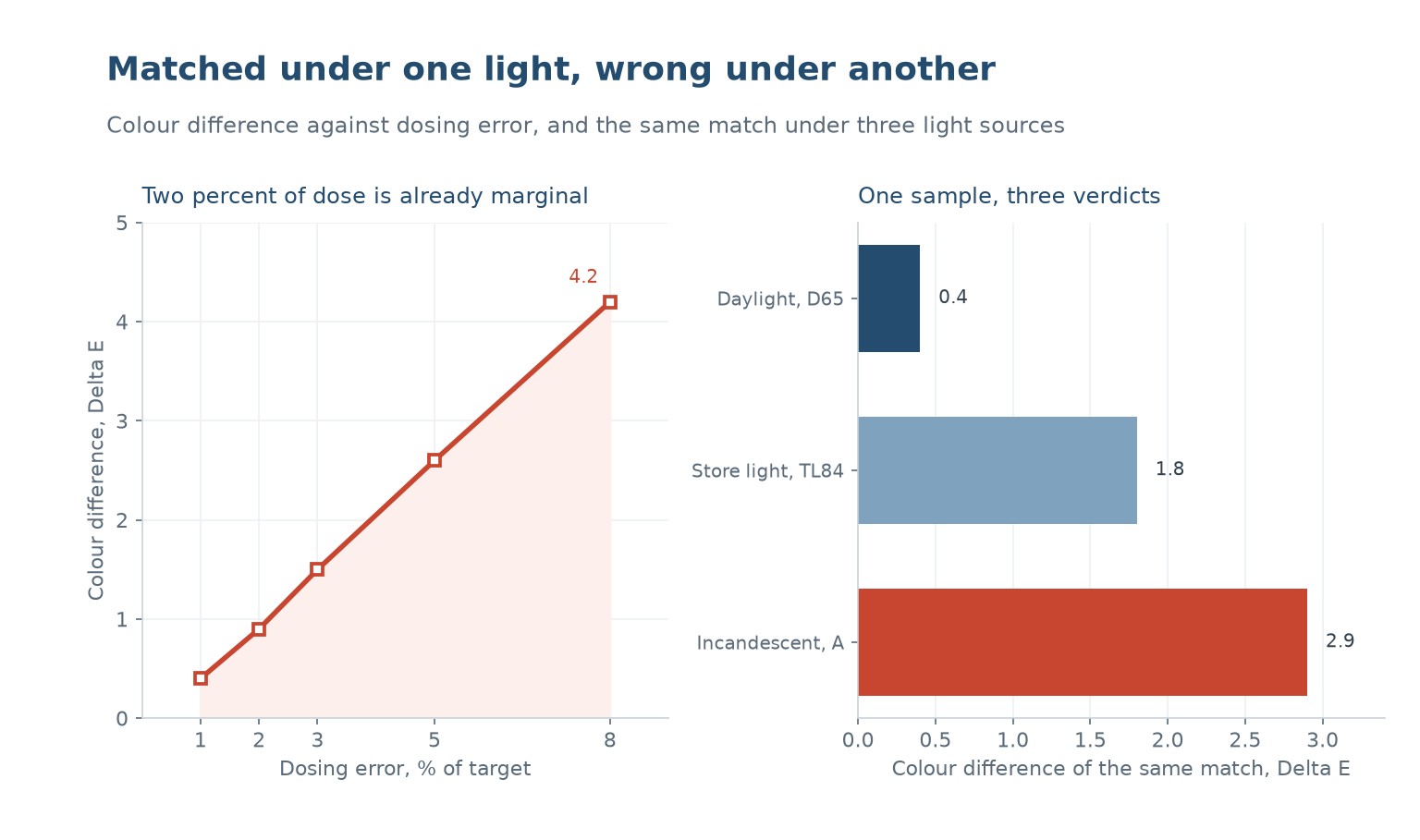
The measured relationship is close to linear but slightly steeper: 1 percent of dosing error gives 0.4 Delta E, 2 percent gives 0.9, 3 percent gives 1.5, 5 percent gives 2.6 and 8 percent gives 4.2. The steepness is why a feeder that is good enough for an additive is not good enough for a colour.
There is a second reason the first metres of a run are the wrong colour. The barrel, the screw and the die are cold at start-up, so the melt viscosity is high, the shear history is different and the colorant disperses differently. The colour drifts for the first 150 to 300 kg and then settles. A first-article sample pulled at 20 kg is measuring the machine warming up, not the process.
Regrind closes the loop in the wrong direction. Regrind already contains colorant, so a fixed let-down ratio over-doses it. A line running 20 percent regrind with an unchanged masterbatch setting will drift lighter or darker depending on whether the regrind was coloured to the same target, and it will do so slowly enough that nobody connects the two.
Metamerism is decided at the colour house, not on the line
A match built from three pigments is almost always metameric. Three reflectance curves can be bent to hit one set of tristimulus values, but there is not enough freedom left to also match the shape of the curve, and the shape is what survives a change of illuminant. A match built from five or six pigments has enough freedom to approximate the curve, and it holds across light sources.
That is the trade the colour house is making when it quotes. A cheap three-pigment match passes the booth and fails in the field. A spectral match costs more per kilogram, sometimes 15 to 30 percent more, and passes both. If the profile is going into a shop, a kitchen or a vehicle interior, the spectral match is the cheaper option once one rejection is priced in.
The way to buy it is to specify the illuminants, not just the Delta E. Ask for the match to hold under D65, TL84 and illuminant A, with a Delta E limit under each. A supplier who can only quote one number is telling you which one they measured.
| Lever | What it changes | コスト | When to use it |
|---|---|---|---|
| More pigments in the match | Spectral shape, so metamerism | 15 to 30 percent on colorant | Any part seen under mixed light |
| Tighter dosing tolerance | Batch-to-batch Delta E | Gravimetric feeder | Every coloured profile |
| Gloss control | Perceived lightness | Calibrator polish, die temperature | Visible faces, matte and gloss in one order |
| Wall thickness control | Apparent depth of colour | Die and haul-off stability | Translucent or thin-wall profiles |
Table 2 — The four levers that decide whether a colour holds, and what each one costs
The surface changes the colour before the pigment does
A profile is not a flat chip, and the geometry reads as colour. The same compound at the same Delta E will look lighter on a 1.2 mm wall than on a 2.5 mm wall if the material is even slightly translucent, because more light passes through and returns from behind. On a hollow profile with a visible rib, the rib reads darker than the face beside it for exactly this reason, and no amount of colorant will make them match.
Gloss does the same thing through a different mechanism. Five gloss units of difference reads as roughly 0.5 to 1.0 Delta E to a trained observer, and it is the most common cause of a part that measures correct and looks wrong. A die that is polished on one face and left as-machined on the other will produce a profile that is one colour and two appearances.
Texture adds a third. An embossed or hairline surface scatters light before it reaches the eye, which lowers perceived lightness and desaturates the colour. Two parts from the same compound, one smooth and one textured, will not match, and the difference is larger than most people expect: a deep texture can read a full Delta E unit darker.
This is why boundary samples beat numbers for a visible profile. A physical sample carries the geometry, the gloss and the texture that the number cannot, and it is the only artefact that answers the question the customer is actually asking.
What actually holds a colour in production
Four controls do almost all of the work, and none of them is a spectrophotometer on its own.
- Weigh the let-down, do not trust the setting. A 200 g shot of compound checked against the masterbatch ratio once per shift catches a feeder that has drifted before the parts do.
- Pull the first article after the machine is warm, not after the first box. On most lines that means 150 to 300 kg in, or a 30 minute delay, whichever comes first.
- Keep a boundary sample in the dark. Colour chips fade, and a faded standard quietly moves the whole process.
- Log the masterbatch lot. When a colour shifts without a setting change, the lot is the first thing to check and the last thing anyone checks.
The spectrophotometer is a confirmation tool, not a control. It tells you that you have drifted; it does not tell you where. The drift is almost always in the dose, the lot, the temperature or the regrind, and each of those leaves a different signature: a dose drift moves lightness and saturation together, a lot change moves hue, a temperature drift moves gloss and lightness, and regrind moves saturation alone.
What to specify on the drawing
A colour specification that can be enforced has five parts, and a drawing that carries only a Delta E has one.
- The target in L, a, b with the illuminant and observer stated.
- A Delta E limit per illuminant, not one overall limit.
- The gloss level and its tolerance on the visible face.
- The surface finish, named, with a boundary sample as the reference.
- The wall section the colour is judged on, if the profile has more than one.
Add the acceptance light. If the customer will look at the part in a shop, agree to judge it in a shop, or at least under a source with a similar spectrum. Judging a retail profile under D65 and shipping it into tungsten light is a rejection that was designed in at the sample stage.
Why does my profile match in the booth and fail at the customer?
Metamerism. The match was built from too few pigments to reproduce the spectral curve, so it hits the target under one illuminant and misses under another. The fix is a spectral match, not a tighter Delta E.
What Delta E should I specify for an extruded profile?
Under 1.0 for parts that will be seen side by side, under 2.0 for parts that never meet. Anything above 3.0 is visible to an untrained eye at a glance.
How much dosing error is acceptable?
About 1 percent of the colorant dose, which is roughly 0.4 Delta E. Two percent is already at the visible threshold for a trained observer.
Why is the colour wrong at the start of a run?
The barrel, screw and die are cold, so viscosity, shear and dispersion differ. Colour settles after 150 to 300 kg on most lines.
Does regrind change the colour?
Yes, because it already carries colorant. A fixed let-down ratio over-doses it, and the drift is slow enough to be missed.
Can gloss difference be read as a colour difference?
Yes. Five gloss units reads as about 0.5 to 1.0 Delta E, and it is the most common cause of a part that measures correct and looks wrong.
A colour that has to survive three light sources?
Send the target, the illuminants the part will be seen under, and the wall sections involved. We will tell you whether the match needs a fourth pigment or a better feeder.




 JA
 EN
 ES
 FR
 DE
 PT
 AR
 RU
 KO
 IT
 NL
 TR
 PL
 ID
