The problem
Symptom. A retail packer rejects clear APET trays because a new sheet lot reads 7.8 % haze instead of the usual 2.1 %, and the printed label shows a grey cast under the goods-in light booth.
What it costs. A 60 000-tray order is quarantined for a clarity the sheet certificate never mentioned, and the converter and sheet supplier argue over how much regrind the lot actually contained.
This guide shows how to measure haze against regrind level, set a ceiling, and write a regrind cap and haze limit into the sheet purchase order.
- 1. Haze is a regrind fault, not a forming-temperature fault
- 2. Measure haze at four regrind levels before changing the oven
- 3. Regrind percentage, IV and melt filtration to specify
- 4. Variables that raise haze after a lot or dryer change
- 5. A haze ceiling and regrind cap for the sheet order
- 6. Costing a capped regrind against a quarantined tray order
Haze is a regrind fault, not a forming-temperature fault
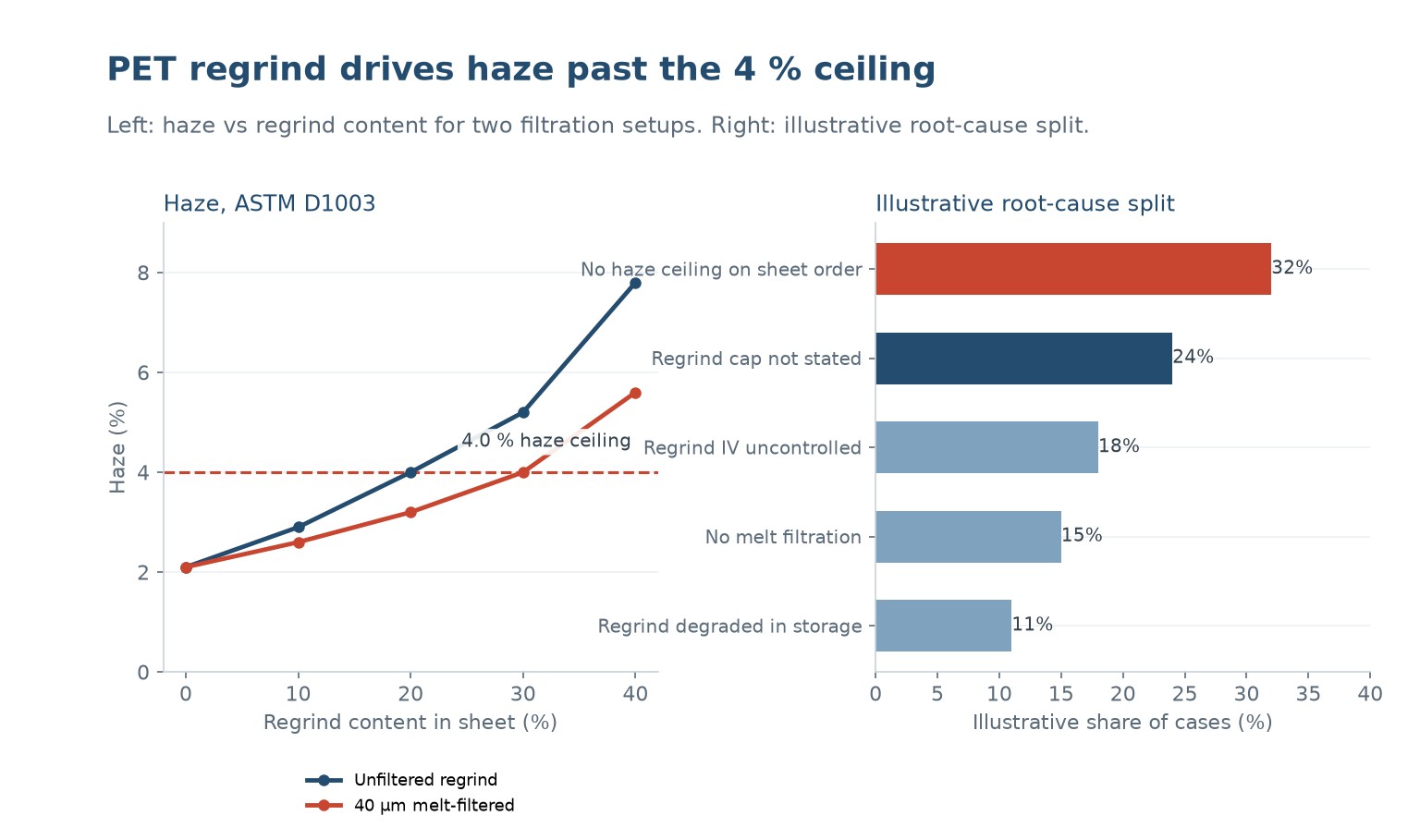
Regrind carries degraded polymer, gels and black specks that scatter light. On 0.6 mm APET, haze by ASTM D1003 rises from 2.1 % at 0 % regrind to 3.4 % at 15 %, 5.2 % at 30 % and 7.8 % at 40 %.
| What goods-in sees | What is physically happening | First measurement |
|---|---|---|
| A grey cast behind the label | Gels and specks scatter light through the base | Haze by ASTM D1003 on flat sheet |
| Only some trays look cloudy | Regrind unevenly blended across the lot | Haze at five points across the sheet width |
| Good one lot, bad the next | Regrind percentage changed without notice | Regrind content declared on the lot certificate |
| Yellowing after storage | Regrind degraded by heat or daylight | IV and colour of the incoming regrind |
Table 1 - Classifying a clarity fault before changing the former
Measure haze at four regrind levels before changing the oven
Read haze on a flat sheet sample with a hazemeter, then section a formed tray. Interpolating between 15 % and 30 % regrind, a 4.0 % haze ceiling corresponds to 3.4 + 5/15 × 1.8 = 4.0 % at 20 % regrind.
A five-step diagnostic sequence
- Sample the sheet.
Take flat sheet from the start, middle and end of the incoming reel. - Measure haze.
Read ASTM D1003 haze at five points across the width with a hazemeter. - Check the regrind.
Record regrind percentage and IV from the lot certificate. - Form and compare.
Thermoform 30 trays and inspect the label zone under D65 light. - Qualify three lots.
Repeat across three sheet lots and attach the haze record to first-off.
The chart below is a typical result from that measurement step. Use it to separate a design limit from a setting that can still be recovered.
Regrind percentage, IV and melt filtration to specify
Three numbers protect clarity: a haze ceiling of 4.0 % by ASTM D1003, a regrind cap of 20 %, and regrind IV held above 0.70 dL/g with 40 µm melt filtration. A 40 % lot at 7.8 % haze fails all three.
| パラメータ | Typical target | What goes wrong outside it |
|---|---|---|
| Haze, ASTM D1003, 0.6 mm sheet | ≤ 4.0 % | A 7.8 % lot greys the label zone |
| Regrind in the sheet | ≤ 20 % | 40 % regrind reads 7.8 % haze |
| Regrind intrinsic viscosity | ≥ 0.70 dL/g | Degraded regrind scatters light and yellows |
| Melt filtration | 40 µm screen | A 60 µm screen lets gels through |
Table 2 - Clarity parameters to write on the sheet purchase order
Variables that raise haze after a lot or dryer change
Haze climbs again as the lot is handled. A dryer running 10 °C hot degrades regrind further, a 60 µm screen lets gels through, and a regrind drum stored in daylight adds yellowing that the hazemeter catches as scattered light.
| Process variable | Effect on haze | Practical control |
|---|---|---|
| Regrind raised from 20 % to 40 % | Haze climbs from 4.0 % to 7.8 % | Cap regrind at 20 % on the sheet order |
| Dryer 10 °C too hot | Regrind degrades and yellows | Log dryer temperature per shift |
| Screen changed to 60 µm | Gels pass into the sheet | Hold 40 µm melt filtration |
| Regrind IV below 0.70 dL/g | Degraded polymer scatters more light | Require an IV value per regrind lot |
Table 3 - Variables that raise haze after sign-off
A haze ceiling and regrind cap for the sheet order
A clarity complaint needs a number, not an opinion. Add a clause: haze ≤ 4.0 % by ASTM D1003 on 0.6 mm sheet, regrind ≤ 20 %, verified on 30 trays from three sheet lots under D65 light.
Want the tray checked against your line?
Send us the tray drawing and the line conditions. We will flag the geometry and material choices that cause jams, and quote a tool with an acceptance test.
What to send us
- Tray drawing with draft and radii
- Sheet grade and gauge
- Stack depth and line speed
- Drawings of the magazine or denester
Costing a capped regrind against a quarantined tray order
Capping regrind at 20 % and specifying 40 µm filtration add roughly 2-3 p per tray but remove the 7.8 % haze lot. One quarantined 60 000-tray order costs more than the resin premium across the whole contract.
Before you sign off this thermoformed tool
- A haze ceiling ≤ 4.0 % by ASTM D1003 is stated on the sheet order
- A regrind cap of 20 % is written into the material specification
- Regrind IV ≥ 0.70 dL/g and 40 µm melt filtration are specified
- Haze is measured on flat sheet and on formed trays under D65 light
- The clarity test covers three sheet lots, not a single first-off reel
A tray that looks right in the carton can still stop a filling line. Test the stack, not a single part.
Why did clarity change with a new sheet lot?
Regrind level is the usual cause. On 0.6 mm APET haze rises from 2.1 % at 0 % regrind to 7.8 % at 40 %. A lot blended to 40 % without notice will grey the label zone even if gauge is correct.
Where does the 20 % cap come from?
It is the regrind level where a 4.0 % haze ceiling is met. Interpolating the measured 3.4 % at 15 % and 5.2 % at 30 % gives 3.4 + 5/15 × 1.8 = 4.0 % at 20 % regrind.
Can a hotter oven clear the haze?
No. Haze is scattered light from gels and degraded polymer in the sheet, not a forming mark. More heat can yellow the PET further. Cap the regrind and specify melt filtration instead.
Is melt filtration worth specifying?
Yes. A 40 µm screen holds back the gels that a 60 µm screen passes, and pairs with the regrind cap. It is cheaper than quarantining a 60 000-tray order for a grey cast.
Does regrind IV matter?
It tracks degradation. Below 0.70 dL/g the polymer has been heat-worked, scatters more light and yellows. Ask for an IV value on every regrind lot and re-qualify haze when it drops.
What should the clarity clause say?
Haze ≤ 4.0 % by ASTM D1003 on 0.6 mm sheet, regrind ≤ 20 %, IV ≥ 0.70 dL/g and 40 µm filtration, verified on 30 trays from three sheet lots under D65 light.
Get a tray that runs on your filling line
Send us the tray drawing or a sample stack. We will review draft, trim and material, then quote a production tool with a measurable line-acceptance test written into it.
To get an accurate quote, send:
- Tray drawing or sample stack
- Sheet material and gauge
- Line speed and denesting method
- Annual volume and target unit price





 JA
 EN
 ES
 FR
 DE
 PT
 AR
 RU
 KO
 IT
 NL
 TR
 PL
 ID