
One variable, two properties
Mould temperature is the least discussed and most consequential setting on an injection moulding machine. It sets the cooling rate, and the cooling rate sets how much the polymer crystallises, how much it shrinks, how glossy the surface is, and how much stress is frozen into the part.
The problem is that it cannot be optimised for one property without affecting the others. A hot mould gives a glossy part with high shrinkage and low stress; a cold mould gives a matte part with low shrinkage and high stress. A part that needs both gloss and dimensional accuracy is asking for two things the same variable cannot deliver.
That is why mould temperature is a specification rather than a machine setting. It should be on the drawing, in a range, with the reason: gloss, shrinkage, weld line strength or cycle time.
Shrinkage follows mould temperature
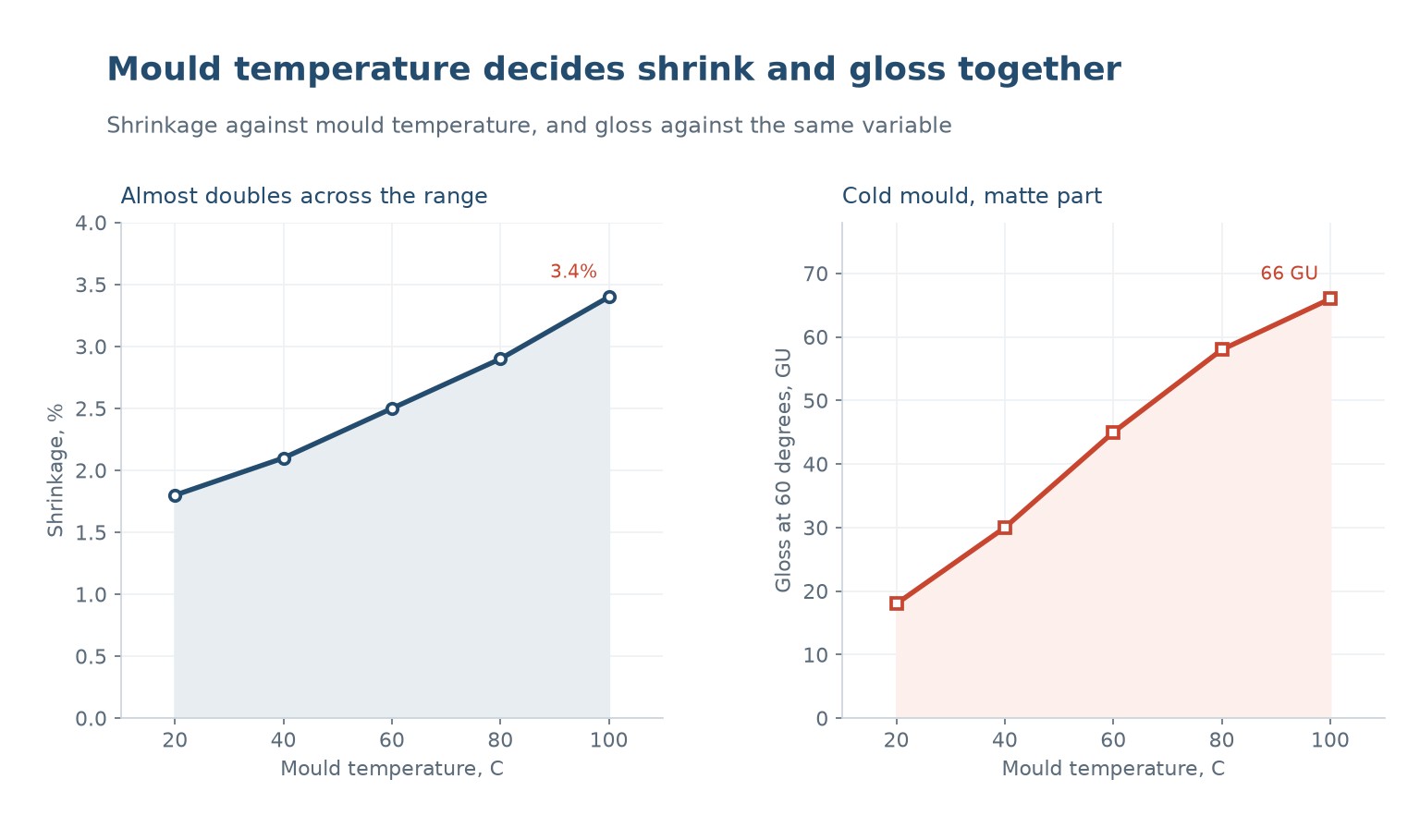
On polypropylene, shrinkage goes from 1.8 percent at a 20 C mould to 2.1 at 40, 2.5 at 60, 2.9 at 80 and 3.4 at 100. It nearly doubles across the range, which on a 200 mm part is 3.2 mm of difference in a dimension that the customer will measure.
The mechanism is crystallisation. A hot mould lets the polymer crystallise more completely before it is frozen, and the crystalline phase is denser than the amorphous one, so the part shrinks more. A cold mould freezes the structure before crystallisation is complete, so the part shrinks less and holds more frozen stress.
This is why a mould temperature change is never a local change. Raising it to fix a gloss problem changes every dimension on the part, and the tool's shrink allowance, which was calculated for one temperature, is now wrong. That is the trap: the gloss improves, the part looks better, and the assembly no longer fits.
| Mould temperature | 収縮 | Gloss | Trade |
|---|---|---|---|
| 20 C | 1.8 percent | 18 GU | Tight dimensions, matte, high stress |
| 40 C | 2.1 percent | 30 GU | Balanced for technical parts |
| 60 C | 2.5 percent | 45 GU | General purpose |
| 80 C | 2.9 percent | 58 GU | Cosmetic parts |
| 100 C | 3.4 percent | 66 GU | High gloss, long cycle |
Table 1 — Shrinkage and gloss against mould temperature on polypropylene.
Gloss is a mould temperature effect
Gloss comes from how faithfully the melt replicates the mould surface. A hot melt in contact with a hot mould stays fluid long enough to flow into the surface texture and to relax the skin, so the part comes out glossy. A cold mould freezes the skin on contact, and the skin records the flow and the texture rather than the mould's polish.
The gloss curve is 18 units at 20 C, 30 at 40, 45 at 60, 58 at 80 and 66 at 100. The steepest part is between 20 and 60, which is the range where most moulds run, and it means that a 10 C error in mould temperature is visible on a gloss part.
This is why a gloss specification has to come with a mould temperature tolerance. A part specified at 45 units and produced anywhere between 40 and 100 C is a part with no gloss specification at all, because the process can deliver anything in that range.
Cavity and core are different circuits
A mould has two temperature circuits, one for the cavity and one for the core, and they are set independently. The cavity sets the visible surface, so it is set for gloss; the core sets the cooling rate through the wall, so it is set for cycle time and warp.
A common arrangement is a hot cavity and a colder core, which gives a glossy visible face and a shorter cycle. The differential also controls warp: the part shrinks towards the hotter side, so a hot cavity bends the part towards the cavity, and that can be used to counteract a warp caused by the geometry.
| Symptom | Reading | 原因 |
|---|---|---|
| Setpoint 60 C, return 48 C | 12 C drop | Flow too low, circuit restricted |
| Return 60 C, gloss gradient | Balanced but uneven | Circuit layout, not flow |
| High pressure drop | Over 2 bar per circuit | Baffle, coupling or scale |
| Cavity and core differ by 20 C | By design | Intentional for gloss and warp |
Table 2 — Reading the return temperatures, which is the cheapest mould diagnostic.
The two circuits should be balanced in flow, not in setpoint. A circuit with a long path and a small diameter will not deliver the setpoint at the far end, so the mould has a temperature gradient that shows up as a gloss gradient across the part. Measuring the return water temperature on each circuit is the cheapest diagnostic in a moulding shop.
Turbulence and flow rate
Water carries heat efficiently only when the flow is turbulent. In a laminar flow the water in the middle of the channel travels faster than the water at the wall, and the wall layer insulates the rest. The practical rule is a Reynolds number above 4,000, which for a 10 mm channel means a flow of about 12 litres a minute.
Most moulds are under-supplied rather than under-set. A 10 mm circuit fed at 4 litres a minute is laminar, and its effective heat transfer is half what the temperature difference suggests. Raising the flow rate to 12 litres a minute often does more for cycle time than lowering the setpoint by 10 C.
The pressure drop tells you whether the flow is there. A circuit that needs 3 bar to pass 4 litres a minute is restricted, and the restriction is usually a baffle, a quick-fit coupling or a corroded channel. A mould that has been in service for years will have all three.
Setting a mould temperature that repeats
A repeatable mould temperature needs four things: a controller that holds within a degree, a flow rate that is turbulent in every circuit, a manifold that balances the circuits, and a measurement of the return temperature on each one.
- Calculate the flow needed for turbulence in the smallest channel in the mould.
- Measure the return temperature on each circuit at that flow and adjust the balance valves.
- Set the cavity circuit for gloss and the core circuit for cycle and warp.
- Record the return temperatures, not the setpoints, on the setup sheet.
- Recheck after any tool maintenance, because a cleaned channel flows differently.
The return temperature is the number that transfers between machines. A setpoint of 60 C means different things on two machines with different pumps and different plumbing, but a return temperature of 58 C means the same thing on both.
How does mould temperature affect shrinkage?
Directly. On polypropylene, shrinkage goes from 1.8 percent at 20 C to 3.4 percent at 100 C, because a hot mould allows more crystallisation before the part freezes.
Why does mould temperature affect gloss?
A hot mould lets the melt replicate the surface and relax the skin, so the part is glossy. A cold mould freezes the skin on contact and the surface records the flow instead.
Should the cavity and core be at the same temperature?
Not necessarily. A hot cavity and a colder core give a glossy face and a shorter cycle, and the differential can be used to counteract warp.
How much water flow does a mould need?
Enough for turbulent flow, which is a Reynolds number above 4,000. For a 10 mm channel that is about 12 litres a minute, and most moulds run at a third of that.
Why is the return temperature more useful than the setpoint?
Because it is what the mould actually sees. A mould set to 60 C and returning at 48 C is running at 48 C, and the setpoint says nothing about the flow or the balance.
Can a mould temperature change fix a warp?
It can shift it. The part shrinks towards the hotter side, so a temperature differential between cavity and core bends the part, and that can offset a geometric warp.
Gloss or dimensions drifting between shifts?
Send the part drawing, the mould layout and the current setpoints. We will check whether the circuits can deliver the temperature the gloss needs, and what that does to shrinkage.




 JA
 EN
 ES
 FR
 DE
 PT
 AR
 RU
 KO
 IT
 NL
 TR
 PL
 ID
