The problem
Symptom. An RFQ reaches a moulder with the resin left as TBC, so the cavity is sized on an assumed shrink range that may not match the grade finally ordered.
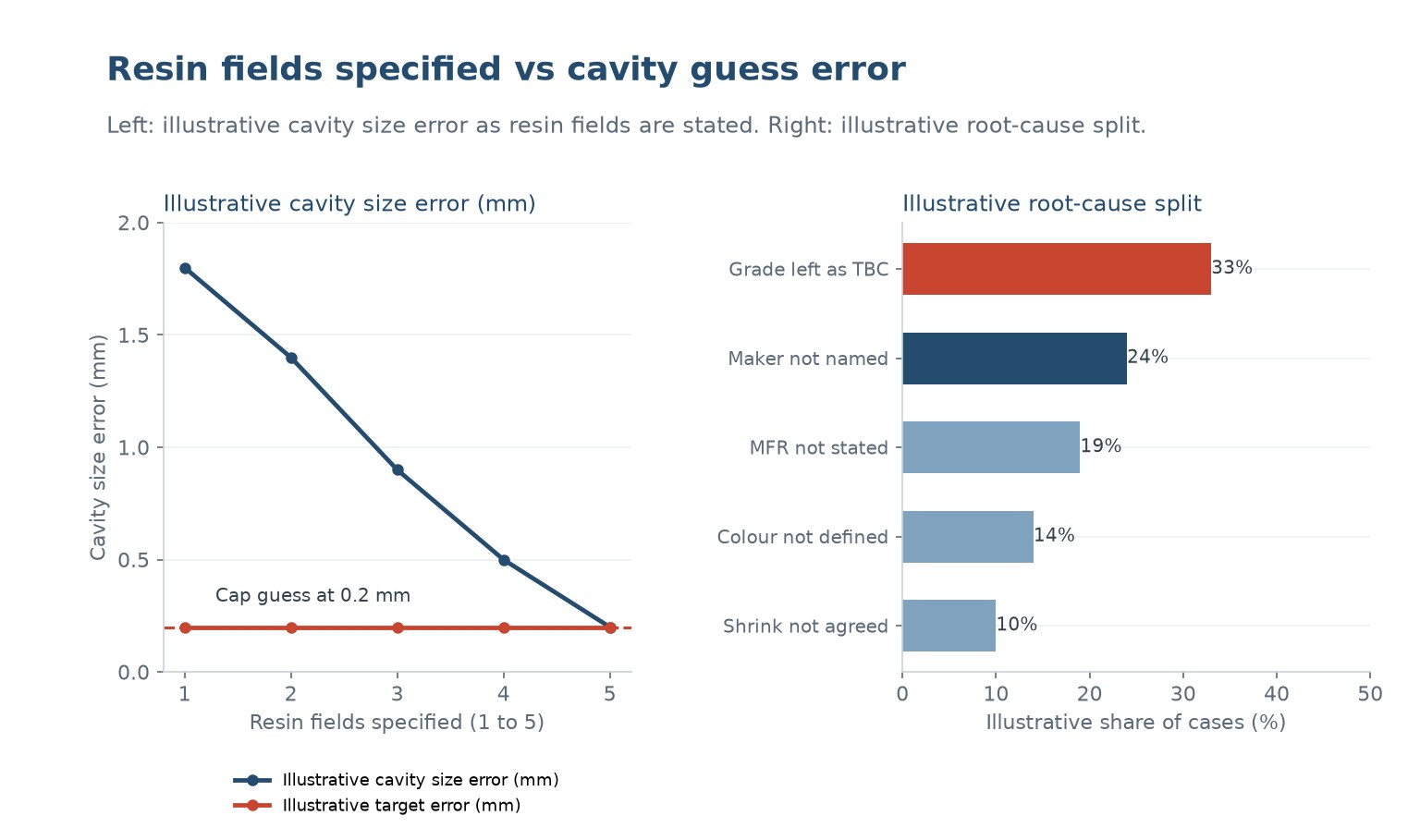
What it costs. Assuming the wrong shrink range sizes a 100 mm cavity at 101.8 mm instead of 100.6 mm, an illustrative 1.2 mm error that only appears at first article.
This article ties the resin grade, maker, MFR and colour to the shrink allowance, and writes the resin clause into the RFQ and specification.
Which resin fields the RFQ leaves as TBC
In one illustrative RFQ a 100 mm housing is requested with the resin marked TBC. The moulder must guess a shrink allowance, and the two likely candidates behave quite differently: an ABS grade at an assumed 0.5 to 0.7 per cent shrink and a PP grade at 1.5 to 2.0 per cent.
| Resin field left open | What it shifts | First figure to check |
|---|---|---|
| Grade and maker | Shrink allowance | Agreed shrink range |
| Melt-flow rate | Cycle and fill | MFR on the datasheet |
| Colour and additive | Appearance and shrink | Filler or UV package |
| Regrind limit | Batch-to-batch drift | Stated regrind percentage |
Table 1 - Reading an incomplete resin clause before cutting steel
Need a fixed price for this moulded part?
Send the 2D drawing, resin grade and annual volume. Our engineers return a DFM review, a material recommendation and a written quotation you can compare line by line.
Size the cavity from the agreed shrink range
Size the cavity from the stated range. At 100 mm nominal, a 0.6 per cent ABS shrink gives a 100.6 mm cavity while a 1.8 per cent PP shrink gives 101.8 mm, an illustrative 1.2 mm difference. These are illustrative worked values from stated assumptions, not a market survey, a quoted price or a measured series.
A five-step diagnostic sequence
- Name the grade and maker.
State the exact resin grade and its manufacturer on the RFQ, not a generic family. - State MFR and colour.
Give the melt-flow rate, colour and any filler, UV or flame-retardant additive. - Agree the shrink range.
Confirm the shrink allowance with the supplier before the cavity is sized. - Compute the cavity.
Size a 100 mm nominal cavity to 100.6 mm for the chosen 0.6 per cent ABS shrink. - Write it into the spec.
Record the grade, MFR, colour, regrind limit and shrink value in the specification.
The chart below is a typical result from that measurement step. Use it to separate a design limit from a setting that can still be recovered.
Name grade, maker, MFR and colour
Name the fields that fix the number. Stating the grade, maker, melt-flow rate, colour and any filler or UV additive removes the guess, so the tool is cut once to 100.6 mm for the chosen ABS. These are illustrative worked values from stated assumptions, not a market survey, a quoted price or a measured series. Write the resin clause into the RFQ and specification.
| Clause or parameter | Agreed value | What goes wrong outside it |
|---|---|---|
| Resin grade and maker | Named exactly | Wrong shrink assumed |
| Melt-flow rate | Stated on the RFQ | Fill and cycle drift |
| Colour and additives | Named with regrind limit | Appearance varies |
| Agreed shrink allowance | Used to size the cavity | Tool cut to wrong size |
Table 2 - Resin clauses for the RFQ and specification
A resin-to-tool dimension check sequence
Run the check in a fixed order: name the grade and maker, state MFR and colour, agree the shrink range with the supplier, then compute the cavity dimension. The table ranks the fields by how much dimensional error each one removes so the shrink range is never assumed silently.
| Control action | What it fixes | Cost or trade-off |
|---|---|---|
| Name the exact grade | Locks the shrink range | A datasheet to attach |
| State MFR and colour | Stable fill and finish | A short clause |
| Agree the shrink value | Cavity cut once | A number to confirm |
| Record regrind limit | Batch consistency | A percentage to state |
Table 3 - Resin controls ranked by dimensional error removed
Write the resin clause into the RFQ and spec
Write the resin clause into the RFQ and specification: exact grade and maker, MFR, colour and additive package, regrind limit and the agreed shrink allowance used to cut the tool. A stated grade turns a cavity guess into a traceable, signed number.
Not sure whether the fault is in the tool or the process?
Send us the drawing, the process window and a few sample parts. We will tell you which change fixes the fault before you commit to a tool modification.
What to send us
- Part drawing with the affected dimension
- Current process settings
- Sample parts from a good and a bad batch
- Annual volume
Re-confirm the grade at every re-order
Re-confirm the grade at every re-order, record the 1.2 mm error actually avoided, and re-issue the clause with the revision. A resin spec reviewed on dated evidence settles the cavity question before steel is cut, not at first article.
Before you release this injection moulding job
- The RFQ names the exact resin grade and manufacturer rather than TBC
- Melt-flow rate, colour and any filler or UV additive are stated
- A regrind limit is written into the specification
- The agreed shrink allowance is confirmed before the cavity is cut
- The resin clause is re-confirmed at every re-order and revision change
Attach this list to the RFQ. Most moulding faults are decided at the drawing stage.
What should a resin clause contain?
The exact grade and maker, melt-flow rate, colour, any filler or UV additive, a regrind limit and the agreed shrink allowance used to size the tool.
Why does TBC resin cause a problem?
Different grades shrink differently. An assumed 0.6 per cent ABS and 1.8 per cent PP give a 100.6 mm versus 101.8 mm cavity on a 100 mm part, an illustrative 1.2 mm gap.
How do I compare quotes with different resins?
Require the same named grade in every quote, so the shrink allowance, cycle time and material price are all built on one basis.
Who signs off the shrink allowance?
A named buyer and the supplier both confirm the shrink value in the specification before the cavity is cut, so the number is traceable.
What do I write into the RFQ and specification?
Write the grade, maker, MFR, colour, additive package, regrind limit and agreed shrink value into both documents.
Do I re-confirm the grade later?
Re-confirm it at every re-order, because a substitute grade with a different shrink range moves the cavity dimension and the first-article result.
Get a mouldable part and a fixed quotation
Send us the part file and the failure history. Our engineers will return a DFM review, a material recommendation and a fixed quotation with a defined first-article acceptance test.
To get an accurate quote, send:
- 3D file or 2D part drawing
- Resin grade and any regrind limit
- Annual volume and target unit price
- The failed sample or defect photos
Request a DFM review and quote
Why buyers work with Uplastech
ISO 9001, ISO 14001 and ISO 45001 certified. Founded in 2016, with injection moulding lines in Shanghai and an extrusion plant in Jiangsu. Moulding machines from 90T to 1100T and a maximum shot weight of 5100 g. Samples and a written quotation are available on request.








 JA
 EN
 ES
 FR
 DE
 PT
 AR
 RU
 KO
 IT
 NL
 TR
 PL
 ID