
What a corner bead has to do
A corner bead is a thin-walled PVC or aluminium profile that caps an external corner, protects a plaster edge, finishes a tile junction or hides a joint between two panels. It is a low-cost part that is bought by the metre and installed by the thousand, so it is designed to the minimum material that will do the job.
That minimum is set by three requirements, in this order. It has to survive handling and installation without cracking. It has to stay straight and flat on the wall for the life of the building. And it has to look acceptable, which for a painted bead means a clean arris and a consistent surface.
The conflict is that all three push in different directions. A thicker wall resists handling damage but costs material and can be harder to fix flat. A larger radius resists cracking but looks blunter on a sharp arris. A hollow section saves material but can dent. Most of the design work is choosing which of these to trade.
Thickness is cubic, and that is the whole argument
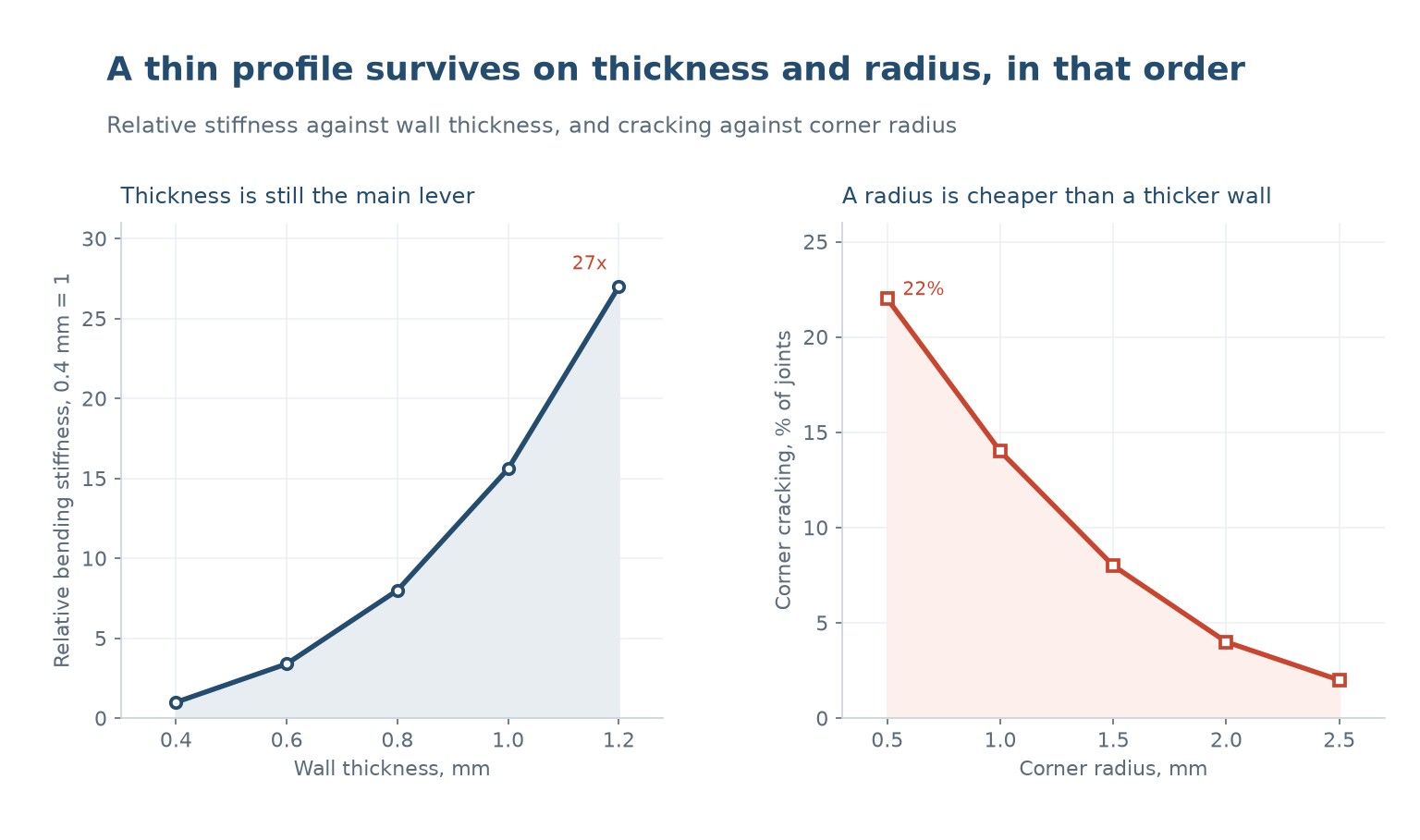
Bending stiffness of a wall goes with the cube of its thickness. A 0.4 mm wall taken as 1.0 gives 3.4 at 0.6 mm, 8.0 at 0.8 mm, 15.6 at 1.0 mm and 27.0 at 1.2 mm. Three times the thickness is twenty-seven times the stiffness, and the same relationship applies to the section's resistance to a local dent.
This is why thin-wall profiles work at all. A 0.5 mm PVC bead is not a flimsy version of a 1.5 mm bead; it is a different structure, and it is stiff enough for the load it sees because the load is small and the span between fixings is short. It is also why a small reduction in wall thickness during a cost-down exercise is far more damaging than it looks: 0.5 to 0.4 mm is a 20 percent material saving and a 49 percent stiffness loss.
The practical floor for a rigid PVC bead is around 0.4 mm, and it is set by the extruder rather than by the structure. Below that the die land becomes too short to consolidate the melt, the wall thickness varies around the section, and the profile will not calibrate consistently.
| Wall thickness | Relative stiffness | Material index | Where it is used |
|---|---|---|---|
| 0.4 mm | 1.0 | 1.0 | Light internal beads, short lengths |
| 0.6 mm | 3.4 | 1.5 | Standard plaster bead |
| 0.8 mm | 8.0 | 2.0 | External corners, higher abuse |
| 1.0 mm | 15.6 | 2.5 | Commercial and public buildings |
| 1.2 mm | 27.0 | 3.0 | Industrial trim, impact zones |
Table 1 — Stiffness against thickness, with the material cost index alongside.
Radius is the cheaper lever
The cracking that fails a corner bead is almost always at the arris, where the two legs meet. The material there has been stretched around a tight radius during extrusion, it is thinner than the legs, and it is the point that takes the impact when a ladder, a trolley or a plasterer's trowel hits the corner.
The relationship is steep. At a 0.5 mm outside radius, 22 percent of joints crack in a standard impact test. At 1.0 mm it is 14 percent, at 1.5 mm 8 percent, at 2.0 mm 4 percent and at 2.5 mm 2 percent. Doubling the radius from 0.5 to 1.0 mm removes a third of the failures, and it costs nothing in material.
The trade is visual. A 2.5 mm radius on a bead that is meant to give a crisp arris reads as a rounded edge, and on a high-end painted finish that is a visible difference. A 1.0 to 1.5 mm radius is the usual compromise: it removes most of the cracking without looking blunt.
There is a second benefit that is easy to miss. A larger radius lets the die be machined with a proper land at the corner, so the wall thickness at the arris is closer to the wall thickness on the legs. A tight radius forces a thin, highly oriented section at exactly the point where the stress concentrates.
Hollow against solid
A solid bead at 1.0 mm wall is a solid triangle of PVC, which is wasteful. Most production beads are hollow: two legs with an internal rib or a hollow triangular core, so that the wall thickness can be kept at 0.8 to 1.0 mm while the overall section is 10 to 15 mm across.
The hollow section gives most of the stiffness of the solid one at a third of the weight, but it changes the failure mode. A solid bead dents and stays dented. A hollow bead dents, then the wall buckles inward and the bead does not recover, so the damage is more visible. For a public building where the bead will be hit, the solid or the ribbed version is often worth the material.
The internal rib also matters for extrusion. A hollow section without a rib is a closed tube with no support at the corner, and it will distort during calibration because the vacuum pulls the walls in. A single diagonal rib ties the two legs together and holds the shape.
| Section | Wall | Weight per metre | Stiffness | Failure mode |
|---|---|---|---|---|
| Solid | 1.0 mm | 高い | Reference | Dents and holds |
| Hollow, no rib | 0.8 mm | 低い | 中程度 | Buckling, no recovery |
| Hollow with one rib | 0.8 mm | 低い | グッド | Local dent, rib holds |
| Hollow with two ribs | 0.6 mm | Lowest | グッド | Rib crushes first |
Table 2 — Section options, and what each one does when it is hit.
Impact modifier is the real variable
Two beads with the same geometry and different compounds behave completely differently. Rigid PVC is brittle at room temperature and very brittle below 5 C, so an unmodified compound will crack at the arris on a cold day during installation, before the building is even finished.
The standard answer is 6 to 10 parts of chlorinated polyethylene or acrylic impact modifier per hundred of resin, which raises the notched impact strength by a factor of three to five without much effect on stiffness. Below 5 parts the improvement is marginal; above 12 parts the tensile strength and the surface finish start to suffer.
For cold-climate work, an acrylic modifier holds impact strength better at low temperature than CPE, at a slightly higher cost. For a bead that will be painted, the compound also has to be formulated for adhesion: too much lubricant and the paint will not key, and the failure shows up as flaking along the arris a year later.
Fixing and jointing
A plaster bead is fixed with the plaster itself or with staples, and the fixing spacing is generous because the load is negligible. A trim bead that covers a panel joint is different: it is usually bonded or clipped, and the fixing has to accommodate the movement of the panels on either side.
Adhesive choice matters more than people expect. A solvent-based adhesive attacks the PVC and leaves a soft, wrinkled edge within months. A neutral-cure silicone or an acrylic tape is safer, and a tape needs a clean, dry surface to hold at all.
Where two lengths of bead meet, a mitre is the neat answer and a butt joint with a connector is the fast one. A mitre on a hollow bead exposes the section, so it needs a corner piece or a filled joint. A butt joint with a moulded connector is more forgiving and is what most installers actually do.
What to specify
A bead drawing that shows only the outline will be quoted at whatever wall the extruder finds convenient. Five numbers make it a specification.
- Wall thickness with a tolerance, typically plus or minus 0.05 mm on a 0.8 mm wall.
- Outside radius at the arris, and the tolerance on it.
- Impact modifier level, or the notched impact strength at minus 10 C.
- Section type: solid, hollow, and the number of internal ribs.
- Colour and surface, including whether it will be painted and with what.
The wall thickness tolerance is the one to hold firm on. A bead specified at 0.8 mm and supplied at 0.65 mm is still within a loose commercial tolerance and has half the stiffness, and nobody will notice until the first one cracks on site.
What wall thickness should a PVC corner bead have?
0.6 to 1.0 mm for most work. Stiffness goes with the cube of thickness, so 0.4 mm is eight times more flexible than 0.8 mm and is only suitable for light internal use.
Why do corner beads crack at the arris?
The arris is where the wall is thinnest and most highly oriented, and it takes the impact. Cracking falls from 22 percent at a 0.5 mm radius to 2 percent at 2.5 mm.
Does a bigger radius weaken the bead?
No. It makes the wall thickness at the corner more uniform and removes the stress concentration, so the bead is stronger. The cost is a blunter visual arris.
What impact modifier is used in PVC beads?
Usually 6 to 10 parts of chlorinated polyethylene or acrylic modifier per hundred of resin. Acrylic holds low-temperature impact better; CPE is cheaper.
Are hollow beads weaker than solid ones?
They are lighter and nearly as stiff, but they buckle locally instead of denting, so the damage is more visible. A hollow bead needs at least one internal rib to calibrate properly.
Can a corner bead be painted?
Yes, with a compound formulated for adhesion and a suitable primer. Too much lubricant in the compound causes the paint to flake along the arris.
Designing a trim or bead profile?
Send the section drawing and tell us how it will be handled and fixed. We will come back on wall thickness, arris radius and compound, and flag where the current design will crack.




 JA
 EN
 ES
 FR
 DE
 PT
 AR
 RU
 KO
 IT
 NL
 TR
 PL
 ID
