
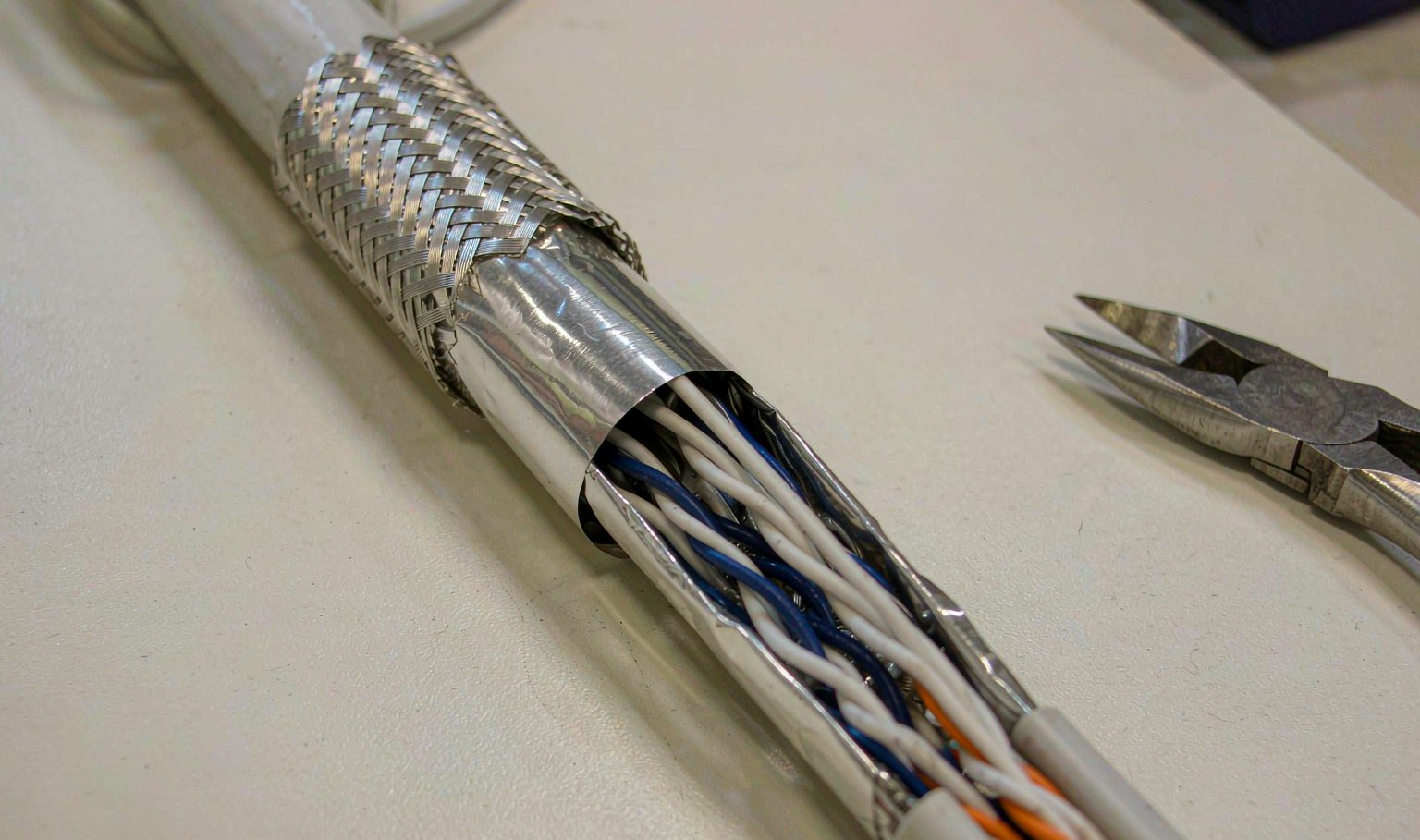
A shielded cable is an assembly
An unshielded cable is an extrusion: conductor in, insulation on, done. A shielded multicore cable is an assembly of five or six processes in series, and only two of them are extrusion. Cores are extruded, they are twisted into pairs, the bundle is filled and taped, the shield is braided or wrapped, and the sheath is extruded over the top.
Each step has its own tolerance and they stack. A core that is 0.1 mm oversize makes the bundle 0.3 mm oversize, which makes the braid 0.3 mm oversize, which makes the sheath 0.6 mm oversize, and the cable that was specified at 12.0 mm comes out at 12.6.
That is why the drawing for a shielded cable is a stack-up drawing and not a section drawing. The important information is the nominal and tolerance at every layer, and the layer that most often gets left out is the filler.
Fillers make it round
Four cores twisted together leave interstitial gaps. If the sheath is extruded straight over that bundle, the sheath sinks into the gaps, the outside diameter varies around the circumference, and the cable is not round. A non-round cable is hard to gland, hard to strip and hard to braid evenly.
Fillers are the answer. They are extruded profiles or twisted yarns that fill the gaps and bring the bundle close to a circle. The measure of how well they do it is the fill ratio, the fraction of the interstitial area that is occupied, and the effect on roundness is large.
At a 70 percent fill ratio the roundness deviation is 9.5 percent. At 78 percent it is 6.2, at 85 percent 3.1, at 92 percent 1.8, and at 97 percent 1.2. Below about 80 percent the deviation is visible on a section and the sheath thickness varies enough to matter for the voltage rating.
The fillers also do a mechanical job. They take the compression when the cable is bent and clamped, which keeps the cores from being deformed, and they keep the bundle from collapsing when the sheath is extruded over it under pressure.

Foil and braid do different jobs
A foil shield is an aluminised polyester tape wrapped around the bundle, usually with a drain wire in contact with the aluminium. It is thin, it is cheap, it gives 100 percent coverage, and it works at high frequency where the skin depth is small. It is also fragile: it cracks when the cable is flexed, and it has to be terminated to the drain wire, which is a poor connection at high frequency.
A braid is woven copper or tinned copper wire. It is flexible, it survives flexing, it is a low impedance connection at the ends, and it is the shield for a cable that moves. It does not give 100 percent coverage: a braid at 85 percent coverage has 15 percent of its area open, and that 15 percent is where the leakage happens.
Most shielded cables use both, foil over braid or braid over foil. The foil gives the coverage at high frequency, the braid gives the mechanical strength and the low impedance termination, and the combination is better than either alone at every frequency that matters.
There is also a spiral wrap, which is a foil or a wire wound helically. It is cheaper than a braid, it is more flexible than a foil, and it is worse than both at high frequency because the spiral is an inductor. It is used for a low frequency shield and for a cable that has to be very flexible.
Coverage is the number
Shielding effectiveness against braid coverage: 22 dB at 40 percent coverage, 34 at 60, 44 at 75, 52 at 85 and 61 at 95. The relationship is roughly logarithmic in the open area, which is why the last 10 percent of coverage is worth more than the first 20.
Coverage is set by the braid geometry: the number of carriers, the number of wires per carrier, the wire diameter and the braid angle. A 16 carrier braid at 45 degrees with 0.12 mm wire gives about 70 percent; the same braid with 24 carriers gives about 85.
The braid angle matters because it sets both the coverage and the flexibility. A steep angle gives more coverage and less flexibility; a shallow angle gives a flexible cable with gaps. A flexible shielded cable is a compromise between the two, and the compromise is usually a coverage in the low 80s.
The sequence on the line, and the tension
Taping is a tension process. The tape has to be wrapped with enough tension to stay in contact and not so much that it wrinkles or that it compresses the bundle. A tape that wrinkles traps air, and air under a foil is a place where the shield corrodes.
Braiding is a speed and tension process. The carriers run at a constant speed and the take-up sets the braid angle, so the angle is a ratio of two speeds and it drifts when either changes. A braid that is checked once at the start of a run is a braid that is wrong by the end of it.
Sheathing is a pressure extrusion over an uneven substrate. The die has to be sized for the bundle as it actually is, not as it is drawn, and the drawdown has to be enough to fill the braid without sinking into it. A sheath that sinks into a braid has a visible weave pattern on the outside and a thin wall over the braid crowns.
All three steps are in line and all three are tension controlled. The most common fault on a shielded cable line is not in any one of them, it is the tension between them: a braider pulling harder than the taper pays out stretches the tape, and a take-up pulling harder than the braider compresses the braid.
| Fault | Looks like | 原因 |
|---|---|---|
| Foil wrinkle | Lump under the braid | Tape tension, wrong width |
| Braid window | Open area in the weave | Carrier run out, tension drift |
| Lumpy cable | Varying diameter | Filler migration |
| Weave pattern on the sheath | Visible braid through the jacket | Die too small, too much drawdown |
| Corrosion under the foil | Green stain at a cut end | Trapped air, moisture |
Table 2 — Shield and sheath faults, and where they come from
What goes wrong
A wrinkle in the foil shows as a lump under the braid, and it is a gap in the shield at that point. It comes from tape tension or from a tape width that is wrong for the bundle diameter.
A braid that has opened up shows as a window in the weave. It comes from a carrier that has run out, from a tension that has drifted, or from a take-up that has surged.
Fillers that migrate show as a lumpy cable. A filler that is not anchored moves along the bundle during taping and leaves a gap where it was, which is a non-round section in the middle of a drum.
And a sheath that sinks shows as a weave pattern on the outside. It is a die sizing problem and it is usually fixed by increasing the drawdown, which is the wrong fix if the bundle is not round to begin with.
| Shield | Coverage | Flex life | コスト |
|---|---|---|---|
| Foil plus drain | 100% | 貧しい | 低い |
| Braid only | 60-90% | グッド | ミディアム |
| Foil over braid | 100% | グッド | Medium-high |
| Spiral wrap | 90-95% | 素晴らしい | 低い |
| Solid conduit | 100% | None | 高い |
Table 1 — Shield types and what each trades away
Why do shielded cables need fillers?
Because twisted cores leave gaps, and a sheath extruded over gaps sinks into them and is not round. Fillers bring the bundle close to a circle, which gives a uniform sheath wall.
What fill ratio is enough?
About 85 percent gives a roundness deviation of 3 percent, which is enough for a uniform sheath. Below 80 percent the deviation is visible on a section.
What is the difference between foil and braid?
Foil gives 100 percent coverage cheaply and works at high frequency but cracks when flexed. Braid is flexible and gives a low impedance termination but only 60 to 90 percent coverage.
How much shielding does 85 percent coverage give?
About 52 dB, against 22 dB at 40 percent. The relationship is logarithmic in the open area, so the last few percent of coverage matter most.
Why does my sheath show a weave pattern?
The sheath is sinking into the braid. Either the die is too small for the bundle or the drawdown is too high, and the underlying cause is usually a bundle that is not round.
Does a shield need bonding at both ends?
For a shield to work it has to carry current, so yes, at both ends and with a low impedance connection. A single ended drain wire is an antenna.
A shielded cable that leaks, or a sheath that sinks into the braid?
Send the construction, the coverage and the flex requirement. We will tell you the filler, the shield and the sheath die the cable needs.
Continue reading
- Cable Jacket Extrusion: Pressure Die, Drawdown and Surface Finish
- Cable Concentricity: The Measurement That Predicts Failure
- Cable Colour Coding: Stripes, Rings and the Identification Nobody Reads
- Crosslinked PE Cable: Silane, Peroxide and the Process Behind Each
- Plastic Extrusion Solutions: Profile, Sheet, Pipe and Tube




 JA
 EN
 ES
 FR
 DE
 PT
 AR
 RU
 KO
 IT
 NL
 TR
 PL
 ID
