
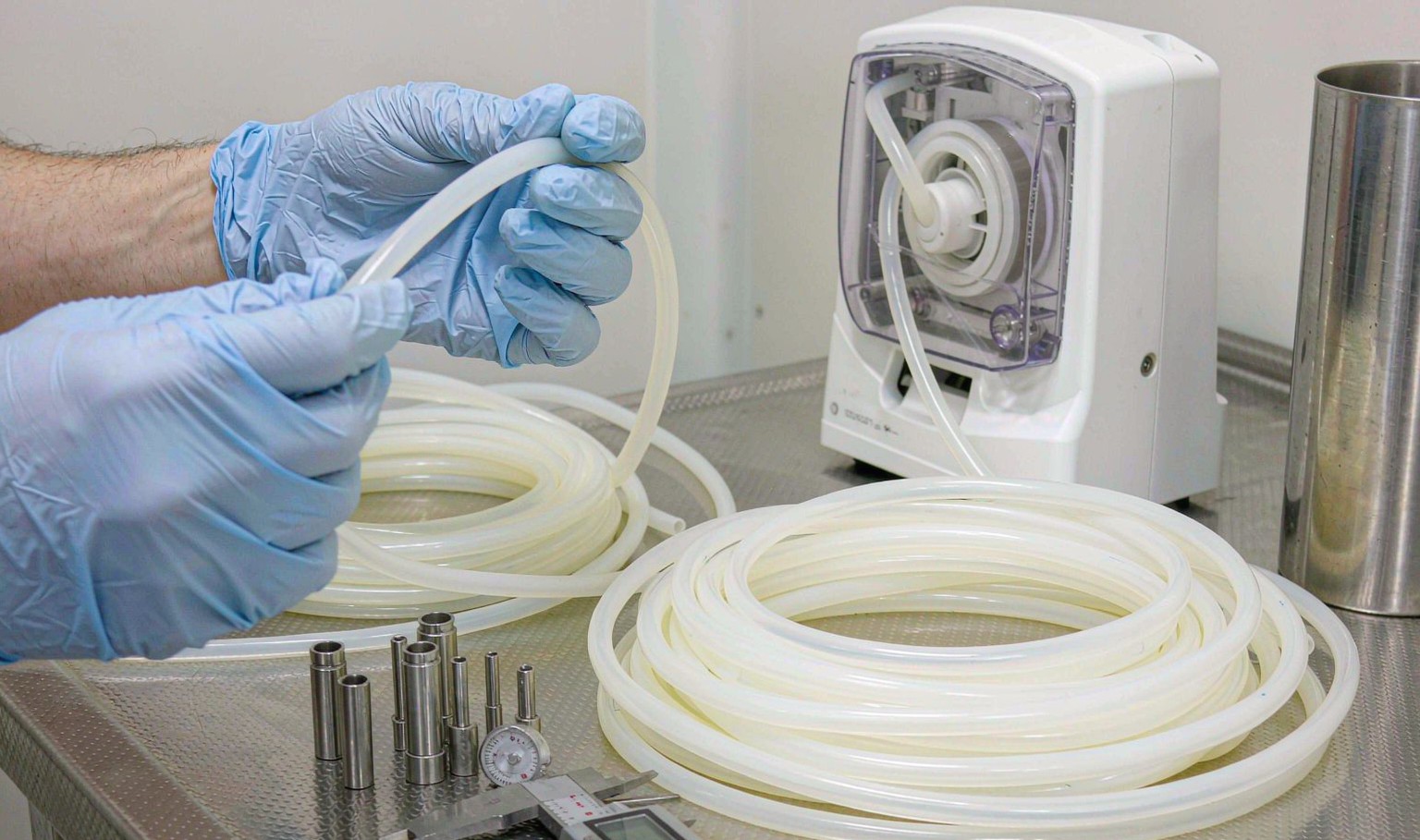
The lumen is the dose
A peristaltic pump does not measure volume. It traps a slug of fluid between two rollers and pushes it along, and the slug is the length between the rollers multiplied by the cross-section of the bore. Nothing in the pump knows how big the bore is, so the bore is the calibration.
That makes lumen tolerance a dosing specification rather than a dimensional one. Volume goes with the square of the diameter, so a 6 mm nominal bore with a plus or minus 0.20 mm tolerance is a plus or minus 6.7 percent area tolerance, and the dose error follows it. Measured against tolerance, the error runs from 2.6 percent at plus or minus 0.02 mm to 17.4 percent at plus or minus 0.20 mm.
Which is why a medical pump tube is specified tighter than a general purpose tube, and why it is often supplied with a measured bore rather than a nominal one. On a 0.02 mm tolerance the pump can be calibrated once; on 0.20 mm it has to be calibrated per tube, and the dose is only as good as the last calibration.
The wall matters too, but for a different reason. The wall is what the roller compresses, and the compression has to be enough to close the lumen completely at every roller. Too little and the pump slips backwards; too much and the tube fatigues.
Wall compression sets the pump life
A peristaltic tube fails by fatigue at the point where the roller compresses it. Every revolution bends the wall through a full occlusion and releases it, and the number of revolutions is the life. The variable that sets the number is how far the wall is compressed as a fraction of its thickness.
At 5 percent compression a silicone pump tube lasts about 1,250 hours. At 10 percent it is 820, at 15 percent 520, at 20 percent 300, and at 25 percent 145. The curve is steep and it is the reason a pump is set up on the low side of occlusion rather than the high side.
The trade is that low compression risks an incomplete occlusion, which shows up as backflow or as a dose that varies with the head pressure. The usual compromise is 10 to 15 percent, which gives 520 to 820 hours on a silicone tube and still closes reliably against a modest head.
Note that the compression is set by the pump's occlusion bed, not by the tube alone. A tube with a wall 0.2 mm thicker than nominal, dropped into a pump set for nominal, is a tube running at 25 percent compression and a fifth of the life. That is why a pump tube is specified on wall as well as bore.

Platinum cured, and why it is not a marketing word
Silicone is cured either with a platinum catalyst or with peroxide. The platinum addition cure leaves no peroxide decomposition products, so the finished tube has far fewer extractables and no taste or odour. For a tube that carries blood, a drug or a cell culture, that difference is the specification.
Peroxide cured silicone is cheaper and it is still used for non-medical tubing. The decomposition products can be driven off with a post-cure, but not completely, and a peroxide tube is not the one to put in a dialysis circuit.
The material also has to be declared. USP Class VI and ISO 10993 are the usual citations, and they are not the same test. Class VI is a biological reactivity test on extracts; ISO 10993 is a family of tests chosen by contact type and duration. A certificate that says Class VI does not cover a 30 day implant contact, and a supplier who offers one as if it did is a supplier to check.
What the tube is made of matters less than what comes out of it. Extractables testing in the intended solvent, at the intended temperature, for the intended time is the only way to know, and it is done on the finished tube rather than on the compound.
Where the tolerance comes from
Extruded silicone tubing is drawn through a die and cured in a tunnel, and the bore is set by the die and by the drawdown. A general purpose tube holds plus or minus 0.10 mm on the bore and plus or minus 0.05 mm on the wall. A precision pump tube holds plus or minus 0.05, and the tightest holds plus or minus 0.02 with a laser gauge on the line and a reject gate.
Moulded tubing, which is really a long hollow moulding, holds the bore on a core pin and is more accurate at the ends and less accurate in the middle. It is used for short lengths, for a shaped lumen and for a multi-lumen tube, where extrusion cannot make the section at all.
The tolerance also has to survive sterilisation. Gamma sterilisation crosslinks and can yellow a silicone; ethylene oxide leaves residues that need aeration; steam at 134 C relaxes the cure and can move the dimensions slightly. A tube that measures at the top of its tolerance before sterilisation can be outside it afterwards.
| Route | Bore tolerance | Wall tolerance | 用途 |
|---|---|---|---|
| Extruded, general | +/- 0.10 mm | +/- 0.05 mm | Drain, transfer |
| Extruded, precision | +/- 0.05 mm | +/- 0.03 mm | Pump tube |
| Extruded, gauged | +/- 0.02 mm | +/- 0.02 mm | Dosing pump |
| Moulded | +/- 0.05 mm | +/- 0.05 mm | Shaped or multi-lumen |
Table 1 — What each route can hold on bore and wall
What the test list actually covers
A tubing certificate usually carries durometer, specific gravity, tensile strength, elongation at break and compression set. Those are compound properties: they tell you the material is what it says, and they tell you nothing about the tube.
The tube properties are the dimensional ones, the extractables and the biological ones. Bore, wall, concentricity, length and camber are measured on the tube. Extractables are measured in a solvent. Bioburden and endotoxin are measured on the finished, packaged product, and they are the ones that decide whether a batch can be released.
Compression set is worth a mention because it is the compound property that predicts pump life. A silicone with a low compression set recovers its wall thickness after each roller pass; one with a high set stays flattened, the occlusion fails, and the pump loses its prime long before the tube breaks.
| Test | Measures | On |
|---|---|---|
| Durometer, tensile, elongation | Compound | Sheet or tube |
| Compression set | Recovery after occlusion | Tube |
| Bore, wall, concentricity | Dose and occlusion | Tube |
| Extractables | What leaches out | Finished tube |
| Bioburden, endotoxin | Cleanliness | Packaged product |
| USP Class VI, ISO 10993 | Biological response | Finished tube |
Table 2 — The test list, and what each item is really about
How a medical tube fails
Spallation is the one that matters most and the one that is least visible. The inside surface of a peristaltic tube sheds particles as it fatigues, and those particles go into the fluid path. A tube that is still pumping and still occluding can be shedding, which is why pump tubing has a stated life in hours and is replaced on the count rather than on failure.
Kinking is a geometry problem. A tube kinks when the wall is thin relative to the bore, and the ratio that avoids it is a wall of about one eighth of the bore. A 6 mm bore wants a 0.75 mm wall; a 1 mm wall is stiff and a 0.4 mm wall kinks at the first bend.
Cold flow at the roller is a slow one. Silicone creeps under sustained compression, so a pump left parked with a roller pressing on the tube develops a flat that does not recover. Parking the pump with the roller off the tube is free and it is rarely done.
Sterilisation is the last one. Gamma at 25 to 40 kGy crosslinks the silicone further, which stiffens it and can reduce pump life; EtO needs aeration to clear residues; steam at 134 C is the harshest and it is the one that most often changes the dimensions.
Why does lumen tolerance affect dose accuracy?
Because a peristaltic pump doses by cross-section, and volume goes with the square of the diameter. A 0.20 mm tolerance on a 6 mm bore is a 6.7 percent area tolerance, which shows up directly as dose error.
What compression should a peristaltic pump run at?
Ten to fifteen percent of the wall thickness for a silicone tube. That closes the lumen reliably and gives 520 to 820 hours of life; 25 percent gives a fifth of that.
What is the difference between platinum and peroxide cured silicone?
Platinum addition cure leaves no peroxide decomposition products, so the tube has far fewer extractables and no odour. Peroxide cure is cheaper and is used for non-medical tubing.
Does USP Class VI cover ISO 10993?
No. Class VI is a biological reactivity test on extracts; ISO 10993 is a family of tests chosen by contact type and duration. A long term implant contact needs more than Class VI.
How tight a bore tolerance is realistic?
Plus or minus 0.10 mm on a general extrusion, 0.05 on a precision pump tube, and 0.02 with a laser gauge and a reject gate on the line.
Why does my pump tube go flat and stop priming?
Compression set. A silicone with high set does not recover its wall after each roller pass, so the occlusion fails. It is a compound property and it is worth specifying.
A pump tube that doses out of tolerance or wears out early?
Send the bore, the wall, the pump model and the fluid. We will tell you the tolerance the application needs and the compression it should run at.




 JA
 EN
 ES
 FR
 DE
 PT
 AR
 RU
 KO
 IT
 NL
 TR
 PL
 ID
