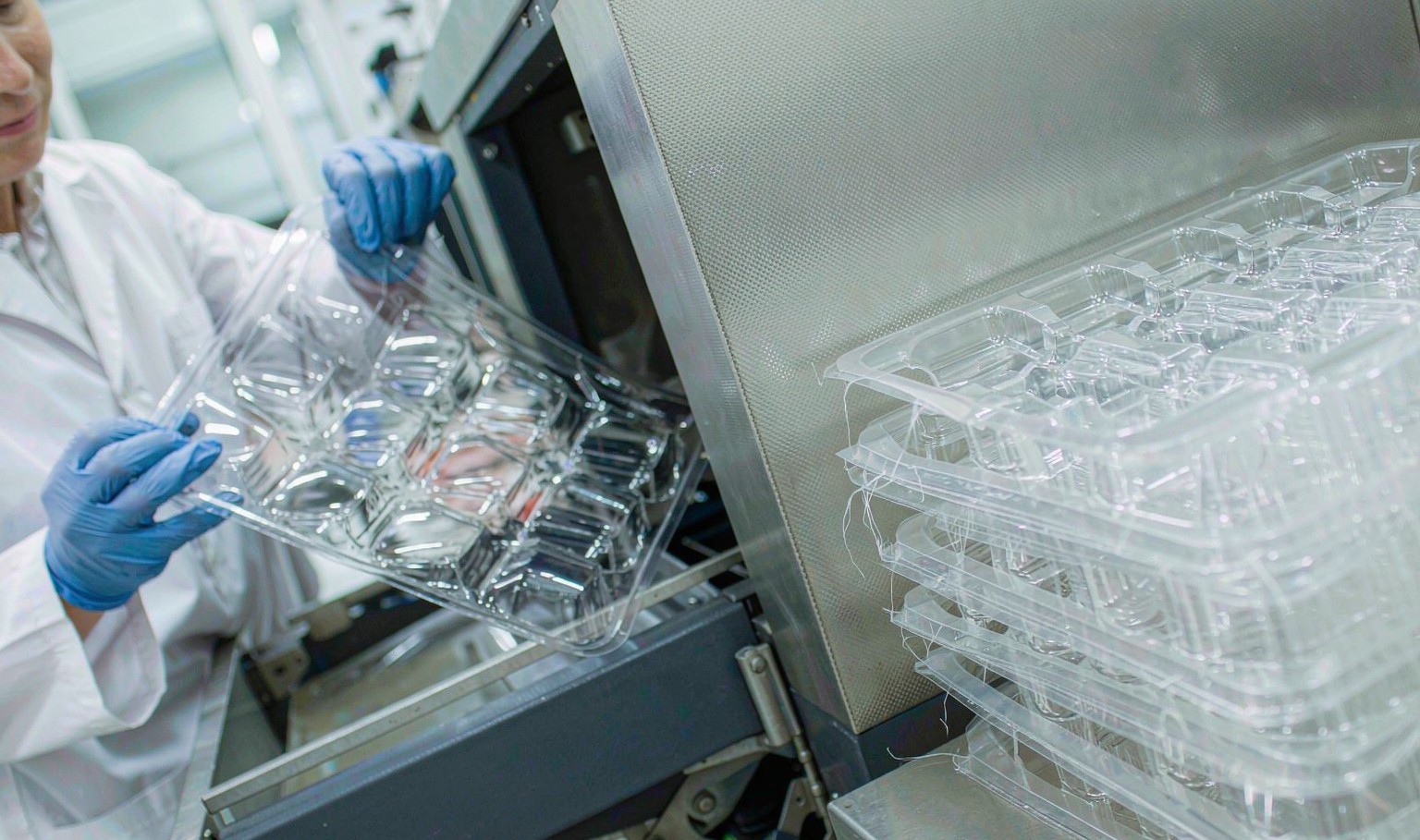
PP trays distort under hot or oily fills when the fill temperature nears the polymer softening range, a limit buyers must set before specifying an application.
What the failure looks like on the line
PP trays and lids are chosen for heat and fat resistance, but the same grades bring higher shrinkage and a narrower sealing window.
A PP tray base bows or loses shape after a warm, oily product is filled, and lids no longer sit flat. The distortion appears during filling rather than in storage.
PP softens progressively as temperature rises toward its melting region, and oily fills both carry heat and can swell the surface. If the fill temperature and dwell exceed the tray heat window, the formed wall relaxes under the product weight and the geometry moves.
Start with the failure as it is reported, not with the parameter that is easiest to measure. On a buyer's specification this distinction matters: a part can measure inside tolerance and still fail in use, because the drawing records geometry while the complaint records behaviour. Fill temperature is usually the first value both sides compare, and it is also the one most often quoted without the conditions attached to it.
The process window that decides it
Four variables move this result more than the rest. The ranges below are illustrative engineering guidance for a first discussion; confirm them on your own tool, material grade and part geometry before they become contract terms.
| Variable | Typical window | What fails outside it |
|---|---|---|
| Fill temperature | 70-90 C | Higher fills push PP towards softening under load |
| Fill dwell before cooling | 1-5 min | Longer dwell lets the warm wall creep |
| Tray gauge | 0.4-0.9 mm | Thin walls carry hot load with less margin |
| Oil content of fill | 0-20 % | Oily fills raise surface heat transfer and swell |
Table 1. Starting window for a joint process trial. Values are engineering guidance, not a measured survey.
Fill temperature is typically held at 70-90 C. Higher fills push PP towards softening under load Record it together with the measurement point and the moment in the cycle; a single number without a location is not a process setting.
Fill dwell before cooling is typically held at 1-5 min. Longer dwell lets the warm wall creep When this drifts, the symptom usually appears at one cavity, one sheet position or one lane before it appears across the whole batch.
Tray gauge is typically held at 0.4-0.9 mm. Thin walls carry hot load with less margin A change here is cheap during a trial and expensive after tooling release, so treat it as a controlled variable with a documented re-approval.
Oil content of fill is typically held at 0-20 %. Oily fills raise surface heat transfer and swell Put it on the change-control list, otherwise an unannounced material or setting substitution will be mistaken for ordinary process noise.
Reading the response curve
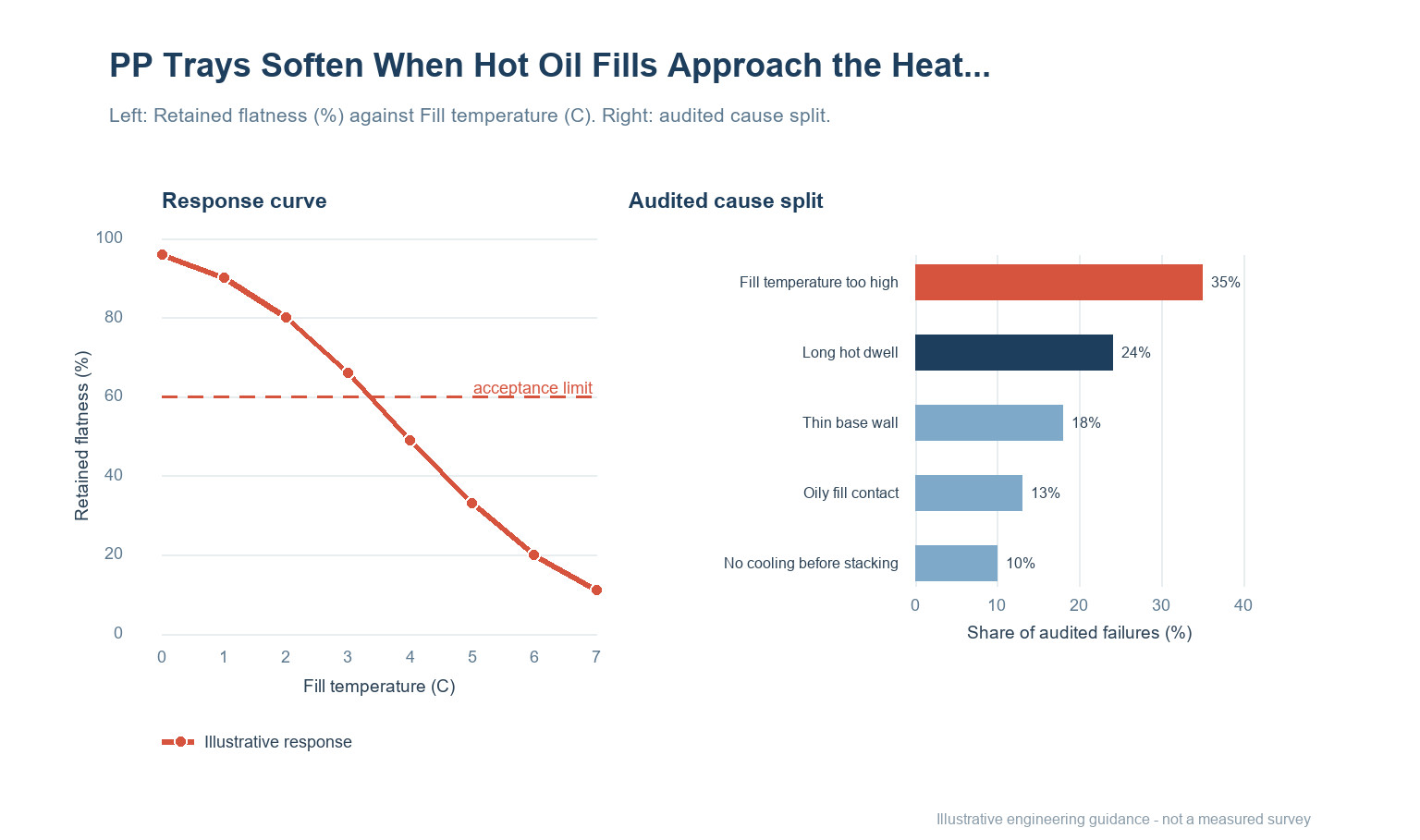
The left panel shows retained flatness (%) as fill temperature (c) increases: the response falls from 96 to 11 on the illustrative 0–100 scale. The dashed line at 60 marks a proposed acceptance limit, not a universal standard. Move that line only after the test method and the sample plan have been agreed, otherwise two suppliers can both be compliant and still deliver different parts.
Read the shape rather than a single point. A curve that changes quickly near the limit is more sensitive to ordinary process noise than one that approaches it gradually, and that difference should be reflected in how tightly the setting is controlled and how often it is checked.
Where the causes actually sit
The right panel of Figure 1 splits audited failures of this type into five groups. The percentages are illustrative engineering guidance for prioritising an investigation, not a measured survey and not a prediction for your line.
| Cause | Illustrative share | First check |
|---|---|---|
| Fill temperature too high | 35% | Record the actual fill temperature at the tray, not the kettle set point. |
| Long hot dwell | 24% | Measure base flatness before and after a controlled hot-fill trial. |
| Thin base wall | 18% | Compare distortion at two fill dwell times. |
| Oily fill contact | 13% | Check formed wall gauge at the base against the drawing. |
| No cooling before stacking | 10% | Confirm the intended use temperature is stated in the specification. |
Table 2. Cause split and the corresponding first check. Shares are indicative and sum to 100.
Fill temperature too high accounts for roughly 35% of the illustrative split. Record the actual fill temperature at the tray, not the kettle set point. Start here before authorising a material or tooling change, because it is the fastest explanation to confirm or eliminate.
Long hot dwell accounts for roughly 24% of the illustrative split. Measure base flatness before and after a controlled hot-fill trial. Start here before authorising a material or tooling change, because it is the fastest explanation to confirm or eliminate.
Thin base wall accounts for roughly 18% of the illustrative split. Compare distortion at two fill dwell times. Start here before authorising a material or tooling change, because it is the fastest explanation to confirm or eliminate.
Checks before sign-off
In practice the sequence below is cheaper to run than a root-cause debate after a rejected delivery.
- Record the actual fill temperature at the tray, not the kettle set point.
- Measure base flatness before and after a controlled hot-fill trial.
- Compare distortion at two fill dwell times.
- Check formed wall gauge at the base against the drawing.
- Confirm the intended use temperature is stated in the specification.
Keep a retained reference sample beside every result. When a batch is disputed, the comparison that settles it is almost always between the retained part and the current one under the same method, not between either part and a number on a drawing. Record the instrument, the operator, the conditioning time and the position on the part or sheet for each reading.
Writing it into the specification and the evidence pack
Base flatness shall remain within the agreed limit after a hot-fill trial at the specified temperature, dwell and fill composition.
Write the requirement as a behaviour at a stated condition, not as a brand of material or a machine setting. State the test method, the conditioning, the sample plan and the rule for deciding a pass. Where a document is needed, ask the supplier for documentation that covers the actual construction and check its scope against your own market before approval; a document for the base material alone does not describe the finished part you are buying.
At first-article approval, freeze the drawing revision, the material and colour identification, the process window, the tool and cavity identification, and the inspection method. Any later change to grade, site, tool, or window should trigger a new first article rather than a paper waiver. Keep retained samples from the approved lot and from each production lot so that a future comparison is possible.
| Evidence item | What it must show |
|---|---|
| Approved drawing and revision | The exact geometry and tolerances the decision applies to |
| Material and colour identification | Grade, supplier, colour reference and any declared recycled content |
| Process window and change log | The agreed settings and any deviation since approval |
| Inspection record and retained samples | Method, conditions, results and a physical reference from the same lot |
Table 3. Minimum evidence pack for a first-article decision and a later batch dispute.
The values quoted here are illustrative engineering guidance, not a measured survey. Agree the test method, the sample size and the acceptance rule before comparing numbers across suppliers.
Questions buyers ask
Is this a material problem or a process problem?
PP softens progressively as temperature rises toward its melting region, and oily fills both carry heat and can swell the surface. If the fill temperature and dwell exceed the tray heat window, the formed wall relaxes under the product weight and the geometry moves. It is worth separating the two before a supplier changes a grade: hold the material constant for one controlled run, then move one setting at a time. If the symptom follows the setting, the material was never the cause.
Can fill temperature be traded against cycle time?
Only within the window stated in Table 1, and only with a recorded trial. Higher fills push PP towards softening under load A faster cycle that sits outside the window usually moves the failure downstream, where it costs more to find.
What should be recorded at incoming inspection?
Keep the measurement, the method, the sample identity and the conditions together. Record the actual fill temperature at the tray, not the kettle set point. A result without its conditions cannot be compared with a later batch.
Does a change of PP require re-approval?
Treat any change to material grade, tool, site or process window as a change that needs a new first-article decision. For thin-wall forming work the drawing alone is not enough; the process route is part of what was approved.
How many samples are enough for a first-article decision?
There is no universal number. Sample across cavities, lanes, sheet positions or reel lengths so that the spread is visible, not just the average. Agree the sample plan and the acceptance rule with the supplier before the trial starts.
What belongs in the evidence pack?
The approved drawing and revision, the material and colour identification, the process window, the inspection method and results, the retained reference samples, and documentation covering the actual construction. Ask the supplier to state the scope of each document and check it against your own market.
Seeing this on a current thin-wall forming job?
Send the drawing, the material and grade, the process window you are running, and the point in the cycle or the shelf life where the fault appears. We will help you separate a material question from a process question and a specification question before anyone changes a tool.
Continue reading
- PP Thin-Gauge Thermoforming: Shrinkage, Warpage and Stacking
- PP Cup Thermoforming: Two Seconds a Cup and No Room for Error
- CPET Ovenable Trays: Dual-Ovenable From a Thermoformer
- Sheet Heating in Thermoforming: The Temperature Window That Decides Everything
- Thermoformed Food Trays: Material, Barrier and the Filling Line

 EN
 ES
 FR
 DE
 PT
 AR
 RU
 JA
 KO
 IT
 NL
 TR
 PL
 ID