The problem
Symptom. A distributor measures 3.2 mm/m of bow on a 6 m rigid PVC delivery that left the factory at 0.6 mm/m, and rejects the shipment as an extrusion fault.
What it costs. The pallet is already on site and the fixing holes are drilled, so a transport fault becomes a re-order and a delayed installation rather than a factory re-run.
This guide links arrival bow to support spacing and container temperature, and gives the four checks that separate handling damage from a process fault.
- 1. Condition the bundle before you measure it
- 2. Trace the bow to the supports and the heat
- 3. Set the packing parameters that hold a 6 m length straight
- 4. Prove it with a support-spacing trial
- 5. Write the packing and conditioning into the order
- 6. What a full-length skid saves over a shipping season
Condition the bundle before you measure it
PVC-U softens near its Vicat point of 75 °C. A container peaked at 65 °C, and with supports only at the ends the 6 m stack crept: 0.6 mm/m at the factory became 3.2 mm/m on arrival against a 1.5 mm/m limit.
| Dunnage spacing (m) | Container peak (°C) | Straightness on arrival (mm/m) |
|---|---|---|
| 0.5 (full skid) | 65 | 0.6 |
| 1.0 | 65 | 0.8 |
| 2.0 | 65 | 1.9 |
| 2.5 (end straps only) | 65 | 3.2 |
Table 1 - Support spacing against arrival straightness after a summer shipment
Need a fixed price for this profile?
Send the cross-section drawing, material, cut length and annual volume. We will review die, calibration and tolerance, then return a written tooling and production quotation.
Trace the bow to the supports and the heat
Typically, the distortion traced to an unsupported mid-span, container heat, end-only strapping, an over-high stack and measuring before conditioning. Check the dunnage first: at 2.5 m spacing a stack of 40 lengths sags about 8 mm over 6 m.
A five-step diagnostic sequence
- Condition before measuring.
Hold the bundle 24 hours at 20 ± 2 °C; measuring a hot load adds 1-2 mm/m of apparent bow that is partly recoverable. - Check the dunnage spacing.
Measure support positions on the pallet; 2.5 m instead of 1.0 m explains an 8 mm sag over 6 m. - Read the container logger.
Confirm the peak temperature; 65 °C in a summer container takes PVC-U toward its 75 °C Vicat point. - Inspect straps and stack height.
Verify straps every 1.5 m plus the ends and a stack of 40 lengths or less; end-only strapping frees the mid-span. - Run the support-spacing trial.
Ship at 0.5, 1.0, 2.0 and 2.5 m and condition each; the 0.6 to 3.2 mm/m rise proves handling, not extrusion.
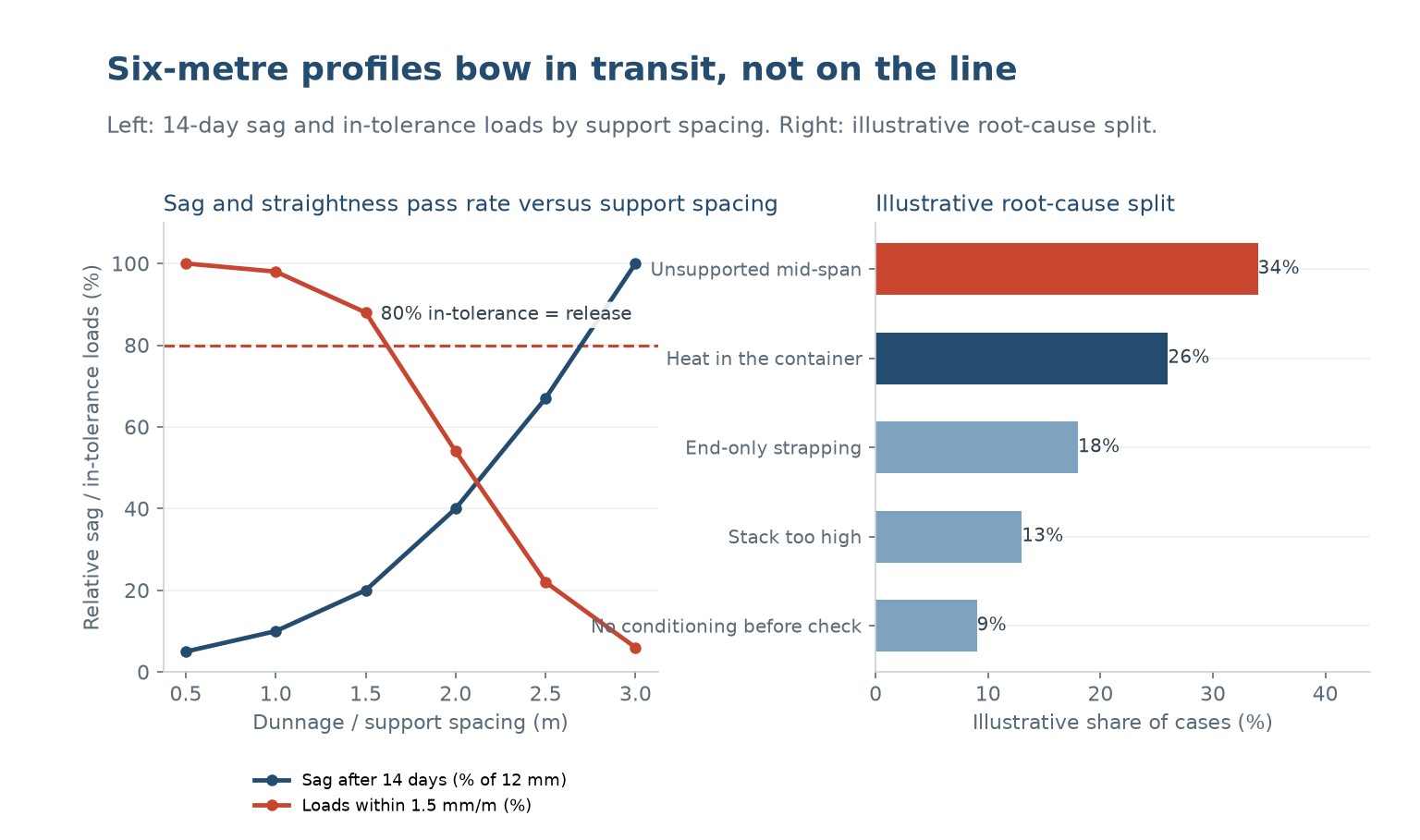
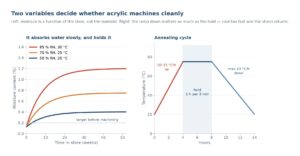
The chart below is a typical result from that measurement step. Use it to separate a design limit from a setting that can still be recovered.
Set the packing parameters that hold a 6 m length straight
Four packing settings hold a length straight: dunnage at 1.0 m or less, a container peak under 45 °C, straps every 1.5 m plus the ends, and 24 hours at 20 ± 2 °C before measurement. Measuring hot adds 1-2 mm/m of apparent bow.
| Параметр | Typical target | What goes wrong outside it |
|---|---|---|
| Dunnage / support spacing | 1.0 m or less along 6 m | At 2.5 m the stack creeps about 8 mm under its own weight |
| Container peak temperature | Under 45 °C | Above 60 °C PVC-U nears its Vicat point and softens |
| Strap positions | Every 1.5 m plus the ends | End-only straps let the mid-span sag freely |
| Conditioning before measurement | 24 h at 20 ± 2 °C | Measuring hot on arrival adds 1-2 mm/m of apparent bow |
Table 2 - Packing settings that keep a 6 m PVC profile straight in transit
Prove it with a support-spacing trial
Run a support-spacing trial with the same stack: set dunnage at 0.5, 1.0, 2.0 and 2.5 m and condition for 24 hours. Arrival straightness reads 0.6, 0.8, 1.9 then 3.2 mm/m, so the share of loads inside 1.5 mm/m falls from 100% to 22%.
| Field symptom | Most likely cause | Check that confirms it |
|---|---|---|
| Smooth bow over the whole length | Unsupported mid-span creep | Dunnage log shows 2.5 m spacing |
| Bow worst in the top layers | Container heat near the roof | Data logger peaked at 65 °C |
| Lengths bow after a hot weekend | PVC-U softening in transit | Profile surface still 40 °C on unloading |
| Bow partly recovers overnight | Measured before conditioning | Re-measure at 20 °C after 24 h is within limit |
Table 3 - Matching arrival bow to the packing fault
Write the packing and conditioning into the order
Write packing and conditioning into the order: dunnage spacing, strap positions, a container temperature limit, and 24 hours at 20 °C before measurement. When both parties measure the same conditioned bundle, a 3.2 mm/m arrival figure is a handling question, not an extrusion rejection.
Need the section checked before tooling?
Send us the section and the installation conditions. We will review wall balance, tolerance and fixing detail, then return a marked-up drawing with a tooling quotation.
What to send us
- Cross-section drawing with wall thicknesses
- Material and colour
- Installation temperature range
- Fixing method and run length
What a full-length skid saves over a shipping season
A full-length skid is cheap cover. A season ships 20 000 m of 6 m trim; 1.0 m dunnage and a 45 °C limit keep 98% of loads inside 1.5 mm/m, while end-only straps bow a whole container before the note is signed.
Before you release this extruded profile
- Dunnage spacing of 1.0 m or less is written into the packing spec
- Strap positions every 1.5 m plus the ends are specified
- A container peak temperature limit of 45 °C is agreed
- 24 hours of conditioning at 20 ± 2 °C precedes acceptance measurement
- Factory straightness and arrival straightness are both recorded
Write the measurement temperature and the tolerance into the drawing; most disputes are really about how the part was measured.
Why did my 6 m profiles arrive bowed when they left straight?
Heat and unsupported spans. A container at 65 °C takes PVC-U toward its 75 °C Vicat point, and dunnage at 2.5 m let the stack creep about 8 mm, turning 0.6 mm/m into 3.2 mm/m.
Is this an extrusion fault or a shipping fault?
A process bow is consistent along every length and present at the factory. Shipping bow varies through the stack and often recovers after conditioning. Compare the factory and arrival records first.
What support spacing should I specify?
1.0 m or less along a 6 m length, with straps every 1.5 m plus the ends. At 2.5 m spacing only 22% of loads stayed inside 1.5 mm/m in our support-spacing trial.
Does container temperature really matter?
Yes. Above 60 °C rigid PVC begins to soften, so a stack that was straight at 23 °C can creep under its own weight during a 14-day summer shipment. Specify a 45 °C peak and use a logger.
Should I measure on arrival?
Not immediately. Condition the bundle 24 hours at 20 ± 2 °C first. A hot load measured straight off the container can read 1-2 mm/m worse than its true straightness.
What should the acceptance clause say?
Factory and arrival straightness, dunnage spacing, strap positions, a container temperature limit and 24-hour conditioning. Then a 3.2 mm/m figure is a handling question, not an extrusion rejection.
Get a profile that holds its dimension
Send us the profile section, the length and the service conditions. We will review die, calibration and tolerance, then quote tooling and production with a defined measurement method.
To get an accurate quote, send:
- Profile cross-section drawing
- Material and colour
- Cut length and annual volume
- Service temperature and exposure
Why buyers work with Uplastech
ISO 9001, ISO 14001 and ISO 45001 certified. Founded in 2016, with injection moulding lines in Shanghai and an extrusion plant in Jiangsu. Moulding machines from 90T to 1100T and a maximum shot weight of 5100 g. Samples and a written quotation are available on request.
Continue reading
- Extrusion dimensional drift
- Extrusion profile tolerance
- Profile calibration and cooling
- PVC profile weathering and colour
- PVC window profile design
Ready to specify? See our plastic profile extrusion services или request a written quotation.

 RU
 EN
 ES
 FR
 DE
 PT
 AR
 JA
 KO
 IT
 NL
 TR
 PL
 ID