

- 1. 1. Two processes, two different materials
- 2. 2. How cast acrylic rod is made
- 3. 3. How extruded acrylic rod is made
- 4. 4. The comparison that matters
- 5. 5. Optical differences you can actually see
- 6. 6. Machining and cementing behave differently
- 7. 7. Which one to specify
- 8. 8. What to send in an RFQ
- 9. 9. Frequently asked questions
- 10. Tell us the diameter, the tolerance and the application
On this page
1. Two processes, two different materials
Acrylic rod is sold under one name but made two ways, and the two products are genuinely different materials — not the same material with a different surface finish. Both are PMMA (polymethyl methacrylate), both are transparent, both are called acrylic rod. The molecular weight, the internal stress, the tolerance and the price all differ.
The reason buyers get caught out is that the difference is invisible at a glance. A 20 mm clear rod from a cast producer and a 20 mm clear rod from an extruder look the same on a desk. They behave differently the moment you drill them, cement them, or measure them against a drawing.
The one-line version: cast rod is polymerised in place, so it has a very high molecular weight and no flow history — excellent optics and machining, looser dimensional tolerance. Extruded rod is melted and pushed through a die, so it has a lower molecular weight and a flow history — tighter tolerance and lower cost, but more stress and less chemical resistance.
2. How cast acrylic rod is made
Cast rod starts as a liquid. Methyl methacrylate monomer is mixed with an initiator, and for coloured rod, with pigment or dye. The mixture is poured into a vertical tube mould — traditionally aluminium, sometimes polyethylene — and the tube is heated slowly so the monomer polymerises into solid PMMA.
The temperature profile is the whole craft. Polymerisation is exothermic: once it starts, it generates its own heat. If the centre of a thick rod runs ahead of the outside, the reaction accelerates locally, the monomer boils, and the rod comes out full of bubbles. The cure therefore starts cool — typically around 40 to 60 °C — and is ramped slowly over many hours, then finished at a higher temperature to drive the conversion close to completion and to relieve stress.
Three consequences follow from this process:
- Diameter is set by the mould tube. The mould must be oversized because the monomer shrinks substantially as it converts to polymer. Wall thickness of the tube and its straightness both show up in the finished rod.
- Very high molecular weight. Because the polymer forms in place without shear, chain length is long. That is why cast acrylic machines so cleanly and resists solvents better than extruded.
- Batch, not continuous. Each tube is a batch. You can cast one rod or a thousand, which is why cast has no real minimum order for large diameters.
Cast rod is then annealed, cut to length, and often the ends are machined and polished. The annealing step is not optional for rod that will be drilled or cemented — an unannealed cast rod carries the stress of its own polymerisation and will craze when a solvent cement touches a machined edge.
3. How extruded acrylic rod is made
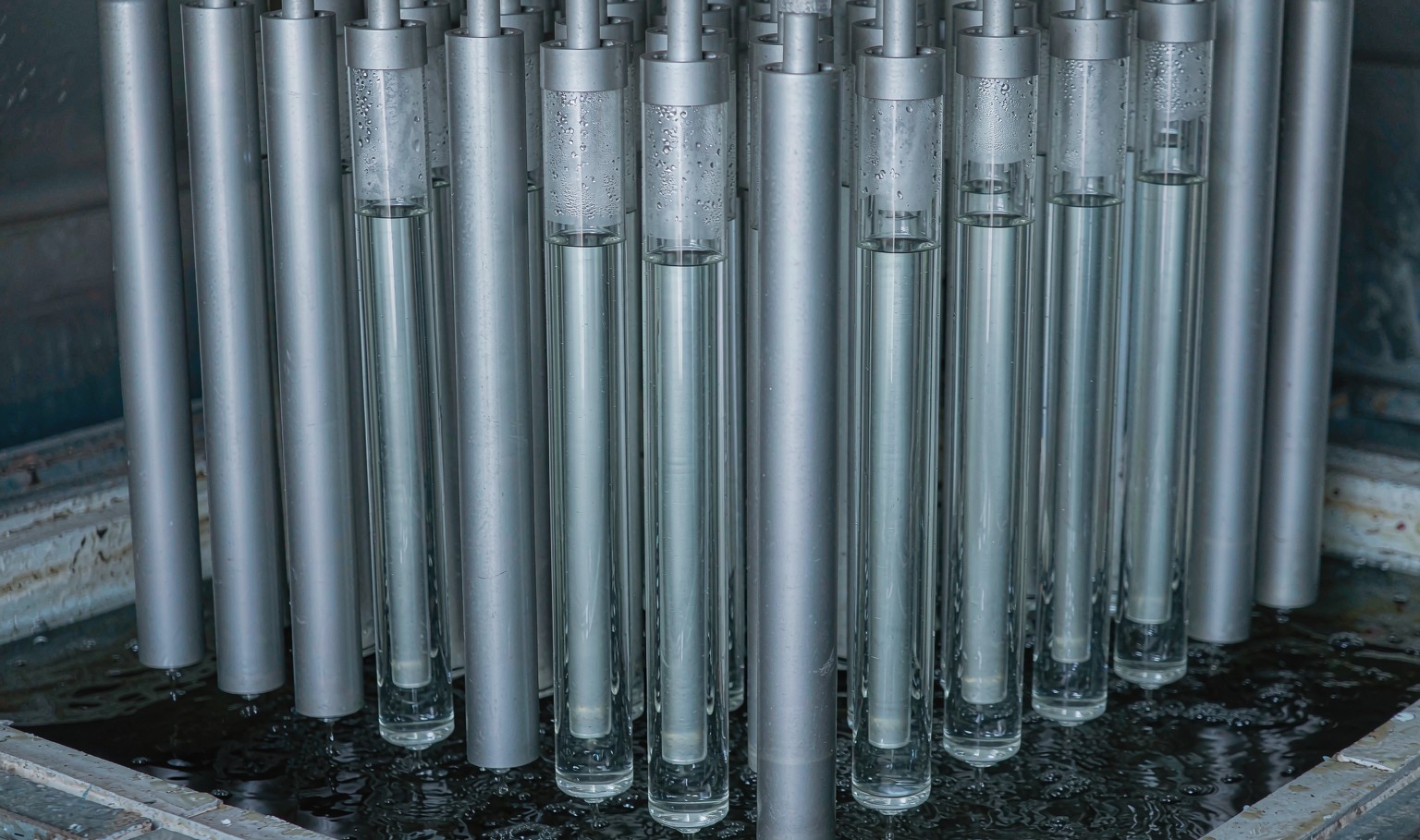
Extruded rod starts as solid. PMMA pellets are dried — acrylic is hygroscopic and must be dried at around 80 °C for two to four hours, or the rod will come out hazy — then fed into a single-screw extruder, melted, and pushed through a circular die. The rod is cooled, either in a water bath or by air, then pulled by a haul-off and cut to length.
Acrylic is one of the more difficult materials to extrude. Its melt viscosity is high and strongly shear-thinning, its processing window is narrow, and it degrades if it is overheated. That is why acrylic extrusion lines are usually purpose-built rather than shared with polyolefins, and why the screw design matters more than for a commodity resin.
Three consequences, mirroring the cast list:
- Diameter is set by the die plus the drawdown. The die is cut larger than the finished rod and the haul-off stretches the extrudate to final size. That drawdown is what makes tight tolerance possible — and what makes the tolerance sensitive to any change in haul-off speed or melt temperature.
- Lower molecular weight. The mechanical and thermal history of extrusion shortens the chains compared with casting. The practical effect is lower resistance to stress crazing and to aggressive solvents.
- Continuous, so there is a minimum run. Setup, purging and stabilisation all cost material. Extruded rod is priced for volume, and short runs carry a disproportionate setup charge.
4. The comparison that matters
| Cast acrylic rod | Extruded acrylic rod | |
|---|---|---|
| Diameter range | 3 mm to 200 mm and beyond | Typically 2 mm to 60 mm |
| Diameter tolerance | ±2 % of diameter, or ±0.5 mm on small sizes | ±0.1 to ±0.3 mm on small and mid sizes |
| Ovality | Up to about 3 % of diameter | 1–2 % of diameter |
| Rechtheid | 2–5 mm per metre | 1–2 mm per metre |
| Molecular weight | Very high | Lager |
| Optical clarity | Best — minimal flow history, low birefringence | Good — can show faint flow lines in large sections |
| Solvent resistance | Better | Lower — crazes sooner |
| Bewerking | Chips cleanly, takes a polish well | Good, but more prone to stress cracking at drilled holes |
| Gloeien | Essential before machining or cementing | Recommended; stress is lower but present |
| Cost per kg | Higher at small diameters, competitive at large | Lower at volume |
| Minimum order | Effectively one piece | Set by run length, typically several hundred kg |
| Geschikt voor | Large diameters, thick sections, optical parts, machined components | Small and mid diameters in volume, tight tolerance, straight lengths |
Tolerances are indicative for standard commercial rod. Tighter figures are achievable on extruded rod with in-line gauging and closed-loop haul-off control; cast rod cannot be brought to extruded tolerance because the mould tube, not a die, sets the size.
5. Optical differences you can actually see
For clear rod, cast is the better optical material, and the reason is birefringence. Polymer chains align with flow during extrusion, and that alignment makes the refractive index slightly different along the flow direction than across it. In a thick section this shows up as a faint "grain" when the rod is viewed against a bright background or between crossed polarisers. Cast rod has no flow history, so it is optically more uniform.
In practice:
- Light guides and lenses — cast. Any internal flow structure scatters light and shows as haze at the edges of a lit rod.
- Decorative clear rod in short lengths — extruded is fine. The flow structure is not visible in normal viewing conditions.
- Coloured rod — the difference is much smaller, because the pigment masks the subtle optical variation. Colour consistency within a batch is usually the bigger issue, and that is a pigment-dispersion question rather than a cast-versus-extruded one.
6. Machining and cementing behave differently
This is where the two materials separate in the workshop, and where most failures originate.
Drilling. Both materials drill well, but extruded rod is more likely to craze around the hole if the drill is dull or the feed is too fast. Cast rod tolerates a slightly heavier cut. In both cases the fix is the same: a sharp drill with a shallow point angle, slow feed, backing support, and clearing the chips rather than letting them pack.
Solvent cementing. Acrylic is usually joined with a solvent such as dichloromethane, which softens the surfaces and lets the polymer chains interdiffuse. That same solvent attacks stress. A cast rod that has not been annealed, or an extruded rod with residual orientation, will craze along the joint within hours. Anneal before cementing — that single step prevents most joint failures.
Polishing. Cast rod takes a better flame polish and a better mechanical polish, because there is no flow structure to reveal itself as a faint line as the surface is cut back. Extruded rod polishes well but can show a subtle directional texture under strong light.
Thermoforming and bending. Both bend at around 150 to 170 °C. Cast rod holds the bend with less spring-back and less risk of surface blisters, because it has fewer volatiles and no orientation to relax.
7. Which one to specify
A short decision guide, in the order the questions usually matter:
| If the requirement is… | Specify |
|---|---|
| Diameter above 60 mm, or a thick solid section | Cast |
| Diameter tolerance tighter than ±0.5 mm | Geëxtrudeerd |
| Light guide, lens, or any optical transmission requirement | Cast |
| Volume above a few hundred kilograms per size, small to mid diameter | Geëxtrudeerd |
| Part will be drilled, tapped or cemented and must not craze | Cast, annealed — or extruded, annealed, with a stress-relief check |
| Prototype or sample quantity of a large diameter | Cast |
| Contact with solvents, cleaning agents or fuels | Cast |
| Long straight lengths where bow matters | Geëxtrudeerd |
Two situations where the answer is neither: if the part needs a diameter tolerance tighter than ±0.1 mm, buy extruded oversize and machine it. If the part needs a colour that must match across several production batches, ask for the colour to be matched to a retained standard rather than to a colour code — see our guide to colour consistency in acrylic rod.
8. What to send in an RFQ
- Diameter and tolerance, as a number, not "standard".
- Length, and whether straight lengths or cut-to-size.
- Colour to a reference — a RAL or Pantone code, a physical sample, or a measured value. For transparent colour, state whether it is a tint or a saturated colour.
- Cast or extruded, if you know. If you do not, describe the application and let the supplier choose — but ask them to state which they are quoting.
- The application and environment — indoor or outdoor, solvent contact, temperature, whether it will be machined.
- Annual volume and per-order quantity, so tooling and setup can be amortised honestly.
- Any test the part must pass — light transmission, colour difference, stress-crazing after cementing.
9. Frequently asked questions
Is cast acrylic rod better than extruded?
Better at some things, worse at others. Cast wins on optical clarity, chemical resistance, large diameters and machinability. Extruded wins on dimensional tolerance, straightness, cost at volume and availability in small diameters. Neither is universally better.
How can I tell cast from extruded acrylic rod?
Three practical checks. Measure the diameter at several points — cast varies more. Look along the rod against a bright background — extruded can show faint flow lines. And check the end: cast rod is often machined and polished, extruded rod is usually saw-cut. The only reliable method is the supplier's declaration, so ask for it in writing.
Can extruded acrylic rod be used outdoors?
Yes, with a UV-stabilised grade. Standard PMMA has good UV resistance compared with most plastics — it does not yellow the way polycarbonate does — but prolonged exposure still degrades the surface. For exterior use specify a grade with a UV absorber, and expect some surface chalking after several years regardless.
Why does my acrylic rod crack after drilling?
Internal stress plus a stress concentrator. The drill creates a sharp-edged hole, and residual stress from casting or extrusion concentrates at that edge. The fixes are to anneal the rod before machining, use a sharp drill with a shallow point angle and slow feed, and avoid coolant that attacks acrylic.
What is the largest acrylic rod diameter available?
Cast rod is produced up to 200 mm and beyond, though availability above about 150 mm depends on the producer's mould range and is usually made to order. Extruded rod is practical up to about 60 mm; above that the cooling and drawdown control become difficult and cast is the normal choice.
Does colour affect the choice between cast and extruded?
Less than buyers expect. Both processes can produce transparent coloured rod with the colour running through the full thickness. The difference is that cast colour is dispersed in the monomer before polymerisation, which gives excellent within-batch consistency, while extruded colour depends on masterbatch dispersion in the screw. For a large single order, cast is usually more consistent; across many repeat orders, both need a retained colour standard.
Tell us the diameter, the tolerance and the application
We will tell you whether cast or extruded is the right route, what tolerance the size can actually hold, and a price for the quantity you need — including a straight answer on whether your drawing is asking for something the process cannot deliver.






 NL
 EN
 ES
 FR
 DE
 PT
 AR
 RU
 JA
 KO
 IT
 TR
 PL
 ID
