
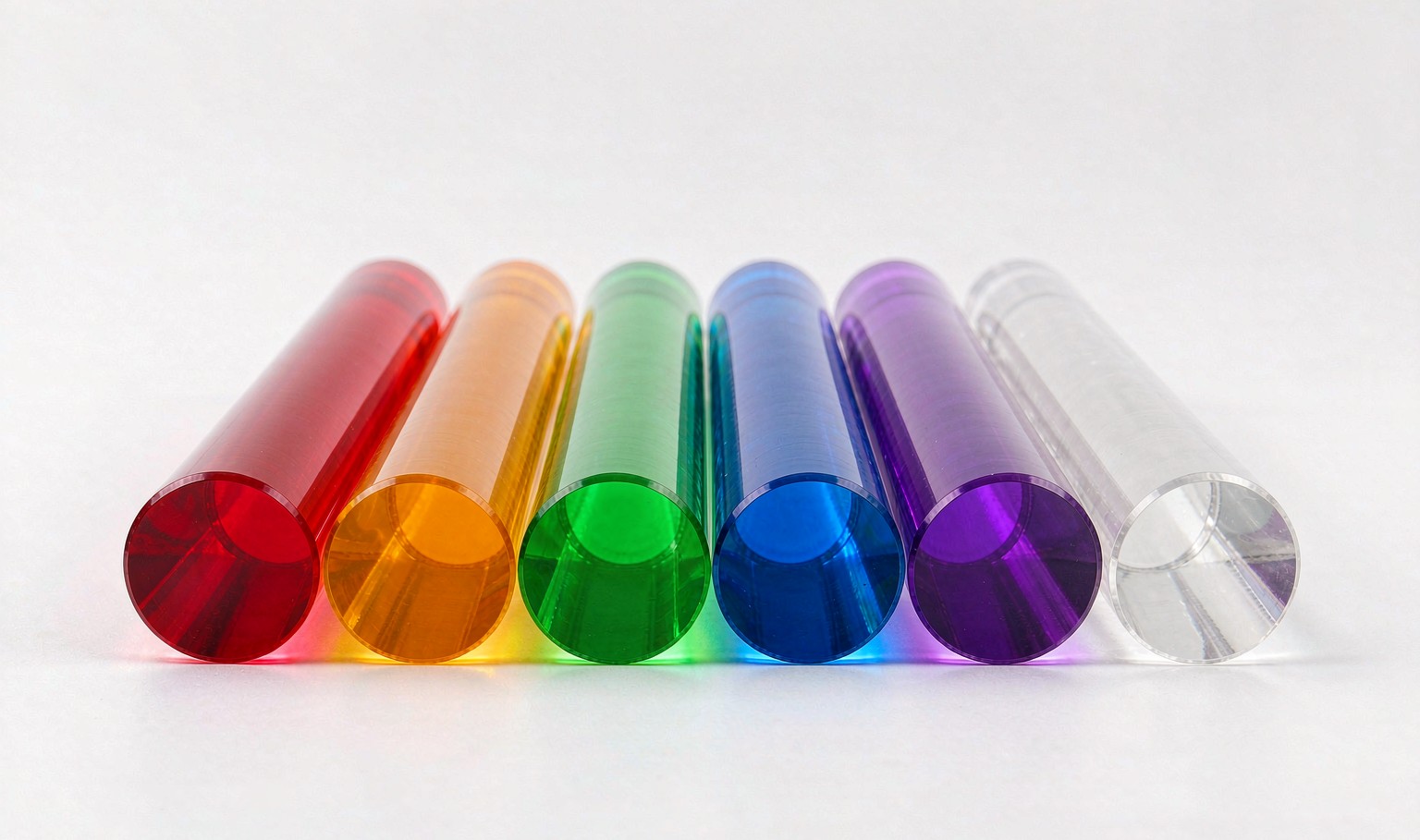
- 1. 1. Why transparent colour is harder than opaque
- 2. 2. Three ways the colour gets in
- 3. 3. The diameter effect nobody warns you about
- 4. 4. What a ΔE number actually means
- 5. 5. Dye or pigment: the durability trade-off
- 6. 6. Batch-to-batch drift, and how to control it
- 7. 7. Five colour faults and their causes
- 8. 8. How to write a colour specification
- 9. 9. Frequently asked questions
- 10. Send us the diameter and the colour you need to match
On this page
- Why transparent colour is harder than opaque
- Three ways the colour gets in
- The diameter effect nobody warns you about
- What a ΔE number actually means
- Dye or pigment: the durability trade-off
- Batch-to-batch drift, and how to control it
- Five colour faults and their causes
- How to write a colour specification
- Frequently asked questions
1. Why transparent colour is harder than opaque
Opaque colour is forgiving. You see the surface, and the surface is the same everywhere, so a small variation in pigment loading is invisible. Transparent colour is not forgiving, for three reasons.
You see through the whole thickness. A transparent rod shows the accumulated colour of every millimetre of material, so any variation in pigment concentration along that path is multiplied. A 0.5 % variation in loading across a 40 mm section is a visible shade difference; the same variation in a 2 mm opaque part is nothing.
Light path length changes with geometry. The colour you see depends on how far light travels through the material. A tint approved on a thin sample becomes much deeper on a thick rod, and a rod viewed end-on looks different from the same rod viewed from the side.
Clarity is part of the specification. An opaque part only has to be the right colour. A transparent part has to be the right colour en clear, and clarity is destroyed by things that would be irrelevant in an opaque material: undispersed pigment particles, moisture haze, micro-bubbles, contamination.
The consequence for buyers: a colour specification for transparent acrylic rod has to state the diameter, the light transmission or clarity requirement, and the acceptable colour difference. "Amber, 20 mm" is not a specification — it is the start of one.
2. Three ways the colour gets in
Understanding the route tells you where variation comes from.
Dispersed in the monomer (casting)
The pigment or dye is dispersed into a concentrated pre-mix, metered into the monomer batch, and mixed before the moulds are filled. Once the mould is full, the colour is fixed — there is no further opportunity to correct it, and the whole batch shares one colour.
This gives excellent within-batch consistency: every rod from that batch is the same colour, because they all came from one homogeneous liquid. The variation risk sits between batches, and it comes from weighing and metering accuracy rather than from mixing.
Masterbatch in the pellets (extrusion)
Colour arrives as masterbatch pellets blended with natural pellets at a let-down ratio, melted and mixed in the screw. Consistency depends on three things: the accuracy of the let-down (usually by a gravimetric feeder), the mixing quality of the screw, and the dispersion quality of the masterbatch itself.
Extrusion has an advantage the casting route does not — the colour can be adjusted during the run, and in-line colour measurement can close the loop. It also has a disadvantage: any fluctuation in let-down ratio shows up immediately as a shade drift along the length of the rod.
Surface colour (neither)
Coating or painting a clear rod is technically possible and commercially rare for rod, because any scratch reveals the clear material underneath and the coating does not survive machining. If a supplier offers a coloured rod at a price well below the market for that colour, ask whether the colour is in the material or on it.
3. The diameter effect nobody warns you about
This is the single most common cause of "the colour is wrong" complaints, and it is almost never the supplier's fault.
Transparent colour deepens with thickness because light travels further through the absorbing medium. Doubling the diameter roughly doubles the optical path, and because absorption is exponential, the effect is more than proportional at higher pigment loadings.
The practical numbers for a typical amber tint:
| Rod diameter | Relative light path | Apparent result |
|---|---|---|
| 6 mm | 1× | Pale amber, almost a hint of colour |
| 12 mm | 2× | Medium amber |
| 25 mm | 4× | Deep amber, clearly saturated |
| 50 mm | 8× | Dark amber to brown, approaching opaque |
Indicative for one tint at one pigment loading. The point is the direction and the scale of the effect, not the specific shade names.
Two practical rules follow:
- Approve colour on the actual diameter. A sample in the wrong diameter is not a colour approval, it is a conversation starter.
- If one colour has to run across several diameters, the pigment loading has to be adjusted per diameter to keep the apparent shade constant. That is a deliberate formulation decision and it should be stated in the quotation, not discovered later.
4. What a ΔE number actually means
Colour difference is measured with a spectrophotometer and expressed as ΔE — a single number combining the differences in lightness and in the two colour axes. It is the only objective way to specify "the same colour".
| ΔE (CIEDE2000) | What a person sees | Where it is appropriate |
|---|---|---|
| < 1.0 | Not perceptible, even side by side | Parts that must match within one assembly, visible together |
| 1.0 – 2.0 | Perceptible to a trained eye on close inspection | Normal commercial tolerance for coloured rod |
| 2.0 – 3.5 | Perceptible at a glance when placed side by side | Acceptable where parts are not seen together |
| 3.5 – 5.0 | Clearly a different colour | Usually a rejection |
| > 5.0 | Different colour family | Rejection |
For transparent materials, three measurement conditions have to be agreed or the number is meaningless:
- The instrument mode. Transmitted colour, not reflected — and on a defined path length, which means a defined diameter or a defined sample thickness.
- The illuminant and observer. D65 and 10° is the common default, but it has to be stated.
- The standard. A retained physical sample, a measured colour value from a master, or a supplier's internal standard. A Pantone code is not adequate for transparent material.
5. Dye or pigment: the durability trade-off
This choice affects both appearance and how long the colour lasts, and it is worth asking about explicitly.
| Soluble dye | Transparent organic pigment | |
|---|---|---|
| Clarity | Best — no particles at all | Very good, very slight haze at high loading |
| Colour strength | Hoog | Moderate — needs higher loading |
| Lightfastness | Poor to moderate; some dyes fade within a season outdoors | Good to excellent |
| Heat stability | Some dyes cannot survive a cast cure or an extrusion melt | Generally good |
| Migration risk | Higher — dyes can migrate into adjacent materials or adhesives | Laag |
| Geschikt voor | Indoor decorative parts, short-life display, very high clarity requirements | Outdoor, long-life, automotive, anything that must not fade |
The failure mode to watch for is a beautiful indoor sample that fades in a shop window. If the part will see daylight, specify pigment and ask for the lightfastness rating. A supplier who cannot state a rating is guessing.
6. Batch-to-batch drift, and how to control it
Even with a fixed formulation, colour drifts between batches. Four mechanisms account for most of it.
Metering error. In casting, the pigment pre-mix is weighed into the batch. A 1 % error in that weighing is a 1 % error in colour strength, which on a saturated colour can exceed a ΔE of 2. The control is a calibrated balance and a record of every batch's weighing.
Pigment lot variation. Pigment suppliers ship lots that differ slightly in strength and undertone. Unless the producer holds a retained sample and re-standardises each incoming lot, that variation passes straight into the rod.
Process temperature. Some pigments shift hue with thermal history — a long hot cast cure or an overheated extruder can move a red toward orange. This is why a colour developed on a small trial sometimes does not reproduce on a full-size rod.
Regrind. Transparent acrylic scrap is often reground and reused. Regrind carries a slightly different thermal history and can darken or dull a transparent colour. If regrind is used, its proportion must be fixed and stated — an unstated regrind ratio is the most common hidden cause of shade drift.
The controls that actually work are unglamorous: a retained physical standard kept in the dark, a spectrophotometer reading recorded for every batch, a fixed regrind ratio, and incoming pigment lots re-standardised rather than trusted.
7. Five colour faults and their causes
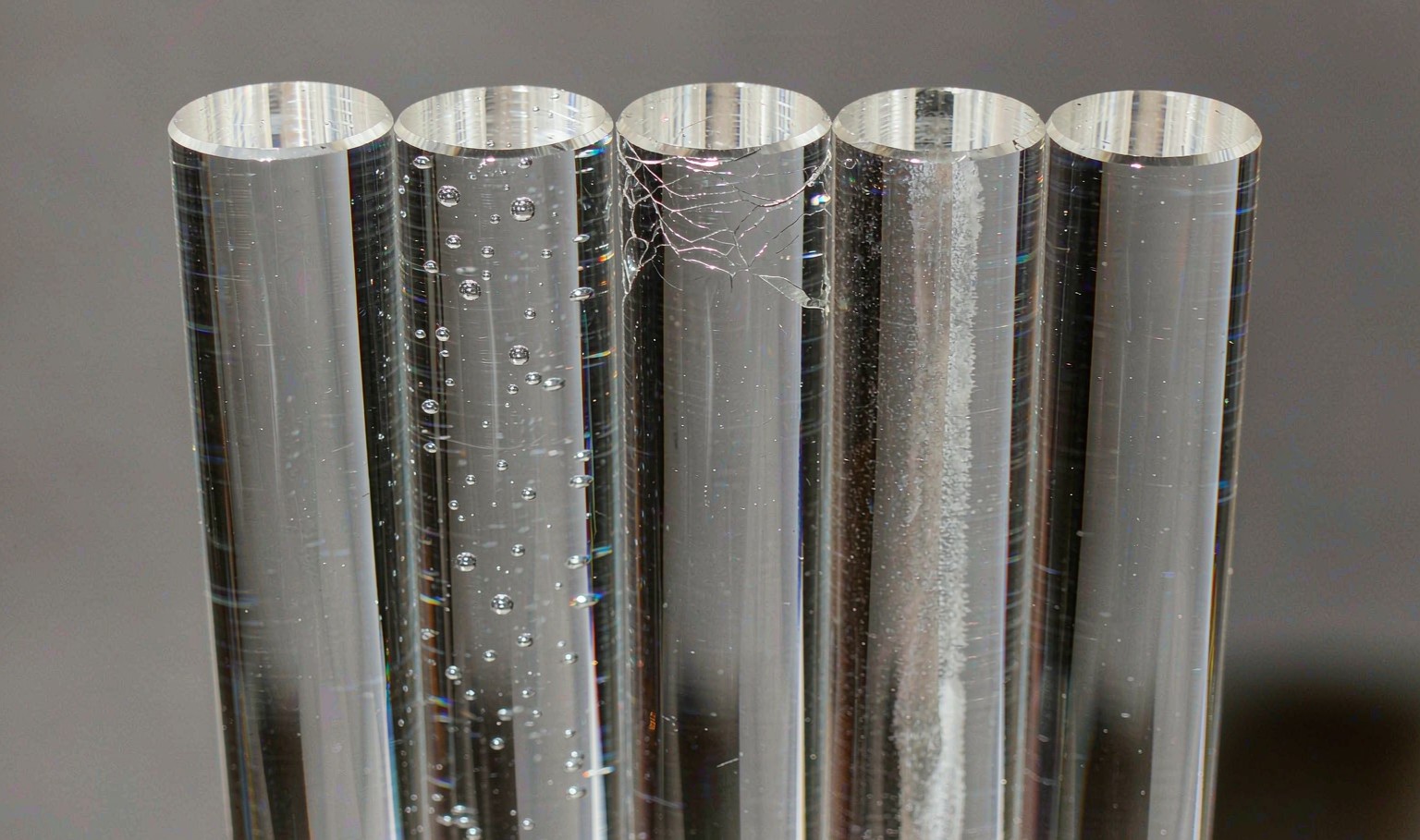
| Fault | What it looks like | Oorzaak | Fix |
|---|---|---|---|
| Streaks | Swirling or directional lines of stronger and weaker colour | Poor dispersion — undispersed pigment clusters, or inadequate screw mixing in extrusion | Better pre-dispersion; higher back pressure and melt temperature; finer masterbatch |
| Haze | Overall milkiness rather than a colour problem | Moisture in the pellets, contamination, or incomplete polymerisation in casting | Verify drying; check monomer and initiator; check for cross-contamination in the feed system |
| Yellowing | A warm cast that should not be there, worse after time or heat | Thermal degradation during processing, or UV exposure in service | Lower melt temperature and residence time; specify UV-stabilised grade for outdoor use |
| Shade drift along the length | Colour starts correct and shifts through a run | Masterbatch let-down drift, or a feeder running low | Gravimetric feeding with in-line colour measurement; refill before the feeder runs low |
| Colour only in patches | Local dark or light areas, sometimes at the ends | Insufficient mixing in the mould during casting, or pigment settling | Correct pre-dispersion and agitation; check the fill procedure |
8. How to write a colour specification
A specification that a supplier can actually work to has seven elements. Most complaints trace back to one of them being missing.
- Reference. A physical sample you have approved, retained by both parties and kept in the dark. Codes alone are not enough for transparent material.
- Diameter. The actual diameter the colour will be judged on, because the light path sets the apparent shade.
- Transparent or translucent. "Clear coloured" is ambiguous. State whether you need to see through it or only to see a glow.
- Measurement condition. Transmitted mode, path length, illuminant and observer, and the ΔE limit.
- Lightfastness requirement. Whether the part is indoor or outdoor, and for how long. This decides dye versus pigment.
- Clarity requirement. Any visible bubble, streak or haze limit — ideally stated as a reference sample with the maximum acceptable defect marked on it.
- Repeat-order expectation. Whether this is a one-off or a programme with quarterly reorders. Repeat programmes justify the cost of a retained standard and a spectrophotometer record.
9. Frequently asked questions
Why does my acrylic rod look a different colour from the sample?
Almost always the diameter. Transparent colour deepens as the light path through the material increases, so a tint approved on a 10 mm sample looks much darker on a 30 mm rod. Check the diameter first before questioning the formulation.
Can transparent acrylic rod match a Pantone colour exactly?
No. Pantone is defined for opaque, reflected colour. A transparent rod transmits light, so its appearance depends on the background, the lighting and the viewing angle. The practical approach is to match a physical transparent sample at the correct diameter and hold that as the standard.
How much colour variation is normal between batches?
A ΔE of 1.0 to 2.0 is a normal commercial tolerance for coloured rod. Below 1.0 is achievable but costs more, because it requires tighter pigment metering and re-standardising every incoming pigment lot. Above 3.5 the colours are visibly different and should be rejected.
Will coloured acrylic rod fade outdoors?
It depends on the colorant. Dyes can fade noticeably within a season in strong sunlight; transparent organic pigments are far more durable. Standard PMMA itself has good UV resistance and does not yellow like polycarbonate, but the colorant is usually the limiting factor. For outdoor parts, specify pigment and a UV absorber.
Is the colour the same all the way through the rod?
Yes. The colour is in the material, not on the surface, so cutting, machining and polishing do not reveal a different colour underneath. This is one reason to be suspicious of unusually cheap coloured rod — it may be coated.
Can I get the same colour in a different diameter?
Yes, but the pigment loading usually has to be adjusted to keep the apparent shade constant. Tell the supplier the full range of diameters you need at the quoting stage, not after the first delivery.
Send us the diameter and the colour you need to match
We will send a sample on the actual diameter, state the pigment type and lightfastness rating, and quote with a ΔE tolerance in writing — so the shade you approve is the shade that arrives on the third reorder.






 NL
 EN
 ES
 FR
 DE
 PT
 AR
 RU
 JA
 KO
 IT
 TR
 PL
 ID
