
- 1. The material that changes size after it leaves you
- 2. Grades
- 3. Moisture: drying, then re-absorbing
- 4. Processing window
- 5. Design rules
- 6. Gears and wear parts
- 7. Defects and causes
- 8. The moisture gradient: why thick parts keep moving
- 9. Glass fibre: what you gain and what you lose
- 10. Under-bonnet: the real requirements
- 11. Frequently asked questions
The material that changes size after it leaves you
Polyamide — nylon 6 and nylon 66 — is the workhorse engineering plastic for anything that needs toughness, wear resistance, temperature resistance and resistance to oils and fuels. Gears, bushes, cable ties, connectors, under-bonnet parts, power-tool housings and conveyor components are all nylon.
It also has a property that causes more quality disputes than any other in injection moulding: it absorbs water and grows. A dry PA66 part left in a normal room reaches equilibrium at 1.5 – 2.5 % moisture and grows by 0.3 – 0.6 % in every dimension. That is 0.3 mm on a 50 mm part. If the drawing does not say whether the tolerance applies to the dry part or the conditioned part, the drawing is incomplete.
The number to design around: unmodified PA66 grows 0.3 – 0.6 % between the dry-as-moulded state and equilibrium at 23 °C / 50 % RH. Glass-filled grades grow 0.1 – 0.2 %. This is not shrinkage — that happens in the tool — it is moisture uptake in service, and it continues for weeks after moulding.
Grades
| Grade | Key property | Moisture uptake at equilibrium | Used for |
|---|---|---|---|
| PA6 unfilled | Tough, good surface, cheaper | 2.5 – 3.0 % | Bushes, general parts |
| PA66 unfilled | Higher strength and HDT than PA6 | 1.5 – 2.5 % | Gears, structural parts |
| PA6 / PA66, 30 % GF | Modulus 9 – 10 GPa, HDT 200 °C+ | 0.8 – 1.5 % | Brackets, housings, fans |
| PA66, 30 – 35 % GF, heat stabilised | Continuous 150 °C | 0.8 – 1.2 % | Under-bonnet |
| PA6, impact modified | Notched Izod 80 – 120 J/m | 2.0 – 2.8 % | Power tools, sports goods |
| PA66, mineral filled | Low warp, good surface | 1.2 – 1.8 % | Automotive exterior |
| PA12 / PA11 | Lowest moisture uptake, flexible | 0.8 – 1.2 % | Fuel lines, precision parts |
| PA6/6T, PPA | High temperature, low moisture | 0.3 – 0.6 % | Lead-free solder reflow, automotive |
| Cast PA (MC nylon) | Very high molecular weight | 2.0 – 2.8 % | Large bushes, sheets — not moulded |
Table 1 — Polyamide grades. PA12 and PPA exist mainly to solve the moisture problem.
Moisture: drying, then re-absorbing
There are two completely separate moisture issues with nylon, and confusing them is the root of most problems.
| Issue | When | Target | Consequence if wrong |
|---|---|---|---|
| Too wet at the hopper | Before moulding | < 0.1 % (PA6), < 0.08 % (PA66) | Hydrolysis: molecular weight drop, brittle parts, silver streaks |
| Too dry in service | After moulding | Conditioned to 1.5 – 2.5 % | Part grows, but also becomes tougher — dry nylon is brittle |
Table 2 — The two moisture problems. They have opposite targets.
| Drying method | PA6 | PA66 | PA66-GF30 |
|---|---|---|---|
| Desiccant dryer, 80 °C | 4 – 6 h | 4 – 6 h | 3 – 4 h |
| Desiccant dryer, 100 °C | 2 – 3 h | 2 – 3 h | 2 h |
| Vacuum dryer, 90 °C | 1.5 – 2 h | 1.5 – 2 h | 1 – 1.5 h |
| Hot air oven, 90 °C | 6 – 8 h | 6 – 8 h | 4 – 6 h |
| Dew point requirement | −20 °C | −20 °C | −20 °C |
Table 3 — Drying schedules. Over-drying above 110 °C oxidises nylon and yellows it.
Note the second row of Table 2: dry nylon is brittle. A freshly moulded, bone-dry PA66 part will snap where the same part conditioned for two weeks will bend. This is why nylon parts are often conditioned deliberately — either by leaving them in a humid chamber, or by boiling them in water for 30 – 60 minutes, which accelerates uptake to near-equilibrium in an hour.
| Conditioning method | Time to equilibrium | 참고 |
|---|---|---|
| Ambient, 23 °C / 50 % RH | 2 – 6 weeks (depends on wall) | Uncontrolled; not a process |
| Humidity chamber, 70 % RH | 1 – 2 weeks | Controllable and repeatable |
| Hot water, 80 – 100 °C | 1 – 4 h | Fast; can relieve stress too |
| Steam autoclave | 1 – 2 h | Fastest; risk of over-absorption |
Table 4 — Conditioning routes. Hot water is the practical answer for production.
Myth: "the part measured 50.00 mm, so it's in tolerance." If it was measured an hour after moulding, it was still dry. Three weeks later it measures 50.25 mm and the customer rejects it. Every nylon drawing must specify the conditioning state — dry as moulded, or conditioned to 23 °C / 50 % RH — and the two give different nominal dimensions.
Processing window
| 매개변수 | PA6 | PA66 | PA66-GF30 |
|---|---|---|---|
| 용융 온도 | 230 – 260 °C | 270 – 295 °C | 280 – 300 °C |
| Barrel profile | 220 / 235 / 245 / 250 °C | 250 / 270 / 285 / 290 °C | 260 / 280 / 295 / 295 °C |
| Mould temperature | 60 – 90 °C | 70 – 100 °C | 80 – 100 °C |
| Injection pressure | 70 – 110 MPa | 80 – 130 MPa | 90 – 150 MPa |
| Injection speed | 빠른 | 빠른 | Moderate — fibre breakage |
| Hold pressure | 50 – 70 % of injection | 50 – 70 % | 60 – 80 % |
| Back pressure | 0.5 – 1.0 MPa | 0.5 – 1.0 MPa | 0.3 – 0.8 MPa |
| Residence time | < 8 min | < 6 min | < 6 min |
| 수축 | 1.2 – 2.0 % | 1.0 – 2.0 % | 0.2 – 0.5 % |
| Regrind | Up to 25 % | Up to 25 % | Up to 15 % (fibre shortening) |
Table 5 — Processing windows. PA66 needs roughly 35 °C more melt temperature than PA6 for the same viscosity.
Mould temperature is the lever that controls crystallinity, and therefore strength, wear resistance and dimensional stability. A PA66 part moulded at 40 °C has a thin amorphous skin, low crystallinity in the core, and poor wear resistance; the same part at 90 °C is fully crystalline and performs as the datasheet says. For gears and wear parts, a hot mould is not optional.
Design rules
| 기능 | Rule | Why nylon is different |
|---|---|---|
| Wall thickness | 1.0 – 3.5 mm | Thick walls have a moisture gradient for months |
| Wall uniformity | Within 15 % | Differential moisture uptake causes warpage after moulding |
| Draft | 0.5 – 1° | Nylon releases well and is slippery |
| Ribs | 0.5 × wall | Thicker ribs hold moisture differently and swell |
| Bosses | Wall 0.6 × nominal | Boss cores stay hot; voids form |
| Gate | Large; avoid restrictive gates on GF grades | High shear degrades melt and breaks fibres |
| Tolerance | Do not specify below ±0.1 mm on unfilled PA | Moisture movement exceeds the tolerance |
| Metal inserts | Design for 1 % differential growth | Nylon grows; metal does not — inserts can split the boss |
| Sharp corners | Internal R ≥ 0.5 × wall | Nylon is notch sensitive when dry |
Table 6 — Nylon design rules. The tolerance row is the one that causes the most arguments.
Gears and wear parts
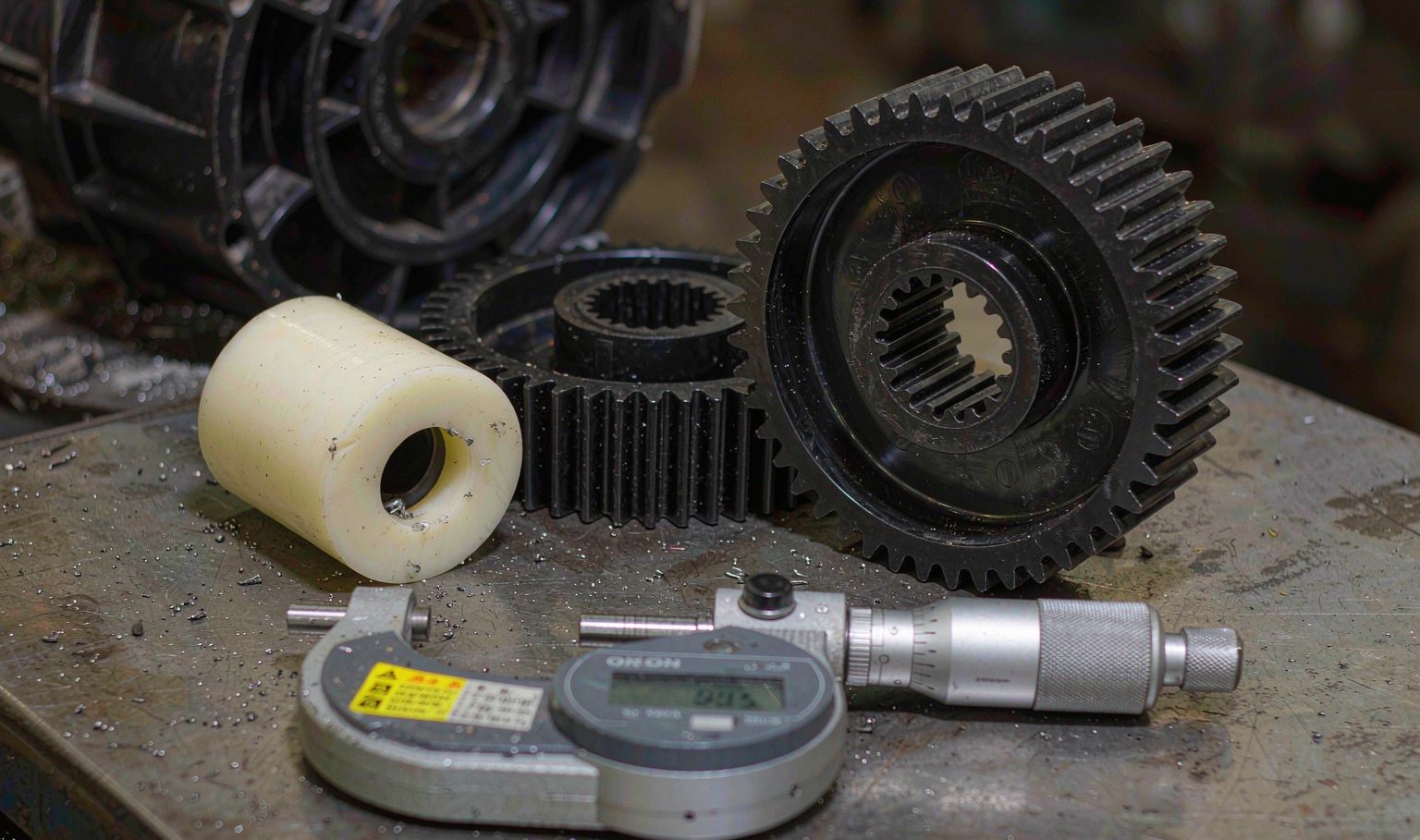
Nylon is the default material for moulded gears and bushes, and the reasons are specific: it has a low coefficient of friction, it tolerates shock loads, it runs without external lubrication in many applications, and it damps noise.
| Requirement | Grade | Design note |
|---|---|---|
| Low load, quiet running | PA66 unfilled | Cheapest; swells most |
| Higher torque | PA66 + 30 % GF | Stronger but more abrasive to the mating gear |
| Mating pair | PA66 gear + POM pinion | Dissimilar materials reduce wear and noise |
| High speed | PA46 or PPA | Better heat resistance at the tooth flank |
| Wet environment | PA66 + GF, or POM | POM absorbs less water and holds tolerance better |
| Food contact | PA66 natural, food grade | Check the colourant |
Table 7 — Gear material selection. Never run nylon against nylon in a loaded pair — it welds and tears.
Gear tolerances need a note: a moulded nylon gear is normally specified to AGMA 8 – 9 or DIN 9 – 10, not to the precision of a machined gear. If the application needs better, the gear is machined from cast nylon or from POM.
Defects and causes
| 결함 | 원인 | Fix |
|---|---|---|
| Brittle parts | Over-dried, over-heated, or too much regrind | Check moisture (not too low), melt temperature and regrind ratio |
| Silver streaks | Moisture above 0.15 % | Dry longer or hotter; check dew point |
| Bubbles in thick sections | Moisture, or voids from shrinkage | Dry; increase hold pressure and time |
| Warpage weeks after moulding | Differential moisture uptake from uneven walls | Uniform walls; condition before inspection |
| Dimensions drifting in service | Moisture uptake | Specify conditioned dimensions; use GF grade or PA12 |
| Flash | Low viscosity at high melt temperature | Lower melt; check clamp tonnage |
| Short shots on GF grades | High viscosity, cold mould | Raise melt and mould temperature; enlarge gates |
| Yellow / brown parts | Over-heating or long residence | Lower melt 10 °C; reduce barrel residence |
| Cracks around inserts | Insert expansion plus dry, brittle nylon | Condition the part; increase boss wall; pre-heat inserts |
Table 8 — Nylon defects. "Brittle" and "wet" can both be true at once — they are different faults.
The moisture gradient: why thick parts keep moving
Moisture enters nylon from the surface. On a 1 mm wall, equilibrium is reached in a few weeks and the whole section moves together. On a 5 mm wall, the outside reaches equilibrium in weeks while the core is still dry, and the part continues to change shape for months.
| Wall thickness | Time to 90 % of equilibrium at 23 °C / 50 % RH | Time at 70 % RH |
|---|---|---|
| 1 mm | 2 – 3 weeks | 1 – 2 weeks |
| 2 mm | 5 – 8 weeks | 3 – 5 weeks |
| 3 mm | 10 – 16 weeks | 6 – 10 weeks |
| 5 mm | 6 – 10 months | 3 – 5 months |
| 8 mm | 18 – 30 months | 10 – 18 months |
Table 9 — Moisture diffusion times for unfilled PA66. Thick sections are never in equilibrium in service.
The engineering consequence is that a thick nylon part should be designed as a dry part with generous tolerances, or made from a glass-filled grade, or made from PA12. Specifying ±0.05 mm on a 5 mm thick unfilled PA66 part is not achievable in any state, because the part is a different size in every month of its first year.
The practical rule: if the wall is under 2 mm and the drawing specifies the conditioning state, unfilled PA is workable. If the wall is over 3 mm, or the tolerance is tighter than ±0.1 mm, move to a glass-filled grade. Above 5 mm, move to PA12 or accept that the tolerance applies only at one defined moisture content.
Glass fibre: what you gain and what you lose
| 속성 | PA66 unfilled | PA66 + 30 % GF | Change |
|---|---|---|---|
| Tensile strength | 80 MPa | 185 MPa | +130 % |
| Flexural modulus | 2.8 GPa | 9.5 GPa | +240 % |
| HDT at 1.82 MPa | 75 °C | 250 °C | +175 °C |
| Elongation at break | 25 – 60 % | 2 – 3 % | −90 % |
| Notched Izod | 50 – 70 J/m | 70 – 95 J/m | +40 % |
| Moisture growth in service | 0.3 – 0.6 % | 0.1 – 0.2 % | −65 % |
| 수축 | 1.2 – 2.0 % | 0.2 – 0.5 % | −75 % |
| 뒤틀림 | Low–moderate | High (anisotropic) | Worse |
| Abrasion of the tool | 낮음 | 높음 | Requires hardened steel |
| Weld line strength | 70 – 90 % of parent | 40 – 60 % of parent | Much worse |
Table 10 — The cost of glass. Stiffness and stability go up; elongation, weld strength and tool life go down.
The weld-line row is the one that fails parts in the field. In a glass-filled material, the fibres do not cross the weld — they lie parallel to the weld line, so there is a plane of unreinforced resin across the part. A 30 % GF nylon part with a weld line in a loaded location behaves like an unfilled part there, and often worse, because the fibres create a notch. If a weld line cannot be avoided, move it out of the load path or use a mineral-filled grade where the filler is more isotropic.
Under-bonnet: the real requirements
| Condition | Test | Grade requirement |
|---|---|---|
| Continuous heat | 1,000 h at 120 – 150 °C | Heat-stabilised PA66, or PA66/PPA |
| Peak heat | 1,000 h at 150 – 180 °C | PA66/6T, PPA, or PA46 |
| Thermal cycling | −40 to +150 °C, 1,000 cycles | Heat-stabilised, impact modified |
| Hot air ageing | 1,000 h at 150 °C, property retention > 50 % | Heat-stabilised grade only |
| Coolant contact | Glycol at 100 °C | Hydrolysis-stabilised |
| Fuel contact | Petrol, diesel, ethanol blends | PA12 or a fuel-resistant grade |
| Salt spray | 500 h | Not a nylon property — protect the inserts |
Table 11 — Under-bonnet requirements. The heat-stabiliser package is what separates an automotive grade from a general-purpose one.
Heat stabilisation is a real additive package, not marketing. Unstabilised PA66 loses about 70 % of its tensile strength after 1,000 hours at 150 °C; a properly stabilised grade loses 20 – 30 %. The difference is a copper or organic stabiliser system that interrupts the thermal oxidation chain. It costs 10 – 20 % more per kilogram and it is not optional for anything that lives near an engine.
Frequently asked questions
Should I specify PA6 or PA66?
PA66 for higher strength, stiffness and heat resistance; PA6 for toughness, surface finish and cost. PA6 also processes 30 – 40 °C cooler, which matters if your machine is limited. For most general parts the difference is small; for under-bonnet or high-temperature work, PA66 or a high-heat grade.
Why do my nylon parts measure differently a month later?
Moisture uptake. Dry nylon grows 0.3 – 0.6 % as it absorbs water to equilibrium. Either specify and inspect in the conditioned state, or switch to a glass-filled grade where the growth is 0.1 – 0.2 %, or to PA12/PPA where it is lower still.
Can I boil nylon parts to condition them?
Yes — 30 – 60 minutes in water at 80 – 100 °C brings most parts close to equilibrium and also relieves moulding stress. It is a standard production step for nylon gears and bushes. Do not boil glass-filled parts for long periods; the sizing on the fibre can be affected.
How much regrind can I use?
Up to 25 % on unfilled grades, 15 % on glass-filled (the fibres shorten with each pass). Regrind must be dried again, and it must be the same grade and colour. Do not use regrind in parts that will be conditioned and held to tolerance.
What is the difference between PA6 and PA6/6T?
PA6/6T is a semi-aromatic polyamide with a much higher melting point (around 325 °C) and much lower moisture uptake. It is used where the part must survive lead-free solder reflow (260 °C) or hold tolerance in humid conditions. It costs 3 – 5× PA66 and needs a hot-runner system rated for 340 °C.
Why is my glass-filled nylon part warping?
Fibre orientation. Glass fibres align with the flow and restrain shrinkage strongly in that direction and weakly across it, so a part with a long flow path warps. Fixes: gate from the centre, use a mineral/glass hybrid filler, raise mould temperature, or redesign the wall to be more uniform.
Does nylon need a hot runner?
Not necessarily, but it benefits more than most materials. Nylon's high melt temperature and narrow processing window mean a cold runner wastes a lot of material and creates a lot of regrind. On a 16-cavity tool the runner can be 60 % of the shot.
Is nylon UV stable?
No. Unstabilised nylon yellows and embrittles outdoors within a year. UV-stabilised grades extend this to 3 – 5 years, and carbon-black-filled grades do better. For long outdoor life, use a painted or coated part, or a different material.
Moulding a nylon part and fighting tolerance drift?
Send the drawing with the conditioning state and the service environment. We will tell you whether the tolerance is achievable in unfilled PA, or whether the part needs a glass-filled grade.
Continue reading
- POM (Acetal) Injection Molding: Thermal Stability and Tooling
- PBT and PET Injection Molding: Glass Fibre, Drying and Warpage
- Injection Molding Tolerances: What Is Actually Achievable
- Injection Molding Material Selection: 14 Plastics Compared
- Custom Injection Molding Guide: Process, Cost & Tolerances




 KO
 EN
 ES
 FR
 DE
 PT
 AR
 RU
 JA
 IT
 NL
 TR
 PL
 ID
