
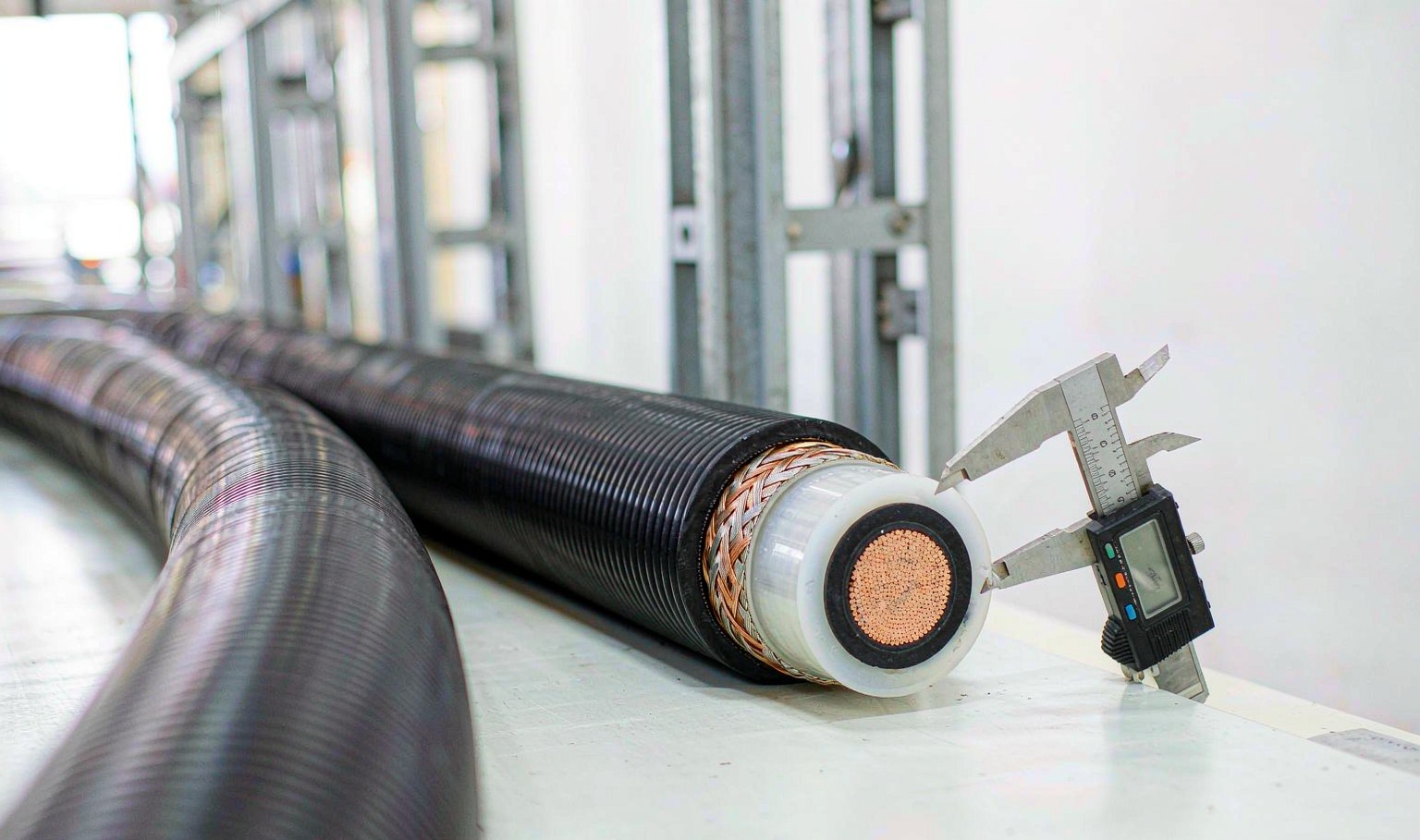
Why polyethylene has to be crosslinked
Polyethylene is a thermoplastic. Heat it past about 110 C and it softens; past 135 C it flows. An insulation that softens at 110 C cannot hold a 90 C continuous rating with any margin, and it cannot survive the 250 C of a short circuit for the second or two it takes a protection device to operate.
Crosslinking joins the polymer chains into a three dimensional network. The material no longer melts. It softens, it chars, and eventually it burns, but it holds its shape and its dielectric strength. A crosslinked polyethylene insulation is rated 90 C continuous, 130 C emergency and 250 C for five seconds at short circuit, and it keeps its electrical integrity at all three.
The crosslink is a covalent bond between chains, and it is measured as gel content: the fraction of the polymer that will not dissolve in hot xylene. Zero gel is a thermoplastic. Sixty percent gel is a serviceable cable. Ninety percent is a fully cured one, and the difference between sixty and ninety is a lot of cure time for very little rating.
Gel content is the number that matters
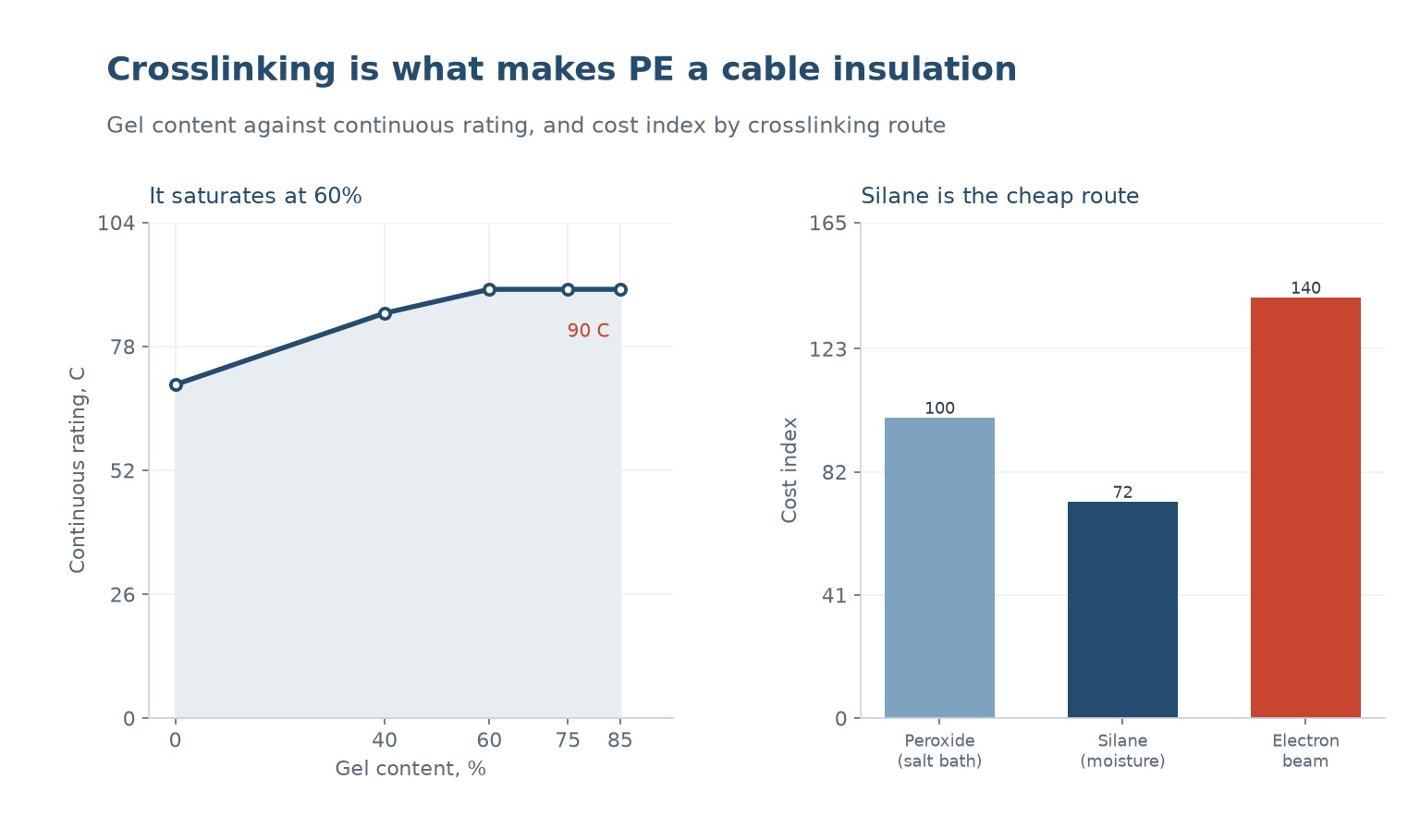
The continuous rating tracks gel content and then saturates. At zero gel the rating is 68 C, which is a thermoplastic polyethylene. At 40 percent it is 86 C, at 60 percent 92, at 75 percent 93, and at 85 percent still 93.
The saturation is the useful part. The target is a threshold, not a maximum: get above about 60 percent and the rating is there, and pushing to 85 costs cure time and buys nothing at all. A line running at 85 percent gel for a 90 C cable is a line giving away capacity.
It also means an under-cured cable is not obviously bad. At 40 percent gel the rating is 86 C instead of 93, which passes a 90 C type test on a good day and fails it after a few years of thermal ageing. That is why gel content is measured on a sample from every run rather than on a type test sample once.
Peroxide: the continuous vulcanising tube
Dicumyl peroxide is compounded into the polyethylene before extrusion. It is stable at the extrusion temperature of 120 to 130 C and decomposes above about 175 C, which is the whole trick: the compound can be extruded as a thermoplastic and then cured in place, after it is already on the conductor.
Curing happens in a continuous vulcanising tube. The cable passes from the crosshead into a tube of pressurised nitrogen at 180 to 200 C, where the peroxide decomposes and the chains link. The pressure, 10 to 15 bar, exists to stop the gas the decomposition produces from forming voids in the insulation. Without it you get a sponge, not a dielectric.
The tube is the cost. It is 40 to 120 m long, it runs at 1 to 3 m a minute for a thick wall, and the cable has to be degassed afterwards in a chamber at 70 to 80 C for several days to remove the methane and acetophenone the reaction leaves behind. That degassing is why a peroxide cable smells of solvent when you cut it.
Peroxide is the route for medium and high voltage, from 6 kV up. It gives the highest gel content and the cleanest dielectric, and the wall can be 20 mm or more, which no other route reaches.
Silane: graft first, then cure with water
Silane crosslinking grafts a vinyl trimethoxy silane onto the polymer chain during extrusion, then hydrolyses it with water. The grafted chain carries methoxy groups that react with moisture to form siloxane bridges between chains, so the cure happens after the cable is made and it happens from the outside in.
The extrusion is a normal thermoplastic process at 150 to 200 C, and the cable is then cured in a water bath or a steam chamber at 80 to 90 C. For a 3.5 mm wall that is four to eight hours. For a 7 mm wall it is closer to a day, because the water has to diffuse to the middle of the wall and diffusion time goes with the square of the thickness.
That is the limitation of the route, and it is a hard one. Silane is a low voltage technology: 1 kV as standard, and up to 10 kV with care. It cannot make a 15 mm wall, because the outside would be fully cured while the inside was still thermoplastic, and the interface between them is where it would fail.
It is also the cheap route, and it needs no tube. A silane line is an extruder, a water trough and a great deal of floor space for the curing, plus the working capital of a day of production sitting in a bath. At high volume on small cable, that is the cheapest crosslinked metre there is.
Electron beam, and what the other two cost
Electron beam crosslinking passes the finished cable through a beam of 1 to 3 MeV electrons. There is no peroxide and no water: the beam breaks carbon-hydrogen bonds, and the radicals that form recombine into crosslinks within milliseconds. The cable is cured as it leaves the extruder.
Penetration is the limit. A 2 MeV beam reaches about 2 mm of polyethylene, so the process suits wire and small cable with a thin wall, not a 10 mm power cable. The cable is also passed through the beam from several sides to even out the dose, which is a machine that costs more than the tube it replaces.
Cost index, with peroxide at 100: silane is 72 and electron beam is 140. Silane is cheaper because the equipment is an extruder and a water bath. Electron beam is dearer because an accelerator is a capital item and the line has to be shielded with a concrete bunker.
The index is not the whole comparison. Silane's 72 is a per-metre figure at high volume; at low volume the curing inventory dominates, because a day of production is a day of cash sitting in a trough. Electron beam has no inventory at all, which is why it survives in appliance wire where the runs are short.
What goes wrong on each route
Voids in a peroxide cable are gas bubbles trapped because the nitrogen pressure was low or the tube temperature was too high. They show up as a partial discharge on a test set, and a drum that fails partial discharge is scrap, not rework. There is no way to get a bubble out of a 15 mm wall.
Under-cure shows up as low gel content and a high hot-set elongation. The hot-set test stretches a sample under load at 200 C for fifteen minutes, releases the load and measures the residual stretch; an under-cured sample keeps going. It is the routine production check because it takes twenty minutes and needs no xylene.
Scorch in a silane line is premature cure inside the extruder, from moisture in the feed or a hot zone. It appears as gels and lumps in the insulation, it raises the pressure at the head, and it requires the screw to be pulled and cleaned. Drying the feed is the whole prevention.
Water trees are the long term failure of an under-cured or contaminated crosslinked insulation in a wet environment. They grow from a defect under voltage, they are visible as a fog in a sliced section, and they are the reason a medium voltage cable is specified on cleanliness as much as on gel content.
Choosing a route
Voltage decides first. Above 10 kV there is only peroxide, because it is the only route that will build the wall. Below 1 kV at high volume it is silane, because it is the cheapest metre. Thin wall and heat sensitive is electron beam, if there is an accelerator within reach.
| Route | Wall range | Cure | Cost index | Typical use |
|---|---|---|---|---|
| Peroxide, CV tube | 1.5-25 mm | 180-200 C in N2, then days of degassing | 100 | MV and HV power cable |
| Silane, moisture | 0.5-6 mm | 80-90 C water, 4 h to a day | 72 | LV building wire, control cable |
| Electron beam | 0.2-2 mm | Seconds, in line | 140 | Appliance wire, thin wall |
Table 1 — The three crosslinking routes and what each can build
| Test | What it measures | Frequency |
|---|---|---|
| Gel content | Cure level, absolute | Each run |
| Hot set | Cure level, fast | Each shift |
| Partial discharge | Voids in the wall | Each drum, MV |
| Tensile and elongation | Ageing, compound | Type test and periodic |
Table 2 — What is actually measured on a crosslinked cable line
What gel content should a crosslinked cable have?
Above 60 percent for the rating to reach the 90 C class, and most specifications call for 75 to 80 percent minimum. Above 85 percent the rating does not move, so the cure time is wasted.
Why does XLPE cable smell of solvent?
The peroxide decomposition products, mainly acetophenone and methane, left in the insulation. A proper degassing removes most of it, and what you smell is what is still there.
Can silane cable be used at 10 kV?
In principle up to 10 kV, in practice rarely. The moisture cure limits the wall thickness and the gel content is lower than a peroxide cable, so the margin is thin.
How long does a moisture cure take?
Four to eight hours for a 3.5 mm wall at 90 C, and roughly four times that for a 7 mm wall. The cure is diffusion limited, so the time goes with the square of the thickness.
What is a hot set test?
A sample is stretched under load at 200 C for fifteen minutes, the load is released, and the residual elongation is measured. An under-cured sample keeps stretching instead of springing back.
Is electron beam crosslinking better?
It is cleaner and much faster, but a 2 MeV beam only reaches about 2 mm of polyethylene. For thin wall appliance wire it is excellent; for power cable it is not an option.
A crosslinked cable that fails gel content or partial discharge?
Send the construction, the wall and the failure. We will tell you whether it is cure, compound or the tube, and which route suits the wall you need.
Continue reading
- Wire Insulation Extrusion: Concentricity, Wall and the Spark Tester
- Cable Jacket Extrusion: Pressure Die, Drawdown and Surface Finish
- Cable Trunking Profile: Extruding a Straight Length That Stays Straight
- Silicone Wire Harness Seal: The Grommet That Keeps Water Out
- Plastic Extrusion Solutions: Profile, Sheet, Pipe and Tube




 KO
 EN
 ES
 FR
 DE
 PT
 AR
 RU
 JA
 IT
 NL
 TR
 PL
 ID
