
The wall is a minimum, not a nominal
An insulated wire is specified by its conductor size and its minimum wall. Not its average wall, and not its nominal wall: the minimum, at any point around the circumference and at any point along the length. That is because the wall is a dielectric, and a dielectric fails where it is thinnest.
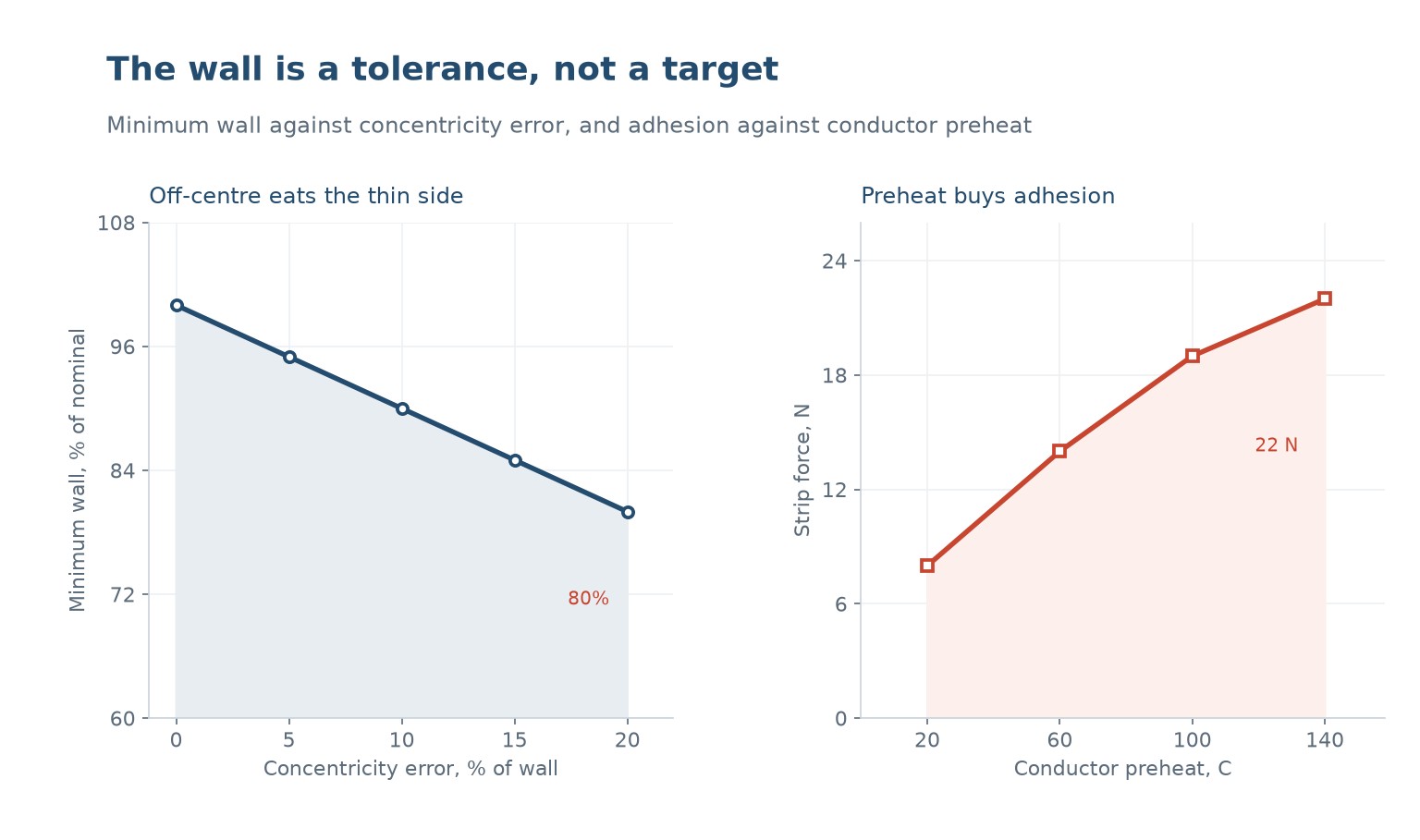
This changes what concentricity means. A wire with a 0.30 mm nominal wall and perfect concentricity has 0.30 mm everywhere. The same wire with a 10 percent concentricity error has 0.33 mm on the thick side and 0.27 mm on the thin side, and it is a 0.27 mm wire for every purpose that matters.
The loss is linear in the error. At 5 percent the minimum wall is 95 percent of nominal, at 10 percent it is 90, at 15 percent it is 85 and at 20 percent it is 80. A tolerance of 10 percent on concentricity is therefore a 10 percent loss of dielectric strength, and the specification has to account for both.
Centring is a die adjustment, and it drifts
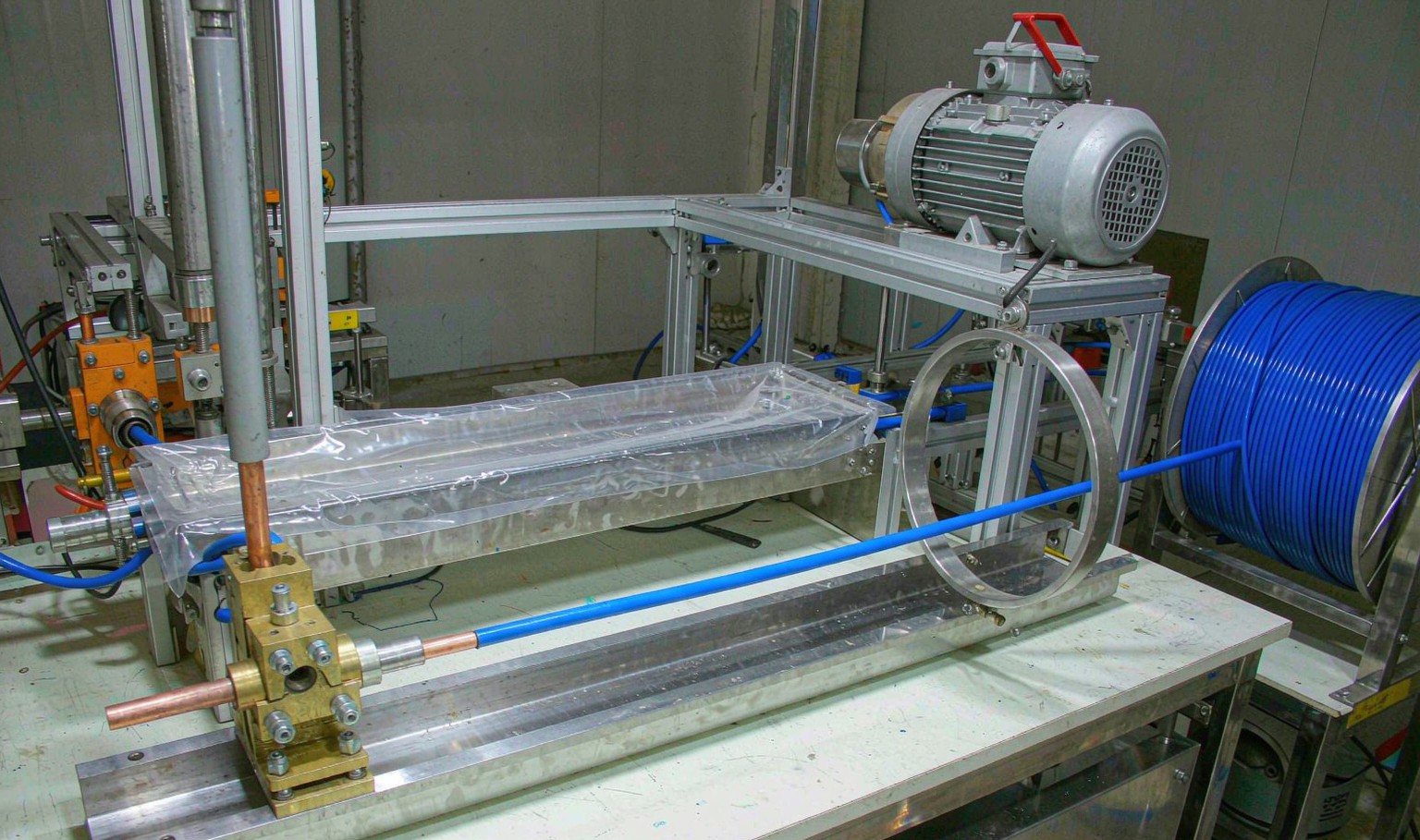
The conductor is centred inside the insulation by the crosshead die, and the centring is set with adjusting screws on the die body. It is a mechanical setting on a hot, pressurised assembly, and it moves: with thermal expansion as the line heats up, with wear on the die, and with any change in the pull direction downstream.
The consequence is that concentricity is not a fixed property of the tool, it is a state that has to be checked. A line that was centred at the start of a shift is not necessarily centred at the end, and the check is a section of wire under a microscope or an optical gauge, taken at the die and again at the take-up.
The most common cause of a sudden concentricity change is not the die at all. It is the tension on the take-up, or a guide roller that has moved, pulling the conductor to one side as it leaves the die. The die is adjusted to compensate, which makes the next change worse, and the real problem is downstream.
Preheat is what stops the insulation sliding
A conductor at room temperature meets melt at 180 to 200 C, and the interface cools instantly. The result is a skin of solidified polymer that does not wet the copper, and the adhesion is poor. Strip force on a cold conductor is about 8 N, which is low enough that the insulation can slide back in a terminal crimp.
Preheating the conductor to 100 to 140 C before the die changes the interface. The melt stays fluid long enough to wet the copper, and the strip force rises to 19 to 22 N. That is the difference between an insulation that grips and one that moves, and it is why a preheat unit is standard on a wire line and not an option.
Preheat also reduces the thermal shock on the polymer, which matters for a thick wall. A thick insulation on a cold conductor cools from the inside as well as the outside, which produces internal stress and can cause voids in the wall. A preheated conductor cools from the outside only, which is the direction that produces a sound section.
The spark tester is the only 100 percent test
A spark tester passes the finished wire through a high-voltage electrode, usually a bead chain or a ring, at a voltage well above the service voltage. Any pinhole, thin spot or embedded contamination that breaks down produces a spark, and the line stops or marks the fault.
It is the only test that covers the whole length. A wall measurement covers a section, a concentricity check covers a section, and both are samples. The spark test is continuous, and it is what catches the fault that a sample missed.
The test voltage has to be set against the wall thickness, not the service voltage. A thin wall breaks down at a lower voltage, so a tester set for a thick wall will pass a thin one. The standard test voltages are tabulated against wall thickness for exactly this reason, and using the service voltage as the setpoint is a common and dangerous shortcut.
| Check | Coverage | Catches |
|---|---|---|
| Wall section | Sample | Wall thickness, concentricity |
| Optical concentricity | Sample | Centring drift |
| Spark test | 100% | Pinholes, thin spots, contamination |
| Strip force | Sample | Adhesion, preheat |
| Diameter gauge | 100% | Overall diameter, ovality |
Table 1 — What each wire line check actually covers
What goes wrong, and what it looks like
A lumpy surface is usually moisture in the compound or a partially blocked die. The lumps are small and regular, and they show up on the diameter gauge as a cyclic variation that matches the screw speed.
A rough, matte surface with a dull finish is usually a cold die or a die that has been contaminated. The polymer solidifies against the die wall before it is drawn down, which produces a surface that looks like sharkskin and a wall that is thicker than intended.
A periodic thin spot is a die problem or a screw problem, and the period tells you which. A spot once per revolution of the screw is a screw or a feed problem; a spot once per revolution of the take-up is a mechanical problem downstream.
Specifying an insulated wire
The specification needs the conductor, the insulation compound, the minimum wall, the concentricity limit, the overall diameter with tolerance and the spark test voltage. It also needs the strip force, because that is what determines whether the wire works in a terminal.
It should also name the application environment, because that decides the compound. PVC is the default for general wiring, PE for signal and coaxial, XLPE for higher temperature and silicone for heat and flexibility. Each has a different wall requirement for the same dielectric strength.
| Insulation | 온도 | Typical wall | 사용 |
|---|---|---|---|
| PVC | 70-105 C | 0.3-0.8 mm | General wiring, appliance |
| PE | 70-80 C | 0.2-0.6 mm | Signal, coaxial, data |
| XLPE | 90-125 C | 0.5-1.0 mm | Power, automotive |
| 실리콘 | 180-200 C | 0.4-1.2 mm | Heat, flexible, appliance |
| FEP | 200 C | 0.15-0.5 mm | High temperature, thin wall |
Table 2 — Insulation compounds and what they need in wall
Why is wire wall specified as a minimum?
Because the wall is a dielectric and it fails where it is thinnest. An average wall of 0.30 mm with a 20 percent concentricity error has a 0.24 mm thin side, and that is the wall that matters.
What causes a concentricity drift?
Thermal expansion of the crosshead as the line heats, die wear, and take-up tension pulling the conductor to one side. The last is the most common and the most often misdiagnosed as a die problem.
How hot should the conductor be preheated?
100 to 140 C for most PVC and PE work. Below that the adhesion is poor; above that the polymer can become too fluid at the die and the diameter control suffers.
What voltage should a spark tester run at?
The voltage tabulated for the wall thickness and the standard being applied, not the service voltage. A tester set too low passes thin spots, and one set too high marks good wire.
Can concentricity be corrected without stopping the line?
On most lines yes, with the die adjusting screws while running, checked against a section at the take-up. It is a live adjustment and it needs a measurement to confirm it.
Why does the surface go matte?
Usually a cold die or contamination on the die land. The polymer freezes against the wall before drawdown, which produces a matte surface and a wall that is thicker than the die gap suggests.
An insulated wire that fails the wall or the spark test?
Send the construction and the failure. We will tell you whether it is centring, preheat or the compound, and what the wall should be for the application.
Continue reading
- Cable Jacket Extrusion: Pressure Die, Drawdown and Surface Finish
- Sheet Thickness Control: The Die Bolt, the Scanner and the Loop
- Silicone Cord Profile: Extruding a Round That Stays Round
- HDPE Sheet Extrusion: Density, Stress and the Flat Sheet
- Plastic Extrusion Solutions: Profile, Sheet, Pipe and Tube




 KO
 EN
 ES
 FR
 DE
 PT
 AR
 RU
 JA
 IT
 NL
 TR
 PL
 ID
