
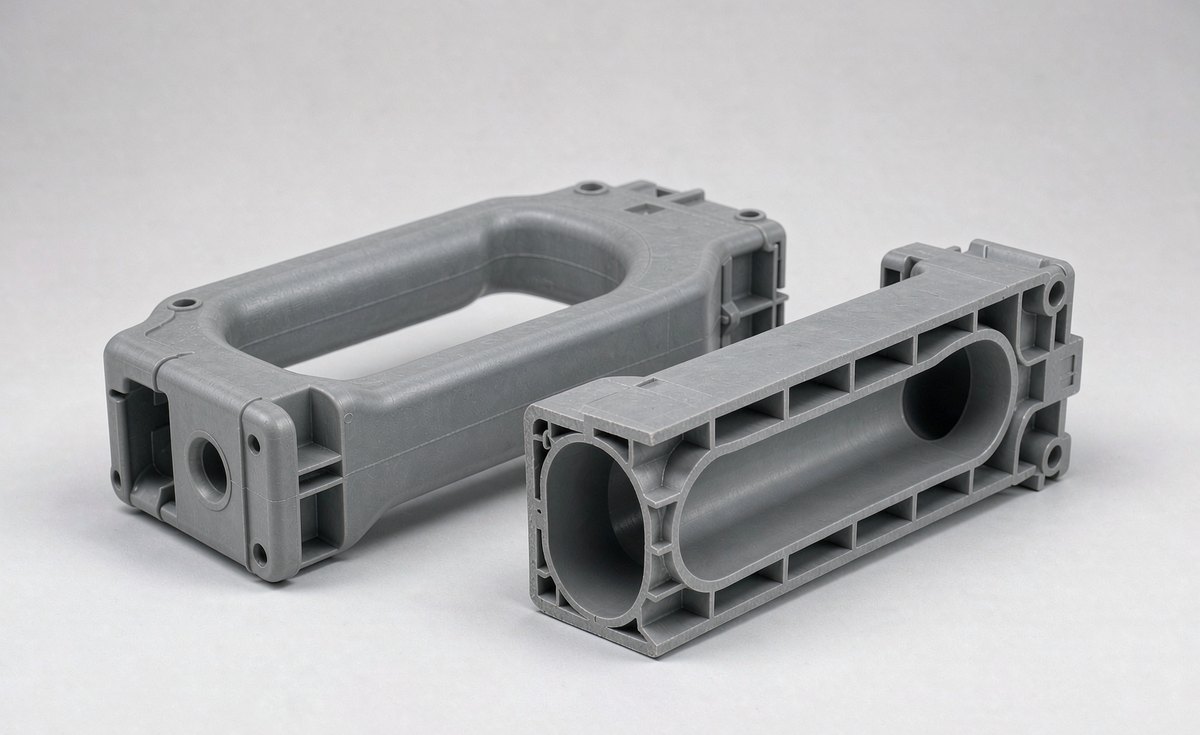
What sequencing actually controls
A valve gate is a needle that opens and closes on command. Most shops run every needle together, which makes the tool behave like a conventional multi-gate mold with a very clean gate vestige. Sequencing means opening the needles at different times during the same shot.
The moment you stagger the openings, you stop filling the cavity from all gates at once. The first gate fills the volume near it, then the second gate opens into material that is already flowing, and the meeting point between the two flow fronts is somewhere you chose rather than somewhere the tooling decided for you.
That meeting point is the weld line, and it is the weakest line on the part. Its position is a design decision. Putting it in a cosmetic face is a mistake; putting it in a rib root or behind a boss is free.
Sequencing also changes the packing path. The gate that opens last is still molten while the earlier gates are already freezing, so the last gate does most of the packing in its own region. That is useful for a deep section and dangerous for a thin one.
How much delay, and why
The delay is set in milliseconds or in millimetres of screw travel, depending on the controller. Screw travel is the more repeatable unit because it is tied to volume rather than to a timer that starts at a slightly different moment each cycle.
The useful rule is that the first gate should fill roughly its own region before the second opens. If it fills much less, the second gate takes over and the weld line lands near the first gate. If it fills much more, the second gate opens into a cavity that is already packed and the flow stalls at the gate, which produces a hesitation mark.
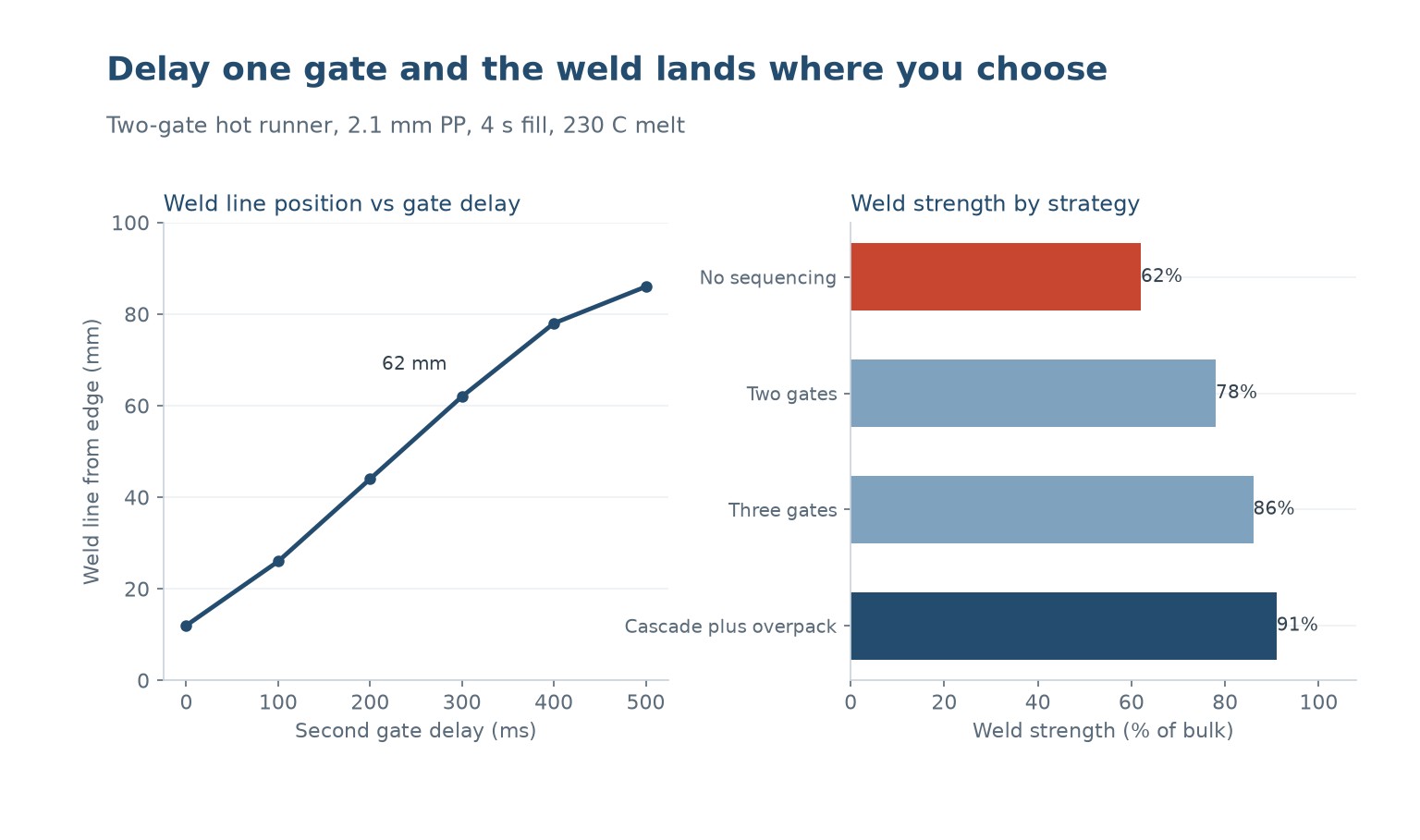
On a two-gate part filled in four seconds, a delay of 200 to 400 milliseconds moves the weld line across a useful part of the cavity. Beyond about 600 milliseconds the first gate has usually finished its region and the second gate is filling into a dead end, which is where short shots and high packing pressures appear.
The delay has to be tuned with the melt temperature stable. A cold start shifts every number, so sequence tuning is always done after the barrel has soaked for at least twenty minutes at production temperature.
Reading the result
A correctly sequenced weld looks like a faint line with no notch at the surface. Run a fingernail across it. A weld that catches the nail is a cold weld, and the delay is too long or the melt is too cold at the meeting point.
Under a low-power microscope the difference is obvious. A good weld shows flow fronts that merged while both were still fluid, with a rounded boundary. A bad weld shows a sharp V notch, and often a small void just below the surface where the fronts met and trapped air.
Strength is the number that matters. A tensile bar cut across the weld typically reaches 60 to 70 percent of bulk strength with no sequencing, 78 to 86 percent with two or three gates sequenced properly, and over 90 percent when the last gate is also used to overpack the weld region while it is still molten.
Do not judge by appearance alone. A weld can look acceptable and still be at 65 percent strength, which matters on any part that sees pressure, impact or a fatigue load.
When sequencing makes things worse
The first failure mode is air trapping. Staggering gates changes where the last-filled region is, and the last-filled region is where the air goes. If the tool has no vent there, sequencing converts a cosmetic weld into a burn mark.
The second is gate freeze. A gate that opens late sees colder material and a colder gate body. If the delay pushes the gate open time past the point where the gate can seal, you get stringing or a gate that drools on the next cycle.
The third is pressure loss. Every gate that opens late has less time to pack, so the region it feeds shrinks more. On a part with a tight flatness callout, sequencing can trade a weld line problem for a warpage problem.
The fourth is cycle time. Sequential filling usually needs a longer hold because the last gate starts packing later. A sequence that costs two seconds of cycle time is not free, and it has to buy something measurable.
| Symptom after sequencing | Likely cause | Correction |
|---|---|---|
| Burn mark at the far end | Last-filled area has no vent | Add vent at the new end-of-fill |
| Stringing at the late gate | Delay too long, gate too cold | Shorten delay, raise gate temperature |
| Sink in the late gate region | Not enough packing time | Extend hold, raise the late gate pressure |
| Hesitation mark near gate one | Second gate opens too early | Increase delay in screw-travel units |
| Warpage across the part | Uneven packing between regions | Balance pack pressure per gate |
Table 1 — What goes wrong after sequencing, and why.
A setup procedure that repeats
Start with all gates open together and record the baseline: fill time, peak pressure, part weight, weld position and weld strength. Without a baseline you cannot tell whether the sequence helped.
Close the secondary gate and fill on the first gate alone until the part is 55 to 65 percent full. That number is your target delay, expressed as screw travel. Convert it to milliseconds at the current shot speed and set it.
Open the second gate at that point and inspect the weld. If it sits in the wrong place, adjust the delay in 50 millisecond steps. Change one gate at a time; changing three gates at once produces a part that is different but tells you nothing.
Once the position is right, tune strength rather than position. The lever for strength is the melt temperature at the meeting point and the packing that follows, not more delay. A longer delay moves the weld but makes it colder.
| Parameter | Starting point | What to watch |
|---|---|---|
| Delay unit | Screw travel (mm) | More repeatable than a timer |
| First-gate fill | 55 to 65 percent | Below 50 percent the weld runs back |
| Delay step | 50 ms | Small enough to see the trend |
| Suhu leleh | Mid-range of the datasheet | Cold melt gives a brittle weld |
| Hold after last gate | Same as baseline plus 10 percent | Watch for sink in the late region |
Table 2 — Starting values for a two-gate sequence.
When not to sequence at all
If the part fills balanced with all gates open and the weld sits in a non-critical area, sequencing adds cycle time and a new failure mode for no benefit. Balanced simultaneous filling is the better default.
If the tool has only one gate, there is nothing to sequence. Single-gate parts get their weld line from core pins and inserts instead, and the fix there is flow-leader geometry, not timing.
If the material is a glass-filled grade, moving a weld line is often worse than leaving it. Glass fibres do not knit across a weld, and a weld in a highly stressed region of a glass-filled part is a crack starter whatever the timing.
The honest summary is that sequencing is a weld-line placement tool. It is very good at moving a weld to a harmless place and improving its strength in the process. It is not a general fix for filling problems, and it will not rescue a tool that is badly gated in the first place.
What is valve gate sequencing?
It is opening the valve gates in a hot runner at different times during one shot instead of all together. The delay controls where the flow fronts meet, which sets the weld line position and strength.
How much delay should a second gate have?
On a part that fills in about four seconds, 200 to 400 ms is the useful range. The repeatable way to set it is in screw travel: close the second gate and note how many millimetres the screw travels to fill 55 to 65 percent of the part.
Does sequencing always improve weld strength?
No. It improves strength when the weld moves into a region that stays hotter longer and when the last gate is used to pack the weld. Applied badly it moves the weld into a cold, poorly vented area and makes the part weaker.
Can sequencing cause burn marks?
Yes. Changing the fill pattern changes where the last-filled region is, and that region is where trapped air ends up. If the tool is not vented at the new end-of-fill, the result is a burn mark or a short shot.
Is sequencing worth it on a two-gate part?
Only if the weld line is currently in a cosmetic or structural area. If the part already fills balanced and the weld is in a harmless place, sequencing adds cycle time without buying anything.
What is the difference between sequencing and cascade molding?
Cascade usually means each gate opens when the flow front from the previous gate reaches it, often with valve gates used to control packing. Sequencing is the simpler case: fixed delays set from screw position, no feedback from sensors.
Weld line in the wrong place?
Send the part drawing, the gate layout and the current fill pattern. We will tell you whether sequencing can move the weld somewhere harmless, or whether the gate layout needs changing.








 ID
 EN
 ES
 FR
 DE
 PT
 AR
 RU
 JA
 KO
 IT
 NL
 TR
 PL
