PS clamshell display faces pick up fine scratches in transit and on shelf, and the high-gloss surface makes even light marks obvious to buyers.
What the failure looks like on the line
PS blister packs and trays are stiff and economical, and their failure mode is usually a crack or a stressed hinge rather than a slow distortion.
Clear PS clamshell lids show hairline scuffs across the display window after unpacking, while the tray body is unmarked. The marks follow the packing and shelf-loading direction.
PS has a hard but brittle surface that polishes to a high gloss, so fine abrasive contact leaves visible light-scattering lines. Without a protective interleaf or film, nesting and case vibration rub the display faces against each other and the carton.
Buyers and suppliers usually agree on the drawing and disagree on the conditions under which the drawing was checked. On a buyer's specification this distinction matters: a part can measure inside tolerance and still fail in use, because the drawing records geometry while the complaint records behaviour. Surface gloss is usually the first value both sides compare, and it is also the one most often quoted without the conditions attached to it.
The process window that decides it
Four variables move this result more than the rest. The ranges below are illustrative engineering guidance for a first discussion; confirm them on your own tool, material grade and part geometry before they become contract terms.
| Variable | Typical window | What fails outside it |
|---|---|---|
| Surface gloss | 85-95 GU | Higher gloss makes fine scratches more visible |
| Interleaf coverage | 1 per face | Missing leaves faces to rub |
| Nesting clearance | 0.6-1.2 mm | Tight nesting increases face-to-face rubbing |
| Case movement | 0-3 mm play | More play raises abrasive contact |
Table 1. Starting window for a joint process trial. Values are engineering guidance, not a measured survey.
Surface gloss is typically held at 85-95 GU. Higher gloss makes fine scratches more visible Record it together with the measurement point and the moment in the cycle; a single number without a location is not a process setting.
Interleaf coverage is typically held at 1 per face. Missing leaves faces to rub When this drifts, the symptom usually appears at one cavity, one sheet position or one lane before it appears across the whole batch.
Nesting clearance is typically held at 0.6-1.2 mm. Tight nesting increases face-to-face rubbing A change here is cheap during a trial and expensive after tooling release, so treat it as a controlled variable with a documented re-approval.
Case movement is typically held at 0-3 mm play. More play raises abrasive contact Put it on the change-control list, otherwise an unannounced material or setting substitution will be mistaken for ordinary process noise.
Reading the response curve
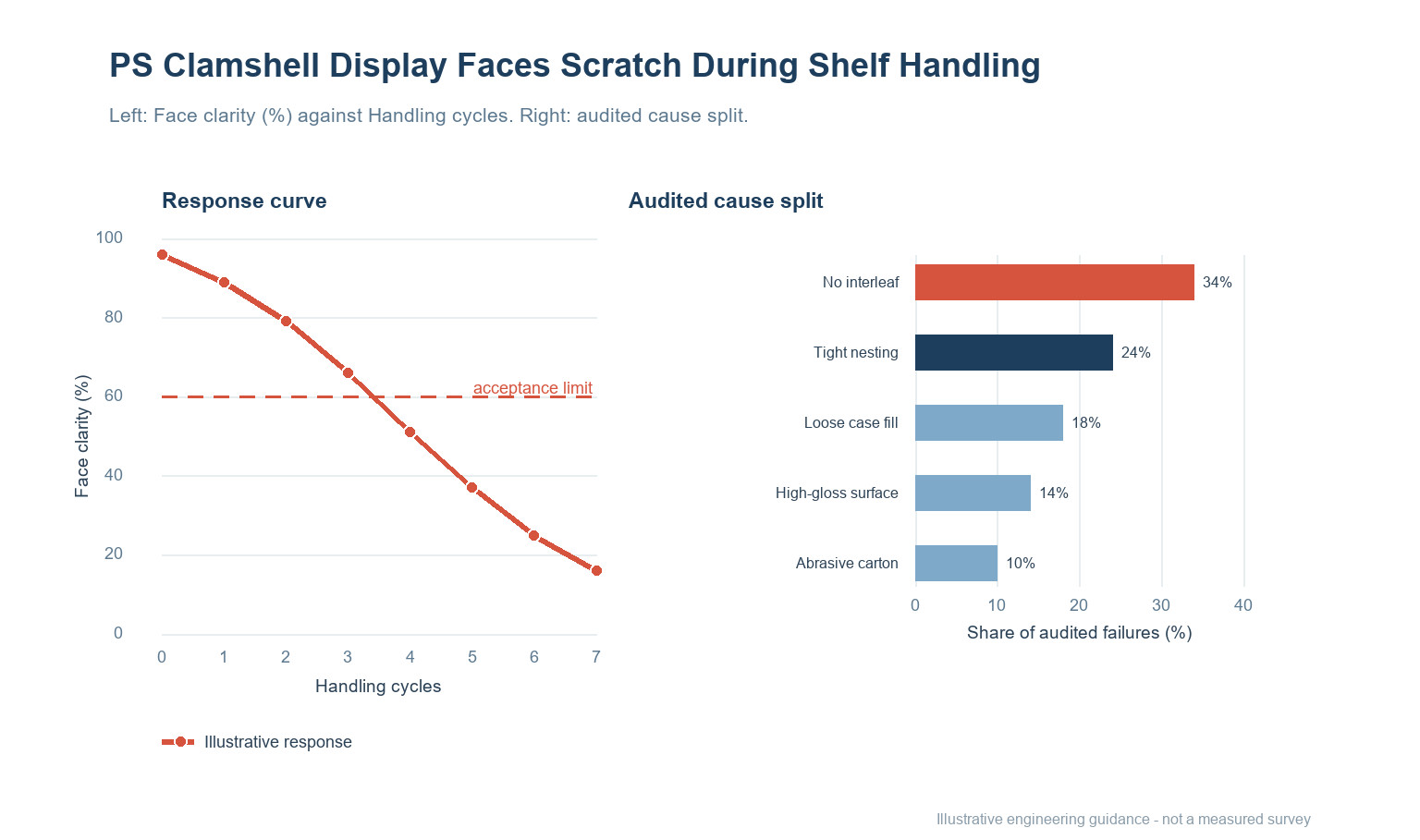
The left panel shows face clarity (%) as handling cycles increases: the response falls from 96 to 16 on the illustrative 0–100 scale. The dashed line at 60 marks a proposed acceptance limit, not a universal standard. Move that line only after the test method and the sample plan have been agreed, otherwise two suppliers can both be compliant and still deliver different parts.
Read the shape rather than a single point. A curve that changes quickly near the limit is more sensitive to ordinary process noise than one that approaches it gradually, and that difference should be reflected in how tightly the setting is controlled and how often it is checked.
Where the causes actually sit
The right panel of Figure 1 splits audited failures of this type into five groups. The percentages are illustrative engineering guidance for prioritising an investigation, not a measured survey and not a prediction for your line.
| Cause | Illustrative share | First check |
|---|---|---|
| No interleaf | 34% | Inspect display faces under raking light after unpacking. |
| Tight nesting | 24% | Check whether an interleaf or protective film is present per face. |
| Loose case fill | 18% | Measure nesting clearance between stacked clamshells. |
| High-gloss surface | 14% | Compare scuff level on nested and individually bagged samples. |
| Abrasive carton | 10% | Judge marks against an approved cosmetic limit sample. |
Table 2. Cause split and the corresponding first check. Shares are indicative and sum to 100.
No interleaf accounts for roughly 34% of the illustrative split. Inspect display faces under raking light after unpacking. Start here before authorising a material or tooling change, because it is the fastest explanation to confirm or eliminate.
Tight nesting accounts for roughly 24% of the illustrative split. Check whether an interleaf or protective film is present per face. Start here before authorising a material or tooling change, because it is the fastest explanation to confirm or eliminate.
Loose case fill accounts for roughly 18% of the illustrative split. Measure nesting clearance between stacked clamshells. Start here before authorising a material or tooling change, because it is the fastest explanation to confirm or eliminate.
Checks before sign-off
Run the same sequence on a retained good sample and on the disputed batch so the comparison means something.
- Inspect display faces under raking light after unpacking.
- Check whether an interleaf or protective film is present per face.
- Measure nesting clearance between stacked clamshells.
- Compare scuff level on nested and individually bagged samples.
- Judge marks against an approved cosmetic limit sample.
Keep a retained reference sample beside every result. When a batch is disputed, the comparison that settles it is almost always between the retained part and the current one under the same method, not between either part and a number on a drawing. Record the instrument, the operator, the conditioning time and the position on the part or sheet for each reading.
Writing it into the specification and the evidence pack
Display faces shall remain within the agreed scratch limit sample after the defined transit and unpacking handling.
Write the requirement as a behaviour at a stated condition, not as a brand of material or a machine setting. State the test method, the conditioning, the sample plan and the rule for deciding a pass. Where a document is needed, ask the supplier for documentation that covers the actual construction and check its scope against your own market before approval; a document for the base material alone does not describe the finished part you are buying.
At first-article approval, freeze the drawing revision, the material and colour identification, the process window, the tool and cavity identification, and the inspection method. Any later change to grade, site, tool, or window should trigger a new first article rather than a paper waiver. Keep retained samples from the approved lot and from each production lot so that a future comparison is possible.
| Evidence item | What it must show |
|---|---|
| Approved drawing and revision | The exact geometry and tolerances the decision applies to |
| Material and colour identification | Grade, supplier, colour reference and any declared recycled content |
| Process window and change log | The agreed settings and any deviation since approval |
| Inspection record and retained samples | Method, conditions, results and a physical reference from the same lot |
Table 3. Minimum evidence pack for a first-article decision and a later batch dispute.
The values quoted here are illustrative engineering guidance, not a measured survey. Agree the test method, the sample size and the acceptance rule before comparing numbers across suppliers.
Questions buyers ask
Is this a material problem or a process problem?
PS has a hard but brittle surface that polishes to a high gloss, so fine abrasive contact leaves visible light-scattering lines. Without a protective interleaf or film, nesting and case vibration rub the display faces against each other and the carton. It is worth separating the two before a supplier changes a grade: hold the material constant for one controlled run, then move one setting at a time. If the symptom follows the setting, the material was never the cause.
Can surface gloss be traded against cycle time?
Only within the window stated in Table 1, and only with a recorded trial. Higher gloss makes fine scratches more visible A faster cycle that sits outside the window usually moves the failure downstream, where it costs more to find.
What should be recorded at incoming inspection?
Keep the measurement, the method, the sample identity and the conditions together. Inspect display faces under raking light after unpacking. A result without its conditions cannot be compared with a later batch.
Does a change of PS require re-approval?
Treat any change to material grade, tool, site or process window as a change that needs a new first-article decision. For thin-wall forming work the drawing alone is not enough; the process route is part of what was approved.
How many samples are enough for a first-article decision?
There is no universal number. Sample across cavities, lanes, sheet positions or reel lengths so that the spread is visible, not just the average. Agree the sample plan and the acceptance rule with the supplier before the trial starts.
What belongs in the evidence pack?
The approved drawing and revision, the material and colour identification, the process window, the inspection method and results, the retained reference samples, and documentation covering the actual construction. Ask the supplier to state the scope of each document and check it against your own market.
Seeing this on a current thin-wall forming job?
Send the drawing, the material and grade, the process window you are running, and the point in the cycle or the shelf life where the fault appears. We will help you separate a material question from a process question and a specification question before anyone changes a tool.
Continue reading
- Clamshell Packaging: Hinge Design, Seal and the Opening Nobody Can Manage
- Surface Marking: Chill Marks, Drag Lines and the Sheet That Was Too Cold
- Sheet Surface Gloss: Chill Roll Temperature and the Matte That Drifts
- Cosmetic Packaging: Surface Finish as the Product
- Comment les produits thermoformés peuvent-ils améliorer la transparence et la brillance ?








 FR
 EN
 ES
 DE
 PT
 AR
 RU
 JA
 KO
 IT
 NL
 TR
 PL
 ID