

A retained part is only useful if the matching records, conditions and supplier documents can still be retrieved with it.
What the failure looks like on the line
Parts for regulated applications are approved on documents as much as on dimensions; ask the supplier for documentation covering the actual construction and check its scope against your own market.
A retained silicone part exists, but the batch link, storage conditions and supporting file cannot be reconstructed months later.
Traceability depends on an unbroken chain between the physical sample, its lot, the process window and the documents that describe the declared scope. Break any link and the sample cannot answer a later question; requesting and verifying the supplier's documentation keeps the chain intact.
Most of these complaints arrive after the parts have been accepted, which is a sign that the acceptance test measured the wrong thing. On a buyer's specification this distinction matters: a part can measure inside tolerance and still fail in use, because the drawing records geometry while the complaint records behaviour. Retained sample count is usually the first value both sides compare, and it is also the one most often quoted without the conditions attached to it.
The process window that decides it
Four variables move this result more than the rest. The ranges below are illustrative engineering guidance for a first discussion; confirm them on your own tool, material grade and part geometry before they become contract terms.
| Variable | Typical window | What fails outside it |
|---|---|---|
| Retained sample count | 3-5 parts per lot | Too few samples fail to represent cavity spread |
| Storage temperature | 15-25 C | Heat accelerates post-cure drift in stored silicone |
| Retention period | as agreed in the supply terms | An undefined period ends the evidence chain early |
| Record retrieval time | within 2 working days | Slow retrieval signals a broken lot link |
Table 1. Starting window for a joint process trial. Values are engineering guidance, not a measured survey.
Retained sample count is typically held at 3-5 parts per lot. Too few samples fail to represent cavity spread Record it together with the measurement point and the moment in the cycle; a single number without a location is not a process setting.
Storage temperature is typically held at 15-25 C. Heat accelerates post-cure drift in stored silicone When this drifts, the symptom usually appears at one cavity, one sheet position or one lane before it appears across the whole batch.
Retention period is typically held at as agreed in the supply terms. An undefined period ends the evidence chain early A change here is cheap during a trial and expensive after tooling release, so treat it as a controlled variable with a documented re-approval.
Record retrieval time is typically held at within 2 working days. Slow retrieval signals a broken lot link Put it on the change-control list, otherwise an unannounced material or setting substitution will be mistaken for ordinary process noise.
Reading the response curve

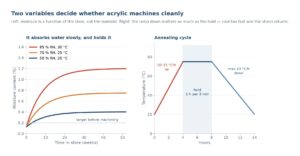
The left panel shows retrievable evidence packs (%) as retention period (months) increases: the response falls from 98 to 34 on the illustrative 0–100 scale. The dashed line at 75 marks a proposed acceptance limit, not a universal standard. Move that line only after the test method and the sample plan have been agreed, otherwise two suppliers can both be compliant and still deliver different parts.
Read the shape rather than a single point. A curve that changes quickly near the limit is more sensitive to ordinary process noise than one that approaches it gradually, and that difference should be reflected in how tightly the setting is controlled and how often it is checked.
Where the causes actually sit
The right panel of Figure 1 splits audited failures of this type into five groups. The percentages are illustrative engineering guidance for prioritising an investigation, not a measured survey and not a prediction for your line.
| Cause | Illustrative share | First check |
|---|---|---|
| Lot link missing on label | 28% | Label each retained part with lot, cavity and date at packing. |
| Storage conditions unlogged | 24% | Store samples away from heat and direct light, and log the conditions. |
| Document scope not re-checked | 20% | Request the supplier's documentation and verify its scope of coverage for each lot. |
| Retrieval path undefined | 16% | Run a retrieval drill on a past lot and time the response. |
| Retention period not agreed | 12% | Reconcile the physical sample against the batch record before disposal. |
Table 2. Cause split and the corresponding first check. Shares are indicative and sum to 100.
Lot link missing on label accounts for roughly 28% of the illustrative split. Label each retained part with lot, cavity and date at packing. Start here before authorising a material or tooling change, because it is the fastest explanation to confirm or eliminate.
Storage conditions unlogged accounts for roughly 24% of the illustrative split. Store samples away from heat and direct light, and log the conditions. Start here before authorising a material or tooling change, because it is the fastest explanation to confirm or eliminate.
Document scope not re-checked accounts for roughly 20% of the illustrative split. Request the supplier's documentation and verify its scope of coverage for each lot. Start here before authorising a material or tooling change, because it is the fastest explanation to confirm or eliminate.
Checks before sign-off
The order matters because each step removes a class of explanation before the next one is opened.
- Label each retained part with lot, cavity and date at packing.
- Store samples away from heat and direct light, and log the conditions.
- Request the supplier's documentation and verify its scope of coverage for each lot.
- Run a retrieval drill on a past lot and time the response.
- Reconcile the physical sample against the batch record before disposal.
Keep a retained reference sample beside every result. When a batch is disputed, the comparison that settles it is almost always between the retained part and the current one under the same method, not between either part and a number on a drawing. Record the instrument, the operator, the conditioning time and the position on the part or sheet for each reading.
Writing it into the specification and the evidence pack
Require each retained part to be retrievable with its lot, cavity, storage conditions and supplier documentation, whose scope of coverage must be requested and verified at lot release.
Write the requirement as a behaviour at a stated condition, not as a brand of material or a machine setting. State the test method, the conditioning, the sample plan and the rule for deciding a pass. Where a document is needed, ask the supplier for documentation that covers the actual construction and check its scope against your own market before approval; a document for the base material alone does not describe the finished part you are buying.
At first-article approval, freeze the drawing revision, the material and colour identification, the process window, the tool and cavity identification, and the inspection method. Any later change to grade, site, tool, or window should trigger a new first article rather than a paper waiver. Keep retained samples from the approved lot and from each production lot so that a future comparison is possible.
| Evidence item | What it must show |
|---|---|
| Approved drawing and revision | The exact geometry and tolerances the decision applies to |
| Material and colour identification | Grade, supplier, colour reference and any declared recycled content |
| Process window and change log | The agreed settings and any deviation since approval |
| Inspection record and retained samples | Method, conditions, results and a physical reference from the same lot |
Table 3. Minimum evidence pack for a first-article decision and a later batch dispute.
The values quoted here are illustrative engineering guidance, not a measured survey. Agree the test method, the sample size and the acceptance rule before comparing numbers across suppliers.
Questions buyers ask
Is this a material problem or a process problem?
Traceability depends on an unbroken chain between the physical sample, its lot, the process window and the documents that describe the declared scope. Break any link and the sample cannot answer a later question; requesting and verifying the supplier's documentation keeps the chain intact. It is worth separating the two before a supplier changes a grade: hold the material constant for one controlled run, then move one setting at a time. If the symptom follows the setting, the material was never the cause.
Can retained sample count be traded against cycle time?
Only within the window stated in Table 1, and only with a recorded trial. Too few samples fail to represent cavity spread A faster cycle that sits outside the window usually moves the failure downstream, where it costs more to find.
What should be recorded at incoming inspection?
Keep the measurement, the method, the sample identity and the conditions together. Label each retained part with lot, cavity and date at packing. A result without its conditions cannot be compared with a later batch.
Does a change of medical food require re-approval?
Treat any change to material grade, tool, site or process window as a change that needs a new first-article decision. For silicone rubber work the drawing alone is not enough; the process route is part of what was approved.
How many samples are enough for a first-article decision?
There is no universal number. Sample across cavities, lanes, sheet positions or reel lengths so that the spread is visible, not just the average. Agree the sample plan and the acceptance rule with the supplier before the trial starts.
What belongs in the evidence pack?
The approved drawing and revision, the material and colour identification, the process window, the inspection method and results, the retained reference samples, and documentation covering the actual construction. Ask the supplier to state the scope of each document and check it against your own market.
Seeing this on a current silicone rubber job?
Send the drawing, the material and grade, the process window you are running, and the point in the cycle or the shelf life where the fault appears. We will help you separate a material question from a process question and a specification question before anyone changes a tool.










 FR
 EN
 ES
 DE
 PT
 AR
 RU
 JA
 KO
 IT
 NL
 TR
 PL
 ID
