

What a stop actually costs
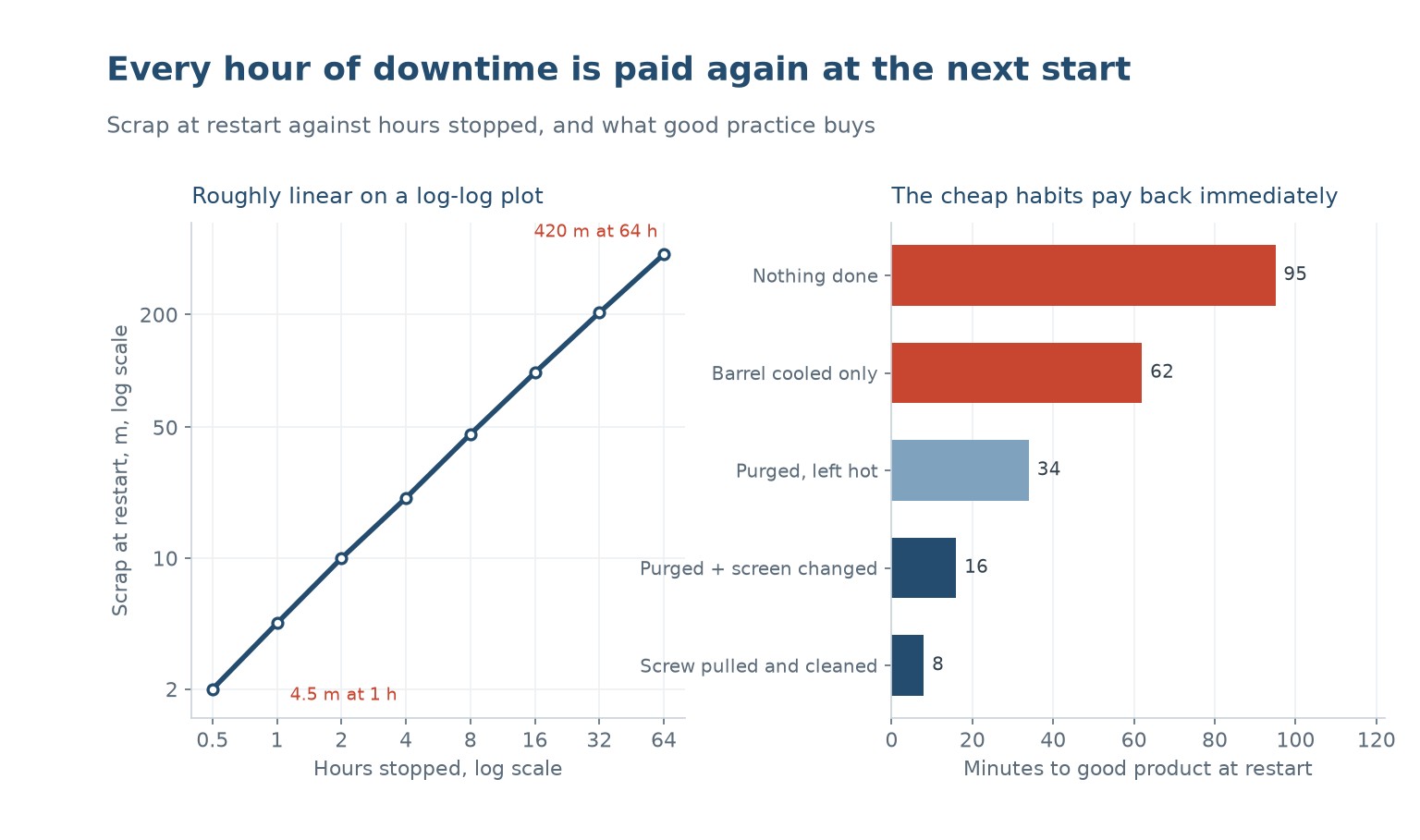
The visible cost of a shutdown is the labour to stop and start. The real cost is the scrap at restart, and it scales with how long the line sat. On a 63 mm PVC pipe line, a one hour stop gives about 4.5 metres of scrap before good product; four hours gives 21 metres; sixteen hours gives 98; sixty-four hours gives 420.
Those numbers are close to linear on a log-log plot, which means each doubling of downtime roughly doubles the scrap. That is a useful rule for planning: if a stop is going to run past eight hours, the difference between doing nothing and purging properly is worth more than the labour of purging.
The mechanism is degradation, not contamination from outside. Material sitting at melt temperature in the presence of oxygen degrades, and the degradation products are dark, cross-linked and sticky. They plate out on the screw, the barrel wall and the die, and they come off slowly over the next hours of running.
The second mechanism is moisture. Hygroscopic materials absorb water while the line is stopped and cool, and that water has to be driven off before the material will process cleanly. A stopped line with PA or PET in the barrel will produce hydrolysed, brittle product for the first hour after restart even if nothing degraded.
Short stops, under two hours
Under two hours, the right answer is usually to keep the line hot and keep material moving. Leave the temperatures where they are, leave the screw running at a low rate, and leave the die on. A hot line that keeps turning will restart in minutes.
The exception is a stop where the material cannot be kept moving, such as a downstream jam. In that case the barrel is hot and static, which is the worst combination. Purge the barrel with a purging compound, or with the production material if the grade is thermally stable, and leave the screw full of the purge rather than of production material.
Do not drop the temperatures on a two hour stop. Cooling the barrel and heating it again takes longer than the stop itself on a large machine, and the thermal cycling is harder on the heaters and the thermocouples than steady operation.
One thing that is worth doing on every stop, however short: pull the vacuum from the sizing sleeve if the line is a profile line, and drain the water trough if the product is sensitive to water marks. A sizing sleeve that cools with product in it will grip the product, and the first metres after restart will be oval or marked.
Long stops, and what to leave in the barrel
For a stop longer than a shift, the barrel should be emptied and purged. The question is what to leave in it. Three options: leave it empty with the screw forward, leave it full of purging compound, or leave it full of production material with the temperatures dropped.
Leaving it empty is the cleanest for the material and the worst for the screw, because an empty barrel at temperature oxidises the residual film into a hard varnish that takes hours of running to remove. Leaving it full of purge compound protects the surfaces and is easy to displace at restart. Leaving it full of production material is only acceptable for materials that are stable at temperature for the duration, which is a short list.
The purge compound matters. A mechanical purge, which is a high-viscosity filled compound, scrubs the screw and barrel by shear. A chemical purge reacts with the residue and lifts it. For a stop of a day, mechanical purge is usually enough; for a stop of a week, or for a barrel that has run PVC, a chemical purge followed by a mechanical one is the only way to get back to clean.
PVC is its own case. It degrades at processing temperature within minutes of standing still, and the degraded material is corrosive. A PVC line that stops for more than fifteen minutes should be purged, and a PVC line that stops for a day should be purged, cooled and, if the die is to be left on, have the die body purged separately.
| Przestój | Beczka | Umierać | Expected restart scrap |
|---|---|---|---|
| Under 30 min | Hot, screw turning slowly | On, hot | 1 to 2 m |
| 30 min to 2 h | Hot, purged once | On, hot | 4 to 10 m |
| 2 to 8 h | Purged, left full of purge | On, hot or cooled | 20 to 45 m |
| 8 to 24 h | Purged, temperatures dropped | Purged, cooled | 50 to 120 m |
| Over 24 h | Emptied and purged, screw forward | Removed and cleaned | 200 m plus, or a clean start |
Table 1 — Shutdown practice by expected downtime
Purging properly
Purging is not the same as running material through. Running production material through a hot barrel displaces some of the degraded material and leaves the rest on the screw flights and in the dead spots behind the non-return valve. A purge compound works because it is designed to have a higher viscosity and a different affinity for the metal than the production material.
The technique is: raise the temperature 10 to 20 C above production, reduce the screw speed, and run the purge through in slugs rather than a continuous stream. Slugs give a high-shear scrubbing action at the flight tips. Continuous running just coats the barrel with a fresh layer.
Then stop the screw with the barrel full of purge, drop the temperature to the holding value, and leave it. At restart, run the purge out, then bring production material through, and do not evaluate the product until the purge is fully displaced. The transition is visible: purge compound is usually a different colour, and the moment the colour is uniform production material is the moment to start checking.
How much purge is enough? A rough rule is one barrel volume for a clean barrel, three for a barrel that has run a filled compound, and as much as it takes for PVC. Barrel volume is roughly the shot weight of the machine, so a machine with a 2 kg shot needs 2 to 6 kg of purge per stop. That is cheap against 400 metres of scrap pipe.
The restart sequence
The restart is the reverse of a good start, with two additions: everything comes up to temperature before the screw turns, and the die is checked before material reaches it.
Bring the zones up in order, barrel first, then adaptor, then die, and let each soak for at least fifteen minutes after the controller says it is at temperature. A thermocouple reads the metal near it, not the melt, and the difference on a large die can be 30 C for a quarter of an hour. Starting before the soak is finished is the most common cause of a cold slug that jams the die.
Then check the die: heater bands seated, thermocouples reading, no purge residue blocking the flow channel. A die that was purged and cooled can have a film of hardened purge in the land, and the first material through will pick it up and drag it into the product.
Then start the screw at low speed, run the purge out, bring production material through, and only then start the downstream. Starting the haul-off before the profile is stable just fills the floor with scrap at a faster rate.
Change the screen pack at shutdown, not at startup. Changing it at startup adds fifteen minutes to the critical path; changing it at shutdown adds nothing, because the line is stopping anyway. The same logic applies to cleaning the sizing sleeve and to checking the vacuum calibrator.
Recording it, so the next stop is cheaper
The useful record is not the downtime. It is the scrap at restart, the practice used, and the time to good product. Three numbers per stop, and after ten stops you know which practice works on which machine.
That record changes behaviour. A line that has been purged on every stop for a year and still produces 40 metres of scrap has a different problem, and the record is what shows it. A line that produces 4 metres after a purge and 90 after no purge makes the argument for the purge without anyone having to make a speech.
It also feeds planning. If a stop is going to be four hours, the record tells you whether it is worth purging. If a stop is going to be three days, it tells you whether to pull the screw. Those are decisions that are made in a hurry at the end of a shift, and having the numbers on the wall is what makes them go the right way.
| Practice | Effect at restart | Cost to do |
|---|---|---|
| Barrel left full and hot | Black specks for the first 100 m | Nothing |
| Purged and left full of purge | Clean melt within minutes | 2 to 6 kg of purge |
| Screen pack changed at shutdown | No startup pressure spike | 10 minutes |
| Die purged and land cleaned | No drag marks on the first metres | 15 minutes |
| Sizing drained and cleaned | No marks from stagnant water | 5 minutes |
| Screw pulled and cleaned | Effectively a new barrel | 2 to 4 hours |
Table 2 — What each shutdown habit buys and what it costs
Should I drop the temperatures on a short stop?
No. Under two hours, keep the barrel hot and the screw turning slowly. Cooling and reheating a large barrel takes longer than the stop and the thermal cycling is harder on the heaters than steady operation.
How much purge compound do I need?
Roughly one barrel volume for a clean barrel, three for a barrel that has run a filled compound, and as much as it takes for PVC. Barrel volume is close to the machine's shot weight.
Why is the first product after a stop discoloured?
Degraded material from the barrel and die. Material sitting at melt temperature with oxygen forms dark cross-linked products that plate out on the screw and the die and come off slowly. Purging before the stop is what prevents it.
Can I leave production material in the barrel overnight?
Only for materials that are thermally stable for that long, which is a short list. Most grades will degrade or absorb moisture. Leave the barrel full of purge compound instead.
When should I change the screen pack?
At shutdown, not at startup. Changing it at shutdown costs nothing because the line is stopping anyway; changing it at startup adds fifteen minutes to the critical path.
Why does a stopped PET or PA line produce brittle product at restart?
Moisture. Hygroscopic materials absorb water while the line cools, and that water hydrolyses the polymer at processing temperature. Dry the material before restart, or keep the barrel purged and empty.
Losing a shift to every restart?
Tell us the material, the machine and the typical downtime. We will suggest the purge and holding practice that fits, and what scrap to expect at restart.




 PL
 EN
 ES
 FR
 DE
 PT
 AR
 RU
 JA
 KO
 IT
 NL
 TR
 ID
