
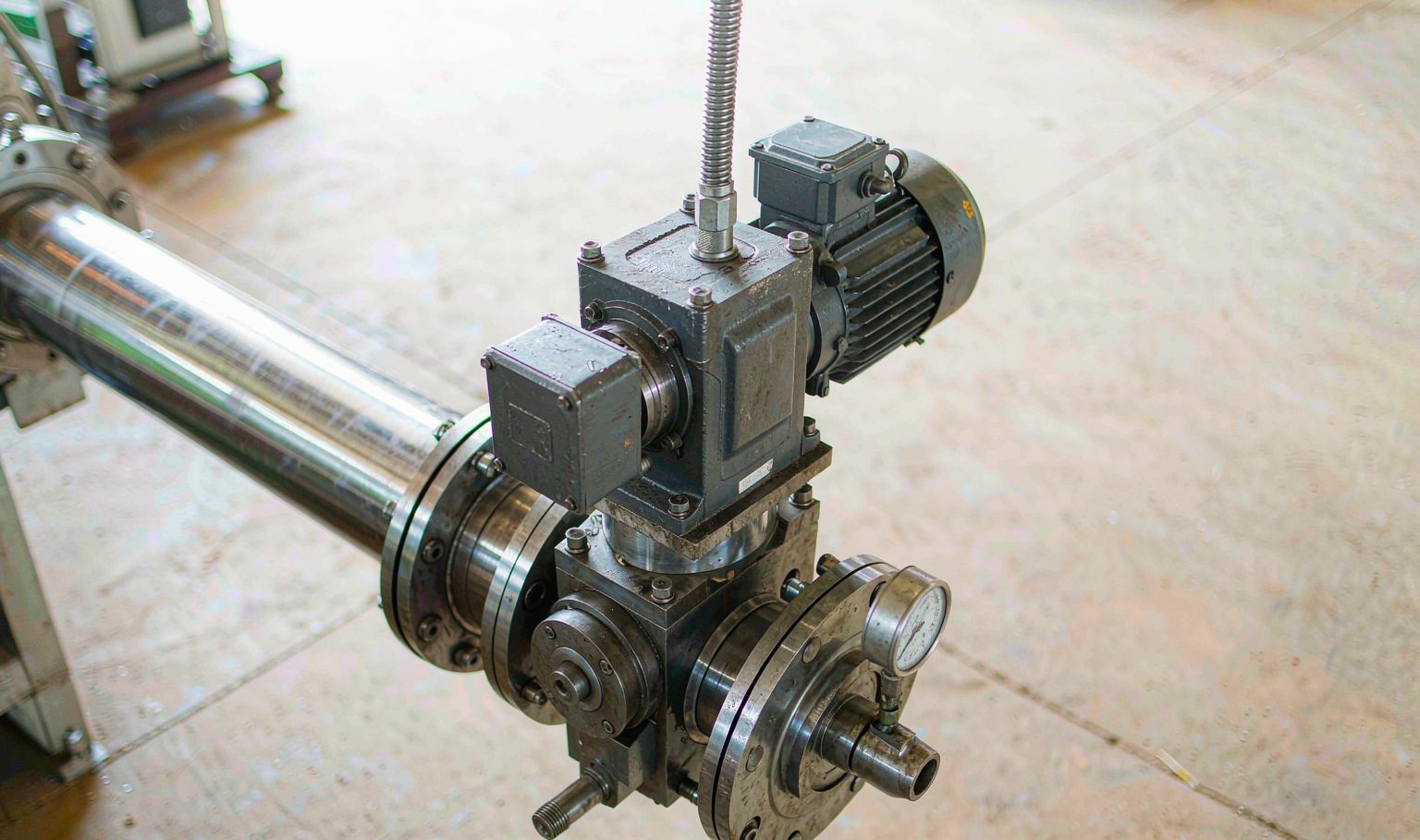
What a gear pump does, and what it does not do
A gear pump is a positive displacement device bolted into the melt stream between the end of the screw and the die. Two meshing gears trap a fixed volume of melt in each tooth space and carry it from the inlet side to the outlet side. The volume per revolution is fixed by geometry, so the output is set by the speed.
What it does not do is melt, mix or generate pressure. It requires melt at the inlet, at a pressure high enough to fill the tooth spaces, and it adds only the pressure needed to push that melt through the die. A gear pump on a starved inlet does nothing useful.
The reason to fit one is decoupling. An extruder screw is a pump whose output depends on viscosity, which depends on temperature, which depends on output. That loop makes the die see a flow that wanders. A gear pump breaks the loop: the screw delivers at whatever rate it delivers, and the pump takes what it needs and sends a fixed volume downstream.
The result is not a better melt. It is a steadier one, and steadier is what a die needs to hold a dimension.
It eats the surge
On a measured line, the pressure at the pump inlet swung plus or minus 7.6 percent over an hour, with a slow oscillation from the screw's own pumping pulsation and a faster component from the melting instability. At the pump outlet the same hour showed plus or minus 0.3 percent.
That is a factor of 25. The pump did not remove the surge, it absorbed it: the surplus melt went into filling the tooth spaces more completely, and the deficit was made up from the same reservoir. What the die saw was the pump's displacement, not the screw's temper.
The consequence downstream is dimensional. On a profile line, a 7.6 percent pressure swing at the die is a 1 to 2 percent thickness swing, because the die is a resistance and flow through it follows pressure. A 0.3 percent swing is a thickness variation below the tolerance band, which is why a gear pump turns a marginal line into a capable one.
The second consequence is temperature. A surging screw runs hotter on the peaks, because the energy going into the melt is not constant. A gear pump flattens the energy input too, and the melt temperature at the die becomes stable to within a degree rather than three or four.
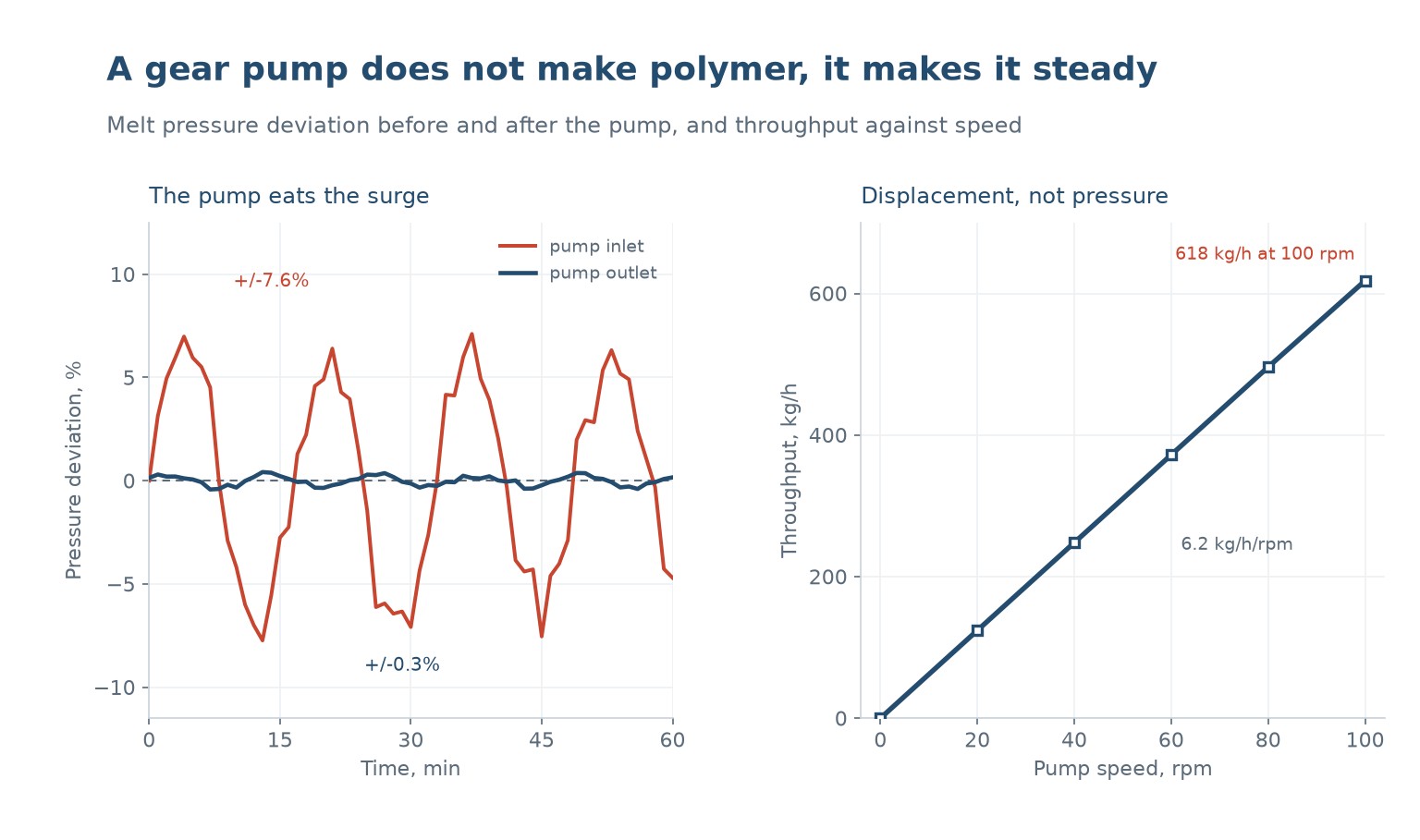
Displacement, not pressure, sets the output
A gear pump's output is displacement per revolution times speed, minus slip. On a measured pump the relationship was 6.2 kilograms per hour per rpm, giving 618 kg/h at 100 rpm and 124 kg/h at 20. The line was straight, which is the point: the output does not care what the die is doing.
Slip is the melt that leaks back past the gear tips and the side plates instead of going out of the discharge. It rises with discharge pressure and with wear, and it is the reason the line is not perfectly straight at high pressure. A new pump at 200 bar may slip 2 percent; a worn one at the same pressure slips 8.
That is why the pump is sized on displacement and the drive is sized on pressure. A pump that is too small has to run fast, which wears the gears and limits the torque available at high pressure. A pump that is too large runs slowly, which is fine for output but gives a poor response to a speed change.
The control loop is usually pressure at the die, trimming pump speed. That is the correct loop, because pressure at the die is what the product depends on. A loop that trims on pump outlet pressure instead will hold the pump's own pressure and let the die drift as the screen blinds.
| Parametr | Without pump | With pump | Dlaczego |
|---|---|---|---|
| Die pressure swing | +/-7.6% | +/-0.3% | Pump absorbs screw pulsation |
| Melt temperature spread | 3 to 4 C | 1 C | Constant energy input |
| Output control | Screw speed and back pressure | Pump rpm | Positive displacement |
| Screen blinding | Shows as output drift | Shows as inlet pressure rise | Decoupled |
| Start-up scrap | Długi | Krótki | Steady within a minute |
Table 1 — What changes when a gear pump goes in
The inlet pressure window is the whole installation
A gear pump needs a flooded inlet. The melt has to arrive at the inlet at a pressure high enough to fill the tooth spaces completely on every revolution. Too low and the pump cavitates, which shows as output variation and a noise the operators describe as gravel.
Too high and the pump is being asked to work against the screw, which puts the axial load on the bearings and shortens their life. The practical window is 20 to 80 bar at the inlet, with 40 to 60 the comfortable middle.
That window is maintained by the screw speed, and it is why a gear pump installation needs a pressure control loop on the screw as well as on the pump. The screw runs in pressure control against the inlet setpoint; the pump runs in speed control against the output setpoint. Two loops, two actuators, one steady stream.
The inlet also needs a screen. A gear pump is a precision device with clearances measured in tens of micrometres, and a piece of degraded material that would have gone through a die will jam a gear. A screen changer upstream of the pump is standard, not optional.
| Inlet pressure | Symptom | Działanie |
|---|---|---|
| Below 15 bar | Cavitation, output wander, gravel noise | Raise screw speed |
| 20 to 40 bar | Workable | Acceptable |
| 40 to 60 bar | Ideal | Leave it |
| 60 to 80 bar | High bearing load | Lower screw speed |
| Above 80 bar | Bearing and seal failure | Resize the pump |
Table 2 — Reading the inlet pressure gauge
Where a gear pump is worth the money
A gear pump installation is a pump, a drive, two pressure transducers, a screen changer and a control system. On a mid-size line that is a meaningful capital sum, and it buys tolerance, not output. The payback comes from the scrap it removes and the tolerance it allows you to sell.
The scrap case is the easiest to justify. A line that takes 20 minutes to stabilise after start-up wastes 20 minutes of material every run. A pump-equipped line stabilises in two or three minutes because the die sees a steady stream almost immediately. On a line that changes product twice a day, that is 35 minutes a day of recovered output.
The tolerance case is worth more if the market pays for it. A profile sold on a plus or minus 0.1 mm wall can be sold at a higher price than one at plus or minus 0.25, and the pump is what makes the tighter number repeatable rather than occasional.
The case that does not justify a pump is a line making thick-section parts where a 2 percent thickness variation is invisible to the customer and the scrap rate is already low. A pump there is a maintenance item with no return.
| Line type | Pump justified | Dlaczego |
|---|---|---|
| Medical tube | Tak | Wall tolerance is the specification |
| Cable insulation | Tak | Capacitance depends on diameter |
| Window profile | Often | Surface and dimension both matter |
| Thick pipe | Rarely | 2 percent is invisible |
| Sheet, thin gauge | Tak | Gauge band is the product |
| Recycling reclaim | Sometimes | Only if the feed is consistent |
Table 3 — Where the tolerance a pump buys is worth paying for
Wear, slip and the efficiency that quietly drops
A gear pump wears at the gear tips, the side plates and the shaft seals. Tip wear opens the clearance and increases slip; side plate wear does the same and is usually faster, because the plates take the axial thrust. Neither produces a visible failure, which is why the drop goes unnoticed.
The symptom is a line that needs a higher pump speed for the same output, and a higher inlet pressure to keep the same fill. An operator compensates by turning the speed up, and the compensation hides the wear until the pump can no longer reach the output at all.
The measurement is a slip test: run the pump at a fixed speed against a fixed die restriction, record the output, then raise the discharge pressure by restricting further and record again. The difference is slip. A pump that slips 2 percent at 200 bar is healthy; one that slips 8 percent needs plates.
Abrasive fillers shorten the interval dramatically. A 30 percent glass-filled compound can wear a set of plates in a year where an unfilled polyolefin runs five. That is a maintenance schedule question, not a design one, and it belongs in the line's plan from the start.
Does a gear pump improve mixing?
No. It is a displacement device with a small clearance and no mixing action. If the melt is not mixed before the pump, it will not be mixed after it.
What inlet pressure does a gear pump need?
20 to 80 bar, with 40 to 60 comfortable. Below that it cavitates and the output wanders; above that the bearings carry an unnecessary axial load.
Why does the pump need a screen upstream?
Because its clearances are tens of micrometres. A piece of degraded material that would pass a die will jam a gear. A screen changer before the pump is standard.
How do I know the pump is worn?
It needs a higher speed for the same output and a higher inlet pressure to stay full. A slip test at two discharge pressures gives the number: 2 percent is healthy, 8 percent needs new plates.
Can a gear pump run without a pressure loop on the screw?
Not well. The screw has to hold inlet pressure while the pump holds output, which needs two loops and two actuators. A single loop will let one of the two drift.
Is a gear pump worth it on a pipe line?
On a line where wall tolerance is the selling point, yes. On a line making thick-section parts where a 2 percent thickness variation is invisible, the payback is longer.
A line that holds dimension on Monday and drifts on Thursday?
Send the die, the output, the pressure trace at the die and the tolerance you need to hold. We will tell you whether the problem is the screw, the die or the absence of a pump.




 PL
 EN
 ES
 FR
 DE
 PT
 AR
 RU
 JA
 KO
 IT
 NL
 TR
 ID
