

The screw is a pump with a bad memory
An extruder screw is a pump. It drags polymer along a channel, compresses it, melts it and pushes it out. Its output depends on the screw speed, the barrel temperature, the die resistance and the polymer's viscosity, and it depends on all of them at once.
That coupling is the problem. If the die resistance changes because a screen is blinding, the output falls and the pressure rises. If the melt temperature drifts, the viscosity changes and both output and pressure move. If the feed rate fluctuates, the whole thing surges.
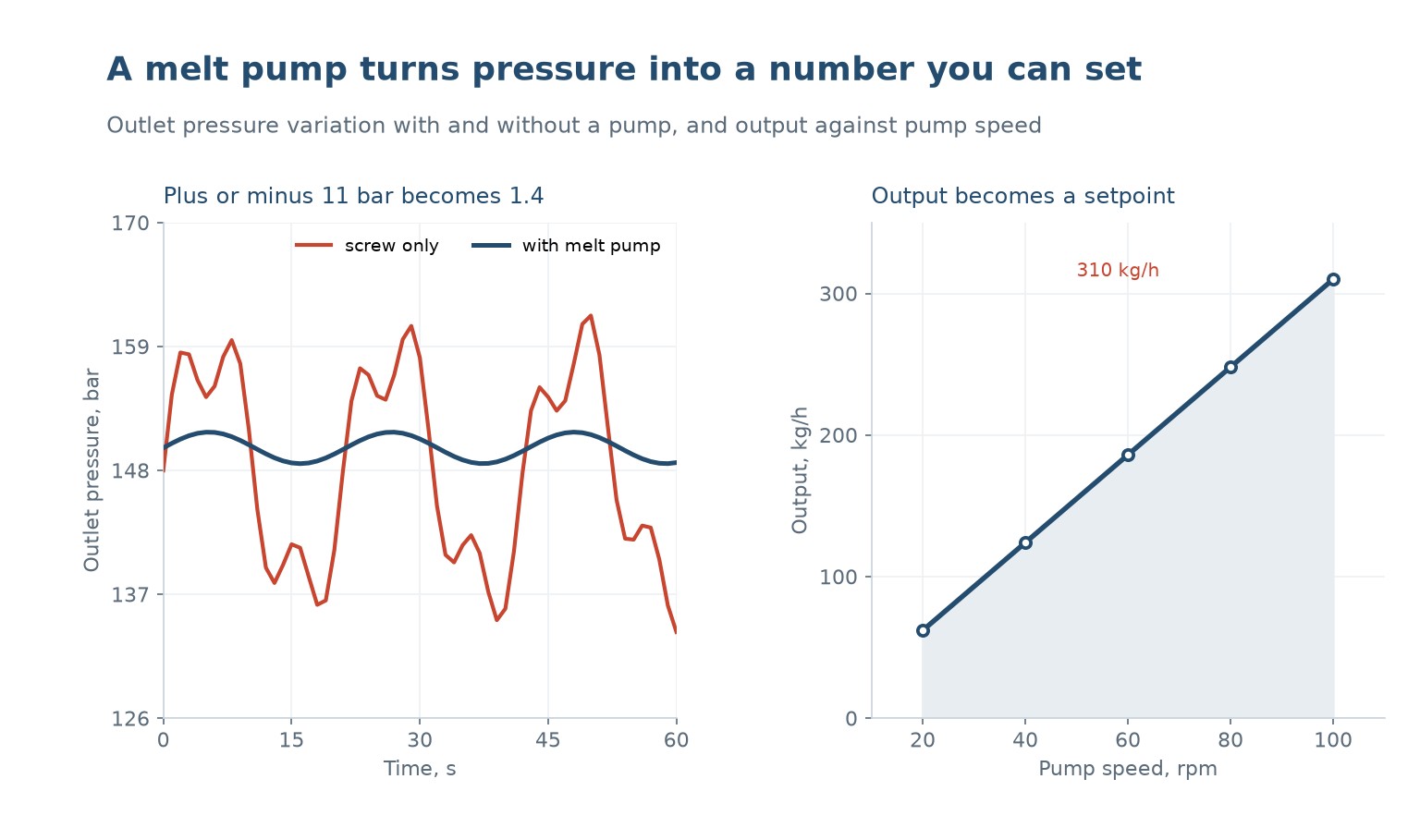
The result is a pressure at the die that oscillates. On a measured line running without a pump, the outlet pressure swings plus or minus 11 bar around 150, with a slow component from the feed and a faster one from the screw. That is a 15 percent variation, and on a product whose wall thickness depends on pressure it is a 15 percent variation in wall.
The screw cannot fix this by itself. A longer metering zone damps it, a barrier screw damps it, and a good screw reduces the swing from 20 bar to 11. It cannot eliminate it, because the screw is a positive-displacement pump only in the limit where nothing else changes.
What a gear pump changes
A gear melt pump is a positive-displacement device: two meshing gears in a close-fitting housing, driven by an independent motor. Each revolution displaces a fixed volume, so the output is the speed times the displacement, and it does not depend on the pressure downstream.
That single property changes the whole line. The pump takes whatever the screw delivers at whatever pressure, and it delivers a fixed flow at a pressure set by the die. The screw no longer controls the output; it only has to supply the pump with enough melt at a stable pressure.
The measured effect on pressure stability is large. With the pump in the line the outlet pressure swing falls from plus or minus 11 bar to plus or minus 1.4 bar, which is an eightfold improvement. The wall thickness variation follows it.
The pump also makes output a setpoint. At 20 rpm it delivers 62 kilograms per hour, at 40 rpm 124, at 60 rpm 186, at 80 rpm 248 and at 100 rpm 310. The relationship is linear and it is repeatable, which means a product change is a number rather than a trial.
Decoupling, and what it lets you do
The pump decouples the die from the screw. That sounds like a small thing and it changes three practices. The first is that a screen change no longer stops the line: the pump keeps delivering while the screen is changed, and the pressure at the die stays steady for the few seconds it takes.
The second is that the melt temperature can be controlled independently of the output. Without a pump, raising the output means raising the screw speed, which raises the shear heating, which raises the melt temperature. With a pump, the screw speed is set by what the pump needs and the output is set by the pump, so the two are separate.
The third is that the screw can run slower and gentler. A screw that only has to feed a pump runs at a lower speed and with a shallower compression, which means less shear, less wear and a cooler melt for the same output. That is worth 10 to 20 C on a heat-sensitive compound.
The cost is capital and maintenance. A pump is an expensive item, it needs a gearbox and a motor, and it wears. The gears and the bearing surfaces are the wear parts, and a pump running an abrasive filled compound needs a harder gear set and a shorter service interval.
| Własność | Screw only | With a melt pump |
|---|---|---|
| Pressure stability | +/- 11 bar | +/- 1.4 bar |
| Output control | Screw speed, coupled | Pump speed, independent |
| Screen change | Line stops | Line keeps running |
| Temperatura topnienia | Rises with output | Independent of output |
| Zużycie śrub | Wyższy | Niższy |
| Capital cost | None | Wysoki |
Table 1 — What the pump changes
When a pump pays and when it does not
A pump pays when the product's tolerance depends on pressure stability. A cable jacket with a plus or minus 0.05 mm wall on a 1.5 mm nominal is a product where a 15 percent pressure swing is a 15 percent wall swing, and no amount of downstream gauging fixes that.
It also pays when the output has to be changed often. A line that runs six products a week and sets the output by trial is a line that spends a shift a week finding the setpoint. A pump makes that a number.
It does not pay on a line making a thick profile where the wall tolerance is plus or minus 0.5 mm. A 15 percent pressure swing on a 6 mm wall is 0.9 mm, which sounds large, but the tolerance is generous and the product is sold by weight rather than by dimension.
The economics are usually expressed as scrap saved against capital and maintenance. On a line running 5,000 hours a year and scrapping 3 percent at 2 units per kilogram, the saving is real and the payback is 18 to 30 months. On a line running 1,000 hours a year it is not.
The other consideration is the die. A pump delivers a steady pressure, and a die that was designed for a fluctuating one may need its land adjusted, because the average pressure with a pump is higher than the average without. A die that was running at 150 bar average with a plus or minus 11 swing is a die that will run at 150 bar steady, and the wall will come out slightly thicker.
Installing one without creating a new problem
A pump has to be fed. It needs a melt at a pressure above its inlet requirement, and it needs that pressure to be stable enough that the pump does not starve. A pump that starves delivers less than its displacement, and the output becomes unstable in a new way.
That is why a pump is always installed with an inlet pressure control loop: the screw speed is controlled by the pressure at the pump inlet, and the pump speed is controlled by the output requirement. The two loops are separate and they must not fight.
The pump also has to be hot. A pump body that is cooler than the melt is a pump that freezes material in its clearances, and a gear pump with frozen material in the clearance is a pump that will seize. The pump heater and its thermocouple are part of the installation, not an accessory.
The third issue is leakage. A gear pump has a small internal leak past the gears, and that leak increases as the pump wears and as the pressure rises. A worn pump still turns at the set speed but delivers less, so the output drifts. The symptom is a pump that needs a higher and higher speed to hold the same output, and the fix is a rebuild.
| Problem | Symptom | Przyczyna |
|---|---|---|
| Output drifts down | Needs more rpm for the same kg/h | Internal leakage, worn gears |
| Output unstable | Surging at constant rpm | Pump starving, inlet pressure low |
| Pump seizes | Drive trips | Frozen material in the clearance |
| Pressure spikes | Alarm on the die | Inlet loop fighting the output loop |
| Gear wear | Metal in the product | Abrasive compound, no hard facing |
Table 2 — Melt pump problems and what causes them
What to specify
A pump specification needs the displacement per revolution, the maximum pressure, the maximum temperature, the gear and bearing material, and the drive. The displacement sets the output range, and the maximum pressure has to be above the highest die pressure plus a margin.
The gear material matters for a filled compound. A standard through-hardened gear set on a 60 phr mineral-filled compound wears in a year; a hardened or coated set lasts three to five. The cost difference is small against the downtime of a rebuild.
The drive matters for control. A servo drive holds speed to within 0.1 percent, which is what makes the output a setpoint. A fixed-speed motor with a gearbox does not, and it defeats the purpose of the pump.
What does a melt pump actually do?
It decouples the die from the screw. The pump is positive displacement, so the output is its speed times its displacement, independent of the pressure downstream.
How much does it improve pressure stability?
On a measured line, the outlet pressure swing fell from plus or minus 11 bar to plus or minus 1.4, which is an eightfold improvement and it shows directly in wall thickness.
Can I run a screen change without stopping?
Yes, with a pump in the line. The pump keeps delivering while the screen is changed, and the die pressure stays steady for the few seconds it takes.
Does a pump let me run a cooler melt?
Yes. The screw only has to feed the pump, so it runs slower with less shear, which is worth 10 to 20 C on a heat-sensitive compound at the same output.
When does a pump not pay?
On a thick profile with a generous wall tolerance, or a line running 1,000 hours a year. The payback is in scrap saved, and there has to be scrap to save.
Why does my pump need more rpm for the same output?
Internal leakage past worn gears. A worn pump still turns at the set speed but delivers less, and the fix is a rebuild rather than a higher setpoint.
A wall thickness that moves with the pressure?
Tell us the tolerance, the output and the compound. We will tell you whether a pump pays, and what it needs upstream and downstream to work.




 PL
 EN
 ES
 FR
 DE
 PT
 AR
 RU
 JA
 KO
 IT
 NL
 TR
 ID
