
What gravimetric dosing measures, and why weight
A volumetric feeder turns a screw at a set speed and assumes that each turn delivers a fixed volume. That assumption holds for a free-flowing pellet of consistent bulk density. It fails for a fluffy regrind, a filled compound, a powder that compacts, or a pellet that changes shape between deliveries.
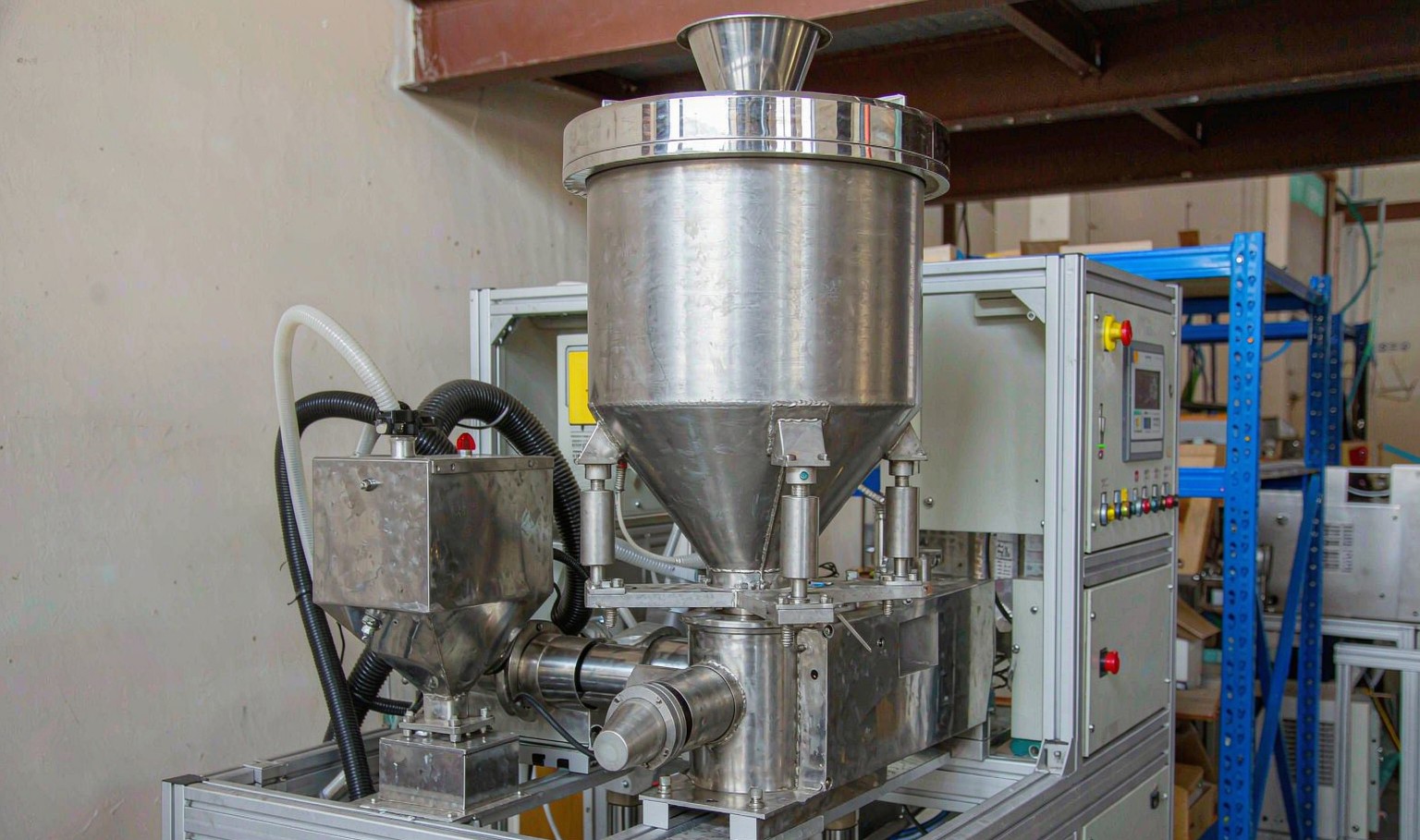
A gravimetric feeder weighs. The hopper sits on load cells, the controller records the weight against time, and the rate of weight loss is the mass flow. The screw speed is adjusted to hold that rate, so the feeder delivers a mass per hour rather than a volume per hour.
That distinction is the whole value. A 2 percent bulk density change on a volumetric feeder is a 2 percent ratio error in the compound, which on a filled or flame-retardant product is a specification failure. A gravimetric feeder sees the density change as a change in the weight signal and corrects it.
The cost is complexity: load cells, a controller, a refill system, and a calibration procedure. The benefit is a ratio held to a fraction of a percent, which is what a flame retardant or a colour masterbatch actually needs.
The refill is the weak point
A loss-in-weight feeder works by weighing a hopper that is emptying. When the hopper is refilled, the weight jumps and the controller cannot tell whether the increase is material or a disturbance. Most controllers handle this by switching to volumetric control during the refill, then returning to gravimetric once the weight has settled.
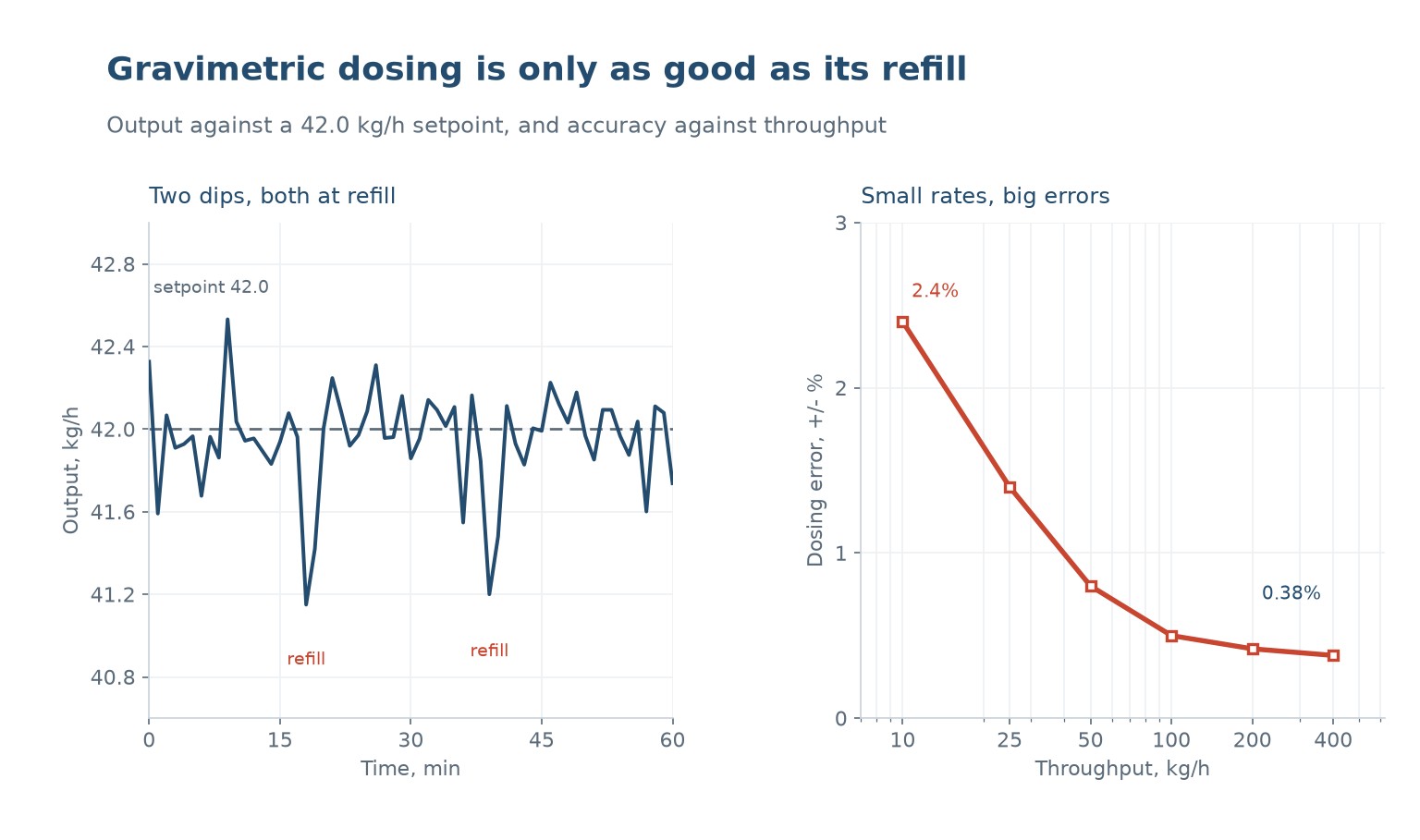
That switch is where the error lives. On a measured line holding 42.0 kg/h, the output trace was flat within plus or minus 0.2 kg/h for most of the hour, and dipped to 41.15 and 41.20 at the two refills, at 18 and 39 minutes. Each dip lasted about two minutes.
The size of the dip depends on how well the refill is controlled. A refill that dumps material in a second gives a bigger disturbance than one that trickles. A refill that starts before the hopper is empty gives a smaller one, because the volumetric period is shorter and the head of material is more constant.
The best systems avoid the problem by using two hoppers and refilling one while the other feeds. That is a twin-hopper or a refill-on-demand arrangement, and it costs more than a single hopper with a level switch. On a product where the ratio is critical, it is the right answer.
Small rates, big errors
Accuracy depends on the mass in the hopper and the time over which the weight is measured. At 400 kg/h a feeder loses 6.7 kilograms a minute, which is a large signal and a short measurement window is enough. At 10 kg/h it loses 167 grams a minute, and the same load cell resolution is a much larger fraction of that.
On a measured set, the dosing error was 2.4 percent at 10 kg/h, 1.4 at 25, 0.8 at 50, 0.5 at 100, 0.42 at 200 and 0.38 at 400. The curve flattens above 100 kg/h, which is where the resolution stops being the limit.
That is why a small additive feeder on a large line is the hardest case. A 0.5 percent masterbatch at 400 kg/h is 2 kg/h, which is the 2.4 percent end of the curve. The fix is a smaller hopper and a finer load cell, not a bigger controller.
The other lever is the measurement window. A controller that averages over 30 seconds has a smoother signal and a slower response; one that averages over 5 seconds responds fast and is noisy. Most systems use an adaptive window, short when the rate is changing and long when it is steady.
| Throughput | Dosing error | Limiting factor |
|---|---|---|
| 10 kg/h | 2.4% | Load cell resolution |
| 25 kg/h | 1.4% | Resolution and refill |
| 50 kg/h | 0.8% | Refill disturbance |
| 100 kg/h | 0.5% | Control tuning |
| 200 kg/h | 0.42% | Mechanical consistency |
| 400 kg/h | 0.38% | Screw and vibration |
Table 1 — Where the error comes from at each rate
Loss-in-weight, batch weighing and the difference that matters
A loss-in-weight feeder controls a continuous rate. A batch weigher weighs a discrete quantity into a mixer. Both are gravimetric, and they solve different problems: the first holds a ratio continuously, the second gets an absolute weight right once.
For extrusion, loss-in-weight is the normal choice because the process is continuous. For injection moulding, batch weighing is normal because the process is cyclic and a batch can be weighed between shots. For a compounding line, both appear: batch weighing for the formulation and loss-in-weight for the additive.
There is a third option that is often confused with gravimetric: volumetric feeding with a gravimetric check. The feeder runs on speed and the controller weighs a sample periodically and corrects the speed. It is cheaper and it is slower to correct, so it holds a long-term average and not a short-term ratio.
The choice comes down to what the specification actually says. A colour that must be within 0.05 percent of target over a shift needs true loss-in-weight. A colour that must look right needs a volumetric feeder and a good eye.
| Typ | Controls | Najlepsze dla | Weakness |
|---|---|---|---|
| Volumetric | Prędkość śruby | Free-flowing pellets | Bulk density drift |
| Volumetric with check | Speed, corrected periodically | Colour, non-critical | Slow correction |
| Loss-in-weight | Mass rate | Additives, flame retardants | Refill disturbance |
| Batch weighing | Absolute weight | Injection, compounding | Not continuous |
| Twin hopper LIW | Mass rate, no refill gap | Critical ratios | Cost and footprint |
Table 2 — Four ways to feed, and what each one actually controls
Calibration and the drift nobody notices
A gravimetric feeder is only as good as its load cells, and load cells drift. Temperature changes, vibration, a build-up of material on the hopper wall and a cable that has been kicked all move the zero. The controller re-zeros automatically, and the re-zero is where a slow error enters.
The standard test is a timed catch: run the feeder at a set rate for a known time, catch the material, weigh it on a calibrated scale, and compare. That test finds the error the load cells cannot see, and it takes ten minutes.
The interval matters. A feeder on a clean pellet line holds calibration for months; one on a filled compound with a dusty additive drifts in weeks. A monthly catch test on a critical ratio, and a quarterly one on a non-critical one, is a reasonable schedule.
The second source of drift is the refill valve. A valve that does not close completely trickles material during the gravimetric period, which reads as a lower consumption and a leaner compound. The symptom is a product that is consistently slightly off specification and a feeder that reports it is on target.
When gravimetric is not worth it
A single-material line running natural pellet does not need a gravimetric feeder. The extruder's own output is what it is, and there is no ratio to hold. A volumetric feeder or no feeder at all is fine.
A line running one colour at one rate does not need one either, if the colour is checked visually and the tolerance is wide. The money is better spent on a better mixer.
The case that does need it is any product where a ratio appears on a certificate: flame retardant loading, glass content, masterbatch concentration, food-contact additive level. In those cases the feeder is not a convenience, it is the evidence.
The middle case is a line that runs many colours at short runs. There, a gravimetric feeder pays for itself in changeover scrap, because the ratio is right from the first metre rather than after ten minutes of adjustment.
How accurate is gravimetric dosing?
About 0.38 percent at 400 kg/h and 2.4 percent at 10 kg/h on a measured set. The accuracy depends on the rate, because the load cell resolution is a fixed mass and a smaller rate makes it a larger fraction.
Why does the output dip at every refill?
The controller switches to volumetric control while the hopper refills, because the weight signal is disturbed. The dip is the volumetric period. A twin-hopper system removes it by refilling one hopper while the other feeds.
Do I need gravimetric for colour masterbatch?
If the colour tolerance is tight or the loading is under 1 percent, yes. At 0.5 percent on a 400 kg/h line the additive rate is 2 kg/h, which is the least accurate end of the feeder's range.
How often should I calibrate?
A timed catch test monthly on a critical ratio and quarterly on a non-critical one. A dusty or filled additive drifts faster than a clean pellet.
What is the difference between loss-in-weight and batch weighing?
Loss-in-weight controls a continuous mass rate for an extruder. Batch weighing gets an absolute weight right once, for a mixer or an injection shot.
Can gravimetric dosing fix a bad mix?
No. It fixes the ratio going in. If the screw does not disperse the additive, an accurate ratio still produces an uneven product.
A ratio that drifts between the certificate and the part?
Send the additive loading, the line output, the feeder type and the calibration history. We will tell you whether the error is the feeder, the refill or the screw.




 PL
 EN
 ES
 FR
 DE
 PT
 AR
 RU
 JA
 KO
 IT
 NL
 TR
 ID
