

Two cure chemistries
Platinum cure, properly called addition cure, uses a platinum complex to link the polymer chains. It produces no byproducts, runs fast, and gives a clean, low odour part. It is the workhorse of liquid silicone rubber molding.
Peroxide cure, a condensation type, uses an organic peroxide that decomposes with heat and cross links the chains while giving off a small molecule. It is slower, smells of the decomposition product, and usually needs a post cure to finish.
The two are not interchangeable in a tool. A peroxide compound and a platinum compound of the same hardness behave identically in the part but completely differently in the pot and on the clock.
So the choice is not about the finished rubber, it is about the process around it: how fast you need to cure, how long the mixed material has to stay usable, and what else is in the room.
Cure speed on the clock
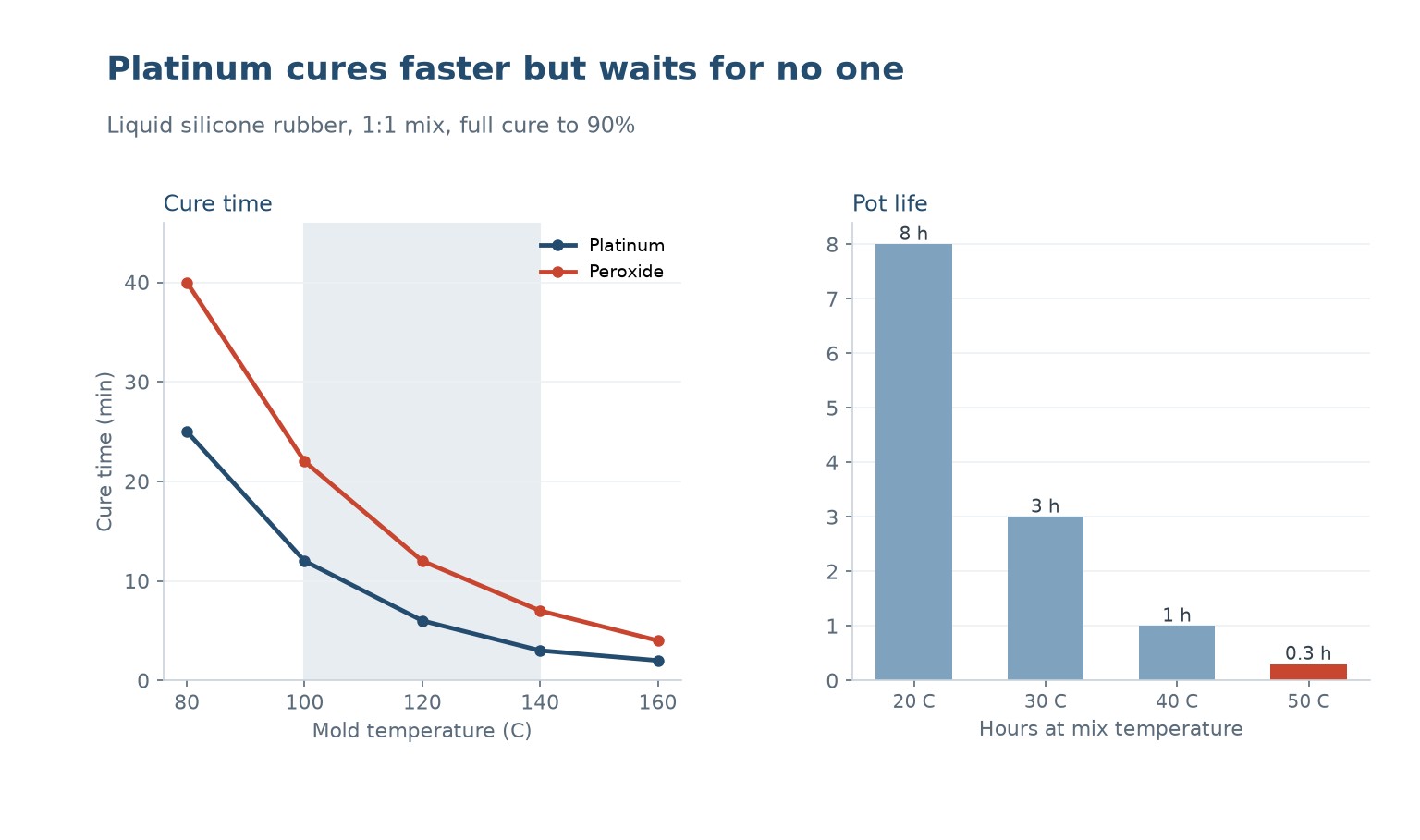
Platinum cures faster at every temperature, because the catalyst is active as soon as it is warm and the reaction has no byproduct to leave. The left chart shows cure time against mold temperature for both systems.
At 120 degrees Celsius platinum is done in six minutes against twelve for peroxide, and at 160 it is two against four. That gap is what lets liquid silicone molding run sub one minute cycles while peroxide compounds sit in the mold far longer.
The penalty is control. Because platinum is fast, the mixed material starts reacting the moment it is warm, so the pot life is short and the process has to be dosed and injected promptly.
Peroxide is more forgiving on the bench because it is slower to kick, which is why it still dominates manual and open molding where the operator values working time over cycle speed.
Pot life is the trade
The chart on the right is the other side. Pot life falls steeply with temperature for both systems, but platinum falls faster because it is already close to reacting at room temperature.
At twenty degrees Celsius a platinum compound may give eight hours of working time, at thirty it is three, and at forty it is under an hour. Keep the mixed material cool and it stays usable; let it sit warm and it sets in the pot.
Peroxide holds longer at the same temperature, which is the reason it is chosen for jobs where the mix has to wait, be transported, or be worked by hand before it goes in the heat.
The practical rule is to store dosed platinum material cold and meter it just in time. A warm dosing room is the most common cause of scrapped platinum batches.
| Mold temp (C) | Platinum (min) | Peroxide (min) |
|---|---|---|
| 80 | 25 | 40 |
| 100 | 12 | 22 |
| 120 | 6 | 12 |
| 140 | 3 | 7 |
| 160 | 2 | 4 |
Table 1 — Cure time at typical mold temperatures.
The platinum trap
Platinum catalyst is poisoned by sulfur, amines and certain tin compounds. A trace of latex glove, a mould release that contains amine, or a neighbouring job using sulfur cured rubber can stop a platinum part from setting at all.
The symptom is a part that never cures in the expected time and stays tacky, often only where it touched the contaminated surface. It looks like a temperature problem and is not.
Peroxide is largely immune to these contaminants, which is why it is the safe choice in mixed workshops where platinum inhibition is hard to police.
The defence is separation. Keep platinum work on its own tools, its own release, and its own gloves, and never let a sulfur or amine source share the bench.
Choosing between them
Choose platinum for closed molding, liquid injection, and any job where cycle time pays. The speed and the clean part usually outweigh the care the catalyst needs.
Choose peroxide for open molding, manual lay up, and any job near sulfur or amine contamination where a platinum batch would be at risk.
Choose peroxide also when the part needs a long post cure anyway, because the chemistry already expects one and the extra oven step costs nothing extra.
And choose by the end use where regulation matters. Platinum leaves no extractable byproduct, which is why it dominates food contact and medical silicone even when peroxide would be easier to run.
| Eigendom | Platinum | Peroxide |
|---|---|---|
| Cure speed | Snel | Langzamer |
| Pot life | Short, heat sensitive | Longer |
| Byproduct | None | Small molecule |
| Inhibition | Sensitive to S, N, Sn | Robust |
| Post cure | Often not needed | Usually needed |
Table 2 — How the two cure systems compare.
Quality and post cure
Platinum parts are usually finished as molded, because the reaction goes to completion in the tool and leaves nothing behind. That is a big part of their appeal for high volume molding.
Peroxide parts often need a post cure to drive off the last of the decomposition product and to complete cross linking, which tightens properties but adds an oven step and a handling cost.
Compression set, the property that decides whether a gasket relaxes, is governed by how completely the cure finished. A peroxide part that skipped its post cure will set more than the data sheet promises.
And both systems are sensitive to the mix ratio at the dosing unit. A platinum system off by a few percent either inhibits or over catalyses; a peroxide system off by the same amount simply cures imperfectly. Meter both accurately.
What is the difference between platinum and peroxide cure silicone?
Platinum is an addition cure with no byproduct and fast cure; peroxide is a condensation cure that releases a small molecule, cures slower and usually needs a post cure.
Which silicone cures faster?
Platinum, at every temperature. At 120 C it cures in about six minutes against twelve for peroxide, which is why liquid silicone molding runs short cycles.
Why does platinum silicone fail to cure sometimes?
The platinum catalyst is poisoned by sulfur, amines and some tin compounds. Latex, amine release agents or neighbouring sulfur rubber can stop it setting.
Which has the longer pot life?
Peroxide. Platinum is close to reacting at room temperature, so its pot life falls fast with warmth; keep dosed platinum material cold.
Does peroxide silicone need a post cure?
Usually yes, to finish cross linking and drive off the decomposition product. Platinum parts are typically finished as molded.
Which is better for food or medical parts?
Platinum, because it leaves no extractable byproduct. That is why it dominates food contact and medical silicone despite needing more process care.
Silicone not curing, or curing in the pot?
Tell us the compound, the mold temperature and what else is in the room. We will tell you whether it is chemistry or contamination.





 NL
 EN
 ES
 FR
 DE
 PT
 AR
 RU
 JA
 KO
 IT
 TR
 PL
 ID
