The problem
Symptom. A buyer rejects 4,200 silicone stoppers after headspace GC reads 1,400 ppm total volatiles against a 500 ppm clause, and the oven chart shows the 200 C for 4 h post-cure was skipped.
What it costs. With no post-cure condition or volatile limit in the specification, a batch with odour and fogging complaints is quarantined and the re-work lands on the moulder.
This article links peroxide decomposition by-products to a missing post-cure, gives the 200 C for 4 h condition to be confirmed per formulation, TGA and headspace GC verification, and the clause that binds the oven record.
When an odour complaint meets a skipped post-cure
A buyer rejects 4,200 silicone stoppers after headspace GC reads 1,400 ppm total volatiles against a 500 ppm clause, and the oven chart shows the 200 C for 4 h post-cure was skipped. The parts are dimensionally correct; the residues are not.
| What the buyer sees | Document behind it | First clause to check |
|---|---|---|
| Headspace GC reads 1,400 ppm | Post-cure omitted | 500 ppm total-volatiles clause |
| Only 'post-cured' on the note | No oven chart | Dated 200 C for 4 h record |
| TGA shows high mass loss | Volatile residues remain | TGA plus headspace GC-MS |
| Compound changed after the trial | Condition no longer valid | Re-confirm 200 C for 4 h per grade |
Table 1 - Reading a post-cure volatiles gap before booking the lot
Need a fixed price for this seal?
Send the gland drawing, temperature range, media and annual volume. We will recommend a compound with test data and return samples with a written production quotation.
Get a silicone seal quotationEmail [email protected]WhatsApp
Ask for the oven chart and a volatiles report
Request the post-cure oven chart with time and temperature plus a TGA or headspace GC volatiles report for the lot. Treat the root-cause split as illustrative engineering guidance to confirm on your own line; a 'post-cured' note has no oven record.
A five-step diagnostic sequence
- Pull the oven chart.
Confirm the post-cure reached 200 C for 4 h and that the chart belongs to the shipped lot. - Measure total volatiles.
Run headspace GC on the lot and compare the 1,400 ppm figure with the 500 ppm clause. - Check by TGA as well.
Thermogravimetric mass loss shows whether volatile residues remain after cure. - Compare with an uncured control.
A drop after post-cure confirms the cycle, rather than the compound, is at fault. - Bind the condition in the order.
Name 200 C for 4 h, the 500 ppm limit and a dated oven chart per lot.
The chart below is a typical result from that measurement step. Use it to separate a design limit from a setting that can still be recovered.
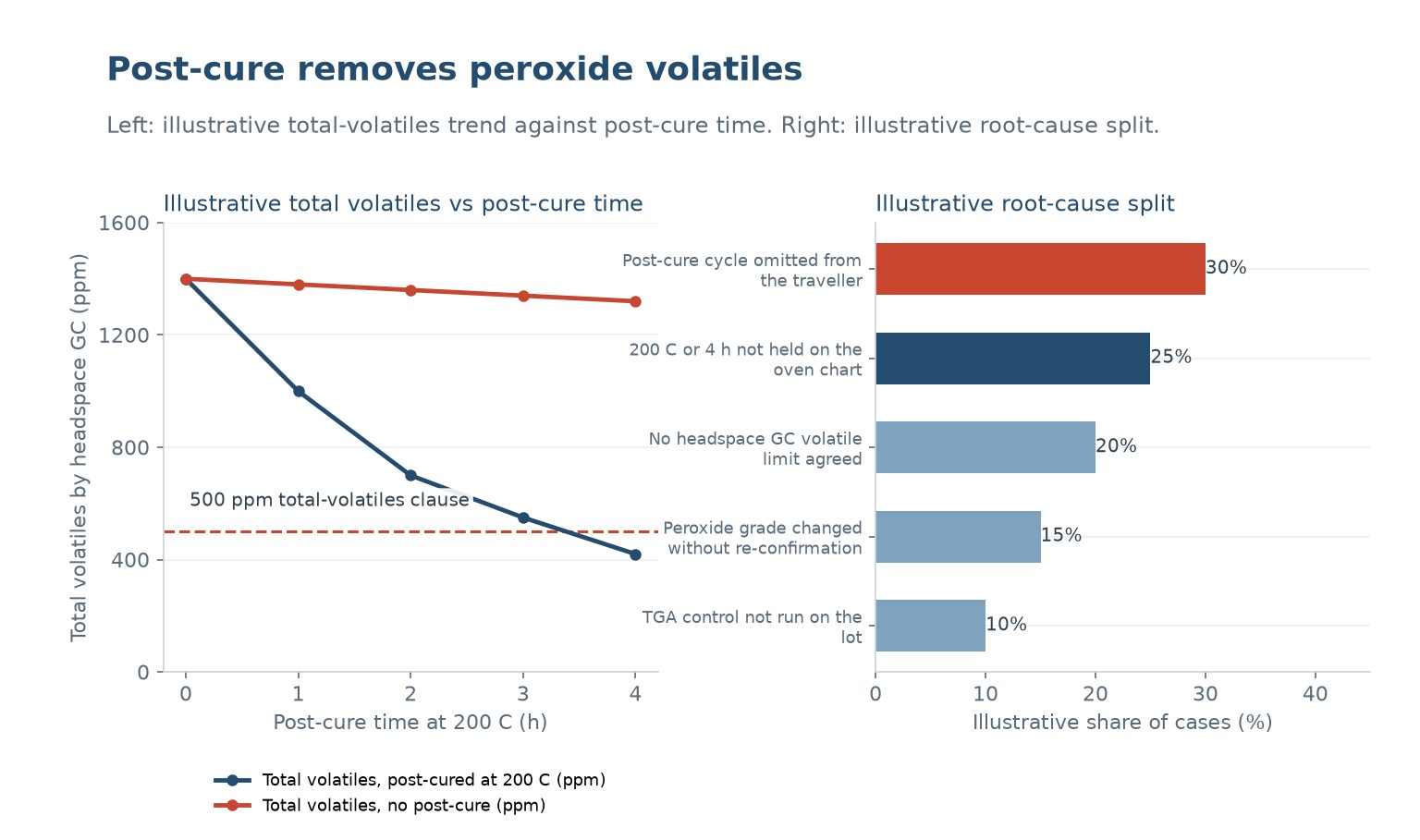
Peroxide by-products and the 200 C for 4 h condition
Peroxide vulcanisation leaves aromatic ketone and acid by-products that a post-cure drives off at elevated temperature. A typical condition is 200 C for 4 h, but the time and temperature must be confirmed for each compound and section thickness.
| Clause or parameter | Required value | What goes wrong outside it |
|---|---|---|
| Cure system | Peroxide, named on the order | Platinum grade quoted against a peroxide condition |
| Post-cure condition | 200 C for 4 h, confirmed per compound | A skipped cycle leaves 1,400 ppm volatiles |
| Total volatiles | Below 500 ppm by headspace GC | Odour and fogging complaints |
| Verification | TGA and headspace GC-MS per lot | No comparable figure between lots |
Table 2 - Post-cure clauses for the part specification and purchase order
TGA and headspace GC verification
Verify by thermogravimetric analysis for total mass loss and headspace GC-MS for individual species, against an uncured control. The 500 ppm clause is an agreed acceptance figure, so state the method, sampling and units that produced it.
| Actie | What it fixes | Cost or trade-off |
|---|---|---|
| Obtain the oven chart for the lot | Closes the record gap | Low: a records check |
| Re-run headspace GC on retained parts | Confirms the 1,400 ppm figure | Low to medium: laboratory test |
| Apply the post-cure and re-test | Removes the residues | Medium: oven cycle and re-test |
| Re-qualify a low-volatile grade | Clears a persistent exceedance | High: new compound and re-run |
Table 3 - Recovery actions ranked by cost
Write the post-cure and volatile limit into the order
On the order name the peroxide cure system, a post-cure of 200 C for 4 h as the starting condition, and a 500 ppm total-volatiles limit by headspace GC. Require a dated oven chart and volatiles report per lot.
Want a compound check before you re-order?
Send us the gland drawing and the service conditions. We will compare the compound data against your temperature range and return a recommendation with sample parts.
What to send us
- Gland dimensions and cross-section
- Temperature range and media
- A failed seal if available
- Annual volume
Recovery actions ranked by cost
For a held lot, first apply the specified post-cure and re-run headspace GC; re-working an existing batch is the cheapest fix. If volatiles still exceed 500 ppm, move to a platinum-cured low-volatile grade and re-qualify, the costliest route.
Before you release this silicone seal
- The purchase order names the cure system and a post-cure of 200 C for 4 h, confirmed for the specific compound
- A total-volatiles limit of 500 ppm by headspace GC is stated with method, sampling and units
- A dated oven chart with time and temperature is required per production lot
- TGA and headspace GC-MS verification is agreed as the evidence method
- Any compound or section-thickness change triggers a re-confirmation of the post-cure condition
Most cold or heat failures are specification gaps, not bad batches. Fix the specification before changing suppliers.
Why were the stoppers rejected?
Headspace GC read 1,400 ppm total volatiles against a 500 ppm clause, and the oven chart showed the 200 C for 4 h post-cure was skipped.
What does post-cure remove?
Peroxide decomposition by-products, mainly aromatic ketones and acids, that cause odour, fogging and elevated extractables if left in the rubber.
Is 200 C for 4 h universal?
No. It is a typical starting condition that must be confirmed for each compound and section thickness, then written into the order.
Which tests verify it?
Thermogravimetric analysis for total mass loss and headspace GC-MS for the individual volatile species, against an uncured control.
Can a platinum-cured grade skip post-cure?
It has no peroxide by-products, but a low-volatile grade may still be post-cured. Confirm the condition for the chosen compound.
Who owns a skipped cycle?
Put it in the order: name 200 C for 4 h, a 500 ppm limit and a dated oven chart per lot, settled by records.
Get a seal specified for the real service conditions
Send us the gland drawing and the service conditions. We will recommend a compound with documented test data, review the squeeze, and supply samples with a production quotation.
To get an accurate quote, send:
- Gland drawing or seal cross-section
- Temperature range and media
- Pressure and movement
- Annual volume and target unit price
Request samples and a quotation
Why buyers work with Uplastech
ISO 9001, ISO 14001 and ISO 45001 certified. Founded in 2016, with injection moulding lines in Shanghai and an extrusion plant in Jiangsu. Moulding machines from 90T to 1100T and a maximum shot weight of 5100 g. Samples and a written quotation are available on request.
Continue reading
- Silicone compression set
- Silicone gasket and seal design
- Silicone hardness: Shore A
- Silicone industrial seals
- Silicone o-ring manufacturing
Ready to specify? See our silicone rubber moulding services of request a written quotation.




 NL
 EN
 ES
 FR
 DE
 PT
 AR
 RU
 JA
 KO
 IT
 TR
 PL
 ID