

Sheet is not inert
A sheet of polycarbonate looks like a stable object. It is not. It is a material in equilibrium with the air around it, and that equilibrium takes days to establish and minutes to disturb. Between the delivery bay and the oven, the sheet is exchanging moisture, picking up dust and slowly changing shape.
The store room is where most of the invisible damage happens, and it is the part of the process that gets the least attention. A forming shop will spend a week tuning heater zones and then store a pallet of PC sheet under a leaking roof, and wonder why the reject rate is inconsistent.
The reason storage is easy to ignore is that the damage is delayed. A sheet that has absorbed water forms perfectly well on the day it is taken out of the rack and badly two days later, so the correlation between cause and effect is broken by time. The rejects appear in a batch that has nothing obviously wrong with it.
The good news is that storage is cheap to fix. Most of the measures cost nothing more than a decision about where the pallet goes and how high the stack is, and they remove a whole class of defects that no amount of process tuning can address.
Moisture and the bubbles it makes
The chart on the left plots reject rate against storage time in an open warehouse for three hygroscopic sheets. Polycarbonate goes from 0.5 percent at day zero to 8 percent at one month and 16 percent at three months. ABS goes from 0.4 to 4.5 to 9. PMMA, which absorbs far less, goes from 0.3 to 2 to 3.5.
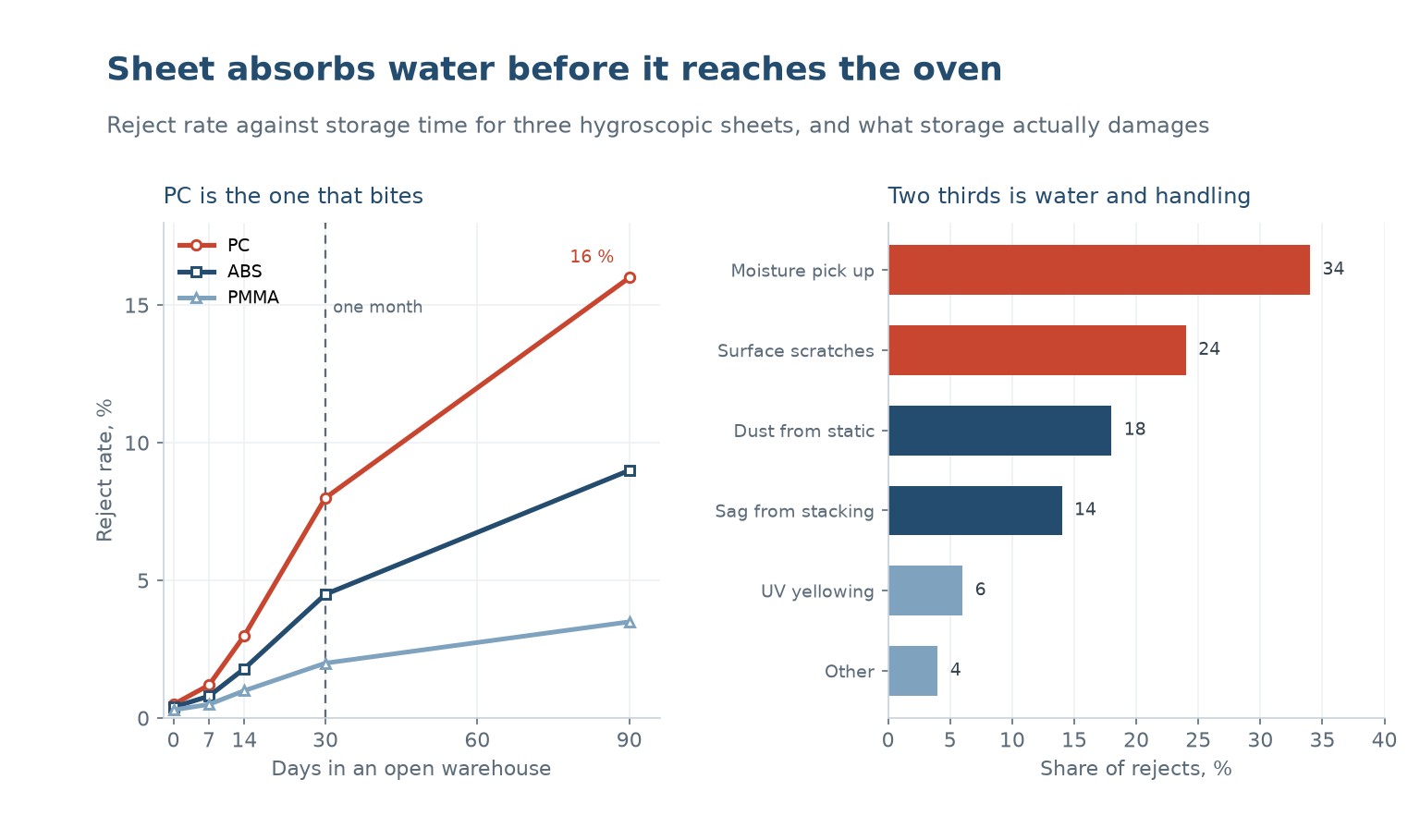
The mechanism is straightforward. Water absorbed into the sheet turns to steam when the sheet reaches forming temperature, and the steam expands inside a material that has become soft but not liquid. The result is a bubble, a haze or a fine surface blister, depending on how much water there is and how fast the sheet is heated.
The reason PC is worst is its chemistry. The carbonate group is polar and holds water, and the absorption is slow enough that a sheet can sit for weeks without looking wet. ABS is less polar but its butadiene phase absorbs water and is also the phase that degrades, so the damage is both physical and chemical.
Drying is the answer, and it has to happen before forming rather than during. A dehumidifying dryer at 120 degrees for two to four hours will bring PC back to a safe moisture level, but it takes time, it takes an oven, and it takes the discipline to do it every time rather than when a batch looks bad.
Static, dust and scratches
A plastic sheet in a dry store room carries a static charge, and a charged sheet attracts dust from the air. The dust lands on the surface that will become the outside of the part, and the forming process presses it in. The result is a speck or a pit that appears after forming and cannot be removed.
The problem is worst with clear sheet because the dust is visible, and worst of all with optical grades where a single speck rejects the part. It is also worst in winter, for the same reason antistatic performance is worst in winter: dry air holds the charge.
Scratches are a handling problem rather than a storage one, and they come from the way sheet is moved. Dragging a sheet across the edge of a rack, stacking sheets without interleaving, and sliding a sheet onto the machine all produce scratches on the face that becomes the visible surface.
The fixes are physical. Interleave with paper or a protective film, store on edge rather than flat, lift rather than drag, and keep the store room at a humidity where static does not build. None of these cost much and all of them are easier than polishing a scratch out of a formed part, which is not possible.
Stacking, sag and edge damage
Sheet stored flat under its own weight sags, and the sag is permanent. A stack of PC sheet a metre square, twenty sheets deep, puts enough load on the bottom sheet to deform it over a warm weekend, and the deformation is not removed by heating. The sheet has taken a set.
That matters because a sagged sheet does not sit flat in the clamp frame. The clamp grips the edges and the middle of the sheet is already below the plane, so the vacuum has to pull it up before it pulls it down. The result is uneven thinning and, in a deep draw, a fold.
Storage on edge is the standard answer, and the rack has to be designed for it. Sheets leaning at too great an angle sag along their length, and sheets leaning on a single thin rail get a line of damage where they touch. A rack with wide, padded supports at a shallow angle is the right shape.
Edge damage is the other consequence of bad stacking. A chipped or crushed edge does not clamp properly, so the seal leaks and the part forms short. It also propagates: a small crack at the edge grows under the clamp pressure and becomes a split that runs into the formed area.
| 재료 | Moisture sensitivity | Dry before forming | Storage note |
|---|---|---|---|
| PC | 높음 | 120 C for 2 to 4 hours | Sealed, on edge, under 30 days |
| ABS | Medium | 80 C for 2 to 3 hours | Sealed, on edge, under 60 days |
| PMMA | 낮음에서 중간 | 70 C for 2 hours if stored long | Interleave, avoid scratching |
| HIPS | 낮음 | Usually none | Sealed, avoid flat stacks |
| PETG | Medium | 65 C for 4 hours | Sealed, hygroscopic like PC |
| PP and PE | Very low | None | Flat stacks acceptable short term |
Table 1 — Storage rules by material
A store room that works
A working store room has four properties. It is dry, it is out of direct sun, it is organised so that the oldest sheet is used first, and it is close enough to the machine that sheets are not dragged through a doorway. Each of those is a decision rather than an expense.
Dry means a roof that does not leak and air that is not saturated. A relative humidity of 50 percent or below is enough to slow moisture pick up and to stop static building. A sealed room with a dehumidifier costs less to run than the rejects it prevents, and it is the single highest return change in a forming shop.
Out of sun matters for two reasons. UV degrades the sheet surface, and radiant heat from a window warms one side of a stack and bows it. A sheet that has bowed in storage will not sit flat in the clamp, and the bow is not always removed by heating.
First in, first out is a discipline rather than a system. A store room where the new pallet is put in front of the old one will always use the new sheet first, and the old sheet will sit until it is scrap. Marking the delivery date on the pallet and loading from the back solves it without any software.
The last rule is a covered route. A sheet carried across an open yard in the rain absorbs water on the way, and a sheet carried through a dusty workshop collects dust. Keeping the store room adjacent to the forming area removes both problems and is worth more than any handling procedure.
Receiving inspection
Receiving inspection for sheet is quick and it catches the problems that storage cannot fix. Check the thickness at five points across the sheet, check the width against the order, look at the surface under a raking light, and check the edges for chips. That takes five minutes per pallet.
Thickness matters because sheet is bought by weight and formed by thickness. A sheet that is ten percent over nominal costs ten percent more material and forms slightly differently; a sheet that is under nominal forms thin. Both are supplier issues and both are worth catching at the door.
The raking light check finds scratches, gels and contamination that are invisible under normal light. A torch held at a shallow angle across the sheet shows every surface defect, and it takes thirty seconds. It is the same check the customer will do on the finished part, done early enough to reject the pallet.
Record the delivery date and the batch on the pallet. That record is what makes first in, first out possible, and it is what lets you correlate a run of rejects with a batch of sheet three weeks later. Without it, every investigation starts from nothing.
| Storage fault | What it looks like formed | Prevention |
|---|---|---|
| Moisture pick up | Bubbles, haze, surface blisters | Seal, dry before forming, use within date |
| Static dust | Specks and pits on the outer face | Humidity control, cover the stack |
| Scratches | Fine lines on the visible face | Interleave, lift rather than drag |
| Sag from stacking | Uneven thinning, folds in deep draws | Store on edge, limit stack height |
| Edge damage | Short forms, leaks at the clamp | Padded rack, handle by the edges |
| UV yellowing | Colour shift at the exposed edge | Block direct sun, rotate stock |
Table 2 — Six storage faults and how they show up
How long can I store polycarbonate sheet?
Thirty days in a dry store room and less in a humid one. Beyond that the moisture content is high enough to cause bubbles unless the sheet is dried before forming.
Should sheet be stored flat or on edge?
On edge, in a rack with wide padded supports at a shallow angle. Flat stacks put load on the bottom sheet and produce a permanent sag that heating does not remove.
Can I dry sheet in the forming oven?
No. Heating the sheet to forming temperature with water still in it produces the bubbles you were trying to avoid. Drying needs a separate oven at a lower temperature for hours.
Why does dust appear on parts only in winter?
Dry air lets static charge build on the sheet, and a charged sheet attracts dust. The same store room in summer holds enough humidity to dissipate the charge.
Does interleaving really matter?
Yes, for two reasons. It stops sheets rubbing against each other and scratching, and it slows moisture pick up at the faces. Paper or a protective film both work.
What humidity should a sheet store be?
Fifty percent relative humidity or below. That is dry enough to slow moisture absorption and to stop static building, and it is achievable with a sealed room and a dehumidifier.
Rejects that appear three weeks after the sheet arrives?
Tell us the material, the storage conditions and the defect. We will tell you whether it is moisture, static or handling, and what to change in the store room.




 KO
 EN
 ES
 FR
 DE
 PT
 AR
 RU
 JA
 IT
 NL
 TR
 PL
 ID
