
- 1. What ring stiffness actually measures
- 2. Why wall thickness dominates, and why doubling it is not linear
- 3. The falling weight test, and why it is a different question
- 4. Why stiff pipes are often brittle pipes
- 5. What the extrusion line does to both properties
- 6. Writing a specification that means something
What ring stiffness actually measures
Ring stiffness is the headline number on every PVC pipe datasheet, and it is widely misunderstood as a strength figure. It is not. It is a stiffness figure: the force required to deflect a ring of pipe by 3% of its diameter, normalised by that deflection and by the pipe diameter.
The test, defined in ISO 9969 and EN ISO 9969, places a 300 mm long pipe section between two flat plates and compresses it at a controlled rate. The load is recorded at 3% deflection. The result is expressed in kN/m², and the classes are SN 4, SN 8, SN 16 and occasionally SN 32.
The reason 3% deflection is used rather than a failure load is that a buried pipe is never supposed to reach failure. It is supposed to deflect a controlled amount and then be held by the soil around it. The design question is not "how much load before it breaks" but "how much will it deflect under the soil and traffic load", because deflection is what transfers load to the surround and what limits the pipe's own capacity.
| Class | Ring stiffness | Typical use | Burial depth (indicative) |
|---|---|---|---|
| SN 4 | 4 kN/m² | Land drainage, cable duct, shallow non-traffic | Up to 2 m, light load |
| SN 8 | 8 kN/m² | Gravity sewer, stormwater, general underground | 2 – 4 m, normal traffic |
| SN 16 | 16 kN/m² | Deep burial, heavy traffic, industrial | 4 – 8 m, heavy load |
| SN 32 | 32 kN/m² | Very deep, airport, rail | Beyond 8 m |
Table 1 — Ring stiffness classes. The burial depths are indicative only; the real design depends on soil type, compaction and live load.
The practical point is that SN 8 and SN 16 pipe can look almost identical from outside. The difference is a wall thickness change of a couple of millimetres on a 315 mm pipe, which is why the class has to be specified and verified rather than inferred.
Why wall thickness dominates, and why doubling it is not linear
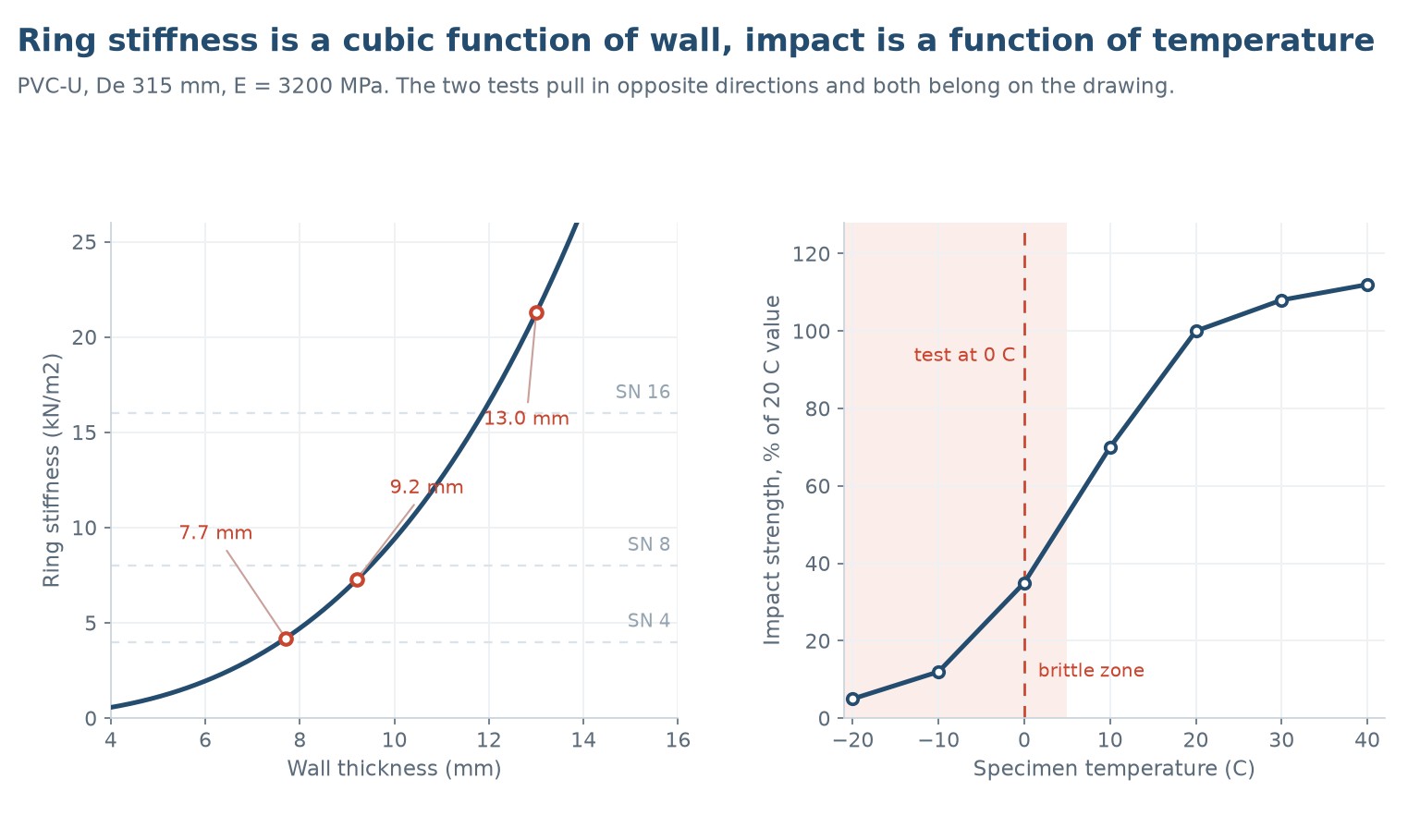
Ring stiffness is a cubic function of wall thickness. That single fact explains most of what follows.
For a thin-walled ring, the second moment of area per unit length is t³/12, and ring stiffness is:
SN = E · I / D³ = E · t³ / (12 · D³)
where E is the short-term modulus in MPa, t is wall thickness and D is the mean diameter, all in millimetres, giving SN in N/mm² which is numerically kN/m².
| Pipe (PVC-U, E = 3200 MPa) | Wall | Calculated SN | Class |
|---|---|---|---|
| De 110 | 3.2 mm | 7.6 kN/m² | SN 8 |
| De 160 | 4.0 mm | 5.1 kN/m² | SN 4 to 8 |
| De 200 | 4.9 mm | 5.1 kN/m² | SN 4 to 8 |
| De 250 | 6.2 mm | 5.2 kN/m² | SN 4 to 8 |
| De 315 | 7.7 mm | 4.3 kN/m² | SN 4 |
| De 315 | 9.2 mm | 7.3 kN/m² | SN 8 |
| De 315 | 13.0 mm | 20.6 kN/m² | SN 16 and above |
| De 400 | 11.7 mm | 7.4 kN/m² | SN 8 |
Table 2 — Calculated ring stiffness for common PVC-U sizes. Note how a 19% wall increase on De 315 lifts the class from SN 4 to SN 8.
The cubic relationship cuts both ways. Going from SN 4 to SN 8 on a 315 mm pipe needs 19% more wall, which is 19% more material — but going from SN 8 to SN 16 needs another 41%. Stiffness gets expensive fast, which is why structured-wall and ribbed pipes exist: they put material where it contributes to the second moment of area instead of spreading it uniformly around a circle.
It also means that wall eccentricity is far more damaging than it looks. A pipe with a nominal 9.2 mm wall that varies from 8.0 to 10.4 mm has a thinnest section whose local stiffness is (8.0/9.2)³ = 0.66 of nominal. The ring test measures the whole ring, so it averages out — but the thin side is where the pipe buckles first in service, and the test will not show it.
The falling weight test, and why it is a different question
Impact resistance is tested by dropping a weighted striker onto a pipe section at a controlled temperature, and counting how many of a batch fail. The standard is ISO 3127 or EN 744, and the result is expressed as TIR — true impact rate — the percentage of specimens that crack.
| 매개변수 | Typical setting | Why it matters |
|---|---|---|
| Conditioning temperature | 0 °C or 20 °C | PVC impact strength collapses below 5 °C |
| Striker type | d90 (round) or d25 (sharp) | Sharp striker is a notch test in disguise |
| Drop height / energy | Set by diameter and wall class | Energy scales with wall thickness |
| Specimens | Usually 10 or 12 | TIR is a pass/fail count, not a value |
| Acceptance | TIR ≤ 10% | One or two failures allowed in ten |
| Support | V-block or flat, per standard | Support stiffness changes the result |
Table 3 — Falling weight impact test conditions. The temperature is the parameter that decides most results.
The temperature is the whole story for PVC. Unplasticised PVC has a glass transition around 80 °C and a ductile-brittle transition that sits uncomfortably close to ambient. At 20 °C it is tough enough to absorb a blow by yielding; at 0 °C it is brittle and the same blow produces a crack that runs the length of the pipe.
This is not a laboratory curiosity. Pipes are installed in winter, transported in winter, and stored on site in winter. A pipe that passes at 20 °C and fails at 0 °C will fail in the field, and the failure will be blamed on handling rather than on the specification. Any impact requirement should state the test temperature, and for cold-climate supply it should be 0 °C.
Specify both numbers, with temperatures. "SN 8, TIR ≤ 10% at 0 °C" is a specification. "High impact" is a wish.
Why stiff pipes are often brittle pipes
The two properties are not independent, and the trade-off is built into the material. Anything that raises stiffness — more wall, higher filler loading, lower plasticiser, higher crystallinity — tends to reduce the energy the material can absorb before it cracks.
Rigid PVC compound for pipe is a formulation, not a single material. Calcium carbonate filler is cheap and raises stiffness, but every percent of filler reduces impact strength. A compound with 10 phr CaCO₃ will hit SN 8 more easily than an unfilled one and will fail the 0 °C impact test that the unfilled one passes. This is why two pipes that both say "SN 8 PVC-U" on the label can behave completely differently on site.
| Formulation change | Effect on ring stiffness | Effect on impact |
|---|---|---|
| Increase wall thickness | Up strongly (cubic) | Up slightly, then down as rigidity rises |
| Add CaCO₃ filler | Up | Down, roughly linearly with loading |
| Add impact modifier (ACR, MBS, CPE) | Down slightly | Up strongly |
| Higher molecular weight resin | Neutral | Up |
| Excess lubricant | Down | Down, and weld lines weaken |
| Thermal degradation in the barrel | Down | Down sharply |
| Poor fusion at the die | Down | Down, especially along weld lines |
Table 4 — Formulation and process effects. The last two rows are process faults that look like material faults.
Impact modifiers are the standard answer, and they work by dispersing rubber particles that initiate many small crazes instead of one crack. They cost money, they lower stiffness slightly, and they are the reason a good pipe compound is more expensive than a simple filled one. A buyer comparing two quotes for the same SN class is very often comparing one compound with modifier against one without.
What the extrusion line does to both properties
Both ring stiffness and impact are set at the die and in the cooling tank, long before the test lab sees the pipe. Several common process faults degrade one or both.
Wall eccentricity. Caused by a mis-centred die, uneven die gap, or a mandrel that has drifted. It reduces local stiffness on the thin side and it is invisible in the ring test, which averages the whole circumference. Measure wall thickness at eight points, not two.
Insufficient cooling. PVC is a poor conductor and a thick wall needs a long tank. Under-cooled pipe comes out with a frozen-in stress gradient, and that stress adds to the stress of the impact test. The symptom is a pipe that passes the test on the day it is made and fails after a week on site, because the stress relaxes and the material ages.
Over-cooling or quench shock. Spraying very cold water onto a hot die face is the opposite error, and it produces a brittle skin. The pipe looks fine, the ring test passes, and the impact test cracks along the outside surface.
Degradation in the barrel. PVC degrades by dehydrochlorination, and once it has started the molecule is shorter and the colour is darker. Degraded PVC loses impact first and stiffness second, and no amount of downstream tuning recovers it. If the pipe is yellow-brown at the cut end, the impact test will fail.
Poor fusion at the die. Material that has been split around a spider or a mandrel support and re-joined forms a weld line, and a weld line in PVC is weak in impact. This shows up as longitudinal splits in the falling weight test, always at the same angular position.
| Symptom | Likely process cause | Check |
|---|---|---|
| Ring test passes, impact fails at 0 °C | Filler loading too high, or too little modifier | Compound datasheet, not the line |
| Longitudinal split at one angular position | Weld line from spider or mandrel support | Die flow analysis, die land temperature |
| Impact failures increase after a die clean | Die land damaged, or gasket protruding | Borescope the die |
| Ring stiffness low on one batch only | Wall thickness drifted down | Wall measurement at 8 points |
| Pipe cracks in storage, before installation | Residual stress plus UV plus cold | Cooling profile, storage practice |
| Dark streaks in the wall | Degradation, poor screw design or hot spot | Barrel temperature profile, screw wear |
Table 5 — Process faults that show up as test failures. The first row is a purchasing problem wearing a process costume.
Writing a specification that means something
Most PVC pipe specifications on the market name a stiffness class and stop. That is enough to compare quotes and not enough to guarantee performance.
| Item | Why it belongs on the drawing |
|---|---|
| Nominal diameter and wall, with tolerances | Wall tolerance is the real stiffness tolerance |
| Ring stiffness class and test standard | SN 8 per ISO 9969, not "SN 8" |
| Impact requirement with test temperature | TIR ≤ 10% at 0 °C is a different pipe from the same at 20 °C |
| Compound type and filler limit | Distinguishes modified from filled compound |
| Eccentricity limit | The ring test will not catch it |
| Colour and UV requirement | Outdoor storage degrades unmodified PVC |
| Joint system | Solvent weld, gasket, or fusion — each has its own tolerances |
| Marking and traceability | Batch identification is how a failure gets investigated |
Table 6 — A pipe specification that can be verified. Items 3 and 5 are the ones most often missing.
The impact requirement is the one that most often gets dropped because it is a pass/fail test rather than a number, and pass/fail feels less like engineering than a stiffness value. In practice it is the property that decides whether a pipe survives the trip to site, and it costs nothing to specify.
Eccentricity is the other omission worth fixing. It is cheap to measure and it is the difference between a pipe that performs as its wall thickness suggests and one that does not. A limit of 5% of wall is a reasonable starting point for pipe that will be buried under load.
What does SN 8 mean on a pipe?
It means the pipe deflects 3% of its diameter under a load equivalent to 8 kN/m² of ring stiffness, measured per ISO 9969. It is a stiffness class, not a strength class — it says how much the pipe moves, not when it breaks.
Does a thicker wall always mean a stronger pipe?
It means a stiffer one, by the cube of the thickness. Whether it is stronger depends on the compound. A thick-walled pipe made from a heavily filled compound can be stiffer and more brittle than a thinner pipe made from a modified one.
Why does my pipe pass at 20 °C and fail at 0 °C?
PVC's ductile-brittle transition sits close to ambient. At 0 °C the same impact energy produces a crack instead of a yield. The test temperature has to be in the specification, or the result means nothing.
Can I test ring stiffness on a finished coil?
No. The test requires a 300 mm straight section cut square, conditioned, and compressed between flat plates. A coiled or deformed section will give a low and meaningless result.
What causes a longitudinal split in the impact test?
A weld line, almost always. Material that was split around a spider or mandrel support and re-joined is weak in impact, and the split follows that line. It appears at the same angular position on every specimen.
Is SN 4 pipe suitable for under a road?
Rarely. Road loading is a live load and the deflection under it usually needs SN 8 or better, depending on burial depth and soil. SN 4 is for drainage and duct where the load is light and the cover is shallow.
How much filler is too much?
It depends on the impact requirement rather than on a fixed limit. Above roughly 10 phr of calcium carbonate, impact strength drops fast enough that most cold-climate specifications exclude the compound. Ask for the formulation, not just the class.
Does the extrusion line affect impact strength?
Substantially. Degradation, poor fusion at the die, quench shock and under-cooling all reduce it, and all of them are visible in the pipe if you know what to look for — colour, weld lines, surface gloss and cut-end appearance.
Need pipe that passes both tests, not just one?
Tell us the diameter, the burial condition, the installation temperature and the joint system. We will specify the wall, the class and the impact requirement together, and tell you what the compound has to be to meet both.




 KO
 EN
 ES
 FR
 DE
 PT
 AR
 RU
 JA
 IT
 NL
 TR
 PL
 ID
