

What a trial is for
A trial run has four jobs and they are often confused. It proves the tool fills and ejects. It establishes a process window. It produces parts for a first article. And it gives the people who will run the job a chance to see it before they are responsible for it. A trial that only does the first of those has wasted the press time.
The distinction matters because each job has a different success criterion. Filling and ejecting is a yes or no. A process window is a range of settings that all produce acceptable parts, and it needs to be explored rather than found once. First article parts need to come from a stable process, not from the first shots. And the people need time, which is the item most often squeezed out.
The most common failure is to treat the trial as a demonstration. The tool is mounted, a few parts are made, everyone agrees they look good, and the tool comes out. The process that produced them is not recorded, the window is not explored, and the first production run starts from scratch with a tool that has cooled down.
A trial is a measurement, and a measurement needs a plan. What will be measured, at which settings, by whom, and what will count as acceptable. Written down before the day, agreed with the customer, and used to structure the hours.
The week before
Material has to be dried and confirmed. Almost every hygroscopic resin needs drying, and a trial that starts with wet material produces silver streaks and a false conclusion about the tool. The dryer should be loaded and running the day before, with the dew point recorded, not switched on at nine in the morning.
The tool has to be inspected and tried in. Water lines pressure tested, hot runner controllers checked, slides and lifters moved by hand, ejector plate cycled. A tool that sticks on the bench will stick in the press, and finding that out during the trial costs the day.
The machine has to be booked and its condition checked. Barrel capacity against shot size, clamp force against projected area, tie bar spacing against mould size. A machine that is 20 percent too small is discovered at the trial if nobody checked, and the day is spent moving the tool.
And the measuring equipment has to be ready. The gauges for the first article, the fixtures, the CMM programme, the boundary samples. A trial that produces good parts and cannot measure them has produced nothing that can be signed off, and the parts sit in a box while the gauges are found.
| Item | Owner | When |
|---|---|---|
| Material dried and dew point recorded | Material handler | Day before |
| Tool tried in, water and hot runner checked | Toolmaker | Two days before |
| Machine booked and capability confirmed | Planner | One week before |
| Process sheet drafted with a starting window | Process engineer | Two days before |
| Gauges, fixtures and CMM programme ready | 품질 | Two days before |
| Customer attendance and approval authority confirmed | Sales | One week before |
Table 1 — Six items that decide the day
The day: a schedule that fits
The chart on the right allocates a nine hour day: two hours for setup and warm up, one for the first article, three for the process window, one for the sample run, one for measurement and one for review and sign-off. The three hours on the window are the part that gets eaten first when the day starts late.
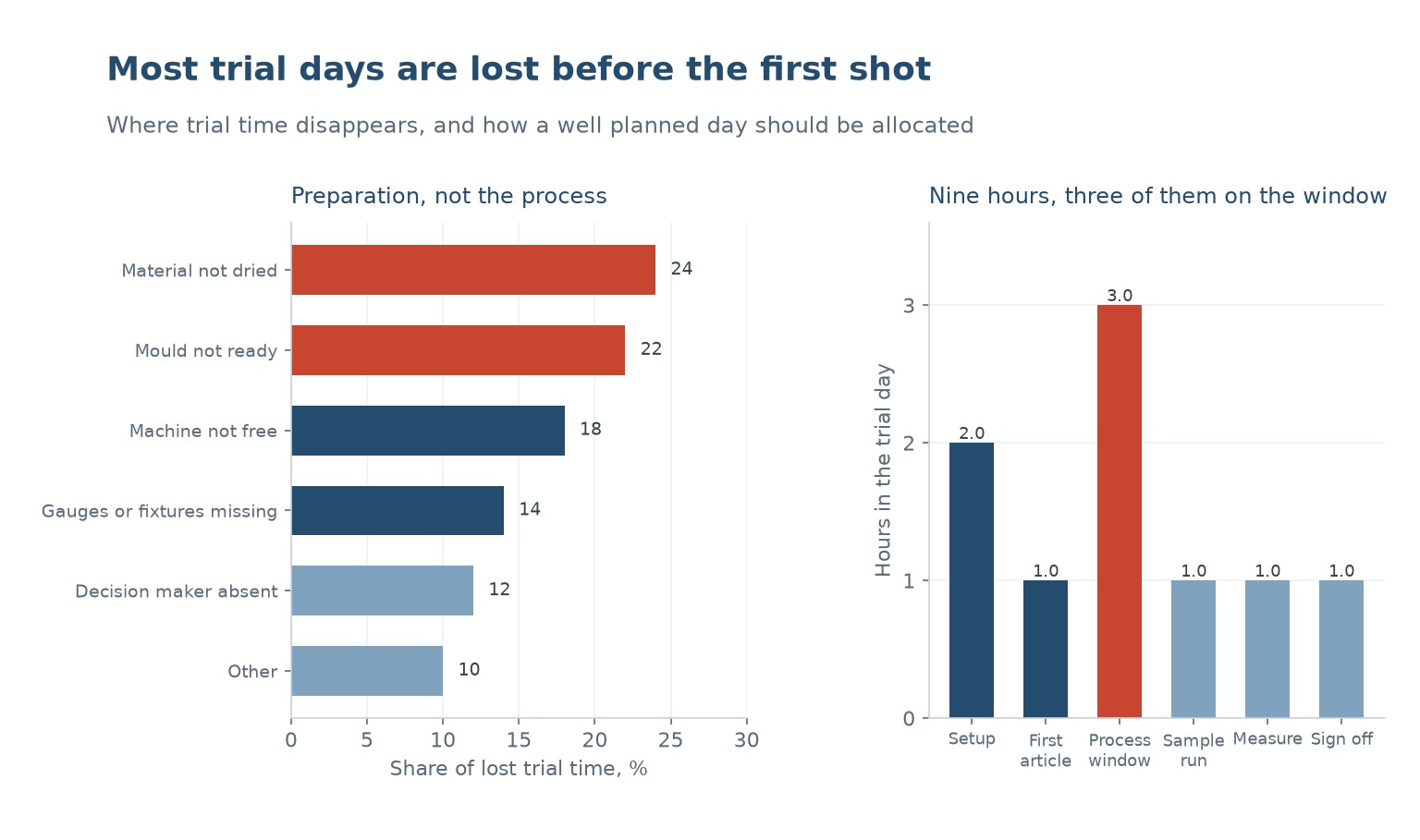
Setup and warm up takes two hours on a cold machine and that is not padding. The tool has to be mounted, the water connected and brought to temperature, the barrel purged, the first shots made and the process allowed to stabilise. Rushing this produces a window that is measured on a machine still coming up to temperature, which is not the window production will see.
The process window needs a systematic sweep, not a series of guesses. Vary hold pressure in four steps and record the part weight and the flash at each. Vary melt temperature in three steps and record the short shot position. The result is a map of where the process is comfortable and where it is on the edge, and it is the most valuable output of the day.
The sample run should be at the centre of that window, not at the setting that happened to produce a good part. Parts for the first article come from this run, and if they come from a setting on the edge of the window, the production process will drift out of it within a week.
Why trial time disappears
The chart on the left is a Pareto of lost trial time. Material not dried is 24 percent, mould not ready 22, machine not free 18, gauges or fixtures missing 14, decision maker absent 12 and everything else 10. The first two are preparation failures and they account for nearly half the loss.
Material not dried is the most avoidable of all. It costs nothing to load a dryer the day before and it costs half a day to recover from a barrel full of wet resin, because the barrel has to be purged and the process restarted. A dew point reading on the batch card is the evidence that it was done.
Mould not ready is the second and it is usually a small thing. A water fitting that does not match, a hot runner controller with the wrong plug, a slide that needs a shim. Each takes an hour to fix and none of them is discovered until the tool is on the platen. A bench trial two days before finds all of them.
The decision maker being absent is the one that costs the most in a different way. If the customer's engineer is not in the room, the parts are photographed and emailed, and the answer comes two days later, by which time the press has moved on. A trial without the authority to approve is a demonstration.
Who has to be in the room
Four roles. A setter who knows the machine and can change a setting safely. A process engineer who owns the window and records it. A quality person who can measure the parts and judge them against the drawing. And someone with the authority to accept or reject, from the customer or from the moulder's management.
The toolmaker should be reachable and preferably present for the first hour. Most tool problems appear in the first twenty shots and are fixed in twenty minutes with the right person there, and take a day with the right person on the phone.
The customer's presence is worth arguing for. It converts a three day loop into a same day decision, and it gives the customer's engineer a feel for the process that no report conveys. If travel is impossible, a video call at the machine for the window sweep is the next best thing.
What should not be in the room is a crowd. A trial with eight observers and two people working is a trial where nobody owns a task. Four roles, plus the toolmaker if the tool is new, is the right size.
Recording and signing
The output of a trial is a document, not a box of parts. The document should contain the process sheet at the centre of the window, the window itself with the settings that were tried and the results, the first article measurements, the parts, and a signature from each role confirming what they saw.
The process sheet is the most important page. It has to be complete enough that a different setter, on a different shift, can reproduce the part. Temperatures, pressures, times, distances, cooling, ejector settings, and the material lot. A sheet that says 'as discussed' is not a sheet.
The window should be recorded as a table rather than a paragraph. Setting, part weight, visual result, dimensional result, and a note on whether it is acceptable. Four rows of that table are worth more than a page of description, because they show where the edges are.
The signature is the part that makes the document usable later. Each role signs for what they are responsible for: the setter for the settings, the quality person for the measurements, the customer for the acceptance. When a question comes up six months later, the signature says who to ask.
| Output | Who signs | What it protects |
|---|---|---|
| Process sheet at the window centre | Setter and process engineer | Reproducibility |
| Window table with the edges | Process engineer | Robustness in production |
| First article measurements | 품질 | Conformance to drawing |
| Sample parts, labelled | 품질 | The physical reference |
| Trial report and open actions | All roles | Accountability for the gaps |
Table 2 — Five outputs and who owns each
How long should a trial run take?
A full day for a new tool, including setup, the first article, a process window sweep, a sample run and a review. A tool transfer or a material change can be done in half a day.
Do I need the customer at the trial?
It is worth arguing for. Their presence converts a three day approval loop into a same day decision and gives their engineer a feel for the process that no report conveys. A video call at the machine is the fallback.
Why does the trial always start late?
Almost always material not dried or the mould not tried in. Both are checked the day before at almost no cost, and both cost half a day to recover from during the trial.
What is a process window and why sweep it?
The range of settings that all produce acceptable parts. Sweeping it systematically shows where the process is comfortable and where it is on the edge, which is the difference between a robust production process and one that drifts out within a week.
Should the sample run be at the window centre?
Yes. Parts for the first article have to come from a setting with margin on both sides, not from the setting that happened to work. Otherwise the production process will drift out of the window almost immediately.
What has to be in the trial report?
The process sheet at the window centre, the window table with the edges, the first article measurements, the labelled sample parts and a signature from each role. A report without the window table is a description, not a record.
A trial day that keeps running out of time?
Send the tool drawing, the material and the part drawing. We will tell you what to check the week before so the day is spent on the process rather than on the preparation.
Continue reading
- Mould Trial and First Article: Running the Validation Properly
- First Article Inspection: The Document That Protects Both Sides
- Choosing an Injection Moulding Machine: The Four Numbers That Matter
- Shot Weight Variation: The Cheapest Process Indicator You Have
- SPC in Injection Moulding: Control Charts That Catch Drift Early




 KO
 EN
 ES
 FR
 DE
 PT
 AR
 RU
 JA
 IT
 NL
 TR
 PL
 ID
