
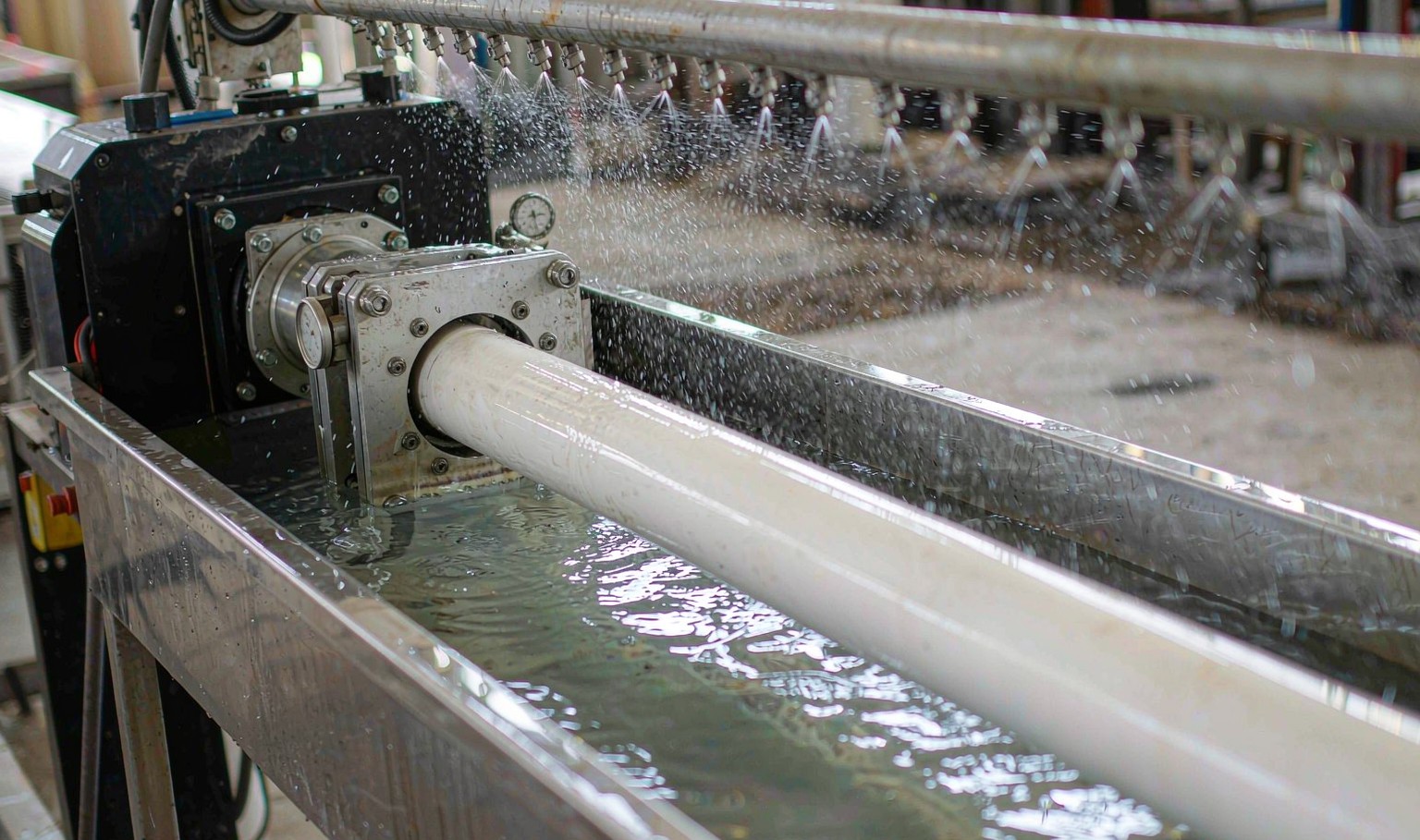
The bath does two jobs that pull apart
A cooling trough has to remove heat from the profile, and it has to hold the profile in shape while the wall is still soft. Those two jobs want different things from the water, and the compromise is where most cooling problems come from.
Removing heat wants cold water and fast flow. Holding shape wants the profile to be supported and cooled evenly on all faces, because uneven cooling is what turns a round pipe oval and a flat profile into a banana.
Cold water removes heat fastest and freezes stress in hardest. Warm water removes heat more slowly but lets the wall relax as it cools, so the stress that remains is lower. The profile that comes out of a warm bath is straighter and less prone to stress cracking, even though it took longer to make.
The number that matters is not the bath temperature on the dial. It is the temperature difference between the water and the wall at the point where the wall goes below its glass transition or its softening range, because that is where the stress becomes permanent.
Temperature sets the stress
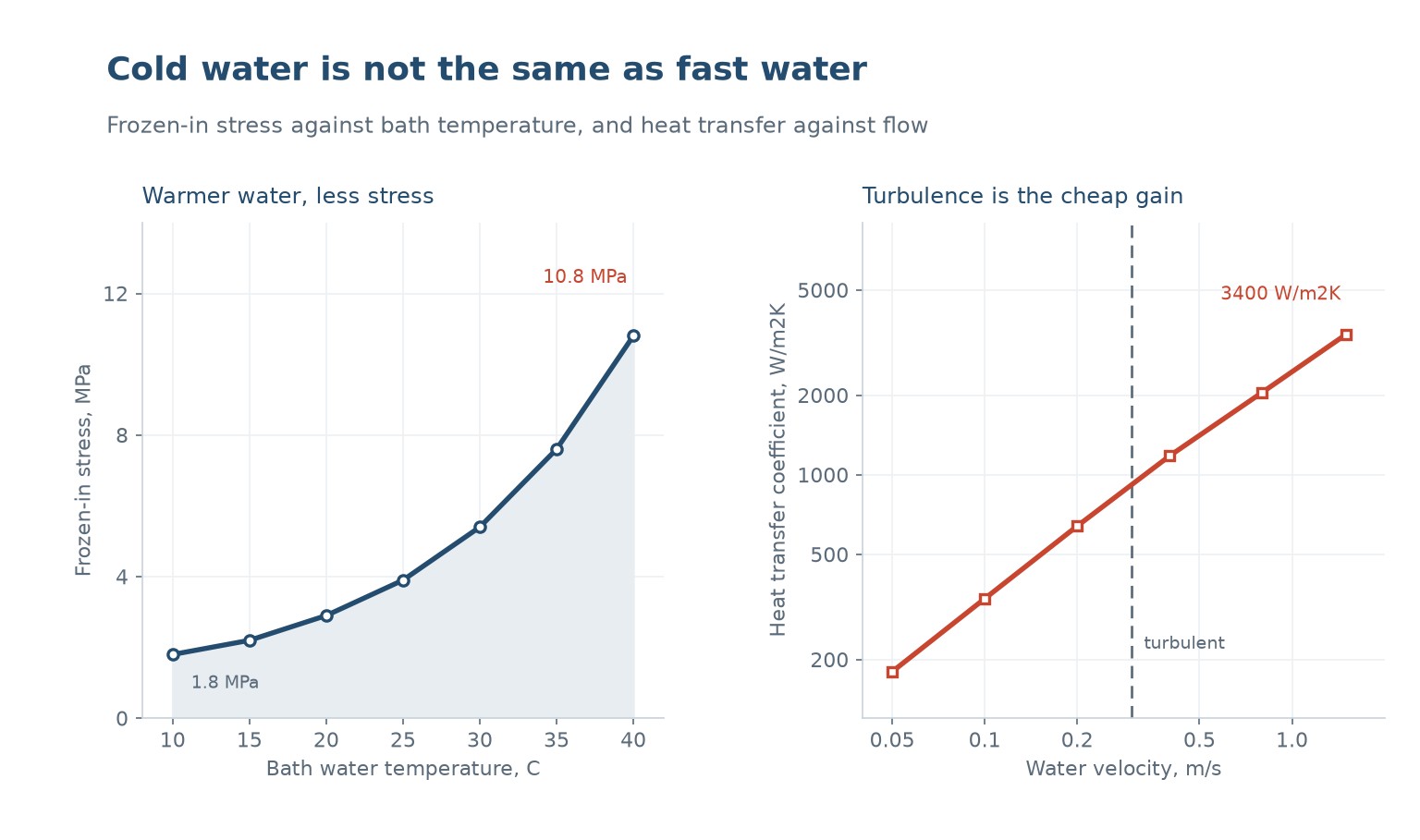
On a measured PVC pipe line running at 2.4 metres per minute, the frozen-in stress in the wall was 1.8 MPa with the bath at 10 C, 2.2 at 15, 2.9 at 20, 3.9 at 25, 5.4 at 30, 7.6 at 35 and 10.8 at 40.
The curve is not linear. Between 10 and 25 C the stress rises by 2.1 MPa; between 25 and 40 C it rises by 6.9. The reason is that the polymer's relaxation time falls steeply with temperature, so above about 25 C the wall has enough mobility to relax most of the stress as it cools, and below 20 C it does not.
That is why the counter-intuitive recommendation is often to run the bath warmer, not colder. A bath at 28 C that gives 4.6 MPa of stress and a straight pipe is better than a bath at 12 C that gives 2.0 MPa of stress and a pipe that splits lengthwise six months later in a cold store.
The limit is the pull-off point. Water above about 35 C does not cool the profile enough to hold it in the sizing sleeve, and the profile starts to drag. The usable band is usually 18 to 32 C, and it is narrower for thick walls.
Turbulence is the cheap gain
Heat transfer from a pipe wall to water is dominated by whether the flow is turbulent at the wall. In a trough with the profile lying in still water, the water next to the wall is a stagnant film a millimetre or two thick, and that film is the whole resistance.
Measured on a 40 mm pipe, the heat transfer coefficient was 180 watts per square metre kelvin at 0.05 metres per second, 340 at 0.10, 640 at 0.20, 1180 at 0.40, 2050 at 0.80 and 3400 at 1.50. The transition from laminar to turbulent happens at about 0.3 metres per second in a trough of this size.
The practical point is that going from 0.1 to 0.4 metres per second multiplies the heat transfer by 3.5, which is worth more than dropping the water temperature by 20 C. And it costs a bigger pump, not a chiller.
Most troughs are run at 0.1 to 0.15 metres per second because the pump was sized for circulation rather than for heat transfer, and because the overflow weir sets the flow. A flow meter on the inlet and a pump with 30 percent more head is usually the cheapest capacity increase available on an extrusion line.
| Water velocity | Heat transfer | Relative to 0.1 m/s |
|---|---|---|
| 0.05 m/s | 180 W/m2K | 0.5x |
| 0.10 m/s | 340 W/m2K | 1.0x |
| 0.20 m/s | 640 W/m2K | 1.9x |
| 0.40 m/s | 1180 W/m2K | 3.5x |
| 0.80 m/s | 2050 W/m2K | 6.0x |
| 1.50 m/s | 3400 W/m2K | 10.0x |
Table 1 — Flow against heat transfer on a 40 mm pipe
Spray, immersion and the difference nobody measures
An immersion trough cools by convection into a large body of water. A spray trough cools by impingement, which is a different mechanism and gives a much higher coefficient for the same water flow, because the droplets break the boundary layer.
The catch is coverage. Spray nozzles cool where they point and leave dry bands between, and a dry band on a soft profile is a flat spot. Spray troughs work well on round pipe, where the nozzles can be arranged in rings, and poorly on complex profiles, where the spray cannot reach into the recesses.
Vacuum sizing with water rings sits between the two: the water is drawn against the profile by the vacuum, so it is in contact everywhere and moving fast. That is why vacuum tanks cool better per metre than plain immersion troughs, and why they are standard on profile lines.
For a plant deciding between the two, the honest answer is that immersion is more forgiving and spray is faster. A hybrid, with immersion for the first metre to set the shape and spray after that to finish the cooling, is common and works well.
How long the trough has to be
Trough length follows from the cooling requirement, not from the floor space. The heat to be removed is the mass flow times the specific heat times the temperature drop, and the rate at which it can be removed is the heat transfer coefficient times the surface area times the temperature difference.
Doing that arithmetic for a 40 mm PVC pipe at 2.4 metres per minute, a 12 C water-to-wall difference and a coefficient of 1180 gives about 3.5 metres of trough to drop the wall from 190 C to 60 C. The same line with the water at 0.1 metres per second needs 12 metres, which is why the trough on the floor is usually longer than the calculation says it should be.
The practical rule is to size the trough for the fastest line speed you intend to run, then add 20 percent, because the coefficient falls as the profile gets hotter and the water gets warmer along the trough. A trough sized exactly for the current speed has no headroom and becomes the bottleneck the first time someone tries to raise output.
If the trough is already too short, the options are to raise the flow, to lower the water temperature, to add a spray section, or to slow down. In that order of cost, and usually in that order of effectiveness too.
| Trough length | Wall out at 2.4 m/min | Practical limit |
|---|---|---|
| 3.5 m | 60 C at 1180 W/m2K | Runs, no headroom |
| 5.0 m | 48 C at 1180 W/m2K | Comfortable |
| 6.0 m | 42 C at 1180 W/m2K | Room to raise speed |
| 3.5 m at 0.1 m/s | 95 C, still soft | Profile drags |
| 12 m at 0.1 m/s | 60 C | Why troughs are long |
Table 2 — Trough length against exit wall temperature
Commissioning a trough properly
The first measurement is the water temperature at the inlet and at the outlet, not at the chiller. A trough with a 6 C rise along its length is not cooling evenly, and the far end is doing most of the work with water that has already picked up heat.
The second is the flow. A bucket and a stopwatch at the overflow is crude and accurate enough: fill a 20 litre bucket, time it, and you have the flow in litres per minute. Most plants are surprised by how far this is from the pump curve.
The third is the profile temperature at the pull-off, measured with a contact probe within a second of leaving the water. If it is above 60 C the profile will deform on the haul-off; below 40 C the line is cooling more than it needs to and could run faster.
The fourth is the stress, and it is the one nobody measures. A simple quality check is to cut a 300 mm length, lay it on a flat table and measure the gap under each end after 24 hours. A pipe that has curled by more than 2 mm has stress that will find a way out later.
What water temperature should a cooling trough run at?
Usually 18 to 32 C. Below 20 C the wall cannot relax and the stress stays in; above 35 C the profile is still soft at the pull-off and drags in the sizing sleeve.
Why does a warmer bath give a straighter pipe?
The polymer has enough mobility to relax the cooling stress before it becomes permanent. Stress, not temperature, is what makes a pipe curl.
How much flow does a trough need?
Enough to keep the water turbulent at the wall, which on a 40 mm pipe is about 0.3 metres per second. Many troughs run at a third of that because the pump was sized for circulation.
Does a spray trough cool better than immersion?
Per metre of length, yes, because impingement breaks the boundary layer. It is less even on complex profiles, where the spray cannot reach into recesses.
How do I check residual stress without a lab?
Cut a 300 mm length, lay it flat and measure the gap under each end after 24 hours. More than 2 mm of curl means stress that will show up as cracking later.
Can I raise line speed by adding a chiller?
Only if the flow is already turbulent. Raising flow from 0.1 to 0.4 metres per second gains 3.5 times the heat transfer for the price of a pump, which is usually cheaper than a chiller.
A line that cannot run at the speed it was sold at?
Send the profile, the wall thickness, the trough length and the current water flow and temperature. We will tell you whether the limit is the trough, the pump or the sizing.
Continue reading
- Extrusion Vacuum Sizing: The Sleeve, the Slots and the Vacuum
- Cable Extrusion Defects: Voids, Protrusions and the Die
- Barrel Heating Zones: Setting a Profile That Matches the Polymer
- Extruder Screen Changer: Filtration Without Stopping the Line
- Plastic Extrusion Solutions: From Die to Finished Profile




 KO
 EN
 ES
 FR
 DE
 PT
 AR
 RU
 JA
 IT
 NL
 TR
 PL
 ID
