

What compression set measures
A seal works because it is compressed and pushes back. If the material takes a permanent deformation under that compression, part of the push is lost forever, and a seal that had 25 percent deflection available now has 15. Compression set is the percentage of the applied deflection that does not come back.
The test is simple and standardised. A specimen, usually a disc or a ring, is compressed by 25 percent between two plates, held at a stated temperature for a stated time, released, and measured after 30 minutes of recovery. The set is the loss of thickness divided by the original compression.
The 30 minute recovery matters. Silicone continues to recover slowly for hours, so a measurement taken immediately reads worse than the part will be in service, and one taken after a day reads better. The standard fixes 30 minutes so that results are comparable, and a result quoted without the recovery time is not comparable with anything.
For a general purpose silicone the set after 22 hours at 175 C is typically 20 to 30 percent. A high temperature grade is 10 to 15, and a poorly cured compound can be 50 or more. Those differences decide whether a gasket lasts a year or a month.
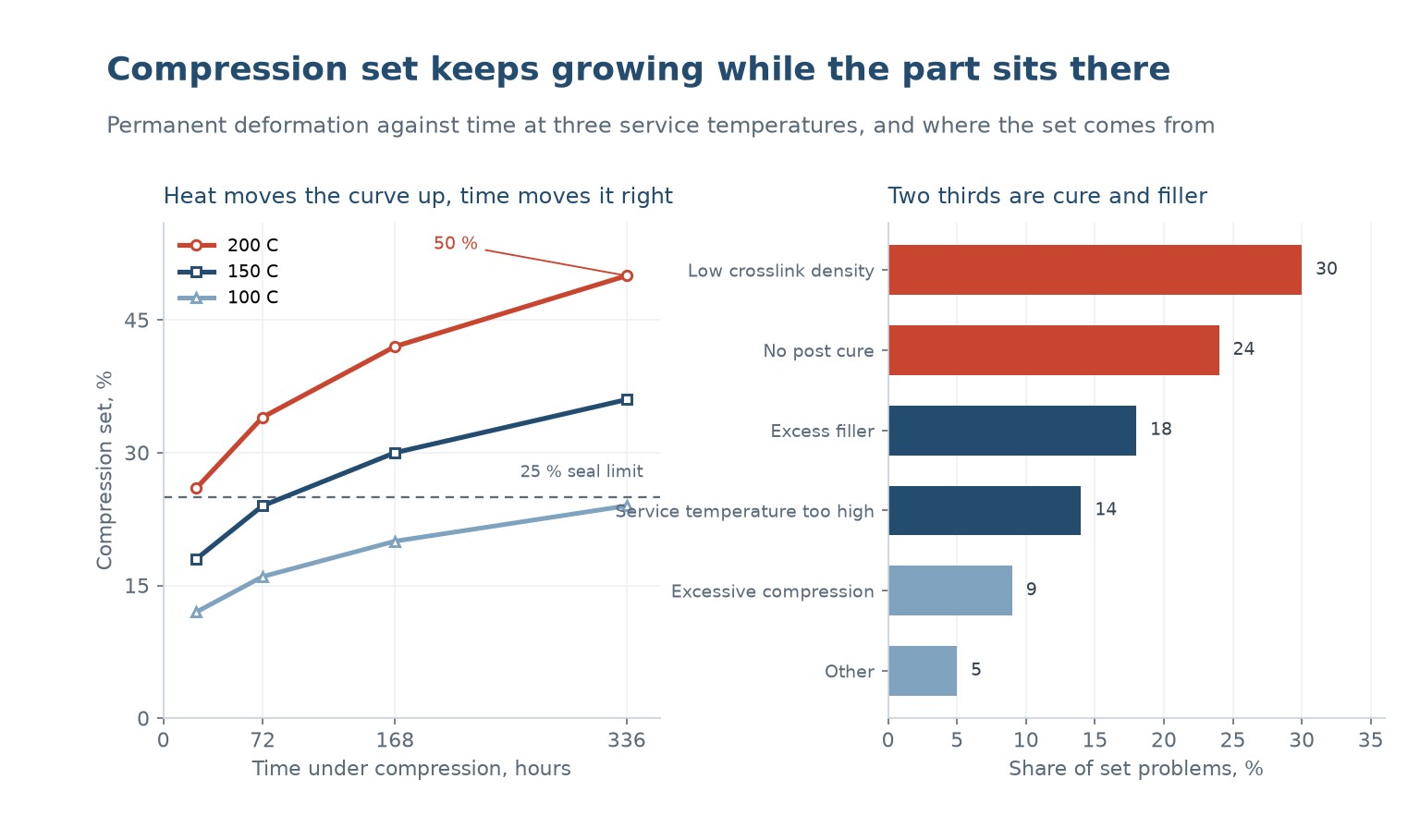
Heat moves the curve up, time moves it right
The chart on the left shows the same 70 Shore A compound tested at three temperatures. At 100 C the set rises from 12 percent after 24 hours to 24 percent after 336 hours. At 150 C it starts at 18 and reaches 36, and at 200 C it starts at 26 and reaches 50.
Two things are happening at once. The time effect is creep: the material continues to flow under load, and the rate falls off slowly. The temperature effect is chemical: above about 150 C the crosslinks themselves begin to rearrange, and the network loses its memory of the original shape.
The practical consequence is that a set measured at 175 C for 22 hours is not a prediction of a part at 100 C for a year. It is a ranking tool. Two compounds tested the same way can be compared, and the one with the lower set will usually last longer, but the absolute number does not transfer to a different condition.
The 25 percent line on the chart is the point at which most gasket designs stop sealing, because the remaining deflection is no longer enough to accommodate the surface roughness of the mating parts. A compound that crosses that line at 150 C within 72 hours has no business in a 150 C application.
The four causes of a high set
The largest single cause, at 30 percent in the survey on the right, is low crosslink density. A compound that is under cured, or formulated with too few crosslinks, has a loose network that flows under load. It will feel correct, measure correct on hardness, and set badly.
The second, at 24 percent, is the absence of a post cure. A peroxide cured silicone needs a secondary vulcanisation in an oven, typically 4 hours at 200 C, to drive off the decomposition products and complete the crosslinking. A part that goes straight from the press to the box still contains those products, and they plasticise the network from the inside.
The third is excess filler at 18 percent. Filler stiffens the compound and raises the hardness, which looks like an improvement, but it also dilutes the elastic network. A 70 Shore A compound made by loading a 50 Shore A base heavily will set worse than one made from a properly formulated 70 Shore A base.
The fourth is the application itself: too high a service temperature at 14 percent and excessive compression at 9 percent. A gasket compressed by 40 percent instead of 25 sets faster, because the strain is higher and the material has further to recover.
Specifying set so it means something
The specification has to state the test condition, because the number is meaningless without it. ASTM D395 Method B at 175 C for 22 hours is the common general purpose condition; 200 C for 70 hours is used for high temperature grades; and some automotive specifications use 150 C for 1000 hours to approximate a service life.
The acceptance limit should be set from the application, not from a catalogue. A static seal in a housing at 80 C can tolerate 40 percent set and still seal. A dynamic seal in a valve at 150 C cannot tolerate more than 20, because it also has to resist wear and extrusion.
The specimen geometry matters as well. A disc and an O ring of the same compound give different numbers, because the O ring has less constraint at the edges. If the production part is an O ring, test an O ring, or accept that the disc number is optimistic.
| Condition | Typical set | Used for |
|---|---|---|
| 175 C, 22 h | 20 to 30 % | General purpose specification |
| 200 C, 22 h | 15 to 25 % | High temperature grade |
| 200 C, 70 h | 25 to 40 % | Severe service, automotive |
| 150 C, 1000 h | 30 to 45 % | Service life approximation |
| 23 C, 70 h | 5 to 12 % | Room temperature creep |
Table 1 — Common test conditions and what they are used for
Bringing the set down
The first lever is cure. Increasing the cure time or temperature, or adding a proper post cure, will bring a set from 45 percent down to 25 without changing anything else. It is the cheapest fix and the one most often skipped because the part looks fine when it comes out of the press.
The second is the compound. A base with a higher vinyl content crosslinks more densely and sets less. A compound with a lower filler loading and a higher polymer content will set less at the same hardness. Both changes cost money per kilogram and are worth it on a seal that has to last.
The third is the design. Reducing the compression from 40 to 25 percent, or increasing the gasket cross section so that a given loss of thickness still leaves enough deflection, are free changes that often solve the problem without touching the material.
| Change | Effect on set | Costo | Il rischio |
|---|---|---|---|
| Add a 4 h post cure at 200 C | Minus 15 to 20 points | Oven time | None, it is required anyway |
| Increase press cure time | Minus 5 to 10 points | Tempo di ciclo | None |
| Higher vinyl base | Minus 5 to 10 points | Material cost | Slightly harder to process |
| Lower filler loading | Minus 5 points | Material cost | Lower hardness, reformulate |
| Reduce compression to 25 % | Minus 8 to 12 points | Design change | Needs a deeper groove |
Table 2 — Options in order of cost against effect
The order in the table is the order to try them. A post cure costs oven time and is required by most specifications anyway, so a compound that fails without one is not a compound problem at all, it is a process step that was left out.
Reading a field failure
A gasket that leaks after a year usually shows a flat section where it was compressed and a set of 35 to 50 percent. The first question is whether the compound was post cured, which can be checked by measuring the volatile content or by comparing the set of a production part with the set of a laboratory plaque.
A gasket that leaks in weeks usually has a different cause: chemical attack, extrusion of the material out of the groove, or a groove that was too shallow from the start. Compression set is a slow mechanism, and a fast failure is usually something else.
The most useful thing a plant can do is keep a retained sample from each batch and measure the set on a production part in a simple fixture. It is not a standard test, because the geometry is not standard, but it is repeatable within the plant and it catches a cure problem before it reaches a customer.
What is a good compression set for silicone?
Under 25 percent at 175 C for 22 hours for a general purpose seal, and under 15 for a high temperature grade. Above 35 percent the seal will lose its deflection in service and leak, even if it looked correct when it was installed.
Why does my silicone set so badly?
In order of likelihood: no post cure, an under cured compound, too much filler, or a service temperature above what the grade was formulated for. The post cure is the first thing to check, because it is a process step that is easy to skip.
Does hardness affect compression set?
Not directly, but the way the hardness was achieved does. A 70 Shore A compound made by loading a soft base heavily sets worse than one formulated at 70 from the start, because the filler dilutes the elastic network.
Can compression set be reversed?
Partly, and only by heat. A gasket that has taken a set can recover some of it if it is heated free of load, which is why some seals are reconditioned in service. The recovery is never complete, and it is not a repair strategy.
How long should a compression set test run?
22 hours is the standard short test, and 70 hours is used where a longer service life has to be approximated. Longer tests give a better prediction but are rarely practical for production control.
Does the groove depth matter?
Considerably. A groove that compresses the gasket by 40 percent instead of 25 raises the set and accelerates the loss of sealing force. The groove is part of the seal design, not just a pocket for the gasket.
Seal failing earlier than expected?
Send the compound, the groove dimensions and the service temperature. We will tell you whether the set is a material problem, a cure problem or a design one.
Continue reading
- Silicone Compression Moulding: The Process Behind Most Rubber Parts
- Post Curing Silicone: The Step That Decides the Set
- Secondary Vulcanisation of Silicone: Why the Oven Matters
- Silicone Hardness Testing: Shore A, IRHD and the Sample Thickness
- Silicone Gasket and Seal Design: Getting the Groove Right




 IT
 EN
 ES
 FR
 DE
 PT
 AR
 RU
 JA
 KO
 NL
 TR
 PL
 ID
