
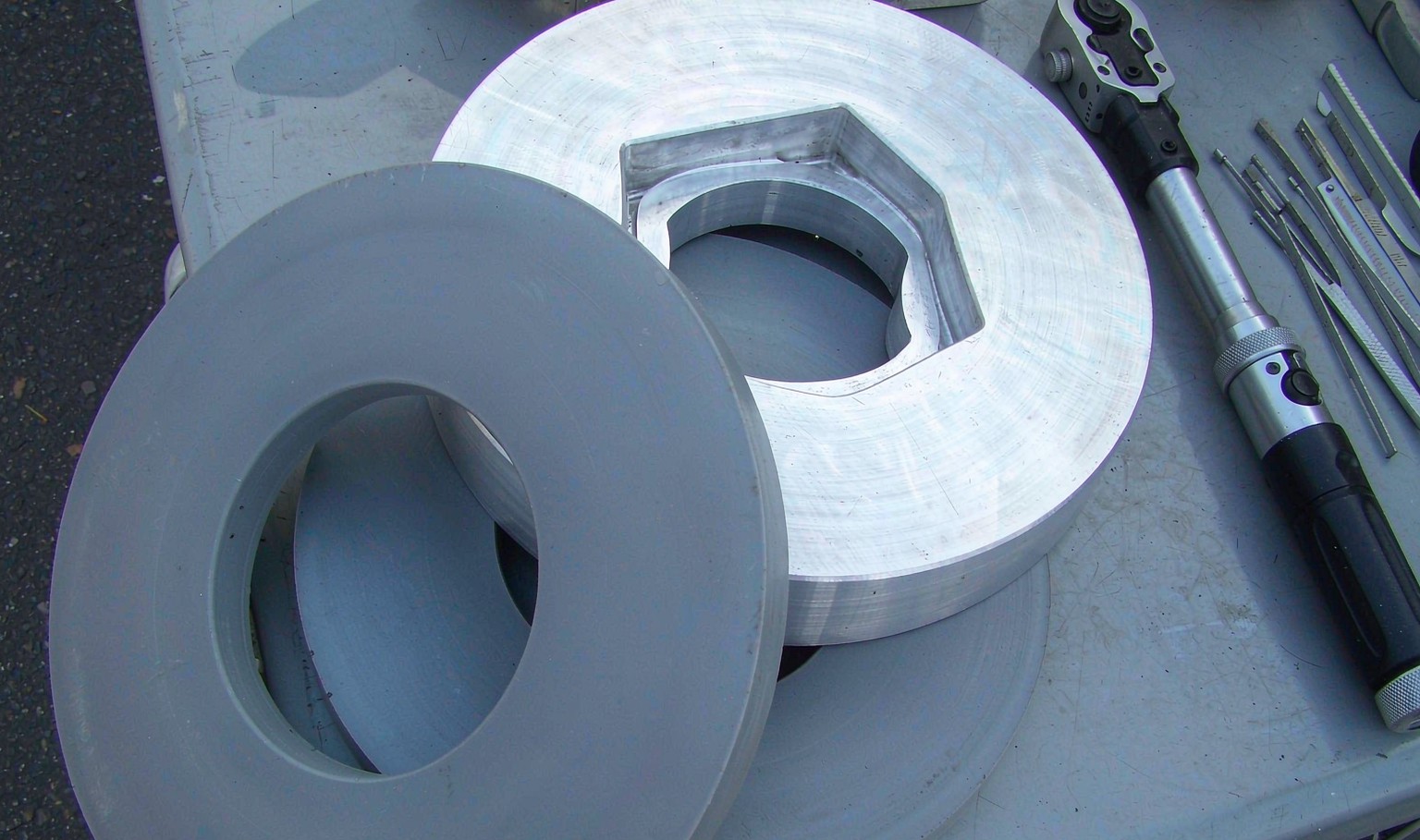
A gasket is a spring with a deadline
A gasket seals by pushing back. It is compressed between two faces, and the force it generates is what keeps the joint closed against whatever pressure is inside. That force is not constant. It falls from the moment the joint is tightened, slowly at first and then faster as the material relaxes and takes a set.
So the question is never whether a gasket seals on the day it is fitted. It is whether it still seals at the end of the service interval, at the highest temperature the joint sees, with the set it will have accumulated by then. A gasket that fails at month eighteen was the wrong gasket at month zero.
Silicone is chosen for this job because it holds elasticity over a wide temperature range and because it tolerates the compression needed for an uneven flange. It is a poor choice when the joint runs hot for long periods, because it continues to crosslink and to take a set faster than a fluoroelastomer or an EPDM would.
Force retention through thermal cycles
Sealing force retained after thermal cycles, for the same gasket at three temperatures: at 150 C it falls to 92 percent after 100 cycles, 86 after 300, 82 after 600 and 80 after 1,000. At 175 C the same points are 86, 76, 70 and 66. At 200 C they are 78, 64, 56 and 50.
Two things are worth reading out of those numbers. The first is that the loss is front-loaded: most of it happens in the first 100 cycles, and the curve then flattens. That is relaxation rather than degradation, and it is predictable. The second is that temperature dominates. Twenty-five degrees between 150 and 175 C costs 14 percentage points of retained force over a thousand cycles.
The practical use is to size the joint for the end point. If the design needs 60 percent of initial force to seal, a gasket at 150 C has margin for a very long life, and the same gasket at 200 C reaches its limit at around 300 cycles. The gasket did not change; the application did.

Set is what leaks
Leak rate against compression set: 0.2 sccm at 8 percent set, 0.5 at 12, 1.4 at 18, 4.0 at 25 and 11 at 32. The curve is flat and then steep, and the steep part is where a joint goes from acceptable to obviously leaking in a short time.
That shape is why gasket failures look sudden. The joint holds a vacuum test at month six and fails at month twelve, and the set has been climbing steadily the whole time. There is no gradual warning because the leak curve does not give one.
It is also why the set figure on a data sheet has to be read with its test conditions. A compound quoted at 15 percent set may be 15 percent at 22 hours and 175 C, which is a different number from 15 percent at 70 hours and 200 C. The second is a much better material.
Creep under load is the other half
Set is what happens after the load is removed. Creep is what happens while it is applied, and for a gasket under a bolted flange it is the more relevant of the two. The gasket continues to thin under constant compression, the bolt preload falls as it does, and the joint loses force from both directions.
The bolts matter here. A steel bolt in an aluminium flange expands more than the flange when the joint heats, so the preload changes with temperature, and it changes in a way that depends on the flange material and the bolt length. A short bolt in an aluminium flange loses preload fast when it gets hot.
The fix is usually a longer bolt or a stiffened flange rather than a different gasket, because the gasket's creep is bounded by its formulation while the bolt's preload loss is bounded by geometry.
| Symptom | Likely cause | What to change |
|---|---|---|
| Leaks after months, not days | Compression set at temperature | Lower-set grade, or a cooler joint |
| Leaks immediately at one point | Flange flatness or a damaged groove | Machine the flange, check the surface finish |
| Leaks at temperature, seals cold | Bolt preload loss, differential expansion | Longer bolts, disc springs, or a stiffer flange |
| Gasket extruded into the gap | Groove fill too high, or gap too large | Deeper groove, smaller section, tighter gap |
| Gasket bonded to the flange | Over-temperature, or no release agent | Check the temperature, use a release coating |
Table 1 — Gasket failures and where each one actually comes from
The flange decides more than the gasket
A gasket can only work with what the flange gives it. Three flange properties matter more than any gasket specification: flatness, surface finish and stiffness.
Flatness sets whether the gasket is compressed evenly. A flange that is 0.1 mm out of flat over its length will compress one side of the gasket more than the other, and the lightly loaded side will leak while the heavily loaded side takes a set. Gaskets do not average out a bad flange; they follow it.
Surface finish sets whether the gasket can seal at all. A machined surface with a fine, non-directional finish seals well. A surface with concentric turning marks gives a leak path along the marks, and no amount of gasket force closes a path that runs under the seal.
| Flange property | Target | What happens if it is wrong |
|---|---|---|
| Flatness | 0.05 mm over the seal face | Uneven compression, one-sided leak |
| Surface finish | Ra 0.8 to 1.6, non-directional | Leak path along machining marks |
| Groove depth | Sized for 20 to 25 percent squeeze | Too shallow: over-fill. Too deep: no force |
| Groove width | Fill below 85 percent | Over-fill, gasket cannot be compressed |
| Bolt stiffness | Long bolts or disc springs | Preload lost at temperature |
Table 2 — Flange properties that decide the seal more than the gasket does
What to specify
A gasket specification should describe the life, not the part.
- Sealing force required at end of life, not at installation.
- Compression set with the test conditions and the service temperature.
- Squeeze percentage and groove fill, both on the drawing.
- Service temperature, continuous and peak, and the number of thermal cycles expected.
- Flange flatness and surface finish, since the gasket cannot compensate for either.
- Whether the gasket is post-cured, which reduces outgassing in a sealed enclosure.
The end-of-life force is the item that changes designs. Most gasket drawings specify a material and a hardness, which says nothing about whether the joint will still seal after two years at 180 C.
Why does a silicone gasket leak after a year but pass the initial test?
It has taken a compression set and the sealing force has fallen below what the internal pressure needs. Set climbs steadily and the leak curve is flat then steep, so the failure looks sudden.
How much does temperature affect gasket life?
Strongly. Force retention after a thousand cycles is 80 percent at 150 C, 66 at 175 C and 50 at 200 C, for the same gasket.
What compression set is acceptable?
Under about 15 percent for a long-life joint, and under 25 percent for a joint that will be serviced. Above 30 percent the leak rate rises sharply.
Why does the joint leak hot but seal cold?
Bolt preload loss from differential expansion, usually a short steel bolt in an aluminium flange. The gasket is not the problem.
How flat does a flange need to be?
About 0.05 mm over the seal face, with a non-directional finish around Ra 0.8 to 1.6. A gasket follows a bad flange rather than averaging it.
Does groove fill matter for a flat gasket?
Yes, for any gasket in a confined groove. Above 85 percent fill there is nowhere for the displaced material to go and the joint cannot close.
A joint that passes the test and fails in service?
Send the flange drawing, the temperature profile and the service life. We will tell you what set the gasket will have at the end and whether it still has the force to seal.




 IT
 EN
 ES
 FR
 DE
 PT
 AR
 RU
 JA
 KO
 NL
 TR
 PL
 ID
