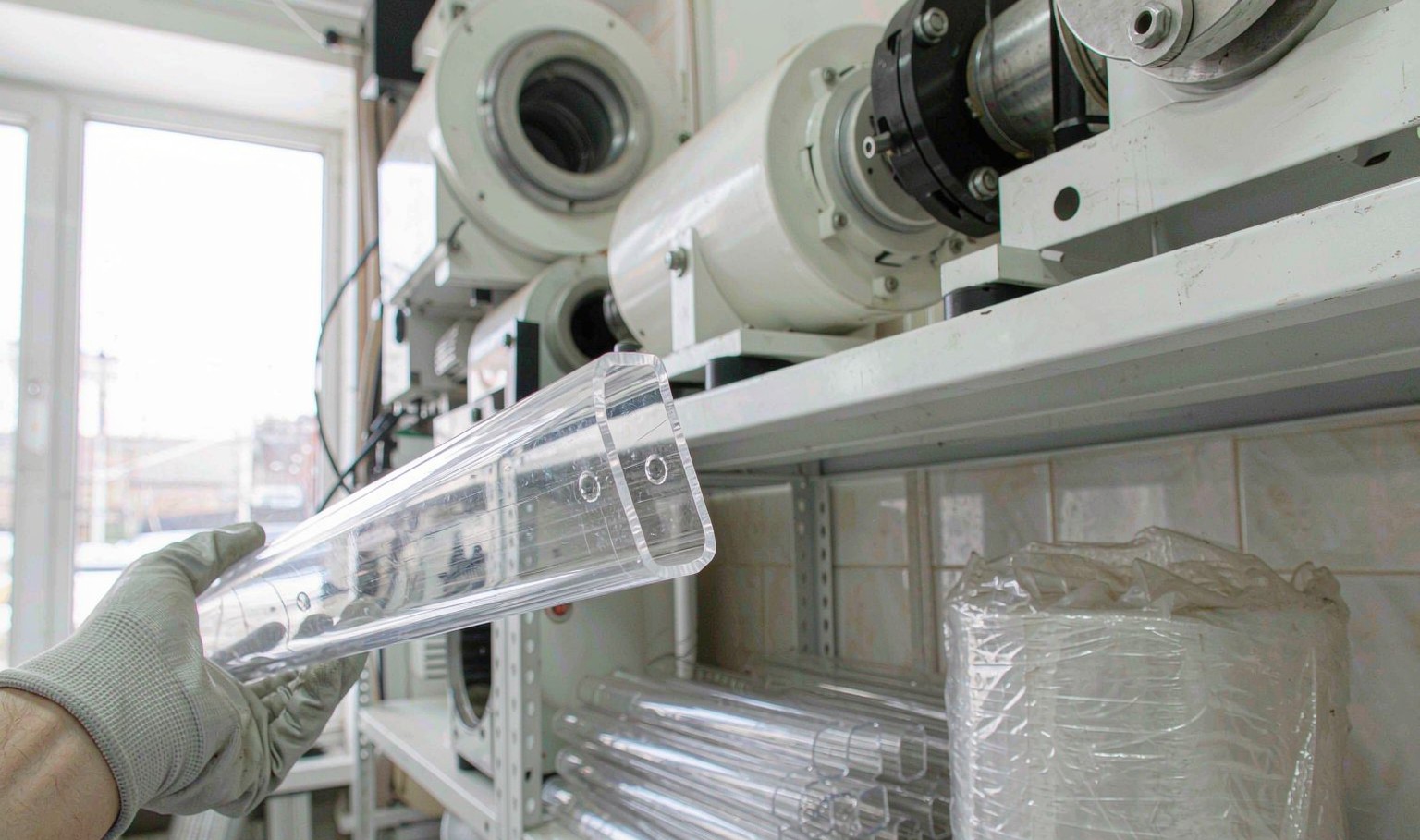
A void is gas, and gas has three sources
A void in an extruded profile is a bubble of gas trapped in the melt as it solidified. The gas is either water vapour from moisture in the compound, air that was dragged into the feed throat or dissolved in the granules, or products of the polymer degrading in the barrel. Each has a different signature.
Water is the most common by a wide margin. Most polymers absorb moisture from the air, and the amount depends on the material: polyolefins absorb very little, polyamides and polyesters absorb a great deal. At extrusion temperatures the absorbed water flashes to steam, and the steam expands into a bubble that the melt cannot collapse before it freezes.
Air entrainment is the second. A feed throat that is running empty, a hopper with a poor flow pattern, or a screw with a shallow feed section can drag air into the melt along with the granules. The air does not dissolve, it forms bubbles, and it tends to appear as a foam rather than as discrete voids.
Decomposition is the third and the least common, but the most serious. A polymer run too hot, or held too long, breaks down and releases volatiles. The voids from decomposition are accompanied by discolouration and smell, which is what distinguishes them from the other two.
A few hundred ppm is enough
The chart on the left plots voids per metre against moisture content. At 200 parts per million there are about 2 voids per metre, at 400 there are 8, at 600 there are 20, at 800 there are 45 and at 1200 there are 90. The relationship is steeper than linear, which is why the problem appears suddenly rather than gradually.

Two hundred parts per million sounds like nothing, and it is about 0.02 percent by weight. In a polyamide that is a dry-looking granule. The reason it matters is that the volume of steam produced from a given mass of water is enormous at extrusion temperature: one gram of water becomes well over a litre of vapour.
The threshold depends on the material and on the profile. A thick-walled profile can absorb some gas because the melt pressure in the die suppresses bubble growth and the wall is thick enough for a small void to be invisible. A thin wall or a transparent product shows every bubble, so the acceptable moisture level is much lower.
That is why the specification has to be material specific. A polypropylene that runs acceptably at 800 ppm is not a guide for a polyamide, which may need below 200. Quoting a single moisture limit for a shop that runs several materials is a common and expensive simplification.
Drying is a process, not a machine
The right hand panel shows the causes: moisture 34 percent, air at the feed throat 24, thermal decomposition 18, screw compression design 14, blocked vent 6. Moisture dominates, and the answer is a dryer that is specified, maintained and monitored rather than a dryer that exists.
A desiccant dryer has to be sized for the throughput and the material, and its dew point has to be low enough for the polymer in question. A dryer delivering minus 20 degrees dew point is adequate for polypropylene and marginal for polyamide, which wants minus 40 or lower.
The second requirement is residence time. A dryer that is undersized for the throughput passes material through before it has reached equilibrium, so the granule leaving the hopper is drier on the outside than the inside. The moisture reads low on a surface test and the voids appear anyway.
The third is the pipe from the dryer to the machine. A long, unheated line in a cold shop allows the dry granules to re-absorb moisture on the way, and a line with a leak admits damp air. The measurement that catches this is a moisture reading taken at the machine hopper, not at the dryer outlet.
Air at the feed and in the screw
Air at the feed throat accounts for 24 percent and it is often a mechanical problem. A hopper that is allowed to run empty pulls air in with the last of the granules; a feed throat with a worn or missing seal admits air; a hopper loader that cycles on and off creates a pulsing flow that traps air between the pulses.
The screw's compression ratio at 14 percent is the design side of the same issue. A screw with a shallow feed section and a high compression ratio compresses the bed of granules, which expels air before the melt zone. A screw with a deep feed section and a low compression ratio does not, and the air ends up in the melt.
This is why a screw that works well on one material can produce voids on another. The compression ratio that suits a bulk density of 0.55 grams per cubic centimetre may be inadequate for a fluffy regrind blend at 0.35, and the machine has no way of knowing.
The blocked vent at 6 percent applies to vented extruders. A vent that is plugged with degraded material stops removing volatiles, and the result is voids plus a smell. Venting is a maintenance item and it is invisible until it fails.
| Signature | Likely source | First check |
|---|---|---|
| Many small bubbles, evenly spread | Moisture | Moisture reading at the machine hopper |
| Foam, especially at the surface | Air entrainment | Hopper level, feed throat seal, loader cycle |
| Large voids, irregular | Decomposition | Barrel temperatures, residence time, purge history |
| Voids only at start-up | Trapped air in a cold screw | Purge procedure, start-up sequence |
| Voids with discolouration | Degraded material in a dead spot | Screw and die dead spots, purging |
Table 1 — Reading the void pattern to find the gas source.
What to change first
The order is fixed by cost. Check the moisture at the machine first, because a meter costs less than any other intervention and it settles the largest cause in a minute. Then check the hopper and the feed throat, which is a visual inspection. Then look at temperatures and residence time. Then at the screw.
If the moisture is high, the question becomes why. A dryer that is working but undersized, a dryer that is working but not being regenerated, a line that is leaking, a material that has been stored in an open bag: all of these produce the same reading and have different fixes.
If the moisture is low and the voids persist, the gas is air or decomposition. Air is mechanical and cheap to fix; decomposition is thermal and indicates that something in the barrel is too hot or has been there too long. A purge and a temperature check is the first step in both cases.
The last thing to change is the screw. It is the most expensive intervention and it is the one most often proposed first, usually by somebody who has not measured the moisture. A screw change that does not address the actual gas source makes no difference and costs a week of production.
| Materiale | Dryer type | Target moisture |
|---|---|---|
| Polipropilene | Desiccant or hot air | Below 500 ppm |
| Polietilene | Hot air is usually enough | Below 300 ppm |
| Rigid PVC | Hot air, short residence | Below 1000 ppm, dry blend |
| ABS | Desiccant | Below 500 ppm |
| Polyamide | Desiccant at minus 40 dew point | Below 200 ppm |
| PET | Desiccant at minus 40 dew point | Below 50 ppm |
Table 2 — Dryer type and target moisture by material.
What voids cost
A void in a structural profile is a stress concentrator and a reduction in wall section. On a pressure pipe it is a leak path. On a transparent product it is a cosmetic reject. The severity depends on the application, and so does the acceptance limit.
The direct cost is the rejected length, which on a continuous line can be large because the fault is often present for the whole run. The indirect cost is the sorting: a coil with voids has to be inspected, and inspection at production speed is not possible for internal voids, so the whole coil is suspect.
There is also a customer relationship cost that is out of proportion. A void that appears in a delivered part is a quality escape, and a quality escape triggers an audit and a tightened inspection regime that costs more than the parts. A shop that measures moisture at the machine prevents most of them for the price of a meter.
What causes bubbles in an extruded profile?
Gas in the melt. It is moisture from the compound about a third of the time, air dragged in at the feed throat about a quarter, and thermal decomposition or screw design for the rest. The pattern of the voids identifies which.
How much moisture causes voids?
A few hundred parts per million is enough in a sensitive material. At 200 ppm there are about 2 voids per metre, at 600 ppm about 20, and at 1200 ppm about 90, so the effect is steeper than linear.
How do I tell moisture voids from air entrainment?
Moisture gives many small bubbles evenly distributed through the wall. Air entrainment gives a foam, often concentrated at the surface. Decomposition gives larger irregular voids with discolouration and smell.
Where should moisture be measured?
At the machine hopper, not at the dryer outlet. A long unheated line or a leak between the two lets dry granules re-absorb moisture, and the dryer reading will look perfect while the machine sees damp material.
Does a higher compression screw always help?
No. It helps when air entrainment is the cause, and it does nothing when the cause is moisture. Changing a screw is the most expensive intervention and should be the last, not the first.
Why do voids appear only at start-up?
Because the screw and barrel were cold and air was trapped in the feed section. A proper purge and a temperature soak before production removes the effect, and a shop that starts producing immediately will see it every time.
A profile without voids
Send us the material, the profile and a sample with the fault. We will tell you which of the three gas sources the pattern points to, and whether the fix is the dryer, the feed throat or the screw.



 IT
 EN
 ES
 FR
 DE
 PT
 AR
 RU
 JA
 KO
 NL
 TR
 PL
 ID