
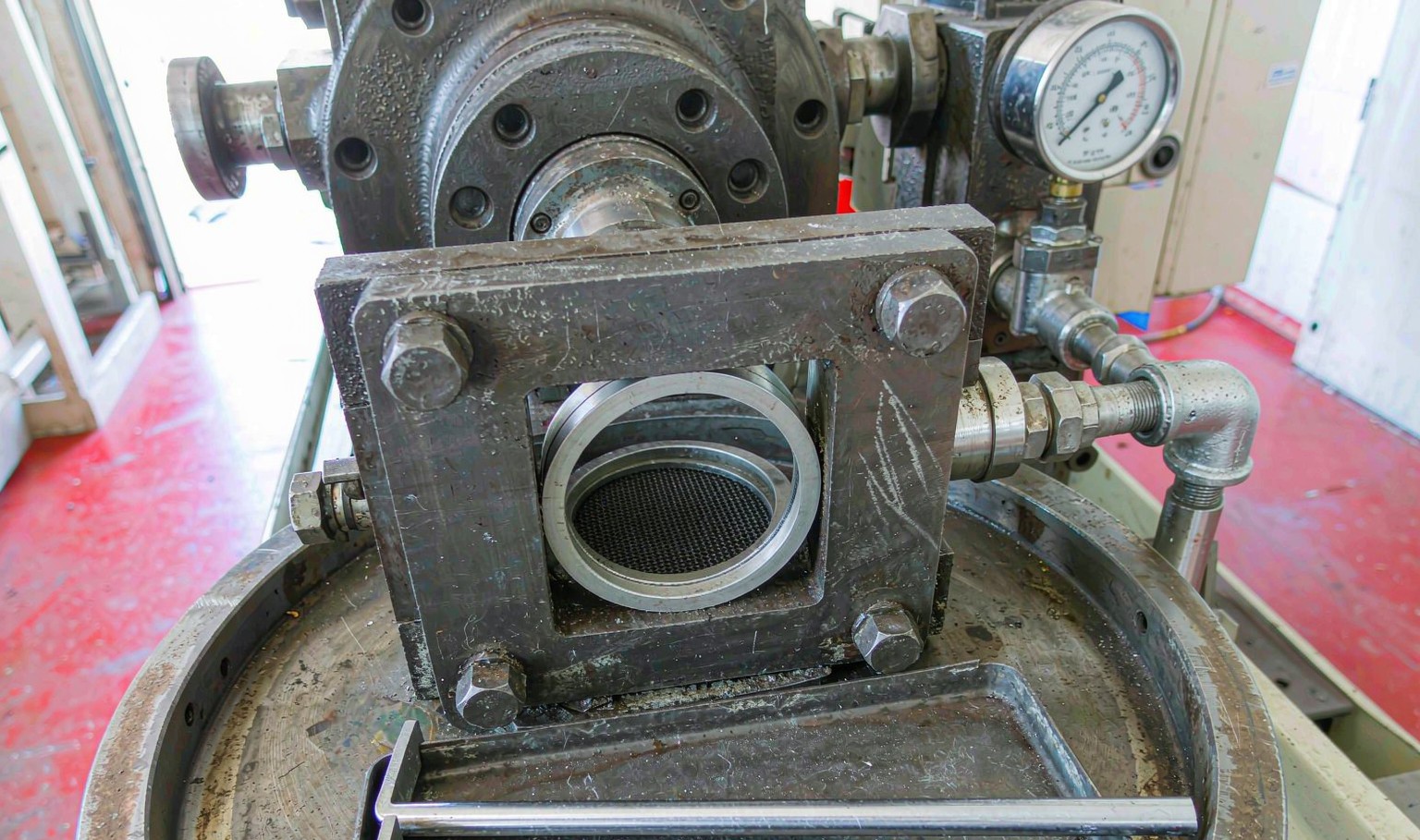
What a screen changer is for
A screen changer holds a steel mesh screen in the melt stream, between the end of the screw and the die. The screen catches contamination: unmelted gel, foreign particles, degraded material, bits of the screw flight. What passes through is cleaner, and the die sees fewer particles that would score it.
The second job is pressure. A screen pack builds back pressure at the end of the screw, which improves mixing and stabilises the melt. That is why some lines run a coarse screen even when the compound is clean: the screen is there for the pressure, not the filtration.
The third job is to fail safely. A screen blinds gradually, the pressure rises gradually, and the rise is a warning that something is changing in the process. A line without a screen changer has no such warning.
The cost is that the screen is a restriction that has to be changed, and changing it interrupts the line. Everything about screen changer design is about making that interruption short and predictable.
Mesh is a pressure budget
Screen mesh is the number of openings per inch. A 20 mesh screen has 20 openings per inch and passes almost everything; a 100 mesh screen has 100 and passes almost nothing above 150 micrometres. The finer the screen, the better the filtration and the higher the pressure drop.
The relationship is steep. On a typical polyolefin line at a moderate output, a 20 mesh screen costs about 12 bar. A 40 mesh costs 28, a 60 mesh 52, an 80 mesh 86 and a 100 mesh 134. Going from 20 to 100 mesh multiplies the pressure drop by eleven.
That pressure has to come from somewhere. It comes from the screw, which means more energy, a hotter melt and a lower output at the same screw speed. A line that adds a 100 mesh screen without changing anything else will run 15 to 25 C hotter and 10 percent slower.
So the mesh is chosen by what has to be caught, not by what is available. A blown film line needs a fine screen because a single gel is a visible defect. A pipe line needs a coarse one because the wall is 5 mm thick and a 200 micrometre particle is invisible.

Changing often is cheaper than changing late
The instinct is to run a screen until the pressure forces a change, because a change costs production. The arithmetic says otherwise, and it is worth doing once.
Changing every hour costs 8.4 percent of output, because each change is a stop of a few minutes and there are many of them. Changing every two hours costs 4.2 percent, every four hours 2.1, every eight hours 1.1, and every sixteen hours 0.6.
So a longer interval is cheaper in lost output, and that is the argument for running late. The counter-argument is quality: a screen that is 90 percent blinded is bypassing contamination, and the parts it makes are the parts that fail. The cost of one rejected batch is more than the output saved.
The resolution is to change on pressure rise, not on time. A screen that has added 25 bar to the baseline is a screen that is 70 to 80 percent blinded, and that is the point where it stops filtering and starts bypassing. A line that changes at 25 bar has a variable interval, and the variation is the information.
A rising interval is a process that is getting cleaner, or a screen that is being bypassed. A falling interval is contamination, a worn screw or a compound change. Logging the interval turns the screen changer into a diagnostic.
Manual, hydraulic and continuous
A manual screen changer has a sliding plate that is moved by hand, or by a screw, and it holds one screen at a time. It is cheap, it is reliable, and it requires the line to stop. On a small line running a clean compound it is the right answer.
A hydraulic screen changer has a hydraulic cylinder that slides a plate with two screens, so one is in the stream while the other is changed. The change takes 2 to 5 seconds and the line does not stop, though the pressure does dip briefly. It is the standard on a production line.
A continuous or belt screen changer feeds new screen from a roll and removes the used screen continuously, so there is no interruption at all. It is used on lines where any interruption is unacceptable, such as a fibre line, and it is the most expensive of the three.
The choice is economic and it is about the cost of a stop. On a line that runs 20 hours a week, a manual changer and a 30 second stop is nothing. On a line that runs 168 hours a week, the same stop is 0.7 percent of the year, and a hydraulic changer pays for itself.
| Tipo | Change time | Costo | Il migliore per |
|---|---|---|---|
| Manual | Line stopped, 5 to 10 min | Basso | Small line, clean compound |
| Hydraulic | 2 to 5 s, line running | Medio | Production line |
| Continuous belt | None | Alto | Fibre, critical lines |
| Rotary disc | 1 to 3 s | Medium high | High output, filled compound |
Table 1 — Screen changer types and when each one pays
What the changer does to the melt
A screen changer is not neutral. It adds a restriction, a residence time and a dead spot. The restriction is the pressure drop already discussed. The residence time is the volume between the screw end and the die, which is where material can sit and degrade.
The dead spot is the bigger problem. A sliding plate changer has a cavity that is in the stream when the plate is in one position and out of the stream when it is in the other. That cavity fills with melt that is never flushed, and it degrades. The symptom is black specks that appear after every screen change.
The fix is a design one: a changer with a short flow path through the plate and no cavity that can be isolated while full. It is also a procedure: purge through the changer after a change, rather than resuming production immediately.
The other effect is on the melt temperature. The pressure drop across a fine screen is dissipated as heat, so the melt leaving a 100 mesh screen is 8 to 15 C hotter than the melt entering it. That is worth knowing before blaming the barrel for a hot melt.
| Mesh | Catches above | Pressure drop | Typical use |
|---|---|---|---|
| 20 | 800 um | 12 bar | Pipe, thick profile |
| 40 | 400 um | 28 bar | General profile |
| 60 | 250 um | 52 bar | Cable jacket |
| 80 | 180 um | 86 bar | Thin wall, film |
| 100 | 150 um | 134 bar | Blown film, optical |
Table 2 — What each mesh catches and what it costs
Running a screen changer well
Change on pressure, not on time. A 25 bar rise above the clean-screen baseline is the trigger, and the baseline should be logged when the screen is new. A line that changes at a fixed time is a line that changes too often on a clean day and too late on a dirty one.
Purge after every change. A purge of 2 to 3 kilograms through the die removes the material that sat in the changer cavity, and it costs less than the parts that would have been made with it.
Keep the screen packs clean and dry. A screen that has been stored in a damp place carries moisture into the melt, and the symptom is a burst of voids after every change. A screen stored in a sealed container does not.
Record the interval. A screen that lasts 12 hours one week and 4 hours the next is telling you something about the compound, the screw or the contamination, and the record is what makes the message readable.
What mesh screen should I use?
The coarsest one that catches what matters. A pipe line runs 20 to 40 mesh; a blown film line needs 80 to 100 because a single gel is a visible defect.
How much pressure does a fine screen cost?
A 100 mesh screen costs about 134 bar where a 20 mesh costs 12. Going from 20 to 100 multiplies the pressure drop by eleven.
How often should I change the screen?
On pressure, not time. A 25 bar rise above the clean-screen baseline is the trigger, which is roughly 70 to 80 percent blinded.
Why do black specks appear after a screen change?
Because the changer has a cavity that sits out of the stream and degrades. Purge 2 to 3 kilograms through the die after every change, and specify a changer without an isolatable cavity.
Does a screen changer raise the melt temperature?
Yes. The pressure drop across a fine screen is dissipated as heat, so a 100 mesh screen adds 8 to 15 C to the melt.
Is a hydraulic changer worth the money?
On a line running 168 hours a week, yes. A 30 second stop is 0.7 percent of the year, and a hydraulic change takes 2 to 5 seconds without stopping.
A screen that blinds in four hours?
Tell us the mesh, the pressure rise and the compound. We will tell you whether it is contamination, a worn screw or the wrong screen for the job.




 IT
 EN
 ES
 FR
 DE
 PT
 AR
 RU
 JA
 KO
 NL
 TR
 PL
 ID
