

Two defects, one mechanism
Extrudate surface defects come in two forms that are often described with the same word. Sharkskin is a fine, regular, transverse roughness, like the skin of a shark, that appears at a well defined shear rate and gets worse as the rate rises. Gross melt fracture is a coarse, irregular distortion, often a spiral or a tearing pattern, that appears at a higher rate still.
Both are caused by the melt exceeding a shear stress it can sustain at the die wall, but they occur at different places. Sharkskin originates at the die exit, where the melt surface is suddenly free and the stress there is not relieved. Gross melt fracture originates inside the die, where the whole body of melt is sheared beyond its elastic limit.
The distinction matters because the fixes are different. Sharkskin responds to die exit geometry, coating and temperature. Gross melt fracture responds to die entry angle, land length and output. Applying the sharkskin fix to a melt fracture problem wastes time and money.
There is a third form that gets confused with both: a rough surface caused by moisture or by unmelted particles. That roughness is random rather than regular, it does not appear at a defined shear rate, and it does not go away when the output is reduced. Checking for it first saves a lot of die work.
At the die wall the melt is stationary and highly sheared. As it leaves the die, the wall constraint disappears and the surface layer, which was stretched, tries to relax. If the relaxation is fast compared with the cooling, the surface stays smooth. If it is slow, the surface ruptures into small transverse cracks, which is sharkskin.
The onset is at a critical shear stress rather than a critical shear rate, and the critical stress is a property of the polymer. For polyolefins it is around 0.1 to 0.2 MPa; for PVC it is lower; for polycarbonate it is higher. Because stress depends on viscosity, the critical shear rate moves with temperature, which is why a hotter melt can run faster before sharkskin appears.
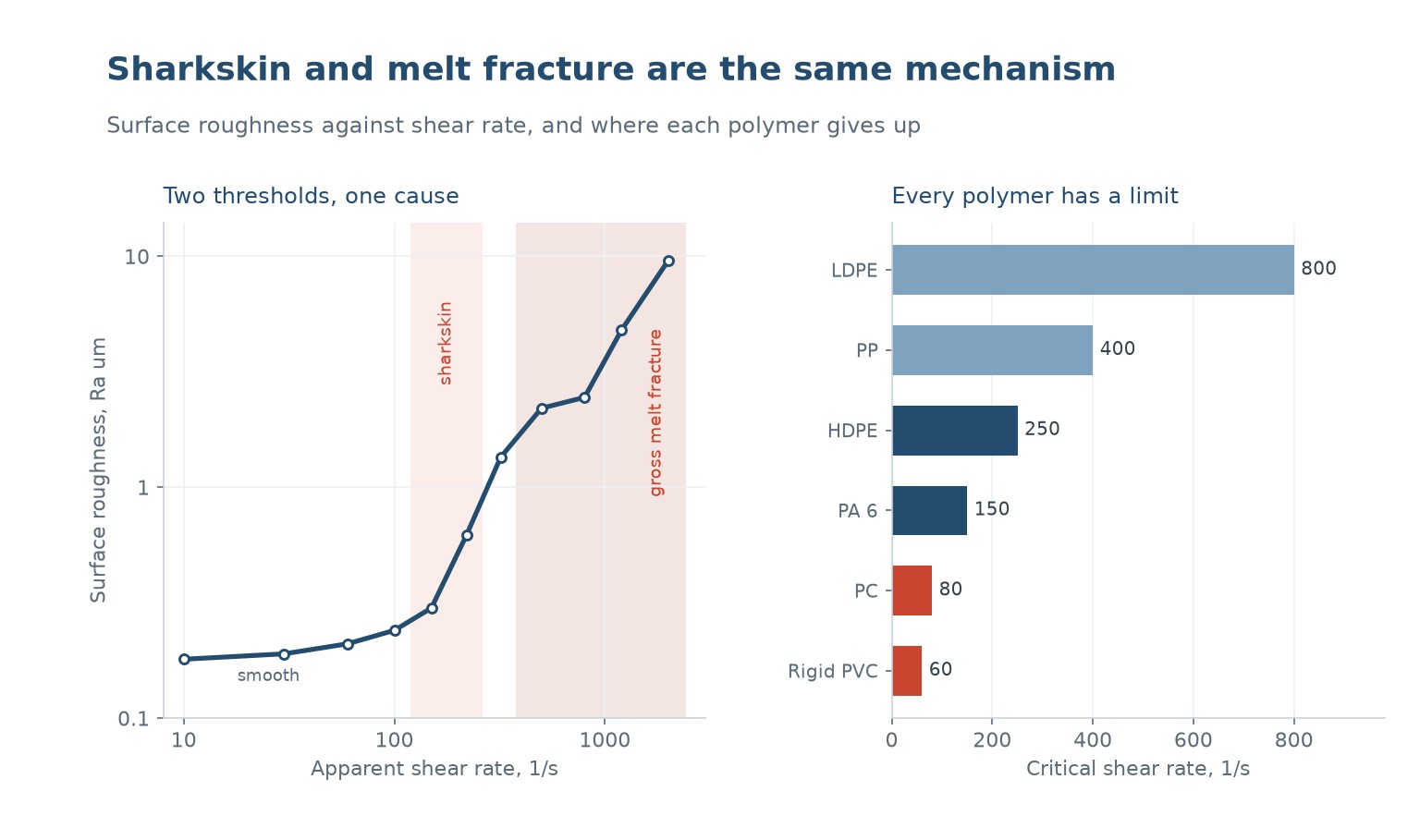
The chart on the left is measured on an LDPE strip. Roughness is about 0.2 micrometres up to a shear rate of 150 per second, rises to 0.6 at 220 and 1.35 at 320, then jumps again to 4.8 at 800 and 9.6 at 2,000. The first rise is sharkskin and the second is gross melt fracture, and the two are separated by a plateau where the surface is rough but stable.
The plateau matters practically. A line running in the sharkskin region produces a consistently rough part, which may be acceptable on a hidden face. A line running in the melt fracture region produces an irregular part that varies from metre to metre, which is never acceptable.
Gross melt fracture: the whole body of melt
At higher shear rates the stress inside the die exceeds the melt's elastic limit and the flow becomes unstable. The extrudate emerges with a helical distortion, a series of deep tears, or a bamboo-like segmentation. The defect is not confined to the surface; the whole cross section is distorted.
The onset depends strongly on the die entry. A sharp entry with a 180 degree included angle concentrates the extension at the entrance and triggers instability at a lower rate than a tapered entry. A 30 to 60 degree included angle is the usual compromise between pressure drop and stability.
Land length helps here as well, for a different reason than it helps die swell. A longer land gives the melt more time to relax after the entry, which raises the shear rate at which instability appears. The cost is pressure drop, and on a large die the pressure limit may be reached before the stability limit.
Temperature is the most effective single lever for gross melt fracture, because raising it lowers the viscosity and therefore the stress at a given rate. A 20 C increase can double the critical shear rate on some polymers, which is why the fix for a melt fracture problem is often simply to run hotter and accept the cooling cost.
Every polymer has a limit
The critical shear rate varies by more than an order of magnitude across common polymers, and it is the single most useful number for setting a line. LDPE tolerates about 800 per second, PP about 400, HDPE about 250, PA 6 about 150, PC about 80 and rigid PVC about 60.
Those numbers are for a clean die at a normal temperature, and they move with the formulation. A lubricated grade runs higher, a highly filled grade lower, and a high molecular weight grade lower still. They are starting points for a trial, not specifications.
The practical use is to calculate the shear rate before running the line. Shear rate in a round channel is roughly 4Q divided by pi r cubed, where Q is the volumetric flow and r the radius. For a slot it is 6Q divided by w h squared. A quick calculation tells you whether the planned output is inside the polymer's limit, and if it is not, the die has to change rather than the setting.
| Polymer | Critical shear rate | First sign | Usual fix |
|---|---|---|---|
| LDPE | About 800 /s | Fine transverse ripples | Die lip coating, or a hotter melt |
| PP | About 400 /s | Matte bands across the profile | Raise temperature, lengthen the land |
| HDPE | About 250 /s | Regular transverse cracks | Tapered entry, lower output |
| PA 6 | About 150 /s | Rough dull surface | Dry the material first, then raise temperature |
| PC | About 80 /s | Fine roughness, then tearing | Higher melt temperature, longer land |
| Rigid PVC | About 60 /s | Rough surface, then burning | Lower output, check the stabiliser |
Table 1 — Critical shear rate and the first symptom for each polymer
What to change first
The first check is not the die, it is the material. Moisture causes a roughness that looks like sharkskin but is random, and it affects hygroscopic polymers most. A PET or PA line that starts rough after a humid weekend is a drying problem, and no die change will fix it.
The second check is the screen pack. A partially blocked screen raises the pressure and the shear in the adapter, which can push a stable line into melt fracture. A line that becomes rough over a shift rather than suddenly is usually a screen building up.
The third is the die lip. A build-up of degraded material on the lip, or a nick from cleaning, creates a local disturbance that seeds sharkskin. Wiping the lip with a copper tool while it is hot, and inspecting it with a light, is a two minute check that solves a surprising share of cases.
Only after those three should the process be changed. Raising the melt temperature is the fastest process fix and the one with the most side effects. Reducing the output is the most reliable and the most expensive. Changing the die is the correct answer when the planned output is simply above the polymer's limit.
Die coatings and exit geometry
For sharkskin specifically, the die exit geometry and its surface condition matter more than anything else. A sharp exit edge concentrates the stress; a radiused or chamfered exit spreads it and delays the onset. A 0.2 to 0.5 mm radius on the exit edge is a standard modification and often enough on its own.
Fluoropolymer coatings on the die land reduce the wall friction and delay sharkskin by a meaningful margin. They wear, and on an abrasive filled compound they wear quickly, so they are a consumable rather than a permanent fix. On a clean unfilled polymer they can last years.
A more recent approach is a gas-assisted or lubricated die, where a small amount of gas or oil is injected at the die wall to create a slip layer. It works well and adds a consumable and a control system, and it is worth considering only on a line that is otherwise at its limit.
| Change | Effect on sharkskin | Effect on melt fracture | Costo |
|---|---|---|---|
| Radius the die exit | Large | Small | Low, a bench modification |
| Fluoropolymer coating | Moderato | Small | Consumable, wears with filler |
| Longer land | Moderato | Large | A new die |
| Tapered entry | Small | Large | A new die |
| Higher melt temperature | Moderato | Large | Cooling cost, degradation risk |
| Lower output | Large | Large | Lost production |
Table 2 — Which change addresses which defect
Diagnosing it on the line
Take a metre of extrudate and look at it under a raking light. Regular transverse ripples that repeat at a constant pitch are sharkskin. Irregular tears, a spiral pattern or a bamboo segmentation are melt fracture. A random mottled surface is moisture or contamination.
Then vary one thing. Reduce the output by 20 percent. If the roughness disappears, the line was above a threshold and the question is which one. If it does not disappear, the cause is upstream: moisture, a blocked screen, or a damaged die lip.
Then raise the melt temperature by 15 C and repeat. If the roughness goes away at the higher temperature, the cause is rheological and the fix is a combination of temperature and die geometry. If it persists, look at the material and the die again.
Record the shear rate at which each defect appears for each die and material. After a few trials the shop has its own threshold data, and a new job can be assessed before the die is ordered rather than after the first run.
What is the difference between sharkskin and melt fracture?
Sharkskin is a fine regular transverse roughness that starts at the die exit and affects only the surface. Melt fracture is a coarse irregular distortion that starts inside the die and affects the whole cross section. Sharkskin appears at a lower shear rate than melt fracture.
Can I fix a rough surface by raising the temperature?
Often, yes, because a hotter melt has a lower viscosity and therefore a lower shear stress at the same output. It works for both defects but it costs cooling and risks degradation. Check the material's drying and the die lip first, because those are cheaper.
Why did the surface go rough halfway through a shift?
Most likely the screen pack is building up pressure, which raises the shear in the adapter and pushes the line over its threshold. A sudden change points to a material or die problem; a gradual one points to the screen.
Does a longer land always help?
It helps melt fracture and die swell, and it can help sharkskin, but it also raises the pressure drop. On a large die the pressure limit may be reached before the stability limit, in which case the answer is a tapered entry rather than a longer land.
Is a rough surface always a rheology problem?
No. Moisture, unmelted particles, degraded material on the die lip and a worn screw can all produce roughness. Check those first, because they are cheaper to fix and they look similar on the extrudate.
How do I calculate the shear rate before running?
For a round channel, shear rate is about 4Q divided by pi r cubed. For a slot, about 6Q divided by w times h squared. Use the volumetric flow in cubic metres per second and the dimensions in metres, and compare the result with the polymer's critical shear rate.
Profile coming out rough?
Send a photo of the surface under a raking light, the polymer grade and the output rate. We will tell you whether it is sharkskin, melt fracture or something upstream.




 IT
 EN
 ES
 FR
 DE
 PT
 AR
 RU
 JA
 KO
 NL
 TR
 PL
 ID
