
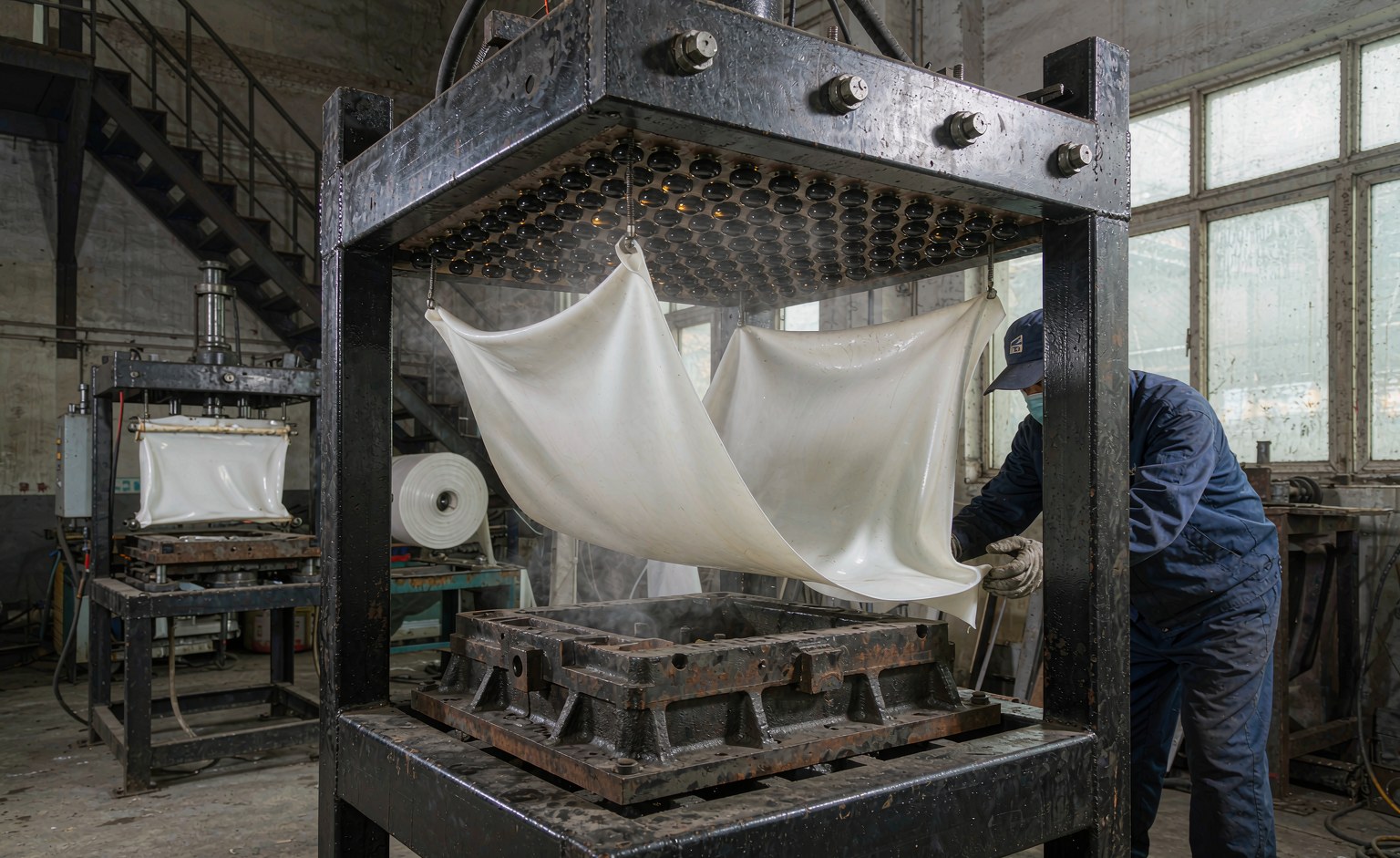
Vacuum forming gets dismissed as the cheap option, usually by people who have never costed a 4 mm ABS enclosure both ways. For a large, shallow, low-volume shell it is not the cheap option — it is the correct one. The tool is a machined aluminium or epoxy block instead of hardened steel, it arrives in two weeks instead of six, and it costs a tenth as much.
What changes is where the risk sits. In injection molding, the risk is in the tool. In vacuum forming, the risk is in the sheet: material is 55–70% of part cost, and every design decision that wastes sheet — a bad draw ratio, an over-deep pocket, a part nested badly on the sheet — is a permanent tax on every unit you make.
- 1. 1. Where vacuum forming actually wins
- 2. 2. Thick wall, thin wall, twin sheet — pick the right one
- 3. 3. Tooling: what a vacuum forming mold actually is
- 4. 4. Six design rules that decide whether your part forms
- 5. 5. Material selection
- 6. 6. Where the cost actually goes
- 7. 7. Tolerance reality check
- 8. 8. Trimming and finishing
- 9. 9. Six defects you will meet
- 10. 10. The break-even calculation you should actually run
- 11. 11. Frequently asked questions
- 12. Have a shell, cover or liner you need formed?
In this guide
1. Where vacuum forming actually wins
Thermoforming is a stretch, not a fill. A heated sheet is pulled over a male or into a female mold, so material thins wherever it stretches. That single physical fact explains both its strengths and its limits.
Choose vacuum forming when:
- The part is large. Above roughly 500 × 500 mm, tooling cost for injection molding climbs steeply while a forming tool stays in the low thousands.
- Volume is under ~3,000–5,000 pieces a year. Below that, tooling amortisation dominates and forming wins on total cost.
- You need thick walls. 4–12 mm sheet is routine. Moulding the same wall thickness by injection means long cooling cycles and sink marks.
- Tooling must be fast. Prototype tools in 5–8 days, production tools in 10–15. A design iteration costs hundreds, not thousands.
- The geometry is a shell. Enclosures, trays, covers, liners, machine guards, medical shells, agricultural tanks, cold-chain boxes.
2. Thick wall, thin wall, twin sheet — pick the right one
| Variant | Sheet gauge | How it works | Typical parts |
|---|---|---|---|
| Thin wall | 0.3–1.5 mm | Roll-fed, continuous, high speed. Often inline with trimming and stacking. | Food trays, blister packs, disposable containers, clamshells |
| Thick wall | 1.5–12 mm | Sheet-fed, single-station or rotary. Slower cycle, tighter wall control needed. | Machine covers, enclosures, tanks, liners, automotive trim |
| Twin sheet | 2 × 1–6 mm | Two sheets formed simultaneously and fused at the perimeter into one hollow part. | Hollow cases, pallets, air ducts, double-wall panels, floats |
| Pressure forming | 0.5–6 mm | Same as vacuum plus positive air pressure on the back face; sharper detail, tighter radii. | Textured panels, fine-grain cosmetic surfaces, sharper logos |
Thermoforming variants. Pressure forming adds roughly 15–25% to tooling but can match injection-molded surface detail.
Twin-sheet is the variant buyers underuse. A twin-sheet pallet or case replaces an assembled two-part injection molding with one cycle, no fasteners, and a hollow core that is stiffer than either sheet alone. For anything that needs to be hollow and rigid in low volume, it is usually the best answer.
3. Tooling: what a vacuum forming mold actually is
Forming tools are not built to survive pressure, they are built to hold shape and pull heat. That is why they are cheap — and why tool material matters more than most buyers expect.
| Tool material | Tool cost | Life | Use when |
|---|---|---|---|
| Wood / MDF | $200–$800 | 50–200 cycles | Concept models, fit checks. Not for production — it moves with moisture. |
| Epoxy / resin | $500–$2,000 | 500–2,000 | Bridge tooling, low volume, large simple shapes. |
| Aluminium | $1,200–$6,000 | 10,000–50,000 | The production default. Good heat transfer, repairable, fast to machine. |
| Acciaio | $5,000–$20,000 | 100,000+ | High volume, abrasive fillers, tight repeatability. |
| Composite / glass-filled | $2,000–$8,000 | 5,000–20,000 | Large tools where weight and thermal stability both matter. |
Forming tool options. Aluminium is the right answer for most production programs between 1,000 and 30,000 parts.
4. Six design rules that decide whether your part forms
Draw ratio
Draw ratio is depth divided by the smallest width of the opening. Keep it under 1:1 for reliable wall distribution; 1.5:1 is possible with a plug assist, and beyond 2:1 you are fighting the process. This is the number that most often kills a design, and it is rarely on a drawing.
Wall thinning
Assume the material thins to 40–60% of nominal at the deepest, sharpest corner. A 3 mm sheet becomes 1.4 mm there. If your structural or sealing requirement needs 2 mm minimum, specify 4 mm sheet, or reshape the corner.
Draft angle
Minimum 3°, 5° preferred, and 7° on textured surfaces. Vacuum forming has no ejection force to speak of, but a vertical wall drags and marks.
Raggi
Corner radius at least equal to sheet thickness, ideally 1.5×. A sharp internal corner on a 5 mm sheet will thin to near-nothing and tear.
Sottotagli
Any undercut needs a movable insert, a split tool, or a secondary operation. A 2 mm return lip on the open edge of a cover is normal and usually handled by the trim; an internal snap feature is not. Tell your toolmaker before the tool is cut.
Texture and grain
Texture depth is limited by sheet thickness — roughly 0.05 mm of grain needs 1 mm of sheet to avoid showing through. Deep grain on thin sheet reads as blotchy. Also budget for the fact that grain hides minor surface marks, which is often a reason to add it deliberately.
5. Material selection
| Materiale | Formabilità | Service temp | Impact | Il migliore per |
|---|---|---|---|---|
| HIPS | Eccellente | 60–70 °C | Basso | Low-cost trays, covers, display parts |
| ABS | Very good | 80–90 °C | Medio | The workhorse — enclosures, machine covers, cases |
| ASA | Very good | 90 °C | Medio | Outdoor parts needing UV stability; better colour retention than ABS |
| HDPE | Buono | 70–80 °C | Alto | Chemical tanks, liners, outdoor housings |
| PP | Fair — high shrink | 100–120 °C | Alto | Hot-fill, sterilisable, living-hinge parts |
| PVC (rigid) | Buono | 60 °C | Low–medium | Flame-retardant electrical covers, machine guards |
| PETG | Eccellente | 65–75 °C | Medium–high | Clear parts, medical trays, food-contact |
| PC | Fair — needs drying | 120–130 °C | Very high | Machine guards, safety screens, high-impact windows |
| PMMA (acrylic) | Buono | 80 °C | Basso | Optical clarity, signage, display covers |
Forming materials. Service temperature is continuous-use, not short-peak; verify against the specific grade.
6. Where the cost actually goes
This is the difference between a buyer who negotiates and a buyer who understands the price. In vacuum forming, material dominates.
| Cost element | Share of part price | What you can influence |
|---|---|---|
| Sheet material | 55–70% | Gauge, resin, nesting efficiency, offcut reuse |
| Machine time | 12–20% | Cycle time, number-up per sheet, oven efficiency |
| Trimming / CNC | 8–15% | Trim complexity, 3-axis vs 5-axis, jig design |
| Tooling amortisation | 3–10% | Tool material, volume, whether the tool is shared |
| Labour / finishing | 5–10% | Printing, assembly, inserts, packaging |
Indicative cost structure for a mid-size thick-wall part. Thin-wall packaging shifts even further toward material.
7. Tolerance reality check
Vacuum forming holds looser tolerances than injection molding, and no amount of tooling spend fully closes the gap. Plan around it rather than fighting it.
| Caratteristica | Typical | Best achievable |
|---|---|---|
| Overall dimension, <300 mm | ±0.8 mm | ±0.4 mm |
| Overall dimension, 300–800 mm | ±1.5 mm | ±0.8 mm |
| Overall dimension, >800 mm | ±3.0 mm | ±1.5 mm |
| Wall thickness | ±20% of nominal | ±10% (pressure forming) |
| Trimmed edge position | ±0.5 mm | ±0.2 mm (CNC trimmed on a jig) |
| Flatness | 1.5 mm / 300 mm | 0.5 mm / 300 mm |
As-formed capability. Trimming on a machined jig is the single most effective way to tighten a forming tolerance.
The practical consequence: never tolerance a formed feature that has to mate with a moulded or machined part. Instead, design an adjustable interface — an oversized flange, a slotted hole, a separate gasket — and tolerance the interface, not the shell.
8. Trimming and finishing
Forming produces a part with a rough, uneven perimeter. Everything downstream of the form is what makes it a product.
- 5-axis CNC trimming — the standard for production. Accurate to ±0.2 mm, needs a dedicated jig, adds tooling cost of $500–$2,000 per part number.
- Die cutting / punch trimming — fast and cheap for high volume, but only for simple perimeters.
- Bonding and welding — solvent bonding for ABS/PVC, hot-plate or ultrasonic welding for PE/PP, adhesive for mixed materials.
- Inserts and hardware — press-fit, heat-set or bonded. Heat-set inserts in thick-wall forming work well; in thin-wall they do not.
- Stampa — screen printing and pad printing both work on formed surfaces, but print after forming, not before, or the image distorts.
9. Six defects you will meet
| Difetto | What you see | Cause and fix |
|---|---|---|
| Webbing | Folded sheet bridging two adjacent walls | Too much material between features. Reduce draw depth, increase spacing, add a plug assist or a material-saving ridge. |
| Thin-out | Wall visibly translucent at a corner | Excessive draw ratio or a sharp radius. Increase sheet gauge, enlarge radius, use plug assist. |
| Chill marks | Dull or mottled patches on the surface | Sheet cooled before contact with the mold. Raise oven temperature or shorten transfer time. |
| Bubble / blister | Trapped air under the surface | Moisture in the sheet, or over-heating. Dry the sheet, reduce oven dwell. |
| Curvatura | Part rocks on a flat surface after cooling | Uneven cooling or asymmetric wall. Add cooling on the thick side, balance the jig, allow stress-relief cooling. |
| Poor detail | Texture or lettering washed out | Insufficient vacuum, holes too small or too few, sheet too cold. Increase vacuum, add holes at the detail, raise temperature. |
Common thermoforming defects. Webbing is the one to design out — it cannot be fixed in processing.
10. The break-even calculation you should actually run
Every "should I switch to injection molding" decision reduces to one comparison. Here it is with real numbers.
Worked example — 800 × 600 mm ABS enclosure
Vacuum forming: tool $4,500 · part $26.00 at 2,000/yr
Injection molding: tool $42,000 · part $9.50 at 2,000/yr
Cost at 2,000 parts: forming $56,500 vs moulding $61,000 → forming wins
Cost at 6,000 parts: forming $160,500 vs moulding $99,000 → moulding wins
Break-even volume = (42,000 − 4,500) ÷ (26.00 − 9.50) ≈ 2,270 parts
So at 2,000 a year, forming is correct. At 6,000, moulding is. The formula is simply the tooling difference divided by the unit price difference — and the honest version includes cycle time, scrap rate, freight and the cost of a design change, which usually pushes the break-even point higher than the simple calculation suggests.
One more factor: if the design is still moving, forming's cheap tooling is worth more than its unit price. A $4,500 tool you can afford to scrap twice beats a $42,000 tool you are afraid to change.
11. Frequently asked questions
How much does a vacuum forming mold cost?
An aluminium production tool for a mid-size part typically runs $1,200–$6,000, versus $200–$800 for a wood or epoxy prototype tool. Large tools above 1.5 m, or steel tools for high volume, reach $5,000–$20,000. Lead time is usually 7–15 days.
What is the maximum sheet thickness for vacuum forming?
Up to about 12 mm in production, with 1.5–6 mm being the practical working range. Above 6 mm, heating time and wall-thickness control become the limiting factors, and cycle times rise sharply.
Can vacuum forming produce parts with undercuts?
Only with movable inserts, split tools or a secondary operation. Simple return flanges at the open edge are standard; internal snap features and re-entrant shapes generally require a redesign or a different process.
How many parts can one vacuum forming tool produce?
An aluminium tool lasts 10,000–50,000 cycles with normal maintenance; epoxy tools 500–2,000; steel 100,000+. Because one cycle can form several parts, tool life in parts is often several times the cycle count.
Is vacuum forming cheaper than injection molding?
For volumes under roughly 2,000–5,000 pieces, almost always — tooling is 5–10× cheaper. Above that, injection molding's lower unit price overtakes it. The exact crossover depends on part size, wall thickness and the price gap between the two processes for your specific geometry.
What is the difference between vacuum forming and pressure forming?
Pressure forming adds positive air pressure behind the sheet, pressing it harder against the mold. This produces sharper detail, tighter radii and better texture reproduction — closer to injection-molded appearance — at 15–25% higher tooling cost and slightly slower cycles.
Have a shell, cover or liner you need formed?
Send a 3D model and your annual volume. We will tell you honestly whether forming, twin-sheet or injection molding is the cheaper route — and quote the one that is.





 IT
 EN
 ES
 FR
 DE
 PT
 AR
 RU
 JA
 KO
 NL
 TR
 PL
 ID
