
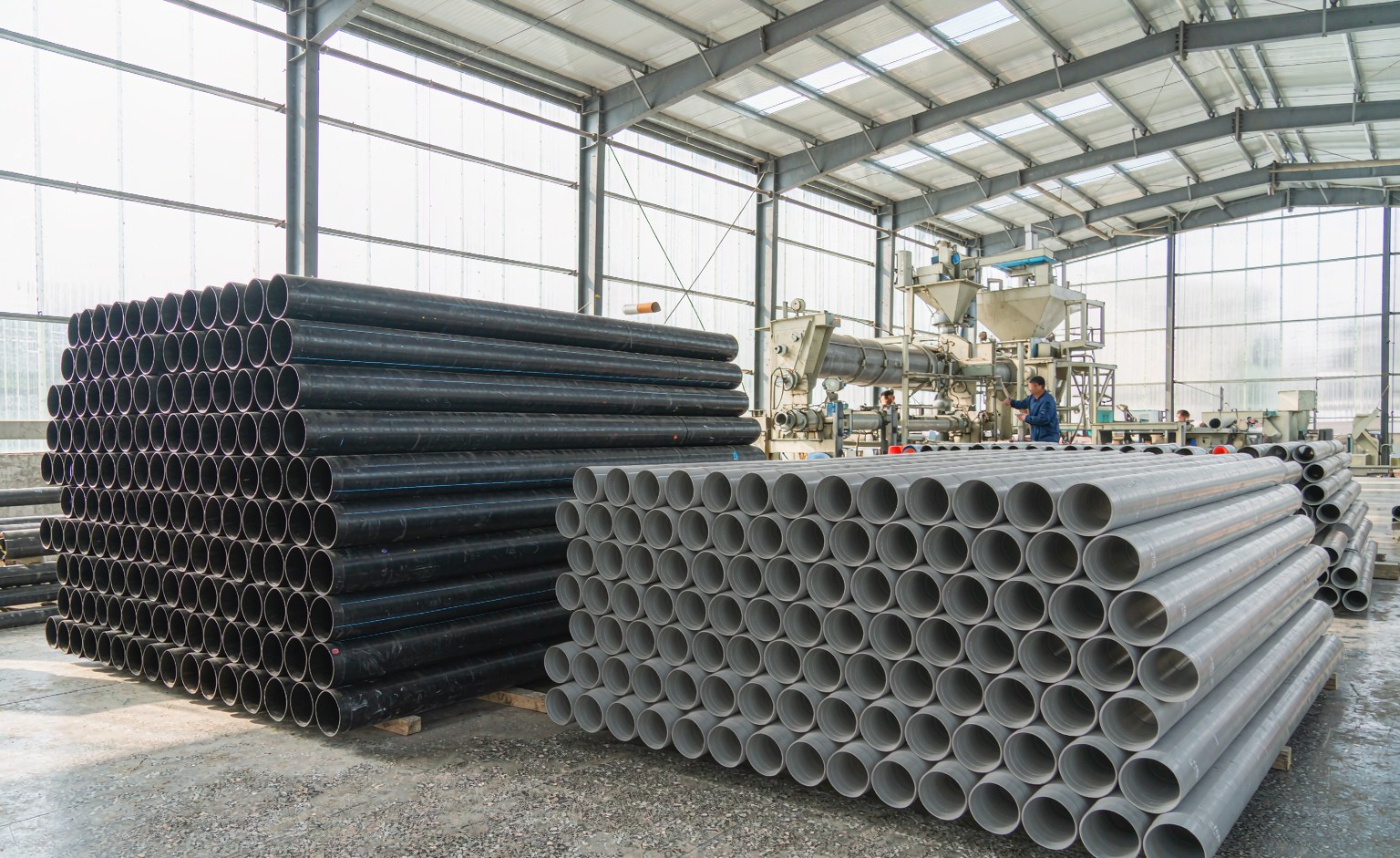
Pipe is the most standardised plastic product in the world, and also the most frequently mis-specified. Two pipes can have the same outside diameter and the same colour and differ by a factor of two in pressure rating — because the only thing that matters is wall thickness relative to diameter.
If you buy pipe, three numbers decide everything: the material grade, the SDR, and the standard you are buying against. Get those right and the rest is logistics. Get them wrong and you will discover it at the hydrostatic test, or two years into service.
- 1. 1. Pipe versus tube — a distinction that affects your tolerance
- 2. 2. Material grades — and why the grade matters more than the name
- 3. 3. The extrusion process
- 4. 4. SDR, PN and pressure ratings — the only formula you need
- 5. 5. Standards by market
- 6. 6. How to specify a pipe properly
- 7. 7. Jointing methods
- 8. 8. Quality tests that actually matter
- 9. 9. Common defects
- 10. 10. Verifying a supplier before you order
- 11. 11. Frequently asked questions
- 12. Need pipe or tube to a specific standard?
In this guide
1. Pipe versus tube — a distinction that affects your tolerance
The industry convention is worth knowing because it changes what the supplier controls.
- Pipe is specified by outside diameter and wall thickness, and is rated for pressure or drainage service. OD is held tightly so fittings and joints work; the bore is a consequence.
- Tube is specified by outside diameter and inside diameter — both are functional. Used where something passes through or fits inside, such as medical tubing, pneumatic lines or sleeves.
Practically: a 110 mm PVC pipe has an OD of 110 mm and a wall that varies with pressure class. A 110 mm tube would specify both dimensions and a much tighter tolerance on each.
2. Material grades — and why the grade matters more than the name
"HDPE pipe" is not a specification. PE 63, PE 80 and PE 100 are different materials with different minimum required strength, and the same SDR gives different pressure ratings in each. Always buy by grade.
| Materiale | Grade / MRS | Typical application | Jointing |
|---|---|---|---|
| PVC-U | MRS 25 MPa | Water supply, drainage, irrigation, electrical conduit | Solvent cement, rubber ring |
| PVC-C (CPVC) | MRS 25 MPa, higher temp | Hot water, industrial chemical lines up to 90 °C | Solvent cement |
| PE 63 / 80 / 100 | MRS 6.3 / 8.0 / 10.0 MPa | Water mains, gas, irrigation, mining slurry, telecom duct | Butt fusion, electrofusion |
| PE-RT | Type I / II | Underfloor heating, hot water, no cross-linking needed | Compression, fusion |
| PP-R | MRS 8.0 MPa (type 3) | Domestic hot and cold water, food-grade lines | Socket fusion |
| PP-H / PP-B | MRS 10 / 8 MPa | Chemical process, drainage, laboratory waste | Butt fusion, flange |
| ABS | — | Drainage, DWV, marine, chilled water | Solvent cement |
| PEX-a / b / c | Cross-linked | Plumbing, radiant heating | Compression, press fit |
Pipe materials and grades. MRS is the minimum required strength used to derive the pressure rating.
3. The extrusion process
Pipe extrusion is profile extrusion with an annular die and a critical extra requirement: the wall must be concentric. Eccentricity is the defect that fails hydrostatic tests.
- Melt preparation. PE and PP are single-screw extruded (L/D 30–36:1); rigid PVC is usually twin-screw, because PVC needs low shear and precise temperature control to avoid degradation.
- Die and mandrel. An annular gap between the die and a central mandrel sets the initial wall. The mandrel is held by a spider or a breaker plate — the spider legs leave faint weld lines that must recombine fully.
- Sizing. Two methods. Vacuum sizing pulls the hot tube against a cooled sleeve, setting the OD precisely. Pressure sizing pressurises inside the tube against a cooled sleeve — better for large-diameter PE where vacuum alone is not enough.
- Cooling. Spray or immersion tanks, often 6–12 m long. Cooling rate controls crystallinity, and therefore ring stiffness and residual stress. Cool too fast and the pipe is brittle; too slow and output drops.
- Haul-off. Belts or caterpillars pull at constant speed and set the final wall — faster pull, thinner wall.
- Cutting and marking. A planetary saw cuts to length; an inkjet or embosser applies the permanent identification marking required by every standard.
4. SDR, PN and pressure ratings — the only formula you need
SDR stands for Standard Dimension Ratio: outside diameter divided by wall thickness. A lower SDR means a thicker wall and a higher pressure rating.
PN = 2σ / (SDR − 1) MPa
σ = design stress of the grade (PE100: 8.0 MPa)
So for PE100 at SDR 11: PN = 2 × 8.0 / 10 = 1.6 MPa = PN 16. At SDR 17: 16 / 16 = 1.0 MPa = PN 10. That is the whole system.
| SDR | Wall / OD | PE100 rating | PE80 rating | Typical use |
|---|---|---|---|---|
| SDR 41 | 1 : 41 | PN 4 | PN 3.2 | Low-pressure drainage, culvert |
| SDR 33 | 1 : 33 | PN 5 | PN 4 | Gravity sewer, non-pressure |
| SDR 26 | 1 : 26 | PN 6.3 | PN 5 | Irrigation mains, gravity flow |
| SDR 21 | 1 : 21 | PN 8 | PN 6.3 | Water distribution, low head |
| SDR 17 | 1 : 17 | PN 10 | PN 8 | Standard municipal water main |
| SDR 13.6 | 1 : 13.6 | PN 12.5 | PN 10 | Higher-pressure distribution |
| SDR 11 | 1 : 11 | PN 16 | PN 12.5 | Pressurised mains, industrial |
| SDR 9 | 1 : 9 | PN 20 | PN 16 | High-pressure industrial, mining |
| SDR 7.4 | 1 : 7.4 | PN 25 | PN 20 | Slurry, high-head applications |
PE pipe pressure ratings at 20 °C, water service. Derating is required above 20 °C and for aggressive chemicals.
For non-pressure drainage pipe, the rating system is different: ring stiffness SN (SN 4, SN 8, SN 16) measured to ISO 9969, which describes resistance to soil load rather than internal pressure. Specifying a PN rating for a gravity sewer is a category error that suppliers will happily accept.
5. Standards by market
Buying against the wrong standard is the single most common cause of rejected pipe shipments. Match the standard to the destination market.
| Applicazione | Europe (EN/ISO) | USA (ASTM) | China (GB) |
|---|---|---|---|
| PVC-U pressure water | EN ISO 1452 | ASTM D1785 | GB/T 10002.1 |
| PVC-U drainage | EN 1329 | ASTM D2665 | GB/T 5836.1 |
| PE pressure water | EN 12201 / ISO 4427 | ASTM D3035 (duct), AWWA C906 | GB/T 13663 |
| PP-R hot/cold water | EN ISO 15874 | ASTM F2389 | GB/T 18742 |
| PE-RT heating | ISO 22391 | ASTM F2769 | GB/T 28799 |
| ABS drainage | EN 1455 | ASTM D2661 / D1527 | — |
| Structured-wall drainage | EN 13476 | ASTM F2648 | GB/T 19472 |
| Hydrostatic test method | ISO 1167 | ASTM D1598 | GB/T 6111 |
Principal pipe standards by market. A pipe made to GB/T 10002.1 is not automatically acceptable under EN ISO 1452 without re-testing.
6. How to specify a pipe properly
A complete pipe specification is one line. Here is the pattern:
PE100, 110 mm × 10.0 mm, SDR 11 / PN 16, EN 12201, 6 m, plain end
Add these where relevant: colour and stripe (blue for potable water, yellow for gas), UV stabilisation for above-ground use, ring stiffness for buried drainage, and whether the pipe must be co-extruded with an identifiable layer. Ambiguity in any of these is where disputes begin.
7. Jointing methods
| Metodo | I materiali | Il migliore per | Watch out for |
|---|---|---|---|
| Solvent cement | PVC-U, ABS, PVC-C | Small to medium diameter, indoor | Joint quality depends entirely on operator technique and cure time |
| Rubber ring / push-fit | PVC-U, PP | Buried drainage, fast assembly | Ring must suit the pipe's OD tolerance class |
| Butt fusion | PE, PP | Water mains, gas, large diameter | Requires calibrated machine; bead and cool time are non-negotiable |
| Electrofusion | PE | Repairs, tight trenches, dissimilar wall | Fitting cost is high; surface scraping must be complete |
| Socket fusion | PP-R, PE small bore | Plumbing, heating | Over-heating narrows the bore; insert depth must be marked |
| Compression | PE, PEX | Irrigation, small bore, field work | Not suitable for high pressure or large diameter |
| Flanged | All, with stub end | Equipment connections, disassembly | Needs a proper backing ring and gasket selection |
Jointing methods. For PE, butt fusion quality is the single largest determinant of system life.
8. Quality tests that actually matter
Ask for these reports, and check that the dates and batch numbers correspond to the pipe you are receiving.
- Dimensional inspection — OD, wall thickness at multiple points, ovality, and concentricity. This is where eccentricity shows up.
- Hydrostatic pressure test (ISO 1167 / ASTM D1598) — the definitive proof test. Typically 20 °C / 100 h and 80 °C / 165 h at specified hoop stress. A supplier who cannot show this has not qualified the material.
- Impact test — falling weight at 0 °C for PE, to catch embrittlement from over-fast cooling.
- Carbon black content and dispersion — 2.0–2.5% for UV-stable PE. Under-dispersed carbon black is a hidden failure mode for above-ground pipe.
- Oxidation induction time (OIT) — confirms the antioxidant package survived processing. Low OIT predicts early brittle failure.
- Vicat softening point — for PVC-U, confirms the formulation and degree of gelation.
- Ring stiffness (ISO 9969) — for buried drainage and structured-wall pipe.
- Melt flow rate — confirms the resin grade actually used matches the certificate.
9. Common defects
| Difetto | What you see | Cause and fix |
|---|---|---|
| Eccentric wall | Wall thickness varies around the circumference | Mandrel misalignment or uneven die flow. Re-centre the mandrel, check die temperature symmetry. |
| Surface roughness | Dull or sharkskin finish | Output too high or melt too cold at the die. Reduce line speed, raise die temperature. |
| Ovality | Pipe out of round after cutting | Insufficient cooling before haul-off, or coil winding stress. Extend cooling, increase vacuum. |
| Internal voids | Bubbles in the wall section | Moisture in resin or insufficient back pressure. Dry resin, raise back pressure, check for air ingress. |
| Longitudinal cracks | Splits along the pipe axis | Residual stress from over-fast cooling or excessive haul-off tension. Slow the cooling, reduce pull. |
| Weld line weakness | Failure at the spider line under pressure | Incomplete recombination in the die. Raise melt temperature, redesign the spider. |
| Poor marking | Illegible or missing print | Ink or embosser issue. Reject — an unmarked pipe is non-compliant by definition. |
Pipe extrusion defects. Eccentricity and residual stress are the two that cause field failures.
10. Verifying a supplier before you order
- Certification scope, not just certificates. An ISO 9001 certificate confirms a quality system, not product compliance. Ask for the third-party product certification — WRAS, DVGW, NSF, KIWA or the equivalent for your market — and check the scope covers your diameter range.
- Ask for a batch traceability sample. Pick a marking from a delivered pipe and ask them to produce the resin certificate, extrusion record and test report for that batch. Suppliers with real traceability can do it in a day.
- Confirm the diameter range on their floor. A supplier with lines up to 400 mm cannot make 800 mm, whatever the catalogue shows.
- Ask how they handle regrind. Some regrind is normal in thick-wall drainage pipe; it is unacceptable in pressure pipe unless the standard permits it and the ratio is declared.
- Request a pre-shipment test report with your batch numbers, plus third-party witness testing for large orders. The cost is trivial against a rejected container.
- Check the marking compliance against the destination standard — many rejections are paperwork and marking failures, not material failures.
11. Frequently asked questions
What does SDR mean in plastic pipe?
SDR is the Standard Dimension Ratio — outside diameter divided by wall thickness. A lower SDR means a thicker wall and a higher pressure rating. SDR 11 in PE100 gives PN 16; SDR 17 gives PN 10.
What is the difference between PN and SN?
PN is a pressure rating for pipes carrying internal pressure, derived from the material's design stress and the SDR. SN is ring stiffness, used for non-pressure drainage pipe and describing resistance to external soil load. They are not interchangeable.
Which is better, PVC or HDPE pipe?
Neither is universally better. PVC-U is stiffer, cheaper for small-to-medium diameters, and easier to solvent-cement, but it is brittle under impact and limited to about 60 °C. HDPE is flexible, fusion-welded, resistant to settlement and freeze damage, and better for long coils and trenchless installation. The choice follows the installation method and the soil conditions.
How long does plastic pipe last?
Pressure ratings are derived from a 50-year design life at 20 °C. In practice, PE and PVC pipe in buried water service routinely exceeds 50 years when correctly installed. Above-ground service life depends heavily on UV stabilisation and the carbon black content of the compound.
Can plastic pipe be used for hot water?
Yes, with the right material: PP-R, PE-RT, PEX and PVC-C are all rated for hot water, typically to 70–90 °C depending on grade and pressure. Standard PVC-U and PE100 are not — both derate sharply above 40 °C and should not be used on hot lines.
What is the minimum order quantity for custom pipe?
Usually one production run — a few hundred metres for small diameters, or a full container for large-diameter pipe. Custom colours and non-standard SDRs typically require a minimum run of 1,000 m or more because of changeover cost.
Need pipe or tube to a specific standard?
Tell us the material grade, OD, SDR and destination market. We will confirm the applicable standard, achievable tolerances and lead time — with test documentation to match.




 IT
 EN
 ES
 FR
 DE
 PT
 AR
 RU
 JA
 KO
 NL
 TR
 PL
 ID
