

Why a thread cannot be stripped
A plain boss can often be bumped off the core because the plastic flexes enough to let the undercut pass. A thread is a continuous undercut, and the same flex that releases a boss will tear a thread.
Stripping does work for shallow threads in soft, ductile materials such as polypropylene and polyethylene, where the thread deforms and recovers. It does not work for a deep thread, a rigid material, or a thread that has to hold torque.
For anything else the core has to rotate out of the part, matching the thread pitch, so the plastic is unscrewed rather than dragged off the steel.
That rotation is what an unscrewing mold provides, and it is why threaded caps, closures and pipe fittings are tooled differently from plain parts of the same shape.
How the core is turned
The rotating core is driven by a rack and pinion, a gear train, a hydraulic motor or an electric servo, depending on the stroke and the torque the thread needs.
A rack is simple and fast for short threads, but it has a fixed stroke, so it suits a known thread length. A gear train or motor can turn further and is used for long threads or where the core must index to a position.
The core has to start in a known angular position every cycle so the thread closes on the previous one. A missing start position gives a thread that is half a pitch out, which reads as a bad part rather than a bad machine.
And the core needs a bearing surface and a seal, because it rotates under pressure and any wobble in the bearing prints a wobble on the thread.
Unscrewing costs cycle time
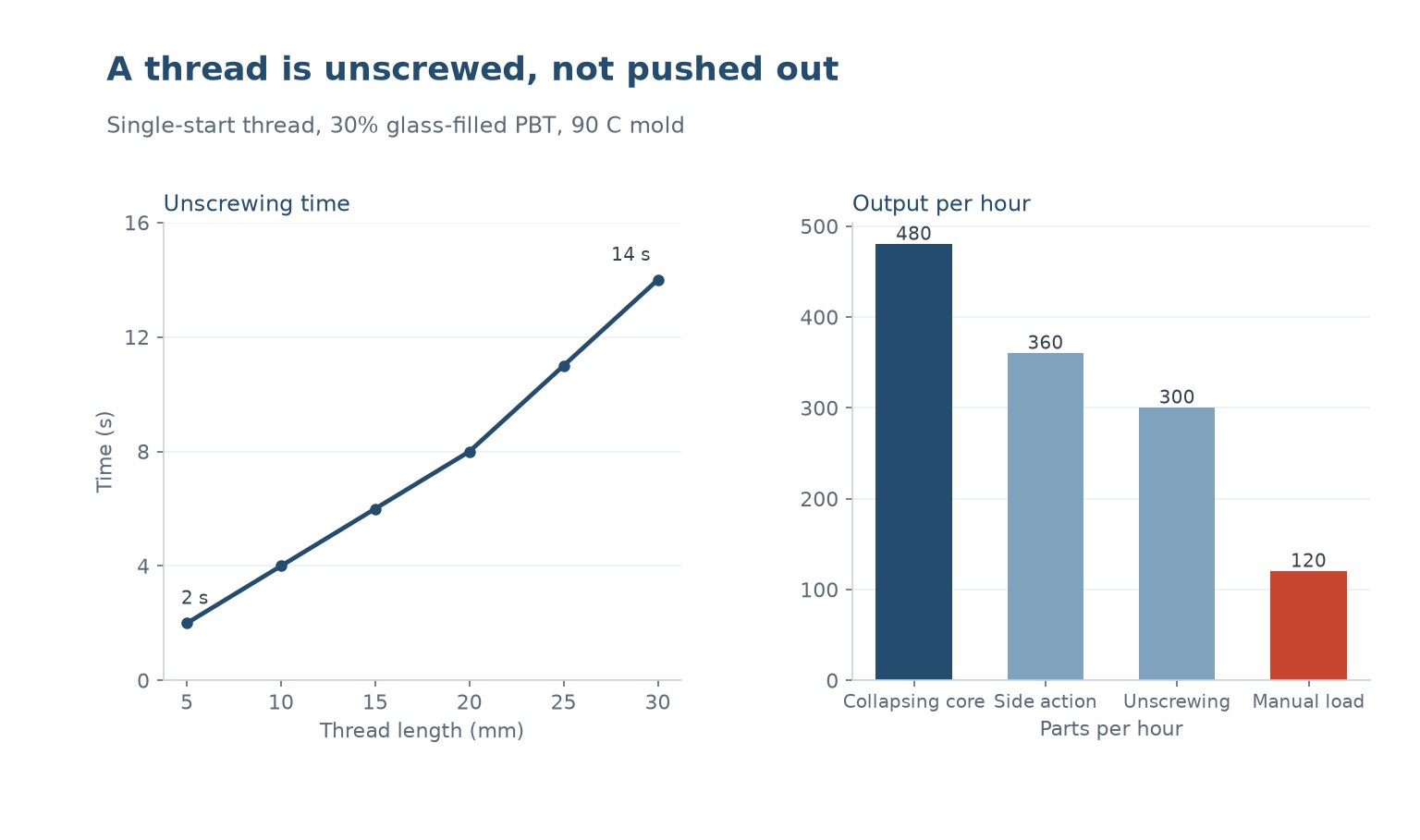
Every revolution the core makes is time the mold is not producing a part. The chart on the left is unscrewing time against thread length: a five millimetre thread takes about two seconds, a thirty millimetre thread takes fourteen.
On a cap with a short thread the penalty is small. On a long threaded fitting it can dominate the cycle and make unscrewing the slowest step in the tool.
The usual fix is to unscrew while the mold opens or during ejection, overlapping the rotation with other motions, so the thread time hides inside the cycle instead of adding to it.
Multi-start threads also help, because a two-start thread of the same lead needs half the turns, which is why coarse multi-start threads unscrew in a fraction of the time.
Designing the thread and the core
Keep the thread as short as the function allows. Thread length is the main driver of unscrewing time and of the torque the drive has to supply, so it is the first thing to trim.
Use a thread form that releases cleanly, with rounded crests and a generous root radius, and avoid sharp internal corners that grip the core as it turns.
The core should be polished in the direction of rotation, not across it, so the plastic slides out rather than being scraped along the steel.
And specify the start position and the number of starts on the drawing, because the toolmaker cannot guess them and a wrong start is a wrong part every cycle.
Unscrewing, collapsing cores and side actions
Unscrewing is the general answer for a continuous thread, but it is not the only one. A collapsing core splits into segments that draw inward, which suits large internal threads and avoids rotation entirely.
A side action pulls a thread-forming slide straight out, which works only for interrupted or very shallow threads and adds a cam or a hydraulic cylinder to the tool.
The right hand panel compares output per hour. A collapsing core is fastest because it needs no rotation, unscrewing sits in the middle, and a manual load is slowest because the operator sets the pace.
Choose by the thread, the volume and the material: unscrewing for most caps, collapsing cores for large internal threads, side actions for interrupted threads.
| Thread type | Demolding method | Catatan |
|---|---|---|
| External, shallow | Stripping / bump-off | PP, PE only |
| External, deep | Unscrewing core | Most caps |
| Internal, deep | Collapsing core | Split core segments |
| Any, interrupted | Side action | Cam or hydraulic |
Table 1 — Which demolding method suits which thread.
Thread defects and what they mean
A torn thread is the classic failure. The part was unscrewed before it was cool enough to hold its shape, so the thread stretched and split. Cool longer, or delay the unscrew.
A partial thread means the core did not fully engage before injection, usually a start position or a short stroke, and it is a setup fault rather than a plastic one.
Drag marks on the thread are the core spinning against plastic that is still soft, fixed by more cooling or a slower rotation rather than by more release agent.
A thread that is off centre is a core alignment problem, checked at the guide pins and the core concentricity rather than at the process settings.
| Cacat | Karena | First fix |
|---|---|---|
| Torn thread | Unscrewed too hot | Cool longer, delay unscrew |
| Partial thread | Core not fully engaged | Check start position |
| Drag marks | Spinning on soft plastic | Cool more, rotate slower |
| Thread off centre | Core misalignment | Check pins, concentricity |
Table 2 — Thread defects and the first thing to check.
Why can't a thread just be stripped from the mold?
A continuous thread is an undercut, so flexing it off tears it unless the material is soft and the thread shallow. Deep or rigid threads have to be unscrewed.
What drives an unscrewing core?
A rack and pinion, gear train, hydraulic motor or servo. Racks suit short threads; motors and gears suit long threads or where the core must index.
How much cycle time does unscrewing add?
About two seconds for a 5 mm thread up to fourteen for 30 mm, unless the rotation is overlapped with mold opening or ejection to hide it in the cycle.
When is a collapsing core better than unscrewing?
For large internal threads and where the torque or thread length makes unscrewing slow. A collapsing core splits inward instead of rotating.
Can side actions form threads?
Only interrupted or very shallow threads, where a slide can pull straight out. A continuous thread needs rotation or a collapsing core.
Why is my thread torn or dragging?
Usually unscrewing before the part is cool enough, or a core spinning against soft plastic. Cool longer or rotate slower.
Threaded parts tearing or dragging?
Send the thread drawing and the material. We will tell you whether it needs unscrewing, a collapsing core or a side action.





 ID
 EN
 ES
 FR
 DE
 PT
 AR
 RU
 JA
 KO
 IT
 NL
 TR
 PL
