
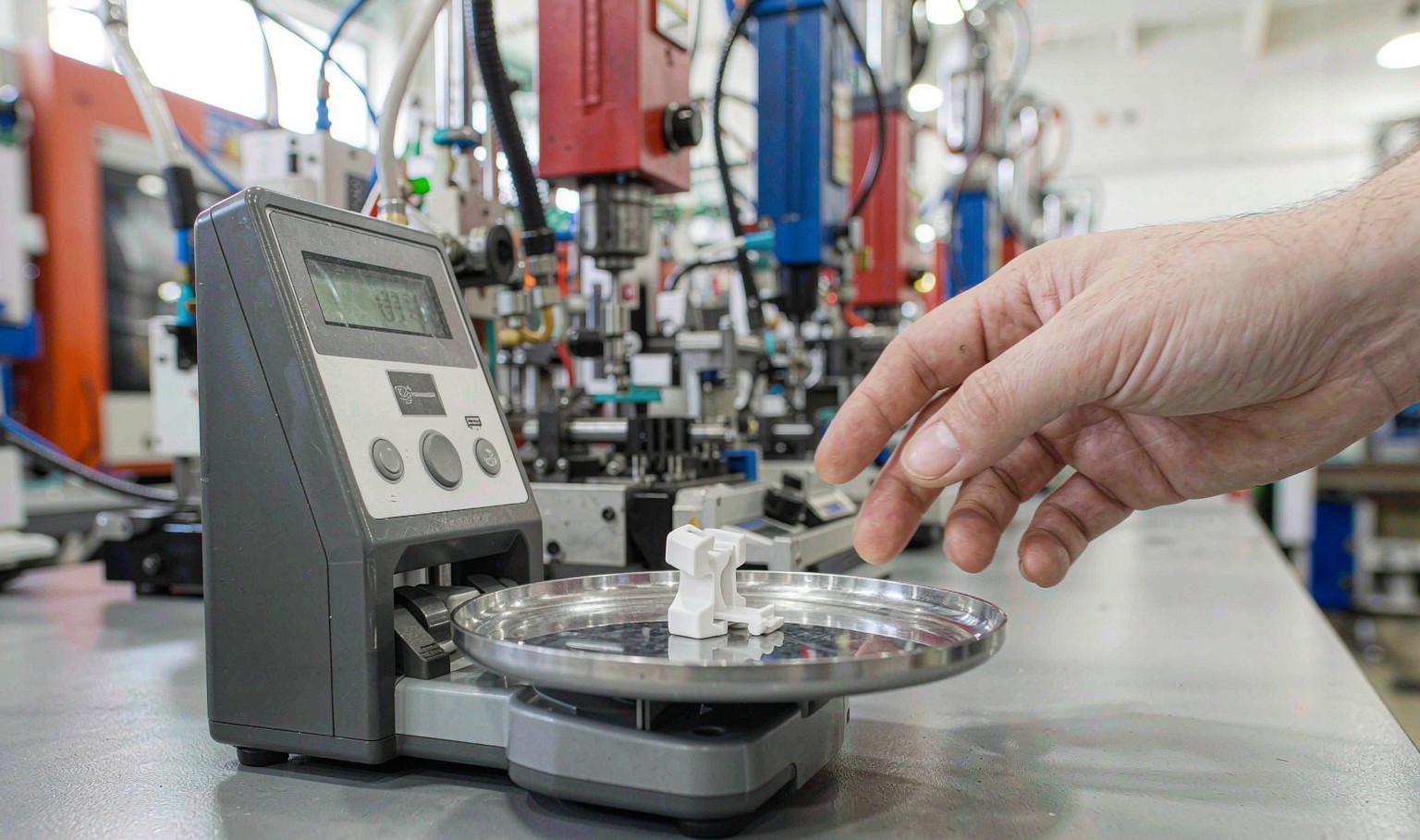
Why shot weight is the best single indicator
Shot weight is the mass of material that actually entered the cavity. It responds to almost every variable that matters: the amount of material metered, the temperature that sets its density, the pressure that packs it, and the leak paths that lose it. A single number on a balance summarises the state of the whole process.
It is also cheap and fast. A 0.01 g balance costs a few hundred euro, a measurement takes ten seconds, and the trend over a shift shows more than a full dimensional report taken once. That is why shot weight is the standard control chart in a well run moulding shop.
The number is not the same as part weight. Shot weight includes the runner and the sprue, and on a hot runner it is the part plus the cushion. What matters is that the measurement is taken the same way every time, on the same features, so that the trend is comparable.
The sensitivity is what makes it useful. A change of 0.05 g on a 10 g part is 0.5 percent, which is well below the dimensional tolerance on most features but is enough to see a check ring starting to leak. Dimensions lag; weight leads.
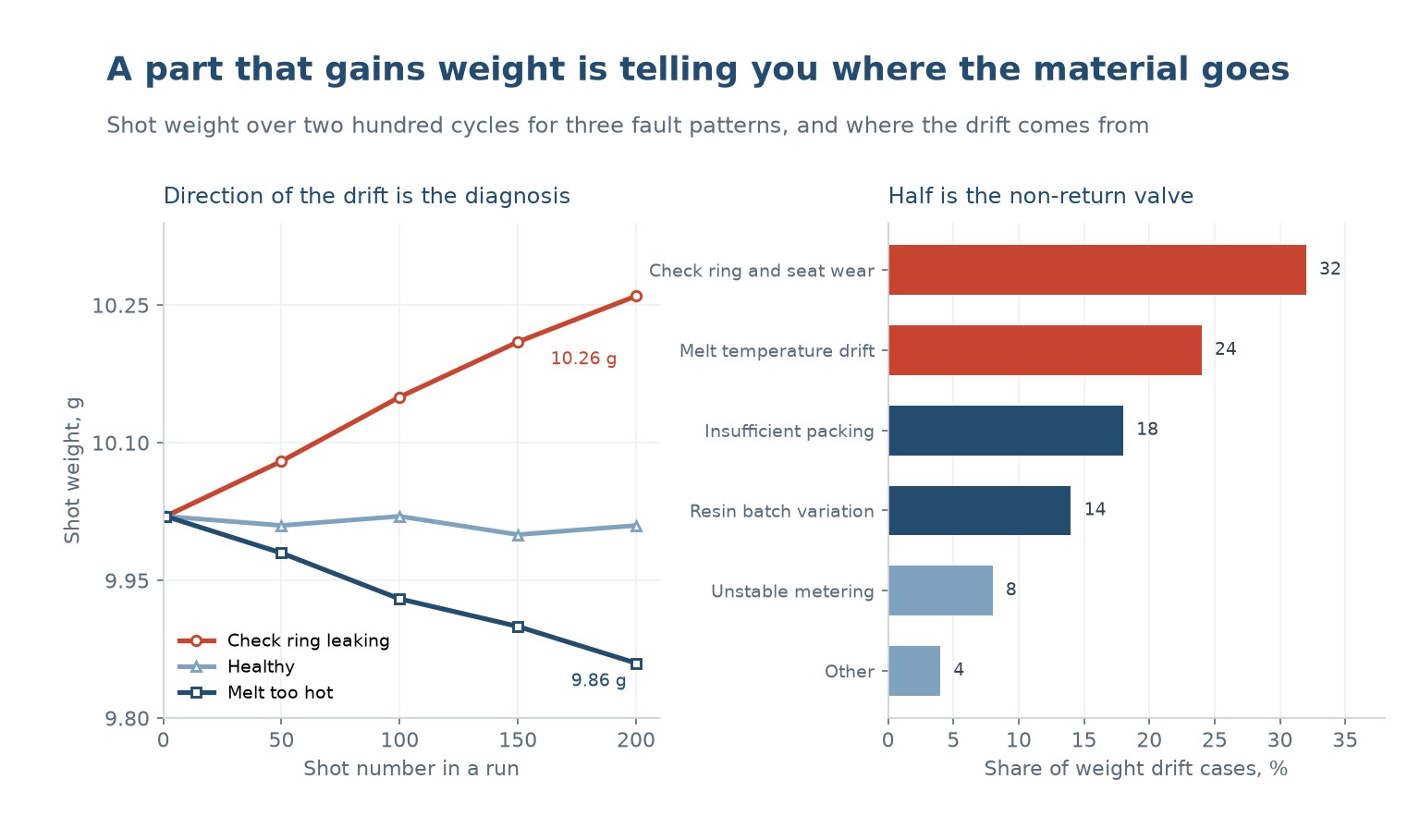
The direction of the drift is the diagnosis
The chart on the left shows three patterns over 200 cycles. A healthy process sits within plus or minus 0.01 g of its set point. A leaking check ring produces a steady climb, from 10.02 to 10.26 g, because material is slipping back past the valve during injection and more is metered to compensate.
A melt that is too hot produces a steady fall, from 10.02 to 9.86 g, because the material's density drops and the same volume holds less mass. It is a smaller effect per degree than the check ring effect per shift, but it is unmistakable over a run.
A process that oscillates rather than drifts has a different cause again: unstable metering, a feeder that is surging, or a temperature controller hunting. The period of the oscillation often identifies the source, because a heater cycle and a feed cycle have different periods.
The practical value of the trend is that it separates wear from setting. Wear is monotonic and does not come back when you change a setting; a setting problem reverses when the setting is restored. Plotting the weight over a week makes that distinction visible in a way that a single measurement never does.
The five causes, in order of likelihood
Check ring and seat wear is the largest cause at 32 percent. The non-return valve closes during injection, and when its seat wears, a film of melt slips back into the screw channels. The machine compensates by metering more, so the shot gets heavier and the part gets heavier with it. The wear is progressive and it never reverses.
Melt temperature drift is second at 24 percent. It changes the density of the melt, so the same screw stroke delivers a different mass. It also changes the viscosity, which changes the pressure needed to fill, which changes the amount packed into the cavity. Both effects point the same way.
Insufficient packing is third at 18 percent. A hold pressure that is too low, or a hold time that ends before the gate freezes, leaves the part under packed and lighter. It often appears as a weight that falls towards the end of a run, when the melt is hottest and the gate takes longest to freeze.
Resin batch variation at 14 percent is the cause that is hardest to control, because the material arrives with a certificate that says it is within specification. A change of melt flow index within the specification band is enough to move the shot weight by 1 percent, and there is nothing wrong with either batch.
Unstable metering at 8 percent covers a range of mechanical causes: a worn feed throat, a starved feed zone, a screw that is not decompressing properly. It shows as an oscillation rather than a drift, and it is often accompanied by a visible variation in the cushion.
Measuring it properly
Weigh the whole shot, including the runner, unless the runner is hot. Weighing the part alone is more relevant to the customer but adds the variability of degating, which is a manual operation and therefore noisy.
Use a balance with a resolution of 0.01 g for parts up to 50 g, and 0.1 g above that. A balance that is too coarse cannot see the 0.5 percent changes that matter, and one that is too fine drifts with draughts and vibration.
Take five consecutive shots and use the average, not a single part. The shot to shot variation on a healthy machine is small but it exists, and a single measurement cannot distinguish a real shift from that noise.
Record the cushion as well. The cushion is the amount of melt left in front of the screw at the end of injection, and it responds to the same variables as the weight. A cushion that is shrinking while the weight is rising is a check ring that is leaking, confirmed in one reading.
| Measurement | Resolusi | Frequency | What it shows |
|---|---|---|---|
| Shot weight, whole shot | 0.01 g | Every hour | The overall process state |
| Cushion | 0.1 mm | Every shot, on the screen | Check ring leak, feed stability |
| Peak injection pressure | 1 bar | Every shot, on the screen | Viscosity change |
| Suhu leleh | 1 C | Every shift | Density and viscosity |
| Part weight after degating | 0.01 g | Every 4 hours | What the customer receives |
Table 1 — What to measure, and how often
Fixing what the trend shows
A monotonic rise with a falling cushion is a check ring. Confirm by measuring the screw's return on decompression, or by pulling the screw and inspecting the seat. Replacement is a maintenance item, not a process change, and it should be planned before the weight drifts out of tolerance.
A monotonic fall with a rising melt temperature is a heater or a shear problem. Check the barrel zone currents and the actual versus set temperatures; a zone that is 8 C high will show up here before it shows up anywhere else.
A weight that falls towards the end of the run is a cooling or packing issue. The mould is getting hotter, the gate freezes later, and the hold time is no longer long enough. Extending the hold, or fixing the mould temperature control, brings it back.
An oscillation is mechanical. Look at the feed throat, the hopper, the screw decompression and the feeder. A gravimetric feeder removes a whole class of these problems, which is why it is the first upgrade on a line that runs engineering materials.
| Pattern | Karena | Fix |
|---|---|---|
| Steady rise, cushion falling | Check ring leak | Replace the ring and seat |
| Steady fall, melt hotter | Heater or shear | Correct the barrel profile |
| Fall late in the run | Gate freezing later | Longer hold, mould temperature control |
| Oscillation | Unstable feed or metering | Feeder, throat, decompression |
| Step change | Resin batch | Segregate and re-qualify the batch |
Table 2 — Pattern to cause to fix
Making it a control chart, not a complaint
The difference between a shop that controls weight and one that argues about it is whether the number is plotted. A chart on the machine, filled in every hour, turns a subjective discussion about part quality into a line on a graph with control limits.
The limits should come from the process, not from the drawing. Run 30 shots on a stable process, calculate the mean and the standard deviation, and set the control limits at plus or minus three sigma. Those limits describe what the process does; the drawing describes what the customer needs. When the two are far apart, the process is capable and the tolerance is generous.
React to trends, not to single points. A single point outside a limit is often a measurement error or a cold shot; six points in a row climbing is a real drift. The rules for control charts exist because operators and engineers both over-react to noise and under-react to trends.
Why does my shot weight keep increasing?
Almost always a leaking non-return valve. Material slips back past the check ring during injection, the machine meters more to compensate, and the shot gets heavier. Check the cushion: if it is falling while the weight rises, it is confirmed.
What is an acceptable shot weight variation?
Plus or minus 0.5 percent on a stable process, and often better. Set the control limits from 30 shots of a known good process rather than from the drawing tolerance, and react to trends rather than to single points.
Does melt temperature change the shot weight?
Yes. A hotter melt has a lower density, so the same screw stroke delivers less mass. It is a smaller effect than check ring wear but it is steady, so it shows clearly on a trend over a run.
Why does the weight fall at the end of a shift?
The mould is getting hotter, so the gate freezes later and the hold time is no longer enough to pack the part. Extending the hold time or fixing the mould temperature control brings the weight back.
Should I weigh the part or the whole shot?
The whole shot for process control, because it avoids the variability of degating. The part alone for customer reporting, taken less often. Be consistent, so the trend is comparable.
What does the cushion tell me?
How much melt is left in front of the screw at the end of injection. A cushion that shrinks while the shot weight rises is the signature of a leaking check ring, and it is visible on the machine screen without any measurement.
Part weight drifting out of tolerance?
Send the part weight trend, the cushion and the process settings. We will tell you whether it is the check ring, the melt or the tool.
Continue reading
- Back Pressure and Screw Recovery: Setting the Metering Stroke
- Screw Cushion and Decompression: Reading the Machine Screen
- Injection Packing Pressure Profile: The Part Is Made in Hold
- Melt Temperature and Barrel Profile: Setting the Zones
- Short Shot in Injection Moulding: When the Cavity Will Not Fill




 ID
 EN
 ES
 FR
 DE
 PT
 AR
 RU
 JA
 KO
 IT
 NL
 TR
 PL
