

The problem
Symptom. A purchasing team compares two extrusion quotations for a 25 mm PVC trim and finds one folds the die charge into the metre price while the other lists it as a separate line.
What it costs. An assumed GBP 1200 die charge folded into a 2000 m order adds GBP 0.60 per metre, so an un-itemised quote hides an illustrative 43 per cent uplift on the first-order unit price.
This article fixes how the die charge is shown, quantifies what folding it into the metre price hides, and writes the itemisation and ownership clauses into the quotation request.
- 1. Which die-charge fields one quotation line is missing
- 2. Quantify what a folded die charge hides per metre
- 3. Set one itemised die-charge figure as the target
- 4. Separate the die charge from the metre price
- 5. Write die ownership and re-cut terms into the quotation
- 6. Keep the die-charge line fixed at each re-quote
Which die-charge fields one quotation line is missing
In one illustrative comparison a purchasing team receives two quotations for a 25 mm PVC trim. One lists a GBP 1200 die charge as a separate line; the other folds it into the metre price, so the buyer cannot see what tooling costs or who owns the die.
| Quotation line | What a bundle hides | First figure to agree |
|---|---|---|
| Die charge | The tooling cost in the metre price | Separate GBP figure |
| Amortisation volume | Which order pays for the die | Metres in the first order |
| Die ownership | Who holds the tool after payment | Named owner clause |
| Re-cut or replacement | Cost of a worn or changed die | Quoted re-cut price |
Table 1 - Reading a die-charge line before comparing quotations
Need a fixed price for this profile?
Send the cross-section drawing, material, cut length and annual volume. We will review die, calibration and tolerance, then return a written tooling and production quotation.
Quantify what a folded die charge hides per metre
Make the folded charge visible. An assumed GBP 1200 die over a 2000 m first order adds GBP 0.60 per metre to a GBP 1.40 production price, an illustrative 43 per cent uplift on the first order. These are illustrative worked values from stated assumptions, not a measured series or a quoted rate.
A five-step diagnostic sequence
- Itemise the die charge.
Write the tooling cost as a separate GBP line on the quotation request, not inside the metre price. - State the amortisation volume.
Give the first-order metres so each supplier spreads the die over the same quantity. - Name die ownership.
Write that the buyer owns the die once paid, so it cannot be re-quoted as new tooling. - Price a re-cut.
Ask for a quoted re-cut or replacement figure and put it beside the original charge. - Record the folded uplift.
File the GBP 0.60 per metre that itemising recovered so the next re-quote has dated evidence.
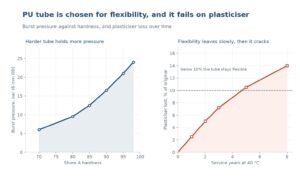
The chart below is a typical result from that measurement step. Use it to separate a design limit from a setting that can still be recovered.

Set one itemised die-charge figure as the target
Set one itemised die-charge figure as the target. Naming the charge and its amortisation volume keeps the GBP 1.40 production price comparable across suppliers. These are illustrative worked values from stated assumptions, not a market survey, a quoted price or a measured series. Write the itemised charge, the amortisation volume and die ownership into the quotation request.
| Clause or parameter | Agreed value | What goes wrong outside it |
|---|---|---|
| Die charge line | Itemised, not bundled | GBP 0.60 per metre hidden |
| Amortisation volume | 2000 m first order | Unit price drifts between quotes |
| Die ownership | Buyer owns the die | Supplier re-quotes the tool |
| Re-cut term | Priced in the quote | Change cost disputed later |
Table 2 - Die-charge clauses for the quotation request
Separate the die charge from the metre price
Separate the die charge from the metre price in a fixed line order: die design, die manufacture, trial runs, ownership and the re-cut or replacement term. The table ranks each line by what it hides when bundled, so the charge is never left inside the unit price.
| Control action | What it fixes | Cost or trade-off |
|---|---|---|
| Itemise the die charge | Exposes the GBP 0.60 uplift | One extra quote line |
| State the amortisation volume | Comparable unit prices | Volume confirmed early |
| Name die ownership | No tool re-quote later | A clause to maintain |
| Price the re-cut | Caps future change cost | Needs a die-life assumption |
Table 3 - Die-charge controls ranked by first-order price clarity
Write die ownership and re-cut terms into the quotation
Write the itemisation and ownership clauses into the quotation: a separate GBP 1200 die charge, the amortisation volume, a statement that the buyer owns the die, and a re-cut price. A dated line turns a hidden uplift into a comparable quote, so send the request to [email protected] and price tooling on one basis.
Need the section checked before tooling?
Send us the section and the installation conditions. We will review wall balance, tolerance and fixing detail, then return a marked-up drawing with a tooling quotation.
What to send us
- Cross-section drawing with wall thicknesses
- Material and colour
- Installation temperature range
- Fixing method and run length
Keep the die-charge line fixed at each re-quote
Keep the die-charge line fixed at each re-quote, record the GBP 0.60 per metre actually recovered, and re-check that ownership and re-cut terms still match. A controlled line reviewed on dated evidence settles the tooling cost before the order is signed.
Before you release this extruded profile
- The quotation shows the die charge as a separate line, not bundled into the metre price
- The amortisation volume and first-order metres are stated in the request
- Die ownership is written into the quotation so the buyer holds the tool
- A re-cut or replacement price is quoted alongside the original die charge
- A named owner records the recovered uplift and re-issues the line at each re-quote
Write the measurement temperature and the tolerance into the drawing; most disputes are really about how the part was measured.
Should a die charge be a separate line?
Yes. An itemised GBP 1200 die over a 2000 m order adds an assumed GBP 0.60 per metre that a bundled quote hides, so unit prices cannot be compared.
Who should own the extrusion die?
Write that the buyer owns it once paid. Without that clause a supplier can re-quote the same tool as new tooling on the next order.
Why does amortisation volume matter?
The die charge per metre falls as the order grows. If each supplier spreads it over a different assumed quantity, the unit prices are not comparable.
What is a re-cut clause for?
It fixes the price of repairing or replacing a worn or changed die, so a later design change does not reopen the tooling cost.
How do I compare two die-charge quotes?
Put both on one basis: the same separate charge, the same amortisation metres and the same ownership and re-cut terms.
Can I reuse the die-charge line at a re-quote?
Re-issue it with the current order metres and re-cut price. A controlled line reviewed on dated evidence keeps the tooling cost settled.
Get a profile that holds its dimension
Send us the profile section, the length and the service conditions. We will review die, calibration and tolerance, then quote tooling and production with a defined measurement method.
To get an accurate quote, send:
- Profile cross-section drawing
- Material and colour
- Cut length and annual volume
- Service temperature and exposure
Why buyers work with Uplastech
ISO 9001, ISO 14001 and ISO 45001 certified. Founded in 2016, with injection moulding lines in Shanghai and an extrusion plant in Jiangsu. Moulding machines from 90T to 1100T and a maximum shot weight of 5100 g. Samples and a written quotation are available on request.
Continue reading
- Extrusion dimensional drift
- Extrusion profile tolerance
- Profile calibration and cooling
- PVC profile weathering and colour
- PVC window profile design
Ready to specify? See our plastic profile extrusion services atau request a written quotation.







 ID
 EN
 ES
 FR
 DE
 PT
 AR
 RU
 JA
 KO
 IT
 NL
 TR
 PL
