
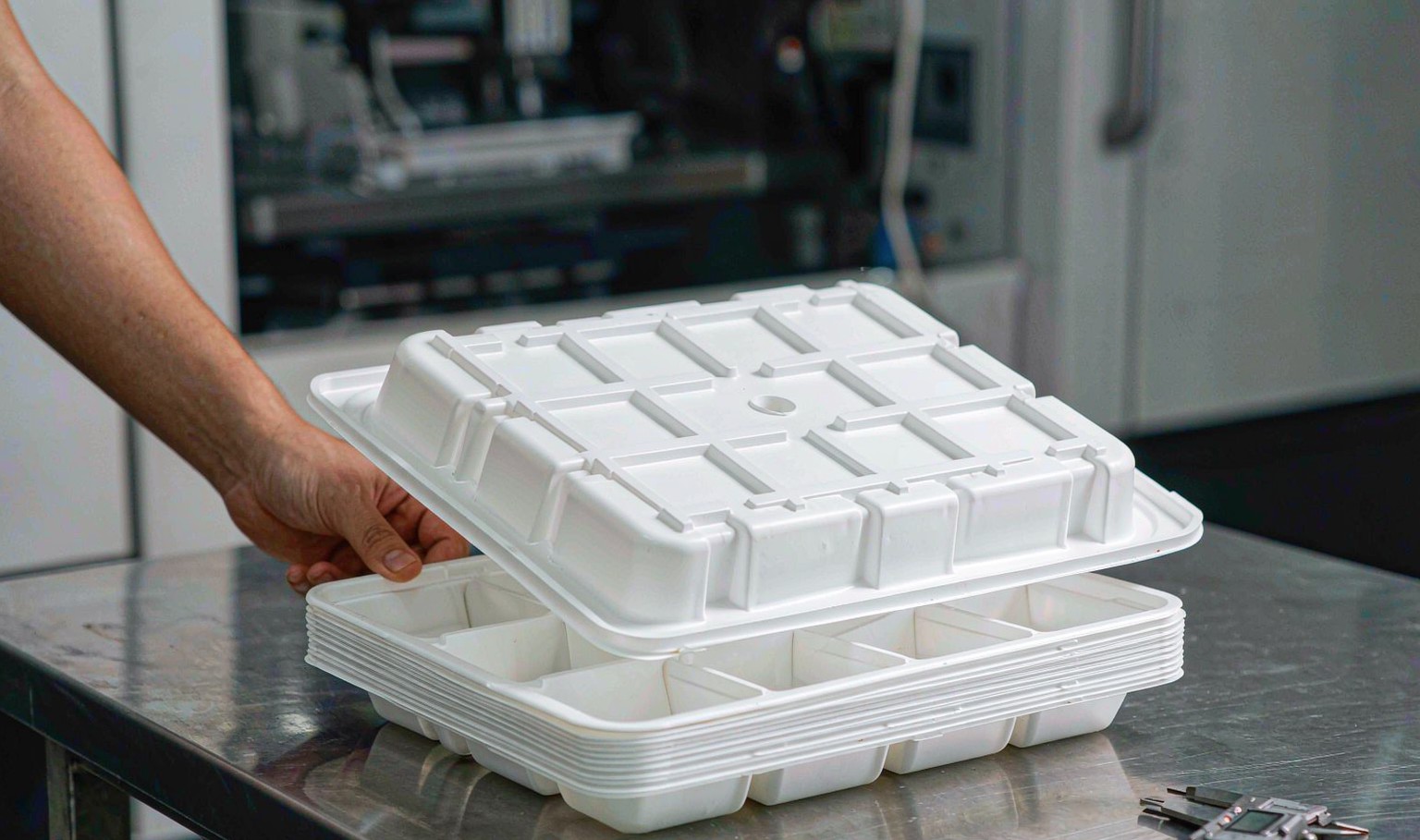
The tray is chosen on the filling line
A food tray is usually discussed as packaging, and it is actually a piece of process equipment. It has to survive the filling temperature, the sealing temperature, the top load in a pallet and the handling in a distribution centre, and it has to do that at a cost that is a few cents.
Those requirements conflict. The material that takes the highest fill temperature, polypropylene, has a modest barrier. The material with the best barrier, PET, has a lower heat resistance. The material with the best sustainability story, PLA, has the lowest heat resistance of all.
The order in which the requirements are considered decides the answer. Start with the fill temperature, then the barrier, then the top load, then the cost. A project that starts with the material has already made the decision before it has the requirements.
Heat resistance decides the material
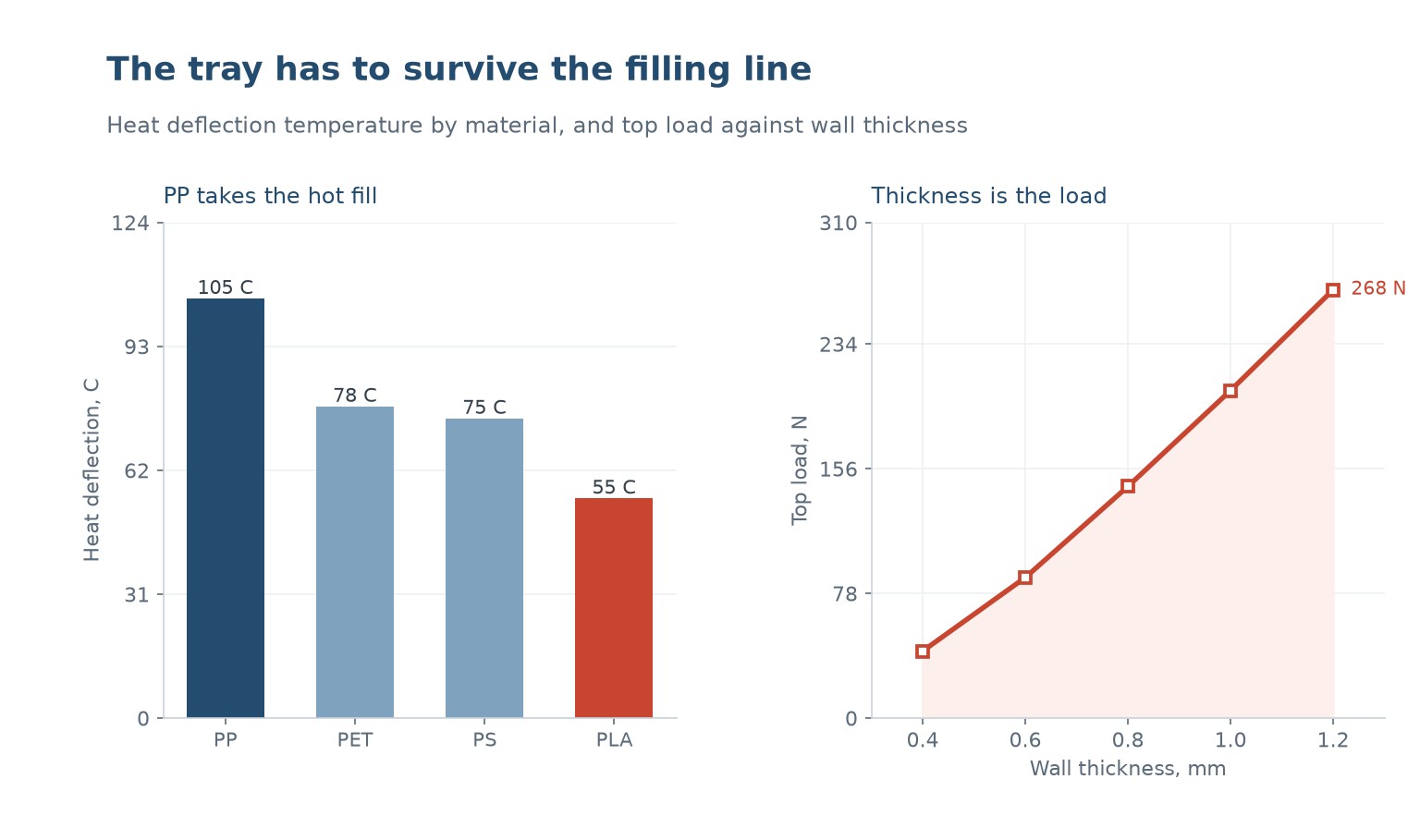
Heat deflection temperature is a reasonable proxy for what a tray can take. Polypropylene sits at about 105 C, PET at 78, polystyrene at 75 and PLA at 55. A hot fill at 85 C is fine in PP and marginal in PET, and it will distort a PLA tray before it reaches the sealer.
That is why PP dominates ready-meal trays and why PET dominates cold and chilled applications. It is not a preference; it is the fill temperature. A PLA tray in a hot-fill application is a design error that no amount of ribbing fixes.
There is a second temperature that matters: the seal temperature. A lidding film seals at 140 to 180 C for a fraction of a second, and a tray that softens at that temperature will deform at the seal head even if it survived the fill. The seal is often the harder requirement.
Wall thickness is what carries the load
Top load is the force a tray takes when it is stacked in a pallet, and it goes up steeply with wall thickness. At 0.4 mm a tray takes about 42 N, at 0.6 mm 88, at 0.8 mm 145, at 1.0 mm 205 and at 1.2 mm 268.
That is a factor of six across the range, and it is the strongest argument against thinning a tray to save material. A tray that has been thinned from 0.8 to 0.6 mm saves a quarter of its material and loses 40 percent of its top load, and the failure appears in the pallet rather than in the plant.
Ribs help, and they help differently from thickness. A rib increases the section's second moment of area without adding much material, so it improves stiffness more efficiently than a thicker wall. The base ribs in a tray are there for exactly this reason, and they are why a 0.6 mm ribbed tray can outperform a 0.8 mm flat one.
Barrier is a separate decision
A single-material tray has the barrier of its material. PP is a good moisture barrier and a poor oxygen barrier; PET is better on oxygen and worse on moisture; PS is poor on both. For a product that needs an oxygen barrier, the tray is either multi-layer or it relies on the lidding film.
Multi-layer trays are co-extruded sheet thermoformed into the same shape, with a barrier layer in the middle. They work, and they are difficult to recycle, which is why the market has moved towards mono-material trays with a barrier lidding film.
The lidding film is often the cheapest place to put the barrier, because it is thin and it is discarded separately. A PP tray with an EVOH-containing lid gives a better total barrier than a mono PP tray with a plain lid, at a lower material cost than a barrier tray.
| Bahan | Heat | Oxygen barrier | Terbaik untuk |
|---|---|---|---|
| PP | 105 C | Miskin | Hot fill, ready meals |
| PET | 78 C | Bagus. | Chilled, bakery, visible product |
| PS | 75 C | Miskin | Cold, dry, low cost |
| PLA | 55 C | Sedang | Cold chain, compostable |
| CPET | 200 C | Bagus. | Ovenable |
Table 1 — Tray materials and what each is good at
Designing for the line, not the shelf
The stack height and the nesting ratio decide how many trays fit in a sleeve and on a pallet, and they are set by the side wall angle and the flange. A tray that nests too tightly jams in the denester; one that nests too loosely takes more space and costs more to ship.
The flange width is set by the sealing head, not by the tray. A flange that is too narrow gives a weak seal; too wide wastes material and can interfere with the denester. The sealer supplier's dimension is the input, and it should be asked for before the tool is cut.
The corner radius matters for the same reason as in any thermoformed part: it is the thinnest point after forming and the place where the tray cracks. A tight corner in a 0.6 mm tray is a crack waiting for a drop.
| Fitur | Set by | Typical |
|---|---|---|
| Flange width | Sealing head | 8-15 mm |
| Side wall angle | Nesting and draw | 5-10 degrees |
| Base rib depth | Top load | 2-4 mm |
| Corner radius | Forming and strength | 5 mm and up |
| Wall | Top load and cost | 0.6-1.0 mm |
Table 2 — Tray features and what actually sets them
The recycling question, honestly
A mono-material PP tray is recyclable in a stream that accepts PP, and a multi-layer tray usually is not. That is the main reason the market has moved to mono-material with a barrier lid, and it is a real improvement rather than a marketing one.
PLA is compostable in an industrial facility and not in a home compost heap, and it contaminates a PET recycling stream. A switch to PLA is a switch to a different waste route, not a free improvement, and it only works where that route exists.
The most effective sustainability decision for a tray is usually thickness. A tray that uses 20 percent less material because it is properly ribbed saves more than a switch to a recycled grade, and it does not depend on infrastructure.
What material should a hot-fill tray be?
Polypropylene, at about 105 C heat deflection. PET at 78 C is marginal for an 85 C fill, and PLA at 55 C will distort before it reaches the sealer.
How thick should a food tray wall be?
0.6 to 1.0 mm for most applications, set by the top load requirement. A 0.8 mm tray takes about 145 N; a 0.6 mm tray about 88 N, so thinning costs top load quickly.
Do ribs help more than thickness?
For stiffness, yes. A rib adds section without much material, so a ribbed 0.6 mm tray can outperform a flat 0.8 mm one. For puncture and impact, thickness still matters.
What is the seal temperature for a lidding film?
Usually 140 to 180 C for a fraction of a second. The tray has to survive that without deforming, and for some materials the seal is a harder requirement than the fill.
Can a PP tray be recycled?
Yes, as mono-material PP. A multi-layer tray with a barrier layer usually cannot be, which is why the market has moved to mono-material trays with a barrier lid.
Why does my tray jam in the denester?
Nesting ratio. A side wall angle that is too steep nests too tightly and the trays stick; too shallow and the stack is unstable. The angle and the flange are the two controls.
A food tray that has to survive the line?
Send the fill temperature, the seal condition and the pallet load. We will tell you the material and the wall, and where the tray will fail first.




 ID
 EN
 ES
 FR
 DE
 PT
 AR
 RU
 JA
 KO
 IT
 NL
 TR
 PL
