
Nesting is not draft, and the difference matters
Draft is the angle that lets a part leave the mould. Nesting is the angle that lets one finished part sink into the next one in a carton. They are usually the same number on a simple tray, which is why the two get conflated, but they are set by different things and they fail in different ways.
A straight-walled tray with zero draft still releases, if the mould is split and the wall is short. It will not nest at all: every part sits rim on rim, and a stack of a hundred is a hundred part-heights tall. Add taper and each part drops into the one below by an amount set by the taper and the height, and the stack shortens quickly.
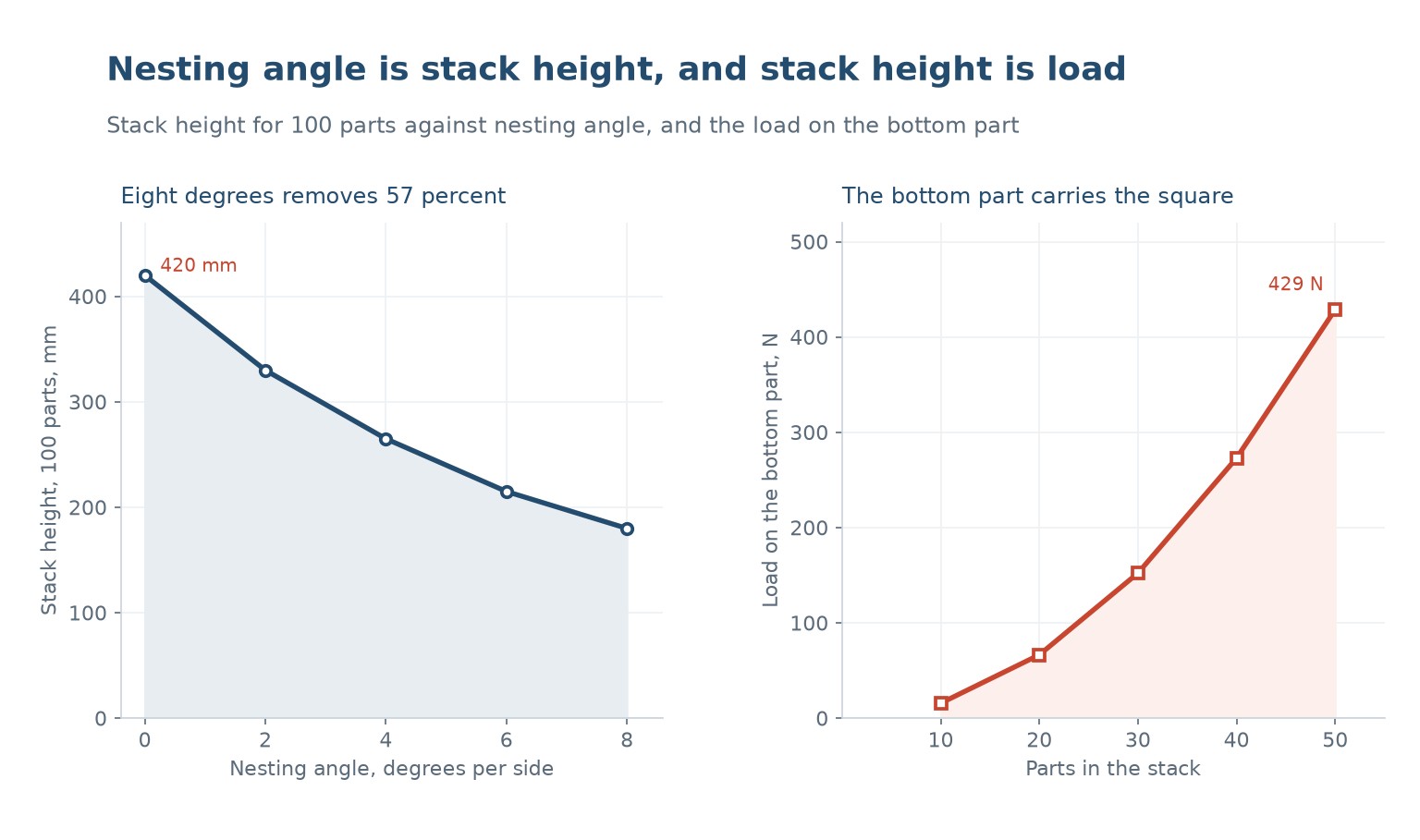
The measured effect is large. At zero degrees a hundred parts stack to 420 mm. At two degrees per side the stack is 330 mm, at four degrees 265, at six 215, and at eight degrees 180 mm. Eight degrees removes 57 percent of the height, which on a full trailer is close to 57 percent of the freight.
That number is why nesting angle gets pushed up in design reviews. It is also where the trouble starts, because the same geometry that lets a part sink deeply also changes how the load travels through the stack.
The bottom part carries the square
In a stack, every part carries the weight of everything above it. The bottom part carries n minus one parts, the one above it carries n minus two, and so on. Summing that series gives a total load on the bottom part of weight times n times n minus one, divided by two. The load is not proportional to stack height. It is proportional to the square of the count.
For a 36 g part, that means 16 N at ten high, 67 N at twenty, 152 N at thirty, 273 N at forty and 429 N at fifty. Going from twenty-five high to fifty high does not double the load, it multiplies it by four. This is the single most under-designed number in thermoformed packaging.
| Parts in stack | Load on bottom part | Equivalent mass | What it does to a 1.2 mm PP wall |
|---|---|---|---|
| 10 | 16 N | 1.6 kg | Nothing measurable |
| 20 | 67 N | 6.8 kg | Elastic, recovers fully |
| 30 | 152 N | 15.5 kg | Marginal after 48 hours at 60 C |
| 40 | 273 N | 27.8 kg | Permanent set on the bottom parts |
| 50 | 429 N | 43.7 kg | Bottom several out of tolerance |
Table 1 — Stack load against count, for a 36 g part, and the damage threshold
The threshold that matters is not yield. Polypropylene at 60 C, which is what the inside of a trailer reaches in summer, creeps at a fraction of its yield stress. A 1.2 mm wall under about 270 N over a 40 by 40 mm contact patch sees roughly 0.17 MPa, and at that stress and temperature it will deflect measurably over 48 hours. The part does not crack. It sags, the rim goes out of flat, and the customer's filling line jams.
Creep is the limit, not the carton
Design reviews set stack height from the carton. The carton is the wrong constraint. The constraint is the bottom part after the shipment, and the shipment is where the temperature is highest and the duration is longest.
Three factors decide whether creep matters on a given part. The first is wall thickness, and it enters to the third power in bending, so going from 1.0 to 1.4 mm nearly triples the resistance. The second is contact area: a rim-to-rim stack spreads the load over the flange, which is the stiffest part of the shell, while a deeply nested stack puts it through wall friction and hoop compression, which is the weakest.
The third is time at temperature. A stack that sits in a warehouse at 20 C for a week is fine at 400 N. The same stack in a trailer at 60 C for two days is not. This is why the same part can ship domestically for years and fail on the first export order.
The practical rule is to set the stack height from the bottom part's stress at the worst temperature the shipment will see, and then check whether the carton can be filled. If the carton is taller than the stack limit, the answer is a divider, not a taller stack.
Nesting that locks is nesting that costs money
Deep nesting has a second cost that never appears in a freight calculation. Parts that are wedged need force to separate. At two degrees a part lifts out with a light pull. At eight degrees the parts are in contact along the full wall, friction is high, and de-nesting force climbs to the point where a vacuum cup lifts the whole stack instead of the top part.
That failure is expensive in a specific way. A manual packing station absorbs it with a twist and a shake, at a second or two per part, which is real labour but invisible. An automated de-nester cannot absorb it at all: the cup either pulls two parts and jams the next station, or it releases and the line stops.
| Nesting angle | Stack, 100 parts | De-nesting force | Verdict |
|---|---|---|---|
| 0 degrees | 420 mm | Near zero, parts barely touch | No freight saving, manual only |
| 2 degrees | 330 mm | Low, one hand | Safe default for manual packing |
| 4 degrees | 265 mm | Moderate, needs a twist | Good balance for most cartons |
| 6 degrees | 215 mm | High, vacuum cups struggle | Automation needs a stripper |
| 8 degrees | 180 mm | Very high, parts wedge | Only with a mechanical de-nester |
Table 2 — The nesting trade: height against de-nesting force
The de-nesting force can be designed out. A shallow relief, a step or a small rib near the rim limits how far one part can enter the next, which caps both the stack shortening and the friction. The relief costs a line in the mould and it decouples the two variables that the angle alone couples.
Choosing the angle from the shipment, not the mould
The arithmetic is straightforward once both sides are priced. Take a carton that holds fifty parts at 420 mm and the same fifty at 265 mm. The nested carton is 37 percent shorter, so a trailer takes about 58 percent more cartons, and the freight per part falls by the same proportion. Against that, if the bottom three parts of every fifty are scrap after a summer shipment, the reject rate is 6 percent, and at a part cost that includes forming and trimming, 6 percent usually exceeds the freight saving.
The crossover is not the same for every part. It moves in favour of more nesting when the part is cheap relative to its volume, when the wall is thick, when the shipment is short and cool, and when the carton is the constraint rather than the truck. It moves against nesting when the wall is thin, the part is expensive, the route is long, or the destination is hot.
There is a middle path that gets most of the freight benefit and none of the creep risk: nest deeply, but ship with a divider every twenty parts. The dividers cost a few cents, they interrupt the load path, and they cap the bottom part at 67 N, which is under any creep threshold. The interval should be set from Table 1 rather than from habit.
What to specify
A stacking specification that survives a shipment names four things.
- The nesting angle, and whether it is per side or included.
- The maximum stack count, derived from the bottom part's stress at the shipment temperature.
- The de-nesting method, manual or automated, because that sets the friction ceiling.
- The divider interval, if the carton is taller than the stack limit.
Add the temperature the shipment will see. A stack limit quoted without a temperature is a number that will be exceeded, and the failure will be blamed on the material rather than on the count.
What is a good nesting angle for a thermoformed tray?
Two to four degrees per side for manual packing, six for automated lines that have a stripper. Eight degrees saves the most height and causes the most wedging.
How much load does the bottom part of a stack carry?
Weight times n times n minus one, divided by two. It grows with the square of the count, so fifty high is four times the load of twenty-five high.
Why do the bottom parts deform in transit?
Creep, not yield. At 60 C inside a trailer, polypropylene creeps at a fraction of its yield stress over 48 hours, and a 1.2 mm wall sags under a few hundred newtons.
Does nesting angle affect de-nesting force?
Strongly. Deeper nesting means more wall contact, more friction, and a vacuum cup that lifts the stack instead of the part.
How do I stop parts wedging without reducing the angle?
Add a shallow relief or a step near the rim. It caps the engagement depth and decouples stack height from friction.
Should I use dividers?
Yes, whenever the carton is taller than the stack limit set by the bottom part's stress. A divider every twenty parts is cheaper than a reject.
A stack that arrives flat?
Send the part drawing, the wall thickness and the shipment route. We will work out the stack limit at the temperature it will actually see, and whether the angle or the carton is the constraint.




 ID
 EN
 ES
 FR
 DE
 PT
 AR
 RU
 JA
 KO
 IT
 NL
 TR
 PL
