
- 1. The short answer
- 2. How each machine actually moves material
- 3. Feeding: the difference that decides most projects
- 4. Mixing and dispersion
- 5. Melt temperature, residence time and heat history
- 6. Pressure, surging and dimensional stability
- 7. Material by material
- 8. Cost, honestly
- 9. How to specify, in order
- 10. A worked selection case
- 11. Six mistakes buyers make
- 12. Frequently asked questions
The short answer
If you are extruding a profile from a single, well-characterised compound and the formulation never changes, a single screw is cheaper to buy, cheaper to run and easier to maintain. If you are extruding a compound you have to make rather than just melt — PVC dry blend, wood plastic composite, filled or glass-reinforced grades, colour concentrates that must be dispersed — a twin screw is not optional.
That is the whole decision in two sentences. Everything else in this article is the reasoning behind it, the numbers that separate the two machine types, and the cases where the simple rule breaks.
Where the confusion comes from: the two machines are both called "extruders" and both push plastic through a die, so they get compared as if they were the same tool at two price points. They are not. A single screw is a pump that happens to melt. A twin screw is a continuous mixer that happens to pump. Those are different jobs, and the machine that is better at one is worse at the other.
How each machine actually moves material
Single screw: drag flow against a pressure gradient
In a single screw, material is dragged forward by the friction between the polymer and the barrel wall. The screw surface is polished and the barrel is not, so the polymer slips on the screw and sticks to the barrel — that difference is what generates forward motion. The output is described by the drag flow minus the pressure backflow:
Q = ½ · π2 · D2 · h · N · sinθ · cosθ − (p1 − p2) · h3 · sin2θ / (12 · μ · L)
You do not need to compute it. You need to see what it says: the first term is proportional to h (flight depth) and the second is proportional to h3. So the backflow term grows three times faster than the drag term as the channel deepens. A single screw's output therefore falls as die pressure rises, and falls sharply. Raise the pressure at the die by fitting a tighter die and the output drops even though the screw has not changed speed.
That single characteristic drives most of the practical consequences below. On a single screw, output and pressure are coupled. You cannot independently set both.
Twin screw: positive displacement, nearly independent of pressure
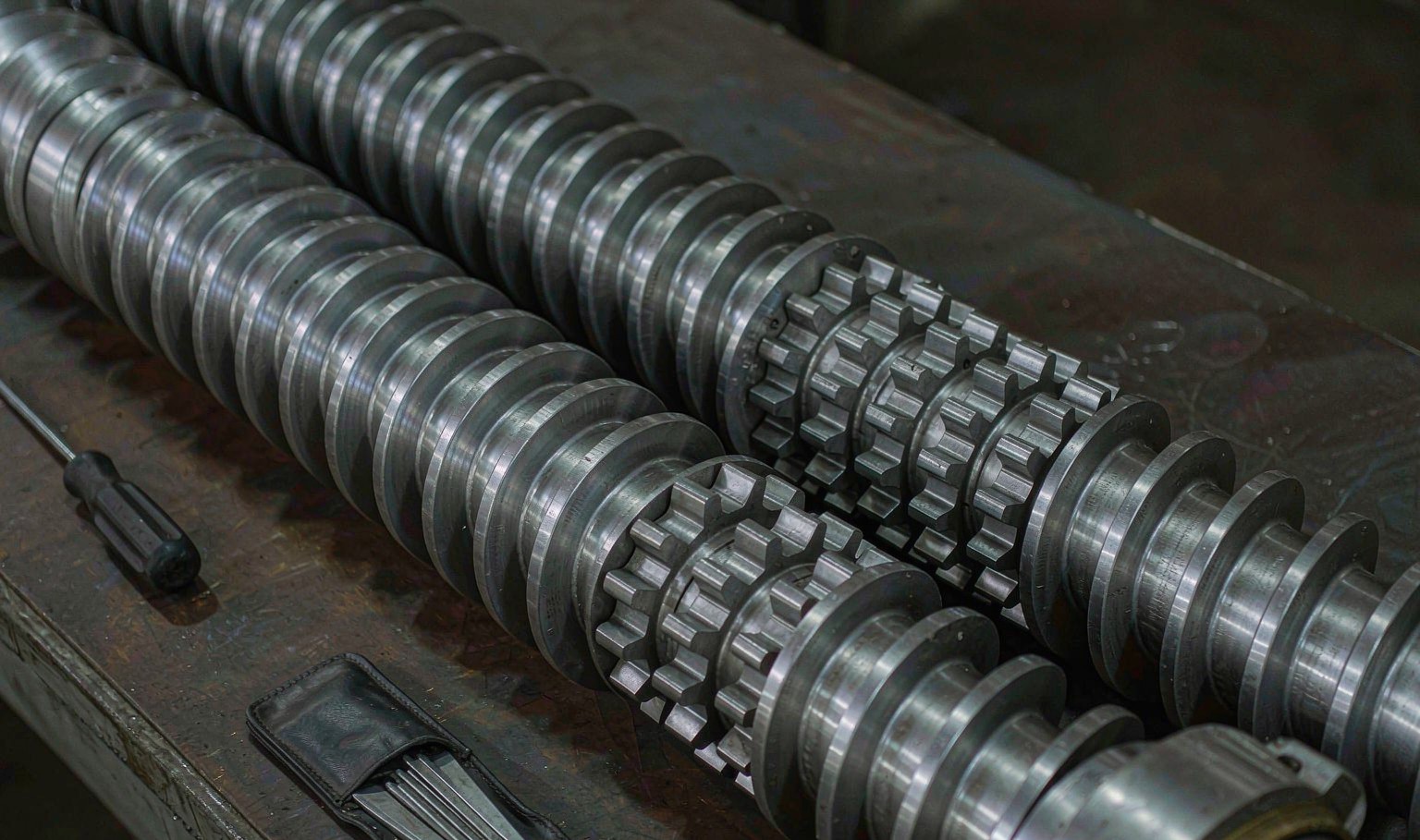
A closely intermeshing co-rotating twin screw is a series of C-shaped chambers that are pushed forward as the screws rotate. Each chamber is closed off from the next by the intermeshing flight, so material is conveyed by volume rather than by wall friction. Output is approximately:
Q ≈ 2 · m · Vc · N · ηv
where m is the number of starts, Vc the chamber volume and ηv a volumetric efficiency typically 0.3 to 0.6 for a filled compound. No pressure term appears. That is the defining difference: on a twin screw, output is set by screw speed and feed rate, and die pressure is whatever the die happens to need. You can change the die and keep the output — or keep the die and change the output — without the two fighting each other.
| Behaviour | Single screw | Intermeshing twin screw |
|---|---|---|
| Conveying mechanism | Drag at the barrel wall | Positive displacement in closed chambers |
| Output vs die pressure | Strongly coupled — more pressure, less output | Nearly independent |
| Can it convey powder? | Poorly — powders bridge and slip | Yes, with the right feed section |
| Can it empty itself? | No — material stays in the metering zone | Yes — starve-fed machines run dry |
| Mélange | Limited; needs add-on mixers | Built in via kneading blocks |
| Residence time distribution | Narrow | Adjustable, and generally narrower when starve-fed |
Table 1 — The behavioural differences that follow from the conveying mechanism.
Feeding: the difference that decides most projects
Feeding is where the choice is usually made, and it is rarely discussed because it is unglamorous.
A single screw needs a consistent pellet — roughly uniform granule size, free-flowing, not too fine. Feed it a fluffy PVC dry blend with a bulk density of 0.55 g/cm³ and the screw cannot grip it. The material sits on the flights and rotates with them, output becomes erratic, and the operator compensates by over-heating the barrel, which starts a degradation cascade. Feed it a wood-flour-filled compound and the same thing happens plus abrasive wear.
A twin screw with the correct feed section handles all of it: powder, fluff, fibre, calcium carbonate at 40 %, glass rovings fed downstream, regrind with a wide particle distribution. Because the screws are self-wiping and force material forward, bulk density only affects the fill level, not whether conveying happens at all.
| Feedstock | Bulk density (g/cm³) | Single screw | Twin screw |
|---|---|---|---|
| Uniform pellet, 3 mm | 0.55 – 0.65 | Bon | Bon |
| Regrind, mixed sizes | 0.35 – 0.55 | Marginal — output surges | Bon |
| PVC dry blend (fluff) | 0.50 – 0.60 | Pauvre | Good — the standard machine |
| Talc / CaCO₃ filled, 40 % | 0.7 – 1.0 | Abrasive wear, poor mixing | Bon |
| Wood flour compound, 50 % | 0.45 – 0.60 | Not practical | Standard |
| Glass-filled, 30 % | 0.6 – 0.8 | Fibre breakage, wear | Good with downstream feed |
| Powder, micronised | 0.3 – 0.5 | Will not convey | Bon |
Table 2 — Feedstock handling. This table, not the price list, decides most machine purchases.
Myth: "a twin screw gives better quality because it's a better machine." A twin screw gives different quality — better dispersion, better devolatilisation, better formulation control. On a clean unfilled homopolymer pellet, a well-set single screw produces a profile indistinguishable from a twin screw's, at lower cost per kilogram. The twin screw earns its price on difficult feedstock and on formulations that need to be made in the barrel.
Mixing and dispersion
Single screws mix by shear in the metering zone, which is weak and largely distributive — it spreads material around without breaking agglomerates. To get real mixing you add hardware: a Maddock or pineapple section, a cavity transfer mixer, a static mixer after the die. Each of these costs pressure and adds a place for material to hang up.
Twin screws mix by geometry. Kneading blocks with a defined stagger angle give you control over the balance between distributive and dispersive mixing:
| Element | Stagger | Mix type | Typical use |
|---|---|---|---|
| Conveying flight | — | None | Feed, pumping |
| Kneading block, 30° | 30° | Mild distributive | Gentle homogenisation, heat-sensitive melts |
| Kneading block, 45° | 45° | Balanced | General compounding |
| Kneading block, 60° | 60° | Distributive, high fill | Colour, filler wetting |
| Kneading block, 90° | 90° | Dispersive, high shear | Breaking agglomerates, pigment dispersion |
| Reverse flight | — | Sealing | Melt seal before devolatilisation |
| Tooth mixing element | — | Low-shear distributive | PVC, shear-sensitive systems |
Table 3 — Screw elements and what each does. The screw is a configuration, not a single part.
This is the structural advantage no single-screw add-on reproduces: on a twin screw you can place high shear exactly where the pigment needs it and low shear everywhere else. On a single screw, the whole barrel sees roughly the same shear history.
Melt temperature, residence time and heat history
Counter-intuitively, the twin screw often runs cooler despite mixing harder, because it does not need the barrel to supply all the melting energy through conduction. The work is done in a short, controlled section and the rest of the screw conveys.
| Metric | Single screw, 90 mm, 30:1 | Twin screw, 72 mm, 32:1 |
|---|---|---|
| Output, rigid PVC profile | 280 – 380 kg/h | 400 – 600 kg/h |
| Melt temperature spread across the channel | ± 4 – 8 °C | ± 1 – 2 °C |
| Melt temperature spread along the screw | ± 6 – 10 °C | ± 2 – 3 °C |
| Specific energy, kWh/kg | 0.18 – 0.28 | 0.12 – 0.20 |
| Residence time, mean | 90 – 180 s | 15 – 45 s |
| Residence time, 95th percentile | 2 – 3 × mean | 1.2 – 1.5 × mean |
| Self-cleaning | Non | Oui |
| Colour change time | 20 – 60 min | 3 – 10 min |
Table 4 — Typical numbers. The residence time and colour change figures are why twin screws dominate on short runs and multi-colour work.
Look at the last two rows together with the 95th percentile. On a single screw, a small fraction of material sits in the barrel for two or three times the mean. On a heat-sensitive compound — rigid PVC above all — that fraction is what scorches, and the black specks that appear in the profile after four hours of running come from that tail, not from anything wrong with the current settings. A twin screw's narrow distribution is a stability guarantee, not a nicety.
Pressure, surging and dimensional stability
Profile dimensional consistency is mostly downstream — calibration, cooling, haul-off — but the extruder sets the starting condition. If output pulses, the calibration unit sees a varying wall thickness and the vacuum cannot fully compensate.
| Symptom | Single screw cause | Twin screw cause |
|---|---|---|
| Slow output oscillation, period of minutes | Feed bridging, or screw starving at the throat | Feed rate drifting, loss-in-weight error |
| Fast pulsation, period of seconds | Solid bed breakup in the compression zone | Rare — usually a partially filled element |
| Output falls over a run | Screen pack blinding, die fouling | Die fouling, or wear on the screws |
| Output rises over a run | Barrel overheating, material slipping | Uncommon |
| Pressure spikes at start-up | Cold material in the die | Cold material, or a flooded feed section |
Table 5 — Surging has different signatures on the two machines, and the diagnosis follows the signature.
Note the "output falls over a run" row. On a single screw, a blinded screen pack raises die pressure, and because output is coupled to pressure, output drops. The operator sees thin wall and turns up the screw speed, which raises melt temperature, which changes the dimensions again. This loop is the single most common reason a profile line drifts. On a twin screw the same blinded screen raises pressure but leaves output essentially unchanged — the fault stays visible as a pressure reading rather than becoming a dimensional defect.
Material by material
| Matériau | Preferred machine | Pourquoi |
|---|---|---|
| Rigid PVC profile | Twin screw (counter-rotating or co-rotating) | Dry blend feeding; shear-heat control; short residence time |
| Flexible PVC | Single screw, often | Pellet feed, forgiving, lower capital |
| HDPE / PP pipe and profile | Single screw | Clean pellet, high output, low cost per kg |
| ABS / HIPS profile | Single screw | Amorphous, easy melt, good melt strength |
| PC and PC blends | Single screw with vent, or twin | Drying is the critical step, not mixing |
| PMMA | Single screw | High viscosity, low shear preferred |
| PA profile | Twin screw, vented | Devolatilisation of moisture; or single with good drying |
| POM | Single screw | Narrow processing window, but pellet feed is fine |
| WPC (wood plastic composite) | Twin screw, vented | Wood flour feeding, moisture removal, dispersion |
| Glass-filled PA / PBT | Twin screw with downstream feed | Fibre length retention, wear resistance |
| Filled PE (CaCO₃ 40 %+) | Twin screw | Powder feeding, dispersion, wear |
| Recycled mixed polyolefin | Twin screw | Variable feedstock, filtration, venting |
Table 6 — The practical mapping. Rigid PVC is the case that made the twin screw a category.
Cost, honestly
Twin screws cost more. How much more depends on size, torque density and whether the machine is a purpose-built profile machine or a compounding machine pressed into service.
| Item | Single screw, 90 mm | Twin screw, 72 mm |
|---|---|---|
| Machine capital cost | 1.0× (baseline) | 1.8 – 2.6× |
| Screw and barrel set, replacement | 1.0× | 2.5 – 4.0× |
| Screw life, abrasive compound | 2 – 3 years | 1.5 – 3 years (with PM HIP steel) |
| Energy per kg | 1.0× | 0.6 – 0.8× |
| Changeover time, colour | 20 – 60 min | 3 – 10 min |
| Scrap on start-up | Plus élevé | Plus bas |
| Operator skill required | Modéré | Plus élevé |
| Spare parts availability | Broad, cheap | Narrower, dearer |
Table 7 — Total cost, not purchase price. The energy and changeover columns are where twin screws recover their premium.
Worked example. A line running 350 kg/h, 6,000 h/year, at €0.14/kWh. Single screw at 0.24 kWh/kg uses 504,000 kWh = €70,600. Twin screw at 0.17 kWh/kg uses 357,000 kWh = €50,000. Saving €20,600 a year. On a €120,000 premium that is a six-year payback on energy alone — before counting the changeover time on a line that runs three colours, where the saving is far larger.
Conversely: a line running one natural HDPE profile 24/7 with no colour changes will never recover the premium. The premium is paid for feedstock flexibility, dispersion and changeover speed, and if you need none of those you should not pay it.
The machine that is neither: a "twin screw profile extruder" with counter-rotating screws and a shallow flight is not a compounding machine. It cannot disperse pigment or handle 40 % filler. It is a PVC machine — very good at PVC, and mis-sold as a general-purpose extruder. Ask what the machine was designed to run before you assume it will run your compound.
How to specify, in order
- Write down the feedstock. Pellet, fluff, powder, regrind, filler percentage, fibre percentage, moisture content. Not "PVC" — the specific form.
- Decide whether the compound is bought or made. If you buy ready-compounded pellet, a single screw is a legitimate answer. If you buy resin and additives separately, you need a twin screw.
- Calculate the changeover requirement. Colours per week, materials per week. Above about four changes a week the twin screw's self-wiping geometry starts to pay.
- Size on output at the die, not on screw diameter. Compare specific output — kg/h per rpm per unit of screw volume — between candidate machines.
- Check the torque, not the speed. A high-speed, low-torque twin screw cannot run a high-viscosity filled compound no matter what the datasheet says about output.
- Confirm the wear package. For filled or glass compounds, the screw and barrel metallurgy matters more than any other specification, and it is the line item buyers cut first.
| Specification | What to ask | Why it matters |
|---|---|---|
| Do / Di ratio | Outer to inner diameter | Sets free volume and torque capacity — 1.55 is deep, 1.25 is high-torque |
| Specific torque | Nm per unit of free volume | The real measure of what the machine can push |
| L/D | Working length / diameter | Processing sections available: feed, melt, mix, vent, pump |
| Max screw speed | rpm | Only meaningful with torque — a fast machine with low torque is a weak machine |
| Screw metallurgy | Nitrided, bimetallic, PM HIP | Wear life on filled compounds |
| Barrel sections | Number and positions of vents | Devolatilisation for WPC, PA, recycled |
| Feed configuration | Gravimetric or volumetric | Gravimetric is essential for dimensional consistency |
Table 8 — The specification sheet items that actually determine performance.
A worked selection case
A customer wants to extrude a 60 mm wide hollow window-profile section in rigid PVC, 400 kg/h, two colours on rotation, plus a wood-filled variant for a garden product. The wood variant is 45 % wood flour with a moisture content of 6 % as delivered.
Single screw: cannot feed the dry blend reliably, cannot feed the wood flour at all, cannot vent the moisture, and the colour change takes 40 minutes each way. Ruled out on four counts.
Twin screw, 72 mm, 32:1, co-rotating, with one atmospheric vent and one vacuum vent: feeds both compounds from a gravimetric feeder, devolatilises the wood moisture at the vent, disperses the pigment in a 60° kneading block, and changes colour in eight minutes. Output 520 kg/h on PVC, 430 kg/h on WPC — both comfortably above the 400 kg/h requirement.
The counter-rotating alternative would run the PVC slightly better — lower shear, more uniform — but would struggle with the wood flour and would be a poor mixer. The co-rotating machine wins on the requirement to run both compounds on one line.
Six mistakes buyers make
| Mistake | Consequence | Better approach |
|---|---|---|
| Buying on screw diameter | Machines look comparable and are not | Compare specific torque and free volume |
| Buying a compounding machine for profile | Over-mixed, over-heated melt; poor pressure stability | Specify a profile-configured screw |
| Skipping the wear package | Screw gone in 14 months on 40 % CaCO₃ | PM HIP or bimetallic from new |
| Volumetric feeding on a twin screw | Wall thickness drifts with bulk density | Loss-in-weight gravimetric |
| Undersizing the drive | Cannot reach output at the required melt temperature | Size on torque at the target viscosity |
| Ignoring changeover | Colour changes eat the margin on short runs | Count changeovers before choosing |
Table 9 — The recurring errors, and each one's cost.
Frequently asked questions
Can I run PVC on a single screw?
Flexible PVC pellet, yes, routinely. Rigid PVC dry blend, only with a purpose-designed single screw (a "PVC screw" with a cooled, grooved feed section and a low-compression metering zone) and with careful temperature control. It is done, but it is a compromise and it limits your formulation freedom.
Is a twin screw always better for filled compounds?
For dispersion, yes. For cost, not necessarily — at 10 % talc in HDPE, a single screw with a mixing section is adequate and much cheaper. The crossover is roughly where the filler starts affecting melt viscosity and where dispersion quality becomes visible in the product, typically above 20 – 25 %.
Why is a twin screw's output almost independent of die pressure?
Because conveying is by positive displacement in closed chambers rather than by wall friction. The pressure gradient creates leakage past the flight tips, which is a small correction, not the dominant term. That is also why a twin screw needs a pressure-independent feed: if you over-feed it, the excess has nowhere to go.
Do twin screws wear faster?
On abrasive compounds they wear differently — the flight tips and the kneading block crests take the load. With a proper wear package (PM HIP steel, or tungsten carbide on the tips) life is comparable. Without one, a twin screw on 40 % CaCO₃ can be worn out in a year while the single screw lasts three.
Can a twin screw run starve-fed?
Yes, and on profile lines it usually should. Starve feeding means the feed rate, not the screw speed, sets the output; the screws run partially filled and the mixing sections fill only where they need to. It gives better mixing control and lower melt temperature, at the cost of needing a reliable gravimetric feeder.
What is the practical difference in start-up scrap?
On a twin screw, colour and dimension stabilise in 5 – 15 minutes because residence time is short. On a single screw, the same change takes 30 – 60 minutes because the old material has to be flushed out of a long barrel. On a line doing two changes a day, that is an hour of production lost daily.
Does a twin screw need a gear pump?
Not always, but more often than a single screw does. Because a twin screw's output is set by the feeder and its pressure is set by the die, adding a gear pump decouples the two completely and gives the most stable profile dimensions available. On tight-tolerance work it is worth the capital.
Which machine is quieter?
The single screw, usually by 5 – 10 dB, because it has fewer moving parts in mesh. Twin screw gearboxes are also more complex. Neither is a deciding factor, but on a line in a residential-zoned building it becomes one.
Not sure which machine your profile needs?
Send us the drawing, the compound and the annual volume. We will tell you which machine type fits, what output to expect, and where the cost actually sits — before you commit to a capital purchase.
Continue reading
- Extruder Screw Design: Zones, Compression Ratio and Wear
- WPC Wood Plastic Composite Extrusion: Formulation and Venting
- Extrusion Die Design for Profiles: Flow, Land and Die Swell
- PVC Profile Extrusion: Dry Blend, Calibration and Formulation
- Custom Plastic Extrusion Profiles: Materials, Dies & Tolerances




 FR
 EN
 ES
 DE
 PT
 AR
 RU
 JA
 KO
 IT
 NL
 TR
 PL
 ID
